



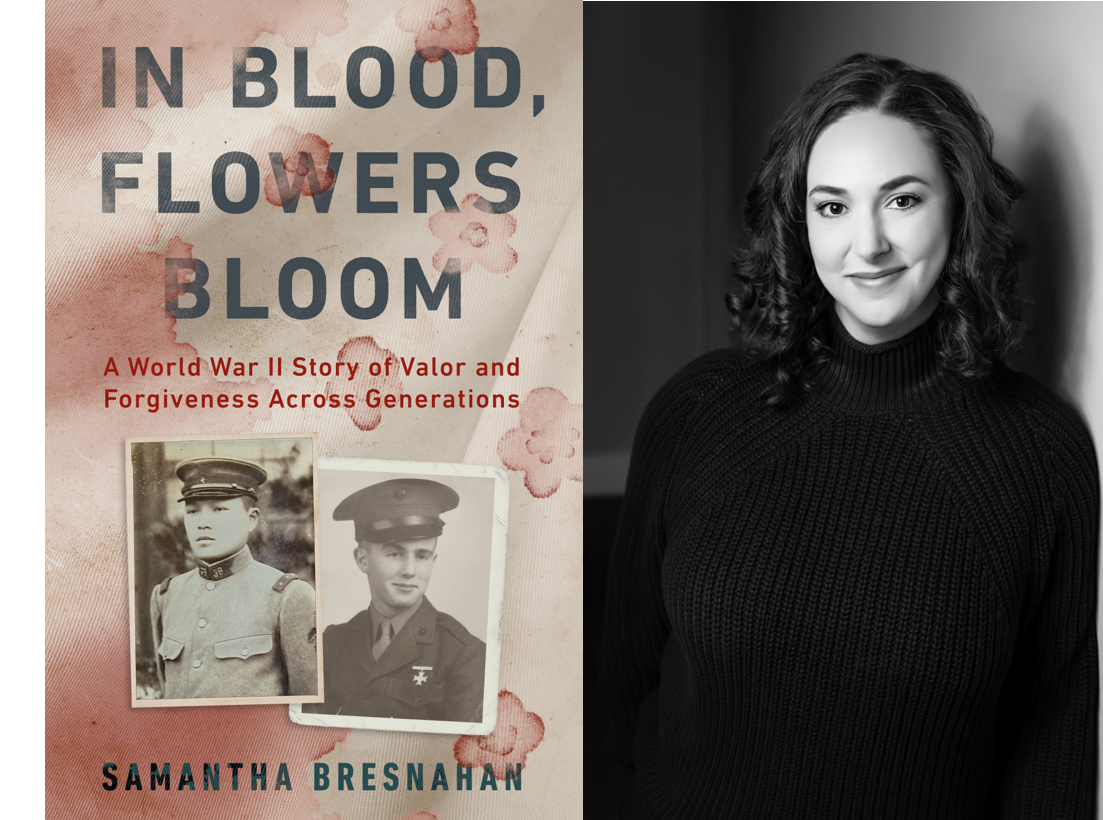
The title of this book comes from a poem inscribed on a family flag, worn by a Japanese soldier in World War II. How it ended up in a shed near Buffalo, New York, in 2003 is the basis for this thrilling and elaborately researched account by award-winning journalist Samantha Bresnahan.
“In Blood, Flowers Bloom: A World War II Story of Valor and Forgiveness Across Generations” chronicles in rich detail the story of how a rolled-up rag meant for the trash became a symbol for healing, reconciliation, and friendship between two former enemies.
Battlefield Souvenirs
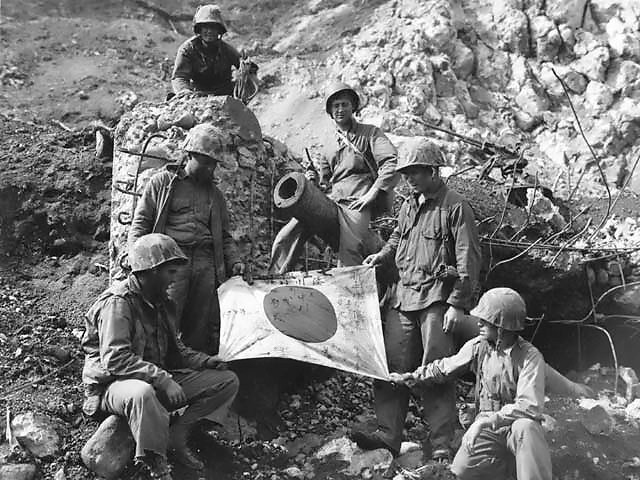
Central to the story are battlefield souvenirs. Swords, knives, family flags, personal documents, and other items considered “war trophies” were removed from the bodies of dead soldiers.
The author does a deep dive into the reasons why these items were so desirable, and puts a positive spin on what has been considered a savage practice. The author refers to a published work on the subject to share the value of these items and the deeper meanings they hold.
In addition to their worth on the black market, they were used by soldiers for swapping or bragging purposes: “[T]he compulsion to collect is in our very wiring.” On the battlefield, “surrounded by death,” the brain’s wiring is activated and so is the desire to collect. The items were symbols for the soldier. Having these souvenirs to bring home gave them the comfort of a future beyond the war.
With her experience as a journalist and supervising producer for CNN International, Bresnahan is in her element. But her story is not an easy one to tell. There are many moving parts from timelines, countries, languages, the WWII veterans on both sides, and accounts of pivotal battles in the Philippines.
Chapter by chapter, the author keeps the story organized and suspenseful. She describes the intricate descriptions of how organizations sprung up between volunteers in Japan and the United States to return battlefield souvenirs to their rightful owners, or in some cases, the surviving wife or child.
Cleaning a Locker
Key players in the story include veterans and their families who we come to know from both sides, particularly Shannon Moore. While cleaning out her father’s locker, she finds a “clumped ball of silk” that, when unfurled, becomes a white rectangle with a red circle in the middle.
There are also “black strokes of ink” which Moore knew to be Japanese characters. It was a recognizable symbol, and she knew immediately it was the national flag of Japan. Though she came close to throwing it away, she wrote, “Something was telling her not to let go.” This discovery of a battlefield souvenir is the stepping point for the remarkable story to come.
Another important piece is about veteran Marty Connor, who survived 36 days on Iwo Jima in one of the bloodiest battles for the WWII Marines. He watched friends die, others looting enemy corpses, and learned quickly what these “field strips” meant.
Connor began collecting his own souvenirs. Decades after the war, Moore, Connor, and many others on both sides of the Pacific began the difficult task of finding the families who owned them, and sending the items back to them.
Despite little advertising, through word-of-mouth or small announcements in veteran newsletters, the work of the group spread quickly and the number of volunteers increased.
Family Keepsakes
What’s revealed is that these rediscovered items are no longer considered trophies. Their return becomes an act of closure. Bresnahan provides plenty of emotional moments. Veterans become more reflective about war; families reunite with treasured family keepsakes, personal letters, and diaries.
Returning soldiers, like Connor, haven’t only been haunted by their war experience, but also by the items brought home and tucked away. Questioning why they were taken, soldiers come to understand their enemy was like them, a father or a son. Just like a U.S. Marine, the Japanese soldier was following orders and loved his country.
Fans of battlefield history or WWII war strategy should know this story focuses more on the aftermath of war and its effects. But it could be any country or any battle. The reader is introduced to the soldiers on both sides, their lives before the war, and how they went on with their lives after returning home.
In one instance, a Japanese captain was so haunted by his experiences that he “exchanged his naval uniform for priest’s robes” and was ordained a Buddhist priest. It’s in these passages that Bresnahan’s talent shines. She focuses more on how war’s psychological wounds can be universal.
Peace and Forgiveness
The power of a book of this kind is far-reaching. It can be a conversation starter for those still suffering war trauma. For those who have their own souvenirs stuffed away, they may learn that opportunities exist to return them and find a way to promote peace and forgiveness. It brings, up close, the face of the enemy, and the reminder that there is more in common than first thought.
The story’s driving force is the step-by-step account of the arduous search for the owner of the flag found in the locker in upstate New York. Readers follow the tenacious family and volunteers who withstand disappointment and dead ends as they identify, translate, and reach out to organizations on both sides of the Pacific.
When the flag is finally handed over, and the Japanese characters in black ink are translated, a poem is revealed that becomes the perfect sentiment for the story. One excerpted phrase, “In blood, flowers bloom,” is the perfect book title.
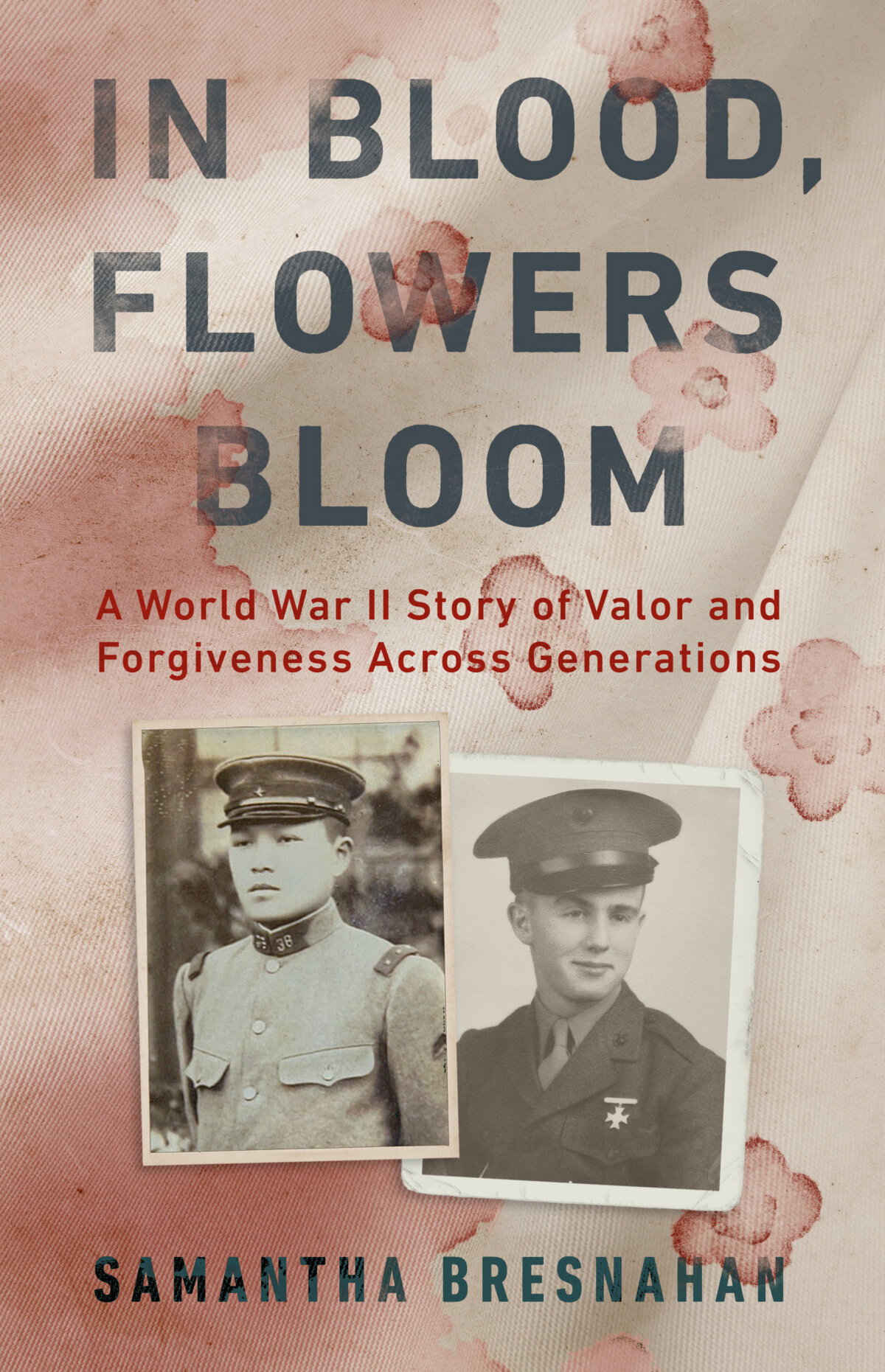
‘In Blood, Flowers Bloom: A World War II Story of Valor and Forgiveness Across Generations’
By Samantha Bresnahan
Public Affairs: April 2025
Hardcover, 304 pages
What arts and culture topics would you like us to cover? Please email ideas or feedback to features@epochtimes.nyc
