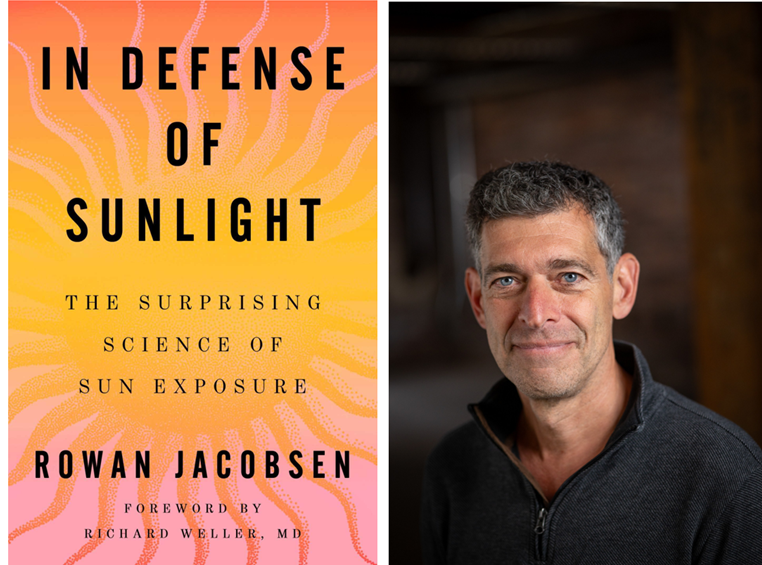
When John Denver sang “Sunshine on my shoulders makes me happy,” he made a statement that’s been the subject of ongoing medical debate. Science writer Rowan Jacobsen echoes Denver’s classic song in his new book, “In Defense of Sunlight: The Surprising Science of Sun Exposure.” In it, he details how sunlight’s therapeutic value has become clouded by an exaggerated fear of skin cancer.
Jacobsen challenges what he views as panic-inducing warnings over the potential danger from sun exposure. According to the author, depriving oneself of being outdoors on a sunny day has significant health risks.
The author puts forth arguments claiming that safely timed sun exposure could be used to mitigate the severity of such diverse conditions as dementia, diabetes, and multiple sclerosis. The thesis is compelling, and the presentation is an invigorating assault on long-held assumptions about health and wellness.
In Olden Days
The author reveals that ancient civilizations recognized the sun’s healing powers. No less a figure than the Roman scientist Pliny the Elder declared that sunlight was “the most powerful of all remedies, and one which is always at a person’s own command.”
Fast-forward to the late 19th and early 20th centuries: The curative power of sunlight was the center of medical research. Theobald Palm, a Scottish doctor, identified sunlight as crucial in the prevention of nutritional rickets. Niels Ryberg Finsen, a Danish physician and scientist, conducted research on using sunlight to treat diseases and won the 1903 Nobel Prize in Physiology or Medicine. Auguste Rollier, a Swiss doctor, pinpointed the value of sunlight in helping patients with tuberculosis regain their health.

So why have medical professionals over the past several decades warned people about the risks from sun exposure?
Jacobsen puts part of the blame on corrosive psychology. He writes: “There’s also a control aspect, something emblematic of our decoupling from nature. The more we retreat into the technological world of cities and screens, the more we need protection from the raw forces of the world. That’s where the dragons live. Don’t go without your armor.”
Skin Cancer Data
Jacobsen number crunches health statistics and reveals that these concerns don’t add up. Yes, skin cancer is a genuine danger, with 5.5 million cases each year in the United States. But that doesn’t mean there are 5.5 million fatalities.
Indeed, U.S. deaths from melanoma (the predominant form of skin cancer) total about 8,500 per year. Jacobsen tartly observes that more people die from choking on food or car crashes than skin cancer. The condition very rarely goes beyond the skin and is easily treatable when identified.
Also, this isn’t a universal plague. Some people are more genetically predisposed to skin cancer, especially fair-skinned white people, while the condition is far less prevalent among people of color.
When dermatologists at Harvard Medical School in 2014 confirmed the sun’s “profound mood-boosting powers,” it contradicted the notion that sunlight creates more problems than solutions.
And you can’t bottle sunlight’s benefits. Evidence that sunlight hitting skin produces vitamin D is now irrefutable. Several studies concluded that vitamin D supplements can’t duplicate the health benefits that the sun provides.
Even worse, research by the epidemiologist siblings Frank and Cedric Garland found that people with low vitamin D levels are shown to have a higher incidence of multiple diseases, including breast cancer, colorectal cancer, high blood pressure, diabetes, cardiovascular disease, and dementia.
Jacobsen recalls a wildly misleading advertising campaign in 2007 by the American Cancer Society, which suggested that death was the likeliest outcome from a skin cancer diagnosis. It was later discovered that the campaign was financed by the skincare brand Neutrogena, which sold a sunscreen line.
The idea that copious applications of sunscreen can stave off skin cancer was always erroneous. Sunscreen wasn’t originally designed as a cancer prevention agent, and even today many sunscreens on the market fail to provide broad-spectrum coverage from the sun’s Ultraviolet A (UVA) rays.
The Author’s Spotlight
Unfortunately, Jacobsen dilutes his presentation by occasionally taking a heliocentric approach in his narrative, making several chapters revolve around himself.
This isn’t severe in the introduction, where he talks about his residence in Vermont. He complains that how it feels “as if [his] cells don’t work” during the winter months, when sunlight is weak and often elusive. He laments that Vermont winters left him looking puffy and feeling depressed. Even his extensive cross-country skiing couldn’t erase his state of enervation because the sun’s power is inadequate in that time and place.
However, he has less success in later chapters as he recalls his experiences in a no-light setting at night in the Arizona desert while living in a 1962 Airstream and as a participant in a sleep laboratory experiment with no access to sunlight. The carefully crafted science writing at the heart of the book gives way to a monotonous dive into solipsism. These boring sections could’ve easily been omitted.
Mercifully, Jacobsen rescues his thesis with a concise summary that offers a simple mantra for good health: Get sun. Not too much. Go outside.
That advice isn’t only for today’s adults but also the next generation. Jacobsen warns that children who remain indoors throughout their formative years have elevated disease rates and cognitive performance issues later in life. If any aspect of the book deserves praise, it’s Jacobsen’s plea to save the next generation with sunlight.
‘In Defense of Sunlight: The Surprising Science of Sun Exposure’
By Rowan Jacobsen
Scribner: June 16, 2026
Hardcover, 288 pages
What arts and culture topics would you like us to cover? Please email ideas or feedback to features@epochtimes.nyc