When was the last time you read an op-ed or watched a video clip that wasn’t dedicated to criticizing some politician, castigating some group, mocking some ideology, or warning of some looming danger? When was the last time you encountered something online filled only with praise and admiration for its subject? If you’re like me, the ratio of critical to admiring content that you find online is something like 10 to one.
Society today suffers from a disease of skepticism and criticism, with angry words and controversies swirling ever higher and higher, enough to block out the sun itself. The truth is, critical content is fun to write and fun to read. It sells. Incendiary remarks stoke our emotions and stroke our egos. Barbed comments bring a perverse satisfaction to both writer and reader. Even here, I am not able to completely avoid it—I’m criticizing society for its addiction to criticism. The tendency is so hard to root out. It has become the unquestioned background to public discourse.
But my aim here is not to criticize, but rather to praise. I want to praise the undervalued (and much-needed) art of admiration. As gratifying as criticism may be, I would suggest that the lost art of admiration fulfills something even deeper in our human nature and makes for a much happier life.
Freedom From Self
In a brief, beautiful article published in the February issue of First Things, Elizabeth C. Corey sang the praises of admiration. She noted that admiration isn’t much admired in our society, which feverishly pushes us to promote ourselves and our personal “brand,” often by tearing down others. Then she asks the obvious yet neglected question, “What if we instead turned the inward eye outward, upon all that the world offers for our admiration?”
What do we gain from this exercise? Well, for one thing, greater interior freedom. Admiration and wonder allow us to escape the burdensome confines of the self.
“When we admire, we are freed from thoughts of ourselves,” Corey wrote. “The better we are at admiring, the less our egos intrude.”
Someone lost in admiration experiences a kind of ecstasy, in the literal sense of the word—they’re “taken out” of themselves and absorbed into the object of admiration. To be lost in admiration is to touch something transcendent.
Philosopher Josef Pieper wrote in “Happiness and Contemplation,” “How splendid is water, a rose, a tree, an apple, a human face—such exclamations can scarcely be spoken without also giving tongue to an assent and affirmation which extends beyond the object praised and touches upon the origin of the universe.”
Everything Wonderful
An attitude of admiration clearly yields an experience more joyful, complete, and beneficial than an attitude of indifference or hostility. Who has a deeper and richer experience of a horse: the casual passerby who notices only the bad smell of the barn, or the young girl who has grown up thinking about and admiring horses and is enjoying her first trip to a real horse barn?
The practitioner of admiration is on the best and most rewarding of treasure hunts because so much of the world offers up quantities of things to be admired, wondered at, and loved—when one has the eyes to see.
Corey observed: “The more we know about the world, the more we find to admire. We can then look with pleasure not only on natural and human beauty, but also on more complex things, such as painting, poetry, philosophy, even moral conduct. The excellence of particular human beings is often the most affecting beauty of all.”
Here, Corey points us to something else noteworthy about admiration: It is the mark of an educated mind.
“Learning to appreciate beauty and excellence is also the essence of liberal education,” she wrote.
Learning fuels admiration, and admiration fuels fruitful learning. Liberal education should result in “a cultivation of the receptive consciousness, a disposition of appreciation.”
This reminds us of Plato’s famous quotation that “the object of education is to teach us to love what is beautiful.” Education doesn’t consist solely in the accumulation of facts. Someone might be quite intelligent and know lots of things yet still lack education in the sense described here. Such a person will lack the interpretive key with which to understand all the facts he has gathered. That key—it was once thought in the Western tradition, at least—was a perspective of admiration and affirmation.
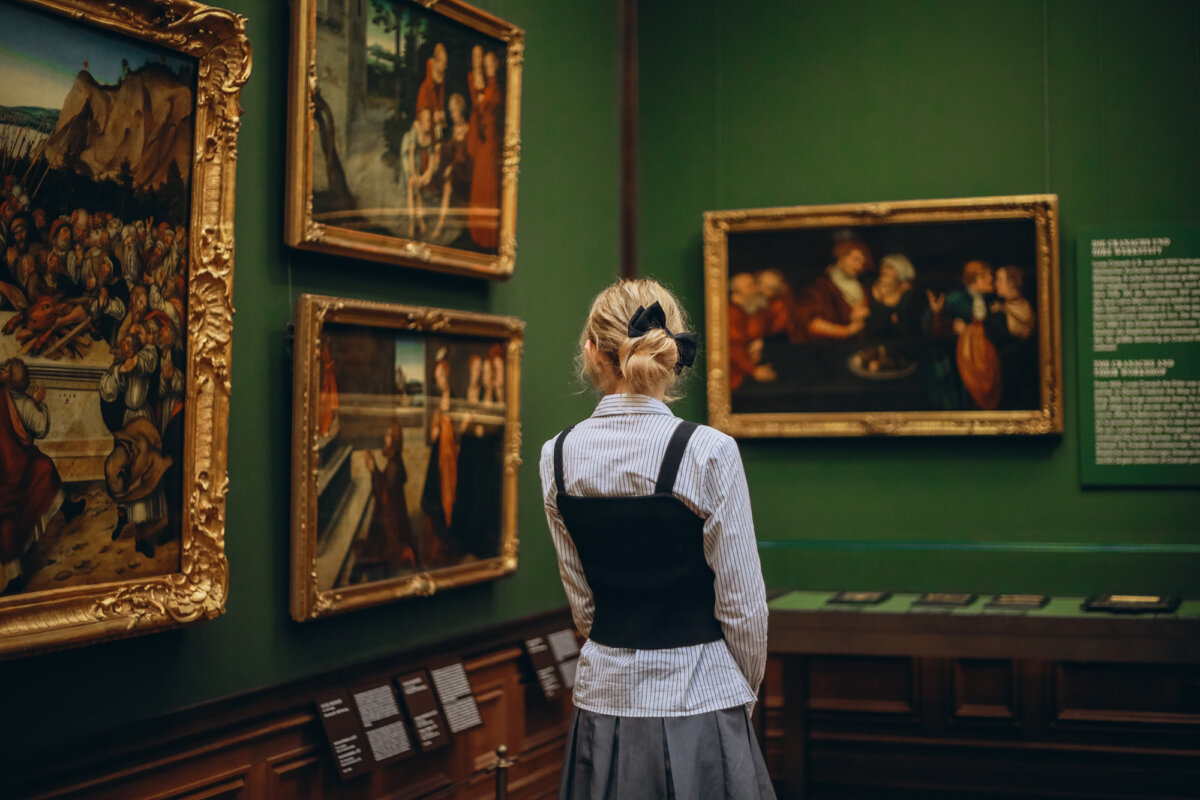
This, too, provides the proper context for art. All the best art begins and ends in wonder and admiration.
Pieper wrote, “Out of this kind of contemplation of the created world arise in never-ending wealth all true poetry and all real art, for it is the nature of poetry and art to be paean and praise heard above all the wails of lamentation.”
Even when art depicts tragedy and evil, it will do so with an eye to the nobility of the person who suffers well and the possibility of redemption and renewal even in the darkest corners of experience. It remains an affirmation of the universe at its core.
The artistic impulse begins with admiration. Children draw pictures of the things they love and admire: their families, pets, or (as it was in my case) dinosaurs. And it is—or should be—the same basic impulse for adult artists. It is the fault of art schools if this basic, healthy impulse has been beaten out of artists.
The Joy of Beauty
Perhaps the most important reason to love admiration, though, is that it leads to happiness and joy. We might get a little spurt of satisfaction from criticism, but it’s shallow and short-lived; it’s not the stuff of lifelong happiness. That can only come from being in the presence of the people and things we admire and learning to admire the people and things around us. Pieper wrote, “It is only the presence of the thing or person loved that makes for happiness. That is, without love, there is no happiness; if there were no spark of assent and affirmation, there could not even be the possibility of happiness. … Love is the indispensable premise of happiness.” The person who has not learned to move past discontent and skepticism to the joy of humbly basking in the goodness of someone or something beloved will struggle—I submit—to be truly happy.
This is not to say that criticism has no value or place in society. Criticism is the flip side of admiration. But it seems to me that public discourse has been dwelling on one side of issues, the critical side, for far too long. This one-sidedness can only lead to a loss of perspective, a cultural myopia, and—at worst—unhappiness.
Criticism may be the easier and more exciting activity, but admiration is the more necessary one.