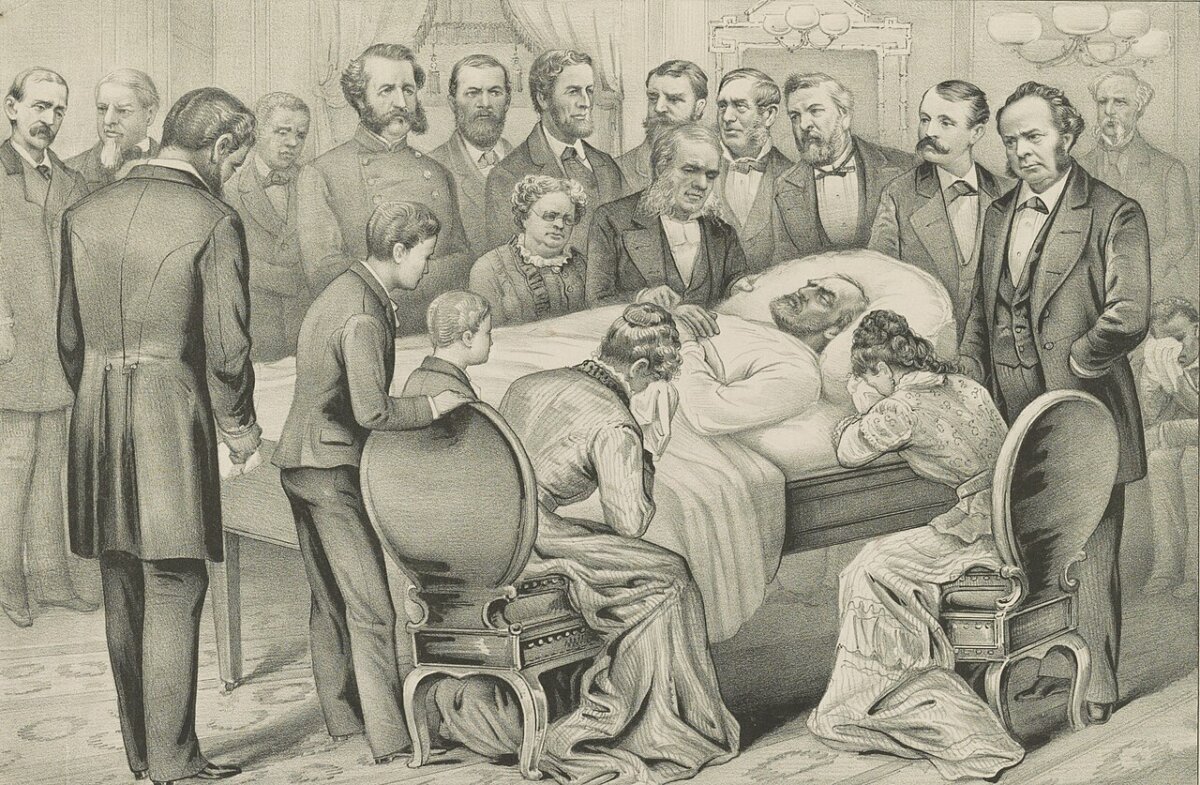
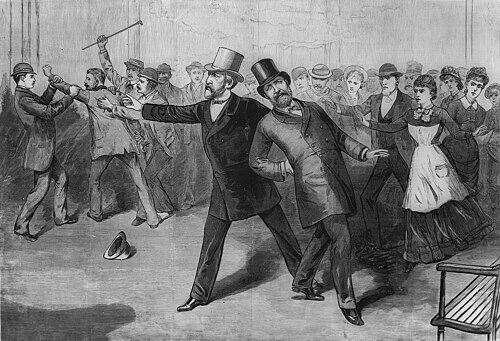
On July 2, 1881, Charles Guiteau, a crazed and disgruntled office seeker who believed President James Garfield (1831–1881) owed him a position in the government, fired two shots from a British Bulldog revolver into the president, grazing his shoulder with the first bullet and striking him in the back with the second. Garfield lived for another 79 days.
During this time, Lucretia Garfield (1832–1918), often called “Crete” by family and friends, remained constantly at his side, consulting with the doctors and doing what she could to help her husband of 22 years fight the horrific pain brought by infection. She herself was only just recovering from life-threatening malaria when news of the shooting reached her, yet she raced to be with James in the White House.
That ordeal and her composure at what some then called “the funeral of the century” won the first lady the admiration of the American people. Tributes appeared in the papers, and hundreds of notes of condolence arrived at 1600 Pennsylvania Avenue.
Only a few of her contemporaries were aware of the backstory to the Garfield marriage, details that only polish Lucretia’s reputation of grace and character.
‘To Try a Life in Union’
Lucretia was the oldest of four children of Zeb and Arabella Rudolph. Three influences from her upbringing on the family’s farm near Garrettsville, Ohio would deeply affect her personality and her life. Her mother taught Lucretia the practice of “self-government,” the importance of control and doing one’s duty. And, although it was clear to the children that their mother and father loved them, they were not at all affectionate parents. Lucretia would later remember rarely being kissed by her mother and never by her father. Finally, she was an inveterate reader, once writing, “It would be of about as much use to stop breathing as to let books alone if they are anywhere in the region about me. I have to read … as I have to live.”
After Lucretia had finished with the local school, this thirst for reading along with her keen intelligence prompted her parents to send her at age 15 to the Geauga Seminary, a boarding school for boys and girls about 20 miles from the farm. There, she met James Garfield, whom she first considered “an overgrown, uncombed, unwashed boy.”
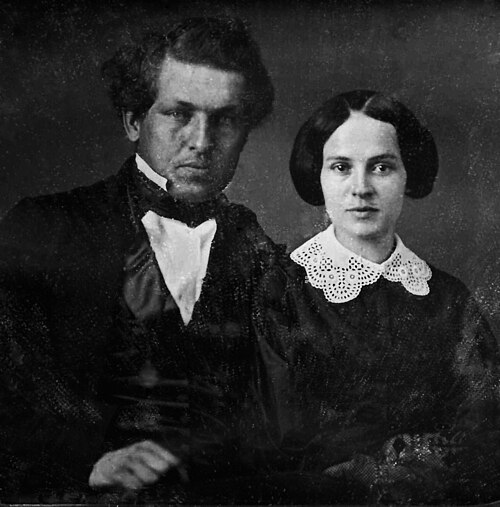
Yet they became friends. In 1850, Lucretia enrolled in the Western Reserve Eclectic Institute, a new educational college that Zeb had helped found. When James entered that school a year later, their friendship evolved into a romance. In 1854, they exchanged a kiss in the college chapel and commenced a long and bumpy courtship.
After graduating that same year, Lucretia worked as a teacher at the Institute and other schools while James continued his education at Williams College in Massachusetts. There, he became deeply attracted to another student, Rebecca Selleck. Matters came to a head when Lucretia attended James’s graduation and met Rebecca, who clearly had laid claim to James. In this critical moment in her relationship with James, Lucretia relied on the principle of self-government her mother taught. She sent him a letter in which she first wrote of the “generous and gushing affection of [his] warm impulsive nature,” so different, she recognized, from her own temperament, and then offered to release him from their relationship if he could love her better and she were better suited to his nature.
Unfortunately for Lucretia, she was unable to express her love face-to-face; a cool demeanor often masked her warm emotions. She herself was aware of these tendencies, that the emotional reticence she had learned from her parents might offend or harm those close to her.
Nevertheless, James chose to remain with Lucretia, and their romance continued on its uneven course until 1858, when they agreed to “try life in union,” to marry. For both of them, however, especially James, that union seemed to rest more on duty and obligation than on love.
An Affair Becomes a Love Affair
The next few years were so strained that the couple later referred to them as “years of darkness.” James was away from home much of the time, serving first in the Union Army and then in the U.S. House of Representatives beginning in 1863. Their letters echo a cold reserve. Both blamed themselves for this rift, with Lucretia writing of “the mask my heart had worn.” After five years of marriage, Lucretia pointed out to James that they had spent only a total of 20 weeks together.
Then came two horrendous back-to-back blows that might destroy any marriage. First, in late 1863, their firstborn 3-year-old, Eliza, whom they affectionately called “Trot,” died of diphtheria. Less than two months later, rumors broke that James had earlier conducted an affair with a young journalist, Lucia Calhoun. In June 1864, James confessed his affair to Lucretia, promised her that it had ended, and begged for forgiveness. Again, she demonstrated, as she had during the earlier crisis, her strong moral fiber by forgiving him and attempting to put the affair behind them.
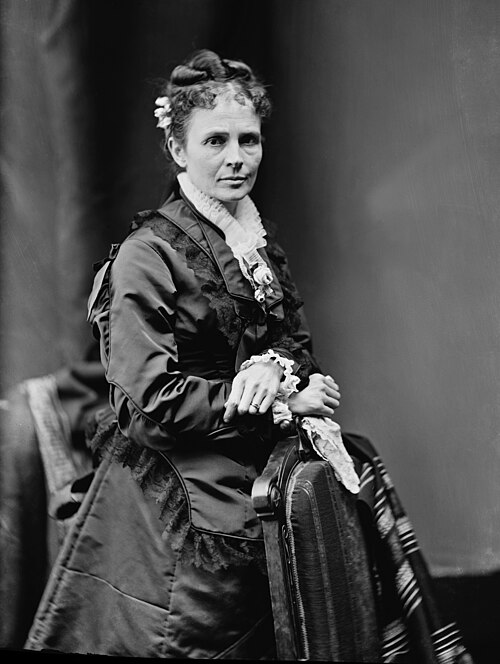
And then, remarkably and perhaps for the first time, the couple fell truly and deeply in love. The tone of their correspondence reflected this shift in their affection, with James writing to her “We no longer love because we ought to, but because we do.” In a 1873 letter written on the eve of her birthday, Lucretia confirmed their newfound attraction, “Tonight in closing up my forty-first year I can scarcely realize I am so old. I do not feel old, and our love is so fresh and full of rosy light that I cannot believe we are more than lovers yet.” James became much more aware of Lucretia’s value to him as a guiding star, while Lucretia, apparently, became much more capable of expressing affection.
Partners in Politics, Partners for Life
Soon after this reconciliation, Lucretia played a larger role in her husband’s political ambitions. She edited his speeches and freely discussed his policies and troubles with him. When he received the Republican nomination in 1880, she was key in organizing what became known as “the Front Porch Campaign,” serving cookies and lemonade to those who came to their home in Mentor, Ohio, seeking a word with the candidate. Garfield took office in March 1881 and was shot in July.
During her brief time in the White House, Lucretia laid plans to renovate the shabby interior of the presidential home, continued the practice of hosting twice-a-week public receptions, and continued to care for her children and her mother-in-law. After her husband’s funeral, she returned to their Ohio farm, where she raised her children and avoided the limelight of publicity. She established what might be considered the first presidential library, a fireproof vault which contained her husband’s correspondence and papers, including their letters to each other about the affair.
In the long years left to her, Lucretia remained a staunch proponent of women’s education, continued her lifelong love of books and reading—she was instrumental, along with her son James, in establishing a library in Mentor—and thoroughly enjoyed frequent visits with her children and grandchildren around the country. As one of her granddaughters noted in 1956, “It was grandmother who had drawn all the families into one great home circle … where, every summer they met and united as one, each to share his joys with the other.”
Following her husband’s assassination, Lucretia dressed in black for the rest of her life as a sign not only of widowhood, but of true and lasting mourning for her beloved husband. Moreover, on her return from Washington to Mentor, she took a guiding hand in the design and construction of the James Garfield Memorial, that grand tomb where today she and her beloved James rest side by side, proof that even a troubled marriage can end in a love “fresh and full of rosy light.”
What arts and culture topics would you like us to cover? Please email ideas or feedback to features@epochtimes.nyc