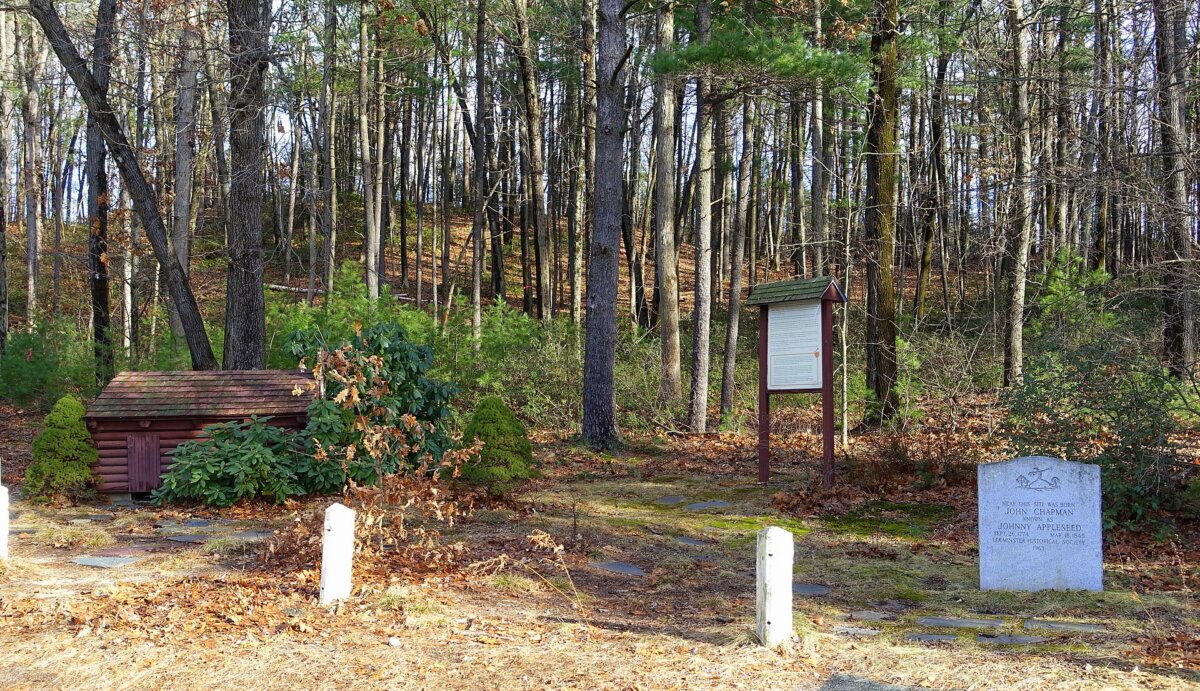
Unlike most westward wayfarers, John Chapman (1774–1845), known to history as “Johnny Appleseed,” didn’t seek a fixed homestead. Instead, he pursued a mobile livelihood as a nurseryman, anticipating where settlement would happen rather than following it. This distinction is central to understanding the real man and the myth that followed him.
Contrary to popular imagery, Chapman established intentional apple nurseries, usually fenced in to protect young trees from livestock. He returned to these sites over the years.
His nurseries were strategically located along rivers, trails, and near emerging settlements, particularly in what are now Pennsylvania, Ohio, and Indiana. When settlers arrived, Chapman sold saplings or parcels of land containing young trees, sometimes on credit, sometimes at reduced cost, and on occasion, without payment.
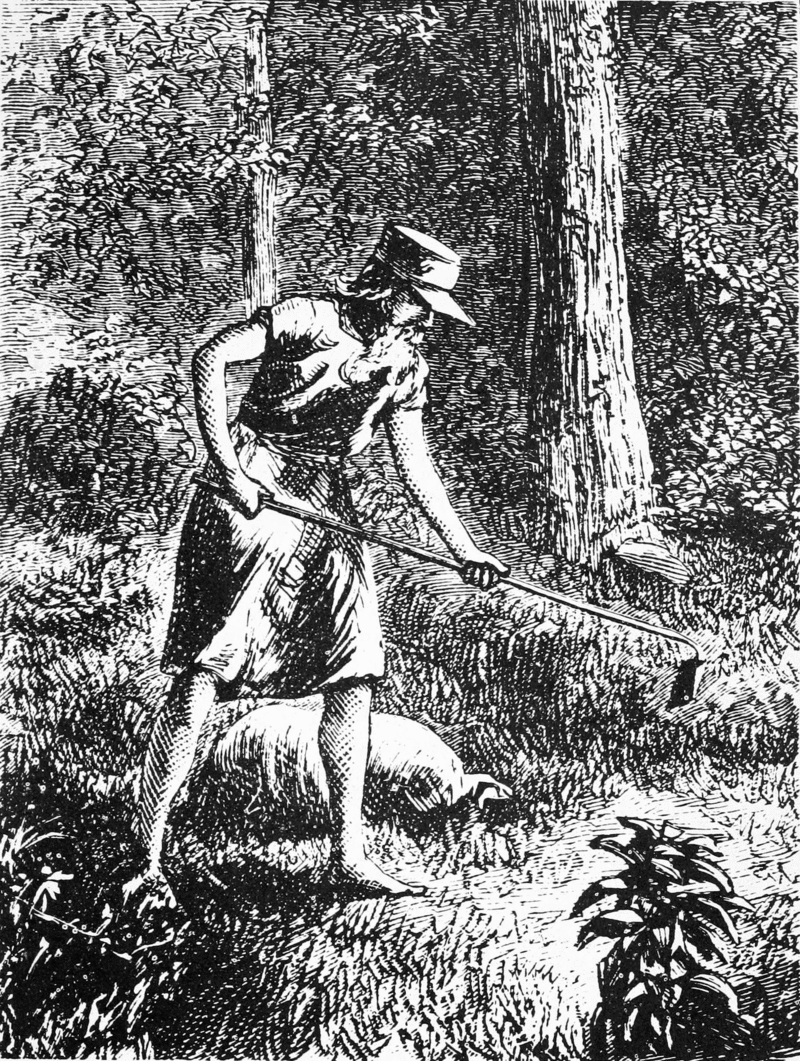 Johnny Appleseed planting apple seeds. (Public Domain)
The apples Chapman cultivated weren’t sweet eating apples. Trees grown from seed typically yield small, acidic fruit well suited for hard cider, a staple beverage on the frontier. At a time when clean drinking water was often hard to find, cider—usually low in alcohol—was widely consumed and considered safer than untreated water. This perhaps explains its ubiquity at frontier tables. Chapman’s work therefore addressed a practical necessity rather than a romantic ideal.
His nurseries intersected with frontier land policy. In parts of the Ohio Territory, settlers were expected to demonstrate land improvement, often through cultivation, to strengthen their claims of ownership. While Chapman didn’t legally secure land titles for others, his nurseries made settlement easier and more viable, quietly aiding westward expansion, perhaps without any formal intention of shaping policy.
Chapman’s personality contributed powerfully to his later legend. He was a lifelong adherent of Swedenborgian Christianity, a movement emphasizing humility, personal conscience, and the spirituality embedded in the natural world. Contemporary accounts consistently described him as gentle, soft-spoken, and unusually compassionate toward animals. He lived simply, often went barefoot, and wore patched clothing, sometimes fashioned from sacks. According to “John Chapman: The Legendary Johnny Appleseed”:
“Chapman dressed in cast-off garments, many of which he took as payment for apple trees. He even made his own shirts by cutting holes for his head and arms in a coffee sack. He claimed it was “as good clothing as any man need wear.”
The familiar image of Chapman wearing a cooking pot as a hat appears to be a later exaggeration, but his appearance and habits were unquestionably eccentric by frontier standards.
 Folk depictions of Johnny Appleseed include more hobo-like qualities than the man’s true life story. Columbus Metropolitan Library, Columbus, Ohio. (Public Domain)
At the same time, Chapman, the son of a Minuteman and Continental Army officer who had served under General George Washington, wasn’t naive. He understood land ownership, negotiated property transactions, and maintained scattered landholdings connected to his nurseries. Estimates that he controlled more than 1,000 acres during his lifetime appear in secondary sources, though exact totals can’t be verified due to incomplete period records.
What’s clear is that Chapman combined moral idealism with practical knowledge of commerce and law; indeed, this balance may explain his long-term effect on the frontier.
Chapman died in 1845, near what is now Fort Wayne, Indiana, most likely of pneumonia. Contemporary medical and burial records are imprecise, but Johnny Appleseed Park in Fort Wayne contains the gravesite most widely accepted by historians and local tradition. The site has been recognized since the mid-19th century and is a modest commemoration, fitting a man who avoided the public eye.
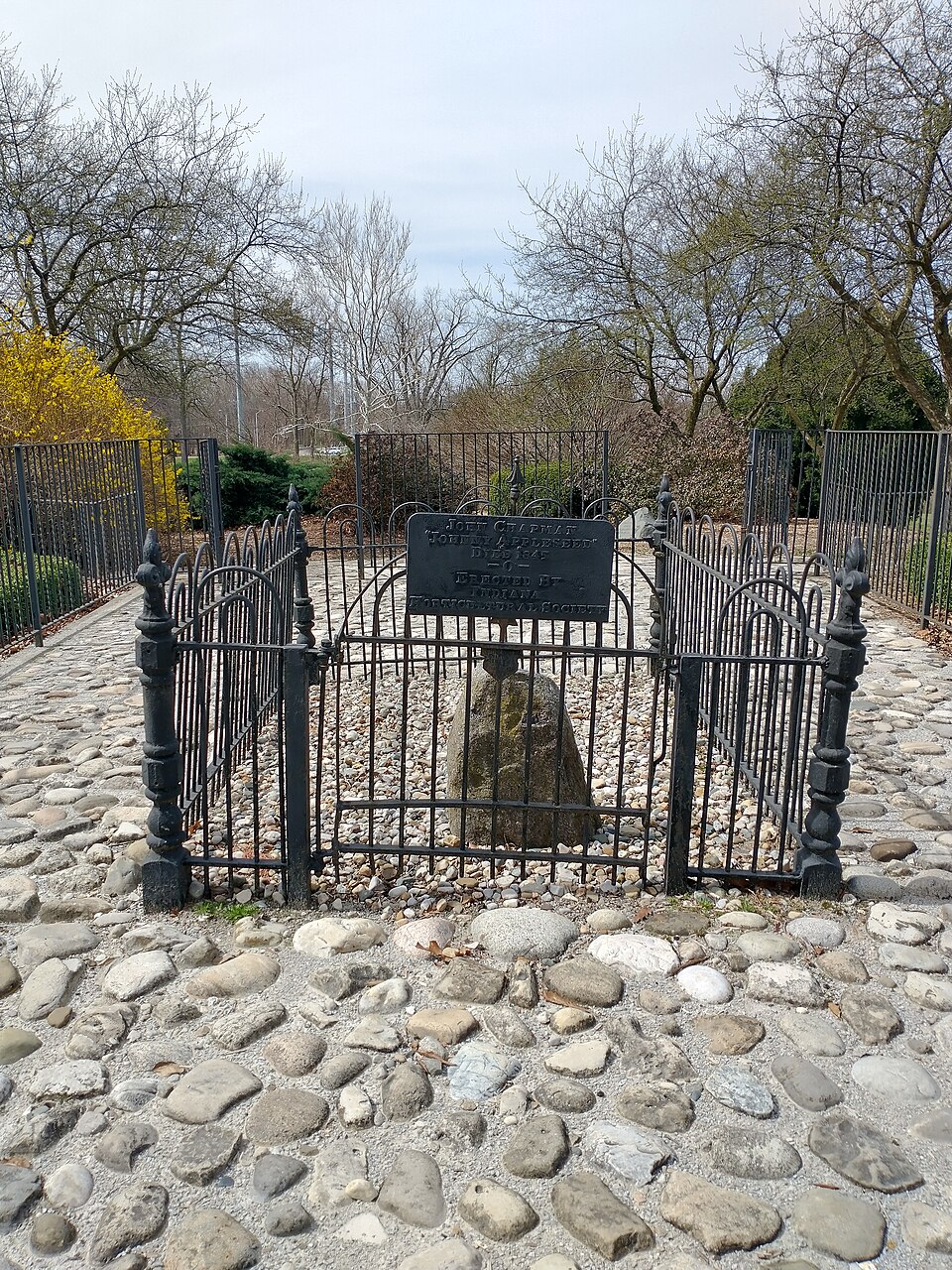 The grave of Johnny Appleseed, located in Fort Wayne, Ind. (amanderson2/CC BY 2.0)
A Famous Folk Hero
His elevation from regional figure to national folk hero occurred largely after his death. An influential 1871 article by Unitarian minister W.D. Haley (1828–1890) in Harper’s New Monthly Magazine was written decades after Chapman’s most active years. It romanticized him as a near-mythic figure, emphasizing humility and benevolence while minimizing his business acumen and religious specificity. From there, the image of the fictional character with orchards to tend and harvests on his mind spread rapidly through children’s books, poems, songs, and later film, fixing Johnny Appleseed in the American imagination.
Physical commemorations followed. In Leominster, Massachusetts, markers and local traditions identify Chapman as a native son. In Cincinnati’s Spring Grove Cemetery, a monument honors his life and work, reflecting the region where he spent much of his productive years, though it isn’t his burial site. Across Ohio, particularly in Mansfield and Ashland—where Chapman established multiple nurseries—monuments, plaques, and annual festivals mark his memory.
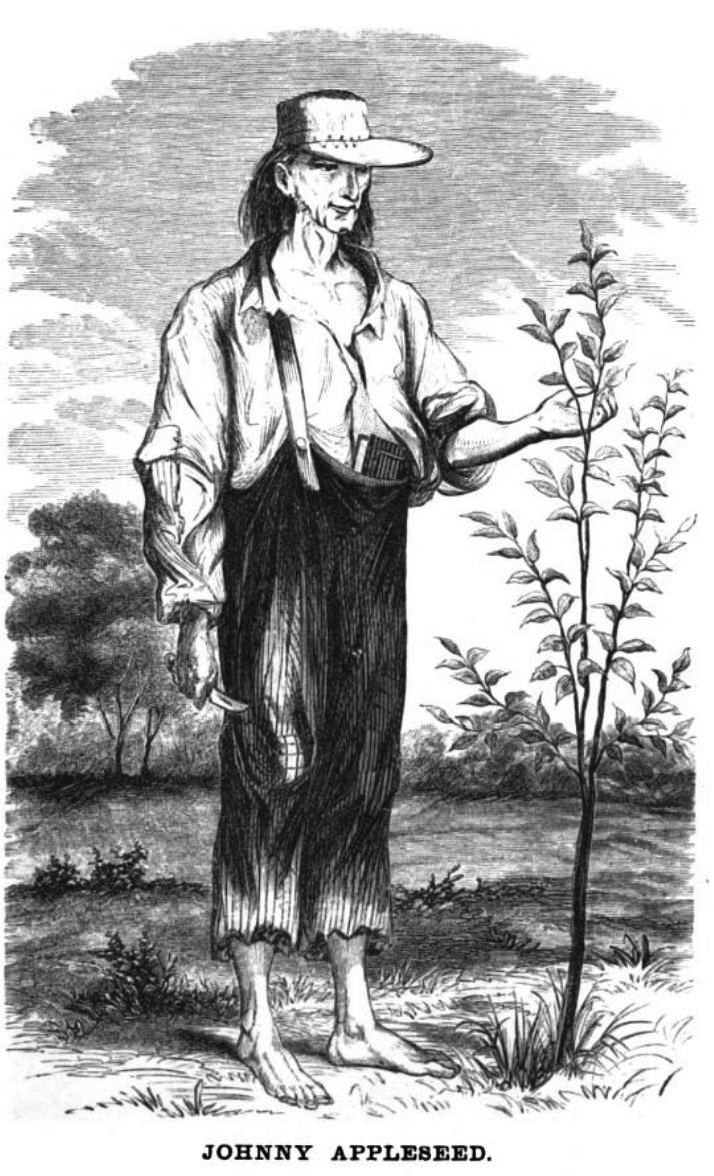 A drawing of Johnny Appleseed from an 1862 book “A History of the Pioneer and the Modern Times of Ashland County,” by H.S. Knapp. (Public Domain)
No verified apple trees planted directly by Chapman survive today. Apple trees aren’t long-lived on a historical scale, and claims of living specimens can’t be substantiated. What endures instead is a cultural landscape shaped by his work: place names, regional traditions, and a persistent story rooted in documented practice.
The real John Chapman was neither saint nor simpleton, neither myth nor curiosity. He was simply a man who understood land, trees, belief, and human settlement at a moment when all four were being renegotiated on the American frontier. His nurseries anticipated many permanent settlements.
What survives isn’t a fairy tale, but a practical legacy rooted in foresight, patience, and an unusually coherent moral vision—one that left a measurable imprint on both the landscape and the culture that followed. It continues to shape how Americans remember the frontier itself.
What arts and culture topics would you like us to cover? Please email ideas or feedback to features@epochtimes.nyc