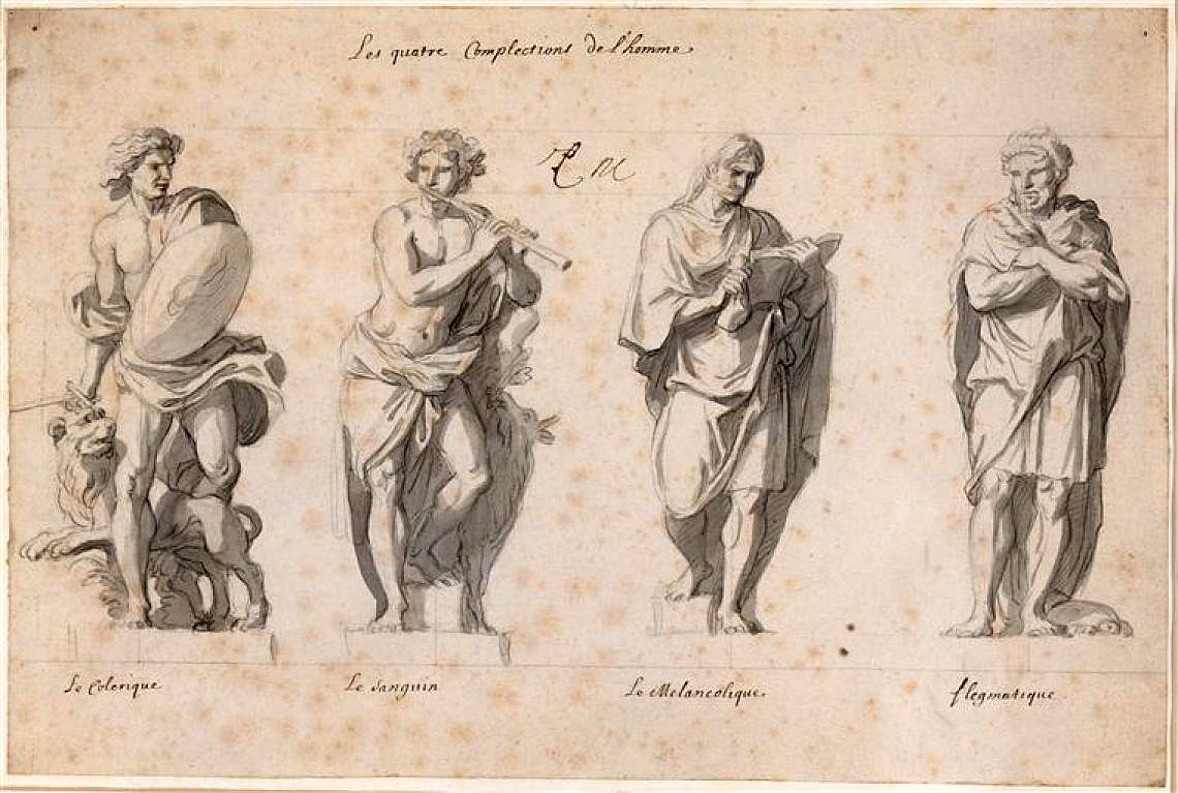
Most of us are familiar with the Myers-Briggs personality test and other contemporary personality tests, but there’s a much older temperament classification model that often gets neglected: the classical four temperaments.
This model originated with Hippocrates 2,000 years ago and was further developed in the Middle Ages. Despite its antiquity, it continues to serve as an excellent key for understanding both oneself and others. Knowledge of temperaments can help us identify and counteract our weaknesses while capitalizing on our strengths. It also enables us to better understand—and get along with—others in our homes, communities, and workplaces.
In his book on the medieval worldview, “The Discarded Image,” C.S. Lewis explained the theory behind the four temperaments. The ancient and medieval conception of the human body saw it as a combination of four fluids or humors that reflected the four elements: hot and moist make blood, hot and dry make choler, cold and moist make phlegm, and cold and dry make melancholy (sometimes tied to bile). As Lewis explained, “The proportion in which the Humours are blended differs from one man to another and constitutes his complexio or temperamentum, his combination of the mixture.”
It’s this variable mixture that gives rise to a person’s personality, according to medieval theory. Generally, one humor predominates, giving the person his or her overall temperament: sanguine, choleric, phlegmatic, or melancholic.
Although the physiological side of the four humors is obviously flawed, the classification of temperaments that derives from this theory remains strikingly accurate. Anyone who comes to understand the four temperaments will immediately recognize in each type the features of real people that he knows. He may also discover insights about his own nature, explanations for characteristics that used to puzzle him.
With this background in view, we can proceed to look at each temperament in detail. The following information is drawn largely from “The Temperament God Gave Your Spouse” by Art and Laraine Bennett, along with the Lewis book cited above, but it’s widely available in many other sources as well.
Sociable Sanguine
The sanguine is lively, talkative, and vibrant. He’s the proverbial “life of the party” and he prizes relationships and human interaction. Sanguines are emotional, but their emotions are generally short-lived. One moment they’re mad, the next they’re laughing. They don’t hold grudges, and they maintain an optimistic outlook on the world. Lewis describes the sanguine as “cheerful and hopeful,” even if he or she is a bit “peppery.”
Like all the temperaments, sanguines have strengths and weaknesses. Because they are impulsive and distractable, they don’t always follow through on projects or commitments. They can grow vain or be excessively concerned about the opinions of others. They may become flighty or irritable, lacking the steady consistency of some of the other temperaments.
Famous sanguine characters from literature would include Mr. Bingley from “Pride and Prejudice,” Mr. Micawber from “David Copperfield,” and Tigger from “Winnie-the-Pooh.”

Commanding Choleric
Cholerics love to be in charge, and they are great at planning, organizing, and getting things done. They often thrive under pressure, and their resolute wills drive them to excel at whatever they set their mind to. They never back away from a fight—they even enjoy a little conflict. They know their own mind, and they often get what they want. With confidence and motivation, cholerics mark out their own path in the world. They are often strong leaders or visionaries.
At the same time, their forcefulness can sometimes bulldoze others. Cholerics struggle with violent anger and being excessively opinionated or harsh. With well-cemented self-assurance, the choleric can fall victim to pride and egotism. Lewis’s description goes like this: “Choleric children are now described (by their mothers) as ‘highly strung.’”
Famous cholerics from literature would include Gandalf from “The Lord of the Rings,” Elizabeth Bennet from “Pride and Prejudice,” and Rabbit from “Winnie-the-Pooh.”

Friendly Phlegmatic
If cholerics are conflict-seekers, phlegmatics are conflict-avoiders. Their reactions to internal or external stimuli tend to be much slower and less dramatic than the reactions of sanguines or cholerics. They are easygoing, friendly, and even-keeled. They don’t allow either the bellowing of a choleric nor the flightiness of a sanguine to bother them too much—or at least, they don’t show it when they are bothered.
Sometimes the phlegmatic is described as a stabilizing “buffer” for the excesses of the other three temperaments. They are peaceable and peacemakers. They can also be thoughtful, methodical, and loyal, making them good managers and planners. A man or woman of few words, the phlegmatic is happy to let others take the spotlight.
However, one of the phlegmatic’s greatest flaws is a tendency toward laziness. Phlegmatics procrastinate, they make excuses, they disappear when they are needed. It can be hard to get phlegmatics to care sufficiently about anything. Sometimes their desire to avoid conflict is actually cowardice.
Famous phlegmatics from literature include Samwise Gamgee from “The Lord of the Rings,” Mr. Bennet from “Pride and Prejudice,” and Pooh from “Winnie-the-Pooh.”

Moody Melancholic
In some ways the most rich and complicated of the temperaments, the melancholic person is deeply introspective and sensitive. The melancholic tends to love books, music, art, nature, and whatever is wistful and lonely. They’re dreamy, highly intelligent, and often bookish. They relish beauty and big ideas and high ideals, and are often deeply affected by things others hardly notice. Although sometimes reclusive, melancholics are also extremely loyal, forming deep commitments and relationships that they don’t easily abandon.
But melancholics are also susceptible to depression, brooding, and spite. They hold grudges, sometimes for years. Some melancholics can be excruciatingly sensitive, hurt by the smallest trifles. They’ll often fall prey to sadness or pessimism for little or no reason. Their love for order and ideals can make them perfectionists with impossible standards.
Famous melancholics from literature would include Hamlet from “Hamlet,” Raskolnikov from “Crime and Punishment,” and Eeyore from “Winnie-the-Pooh.”

Most people possess qualities from more than one of the four temperaments. Usually, a person is mostly a combination of two temperaments, a primary and a secondary—for example, a melancholic phlegmatic or a sanguine choleric.
The pursuit of virtue involves balancing out one’s temperamental inclinations. The phlegmatic needs to strive after some of the choleric’s courage and resolve, while the choleric needs to acquire some of the phlegmatic’s cooperativeness and peaceableness. The sanguine could use some of the depth and reflectiveness of the melancholic, while the melancholic stands in need of the sanguine’s cheerfulness and optimism.
It’s worth noting that what we fail to achieve in ourselves we can find in others. Melancholics benefit from being around sanguines, and vice versa. In this way, the temperaments depend on one another. It’s possible for beautiful harmony and complementarity to be achieved within a home or place of work, especially when everyone understands their temperamental inclinations. We all have the potential to complement one another.
Correction: An earlier version of this article misspelled the name of the character Mr. Micawber from Charles Dickens’s “David Copperfield.” The Epoch Times regrets the error.