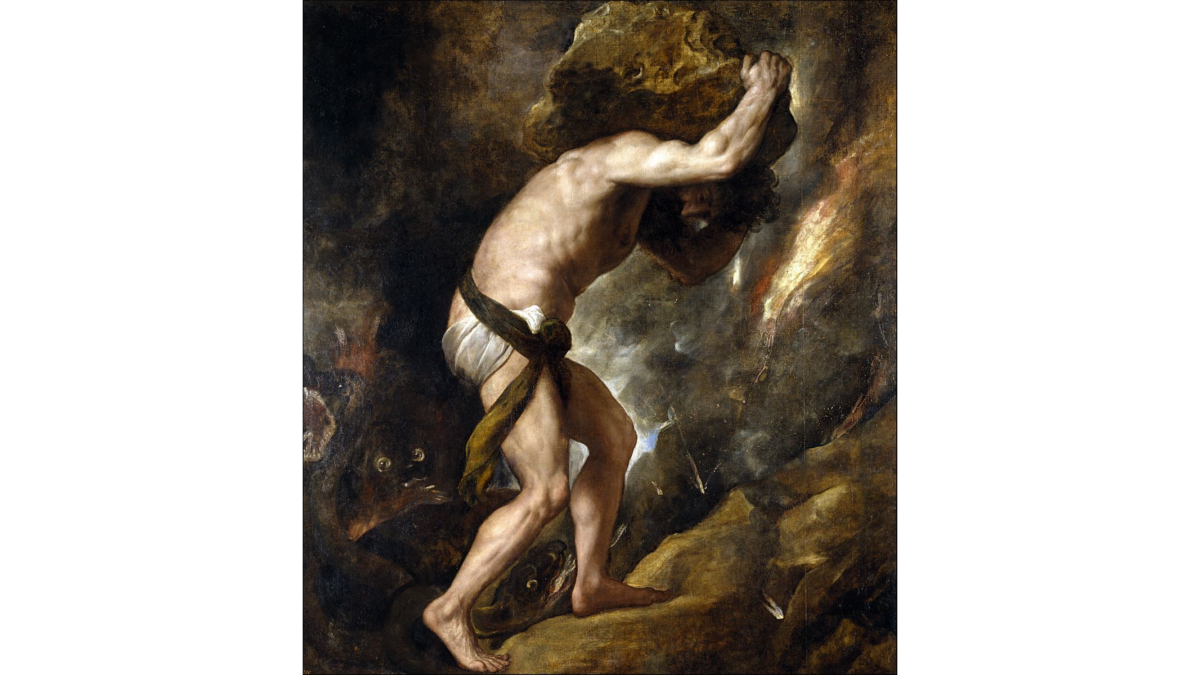
One of the great things about the Greek myths is their ability to explain human psychology and reveal more than the merely superficial. Psychologist James Hillman wryly observed: “Mythology is a psychology of antiquity. Psychology is a mythology of modernity.”
Take the case of Sisyphus. He was a mortal, and his name (spelled, Sesephus, according to English critic Robert Graves) means “very wise.” His father was Aeolus, king of Thessaly and keeper of the winds, though, in later traditions, Aeolus became associated with being the god of the winds. Sisyphus was mortal. Nevertheless, as with many Greek heroes (and a villain, in this case), he was brushed with some divine connection.
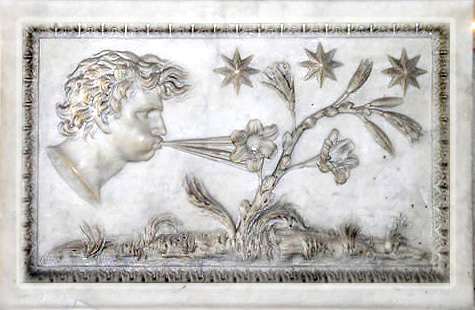
The connection to the god of the winds is instructive. Wind is air in motion, and air is traditionally associated with the intellect (as water is with the emotions). Thus, with the myth of Sisyphus, we are dealing with a human being who uses his (very wise) mind—actually, his cunning—to achieve what he wants. This mind was as brilliant as it gets for a human being, as we shall see.
However, clever as he was, Sisyphus is not really famous for the power of his intellect. Neither is he remembered as a robber, murderer, and rapist; in other words, he was not a very good person. Nor is he famous for even allegedly being the father (by a ruse) of Odysseus, another trickster famous for outwitting others.
Instead, Sisyphus is famous for being condemned to Tartarus (the Greek myth’s underworld). There, he must eternally roll a large boulder up a steep slope and just as he reaches its summit, the boulder’s weight overwhelms him and crashes back down, and so Sisyphus has to start the procedure all over again—forever. He was condemned to this penance in Tartarus, the lowest pit of the underworld, where all the worst offenders worked out their respective and eternal sentences.
Sisyphus’s Sins
Sisyphus was not condemned to hell because he was a robber, murderer, or rapist. King Zeus took a dim view of these earthly and sordid deeds, but, no. Rather, he was condemned because he attempted to outwit the gods. His hubris was his unforgiveable sin.
Such were his intellectual powers—also known as trickery—that he managed to outwit or offend them three times, and each time he acted with seeming impunity.
His first transgression was to inform on Zeus. Zeus had abducted Aegina, the daughter of Asopus, a river god. Sisyphus knew that Zeus had perpetrated this act. When Asopus appeared looking for his daughter, Sisyphus bartered this information for an endless spring of water for his kingdom of Corinth, which Asopus duly supplied.
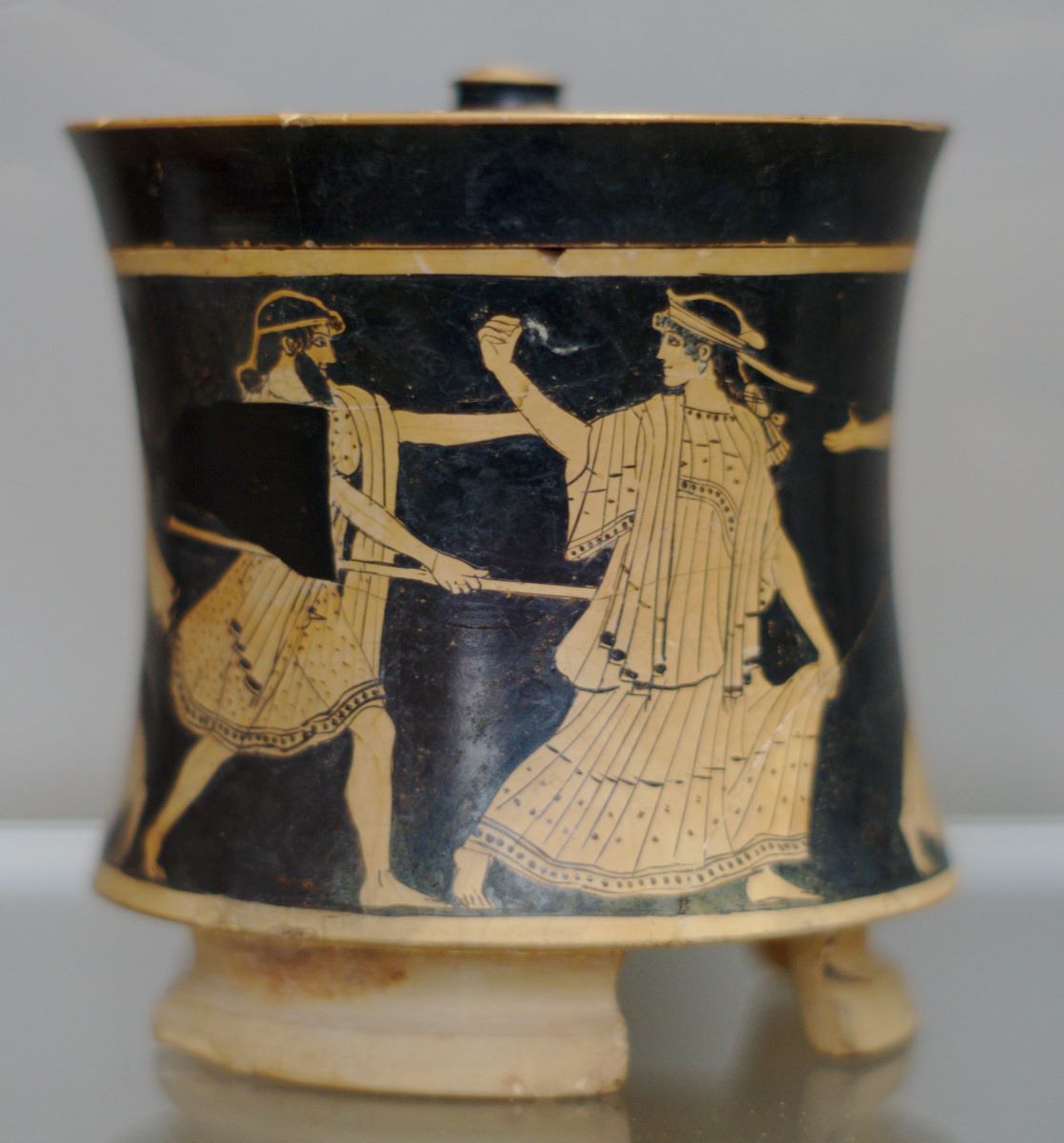
Zeus was less than pleased when he found the enraged river god pursuing him at speed. Zeus had to use his thunderbolts to force a retreat from Asopus. Whatever the rights and wrongs of Zeus’s actions (keeping in mind that his actions often seemed necessary to produce heroic offspring who saved the cosmos), the point is: Informing on the god of order, supreme in the universe, was a treacherous betrayal.
Given Sisyphus’s general degeneracy, Zeus decided he needed to be punished. Zeus sent Thanatos, the god of death (and servant of Hades, the god of the underworld where the dead existed) to take him down. Here, the ingenuity of Sisyphus blossomed: He cheated death. Through exceptional cunning, he asked Thanatos to demonstrate how a pair of handcuffs worked and then locked them on Death himself, and entrapped him in his own heavy chains.
Initially, no one missed the fact that Thanatos was missing. In short order, no one was dying anymore, whatever, or however severe, their injuries might be. And Sisyphus had not gone down to Hades. In fact, he had spent his time in the upper light of the living preparing for his next ruse.
Finally, Ares, god of war, who was most upset by the lack of deaths, was sent to release Thanatos and to deliver Sisyphus to him again. Now immune to Sisyphus’s trickery, Thanatos does take him down to hell this time.
But, here, Sisyphus performed his third and final act of hubris. He’d arranged for his wife, Merope, to forego the customary burial procedures, including the payment to Charon, the ferryman. Sisyphus arrived at the abode of Hades as an unburied pauper. Appealing to Queen Persephone, Sisyphus told her that he had no right to be there.
Since he had received no proper burial and no coin to pay Charon, Sisyphus should have been left stranded beyond the Styx. Moreover, he contended that his wife’s failure to perform the funeral rites and sacrifices might encourage other widows to follow her poor example.
Sisyphus begged Persephone to grant him just three days on the earth’s surface. In that brief span, he intended to ensure his funeral was arranged, to punish his wife for shirking her responsibilities, and to impress upon her the need to honour the rulers of the Underworld. Moved by his entreaty, Persephone granted his request—an act no other god could revoke.
Of course, Sisyphus had no intention of returning and lived for another 50 years. But eventually his wife died, and old age caught up with him. This time, the god Hermes took him down, and there was no return. Instead, there was the punishment for which he is famous.
A Punishment That Fits the Crime
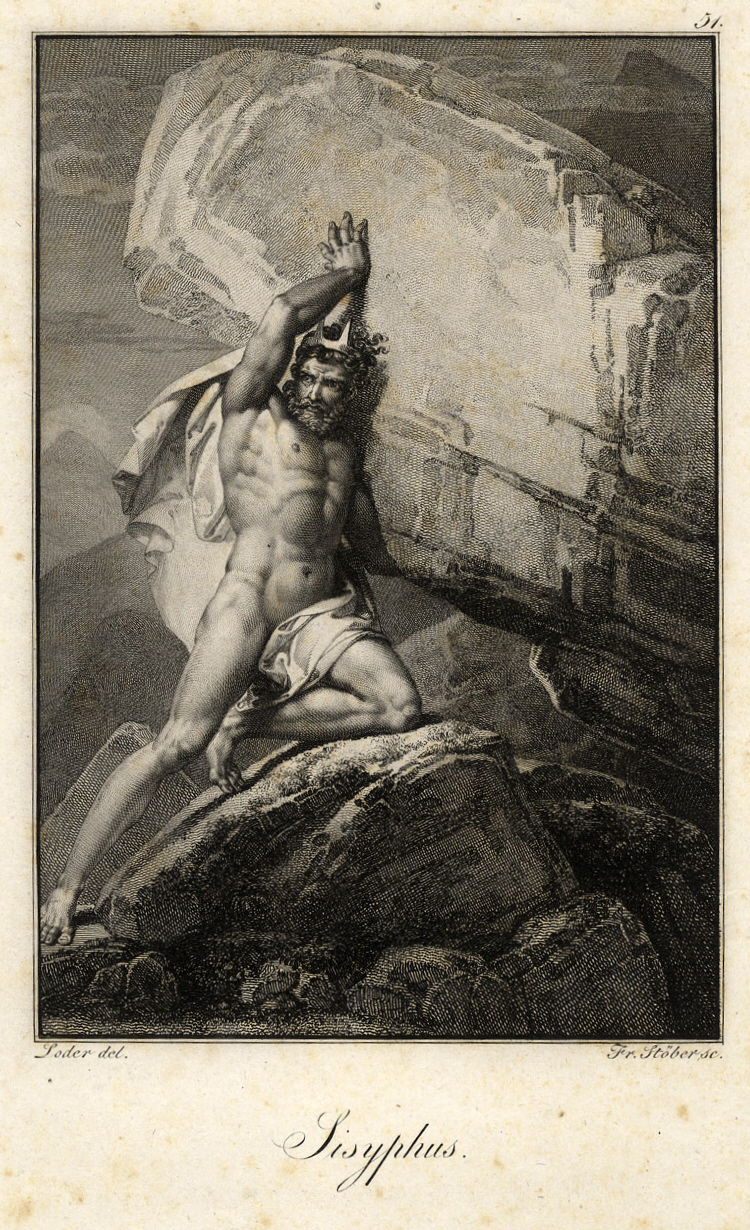
In an ordered and just universe, contrapasso punishment is required. The penalty has to match and be proportional to the crime. Sisyphus’s lifelong behavior had been to outwit fate—identical to trying to defeat the gods. Now, fate endlessly defeated him.
Second, his whole life had been spent gaining control or mastery over others—including death and the gods. Now, he is given an endless and fruitless struggle to defeat a mere stone.
Finally, his cleverness all came to nothing, leading to nowhere. This is reminiscent of the powerful biblical warning: “No wisdom, no understanding, no counsel prevail against the Lord” (Proverbs 21:30).
Sisyphus Now
There is a saying, often attributed to Einstein: “Insanity is doing the same thing over and over again and expecting different results.”
We don’t have to wait until we get to hell to find this situation: All addictions and compulsions have this characteristic. The gambler expecting his winnings, the drug addict expecting his highs, the drunk expecting his numbness, the sex addict expecting his or her thrills, they all experience the same end.
And, it’s not just these obvious types: People doing their jobs in the same routine way day in, day out, who expect some miraculous transformation in their lives’ quality, are trapped in the same way.
Perhaps this is nowhere truer than in relationships and in the masks we like to portray to the world, from the abuse victims who, even when they escape, seem to find another abuser, to the depressives who constantly play the victim card. Sisyphus, essentially, is a symbol of all our overarching, overweening desires to prevail against reality. Sisyphus is us, now!
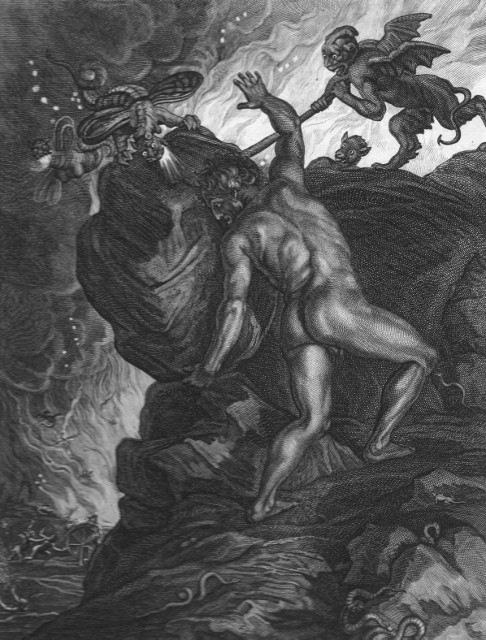
Albert Camus, the great existentialist writer, realized this and tried to normalize it in his essay, “The Myth of Sisyphus.” In it, he argued that Sisyphus was happy, because “the struggle itself toward the heights is enough to fill a man’s heart.” Simply put, he had something to keep him busy, and this was enough!
But normalizing this fruitless endeavor only succeeded in advancing the whole existentialist agenda: that of demeaning life as purely meaningless, entirely subjective and, naturally, godless. From this point of view, so typical of the 20th and 21st centuries, Sisyphus transcends his suffering, and his rebellion against the gods becomes an act of defiance and freedom—an existential victory.
However, for those of us who prefer reality to fantasy, who have seen all the Sisypheans littering our culture, such a point of view is invalid: Sisyphus, happy in his existential victory? Homer knew much better. For what did Odysseus see when he descended into Hell?
And I saw Sisyphus too, bound to his own torture,
grappling his monstrous boulder with both arms working,
heaving, hands struggling, legs driving, he kept on
thrusting the rock uphill toward the brink, but just
as it teetered, set to topple over—time and again
the immense weight of the thing would wheel it back and
the ruthless boulder would bound and tumble down to the plain again—
so once again he would heave, would struggle to thrust it up,
sweat drenching his body, dust swirling above his head.
Does that sound happy? No, it sounds compulsive, trapped, and hellish. The lesson of Sisyphus tells us to ignore the siren voices that tell us we are being existential (or authentic) when we use our minds to think that we are cleverer than we really are and, certainly, never as smart as that invisible Power that controls the cosmos. We do well when we avoid hubris.
What arts and culture topics would you like us to cover? Please email ideas or feedback to features@epochtimes.nyc.