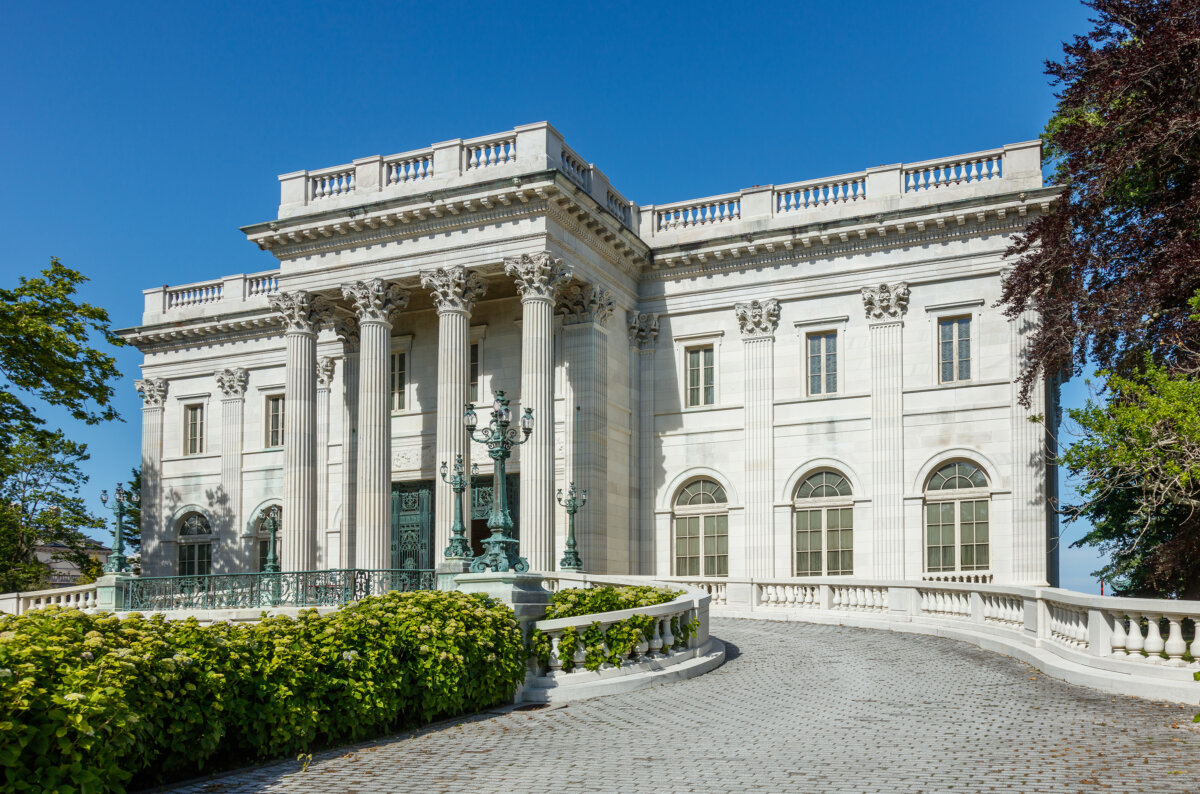
A curved carriage ramp sweeps up to the projecting entry portico, where four massive fluted Corinthian columns rise in stately support, flanked on either side by stone railings that follow the graceful arc of the entry drive. This same Corinthian order—rendered with equal refinement—graces the facade of the Petit Trianon, whose four slender columns speak to the restrained elegance of the Neoclassical style. (The Preservation Society of Newport County)
Marie Antoinette had the Petit Trianon. Alva Vanderbilt had Marble House—and she refused to consider that a lesser fate. When William Kissam Vanderbilt presented it to her on her 39th birthday, he wasn’t simply giving her a home. He was casting her in a role for which she had been rehearsing for 39 years: the most powerful woman in the most opulent home in the country.
Known for her formidable social ambitions and commanding personality, Alva demanded a setting of extraordinary scale and grandeur. For her, Marble House was a bold declaration that American wealth could rival the prestige and refinement of Europe’s aristocratic courts. Much of the mansion’s inspiration came from France, where Alva had spent part of her youth attending private schools and cultivating a deep appreciation for classical design and the theatrical elegance of French architecture. Her model for the Newport estate was the Petit Trianon at Versailles, the refined retreat once presented by Louis XVI to Marie Antoinette.
Constructed between 1888 and 1892 at the height of the Gilded Age, the mansion emerged among the vast “summer cottages” that powerful families built along Bellevue Avenue to proclaim their status. The mansion was designed by Richard Morris Hunt, the first American architect trained at the Ecole des Beaux-Arts in Paris. Its design exemplifies beaux arts classicism, a style defined by symmetry, grandeur, and elaborate ornamentation. Modeled after the Petit Trianon, Marble House lives up to its name—it’s 140,000 square feet of grandeur built upon roughly 500,000 cubic feet of marble.
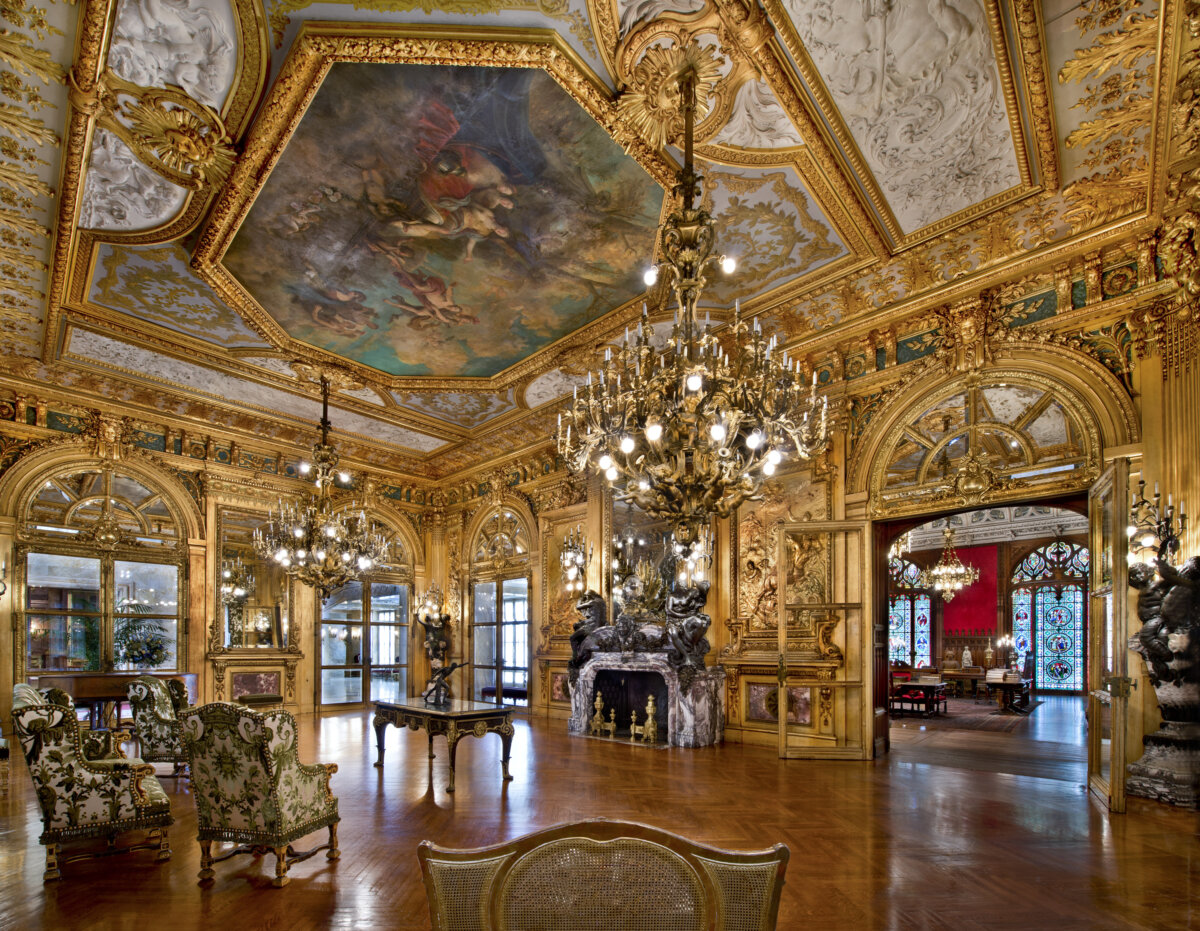
The interiors were conceived as dramatic settings, including the dazzling Grand Salon, decorated with 22-karat gold leaf. French influences appear throughout the mansion’s 50 rooms. Examples include a ballroom inspired by the Hall of Mirrors, Louis XVI decor in William’s private bedroom, and a relief portrait of Jules Hardouin-Mansart, the architect of Versailles. Together, these features turn the residence into a theatrical display of wealth and cultural refinement.
Today, Marble House is preserved as a historic landmark by The Preservation Society of Newport County and operates as a public museum. Visitors can explore the grand rooms of the house, an enduring example of Gilded Age architecture and ambition.
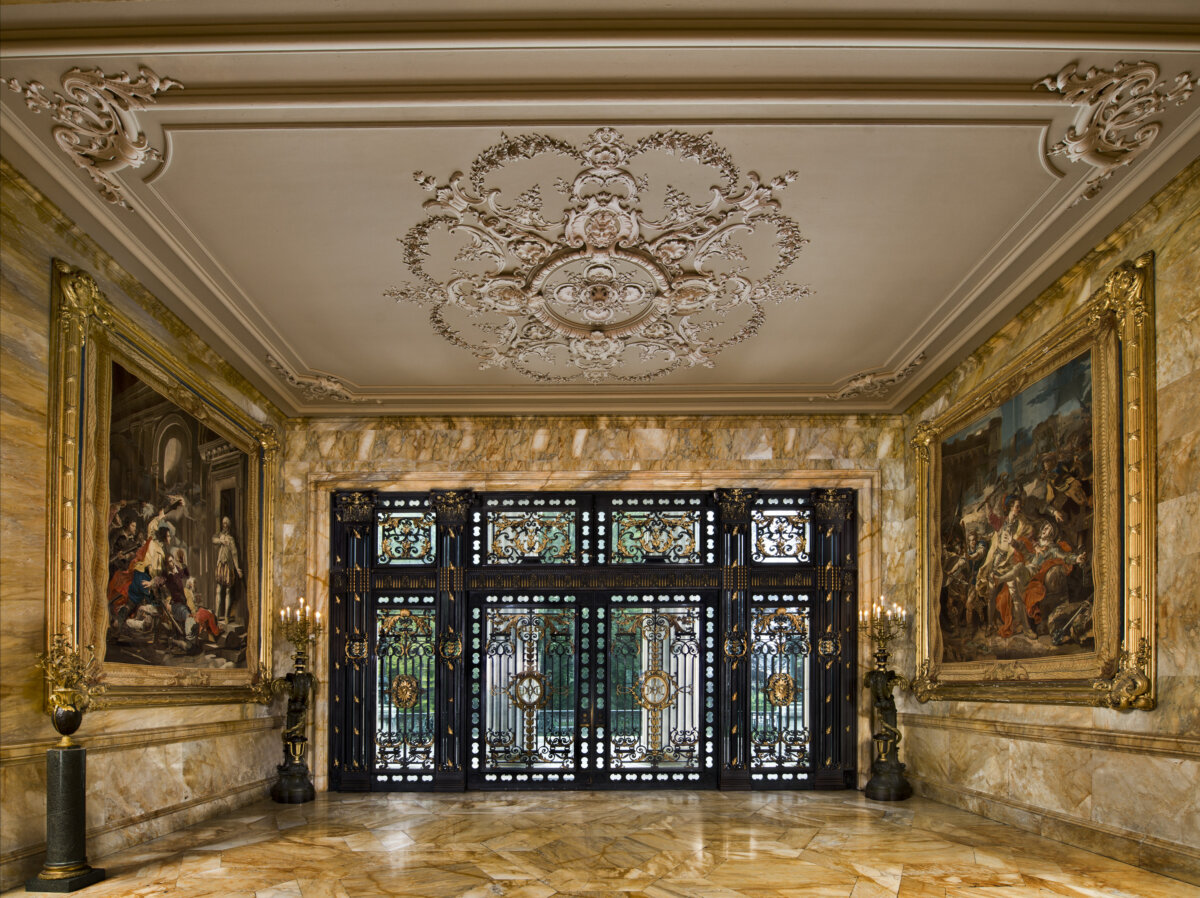
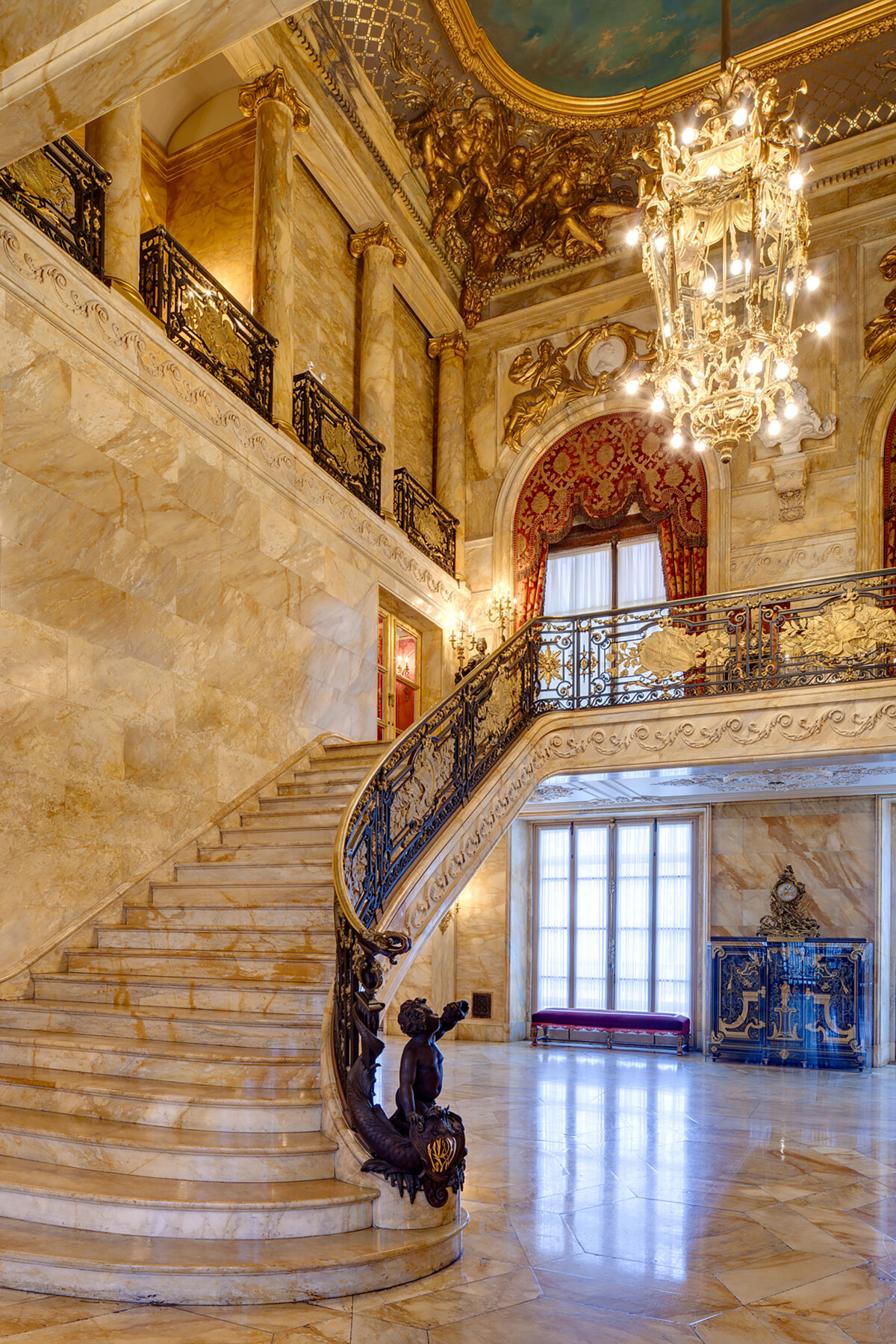
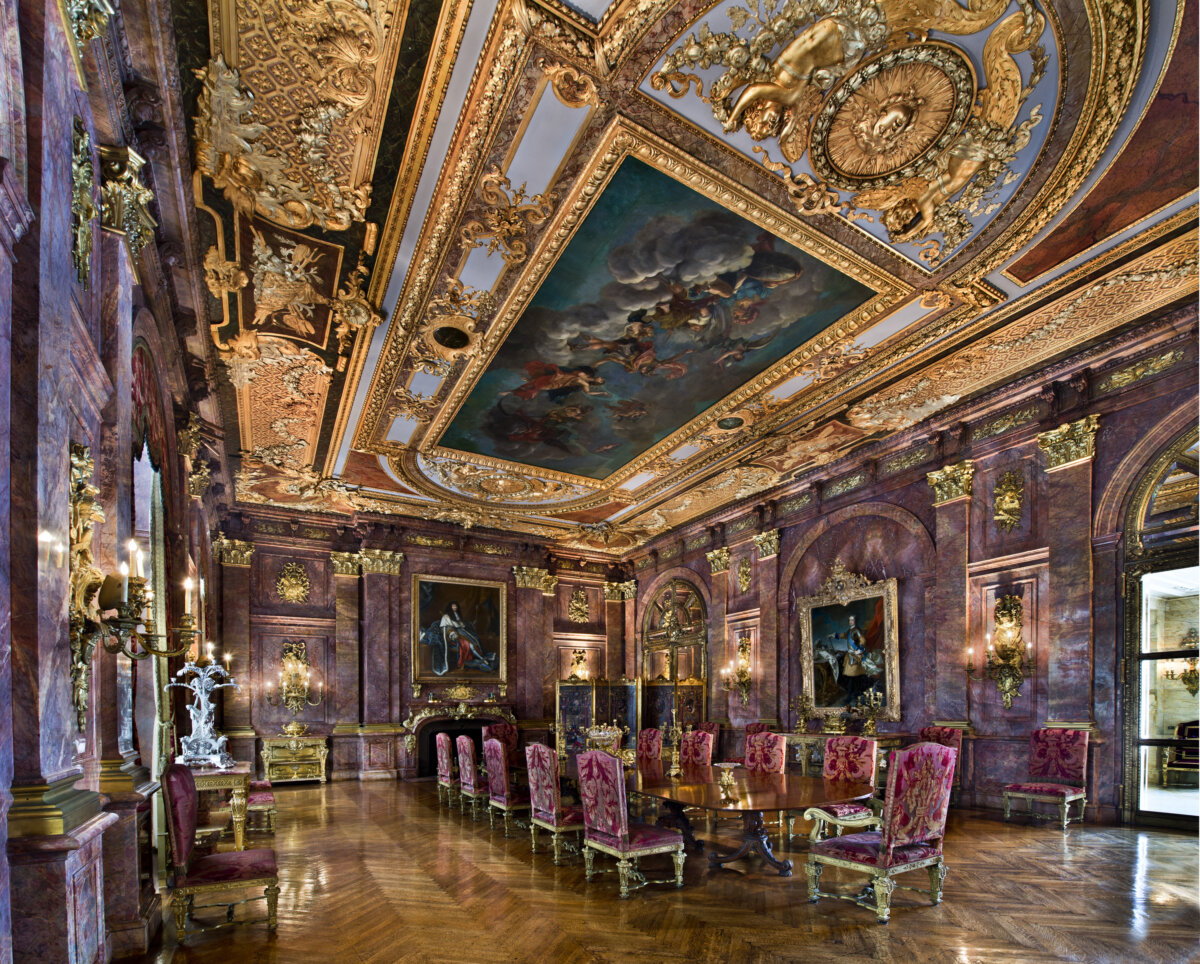
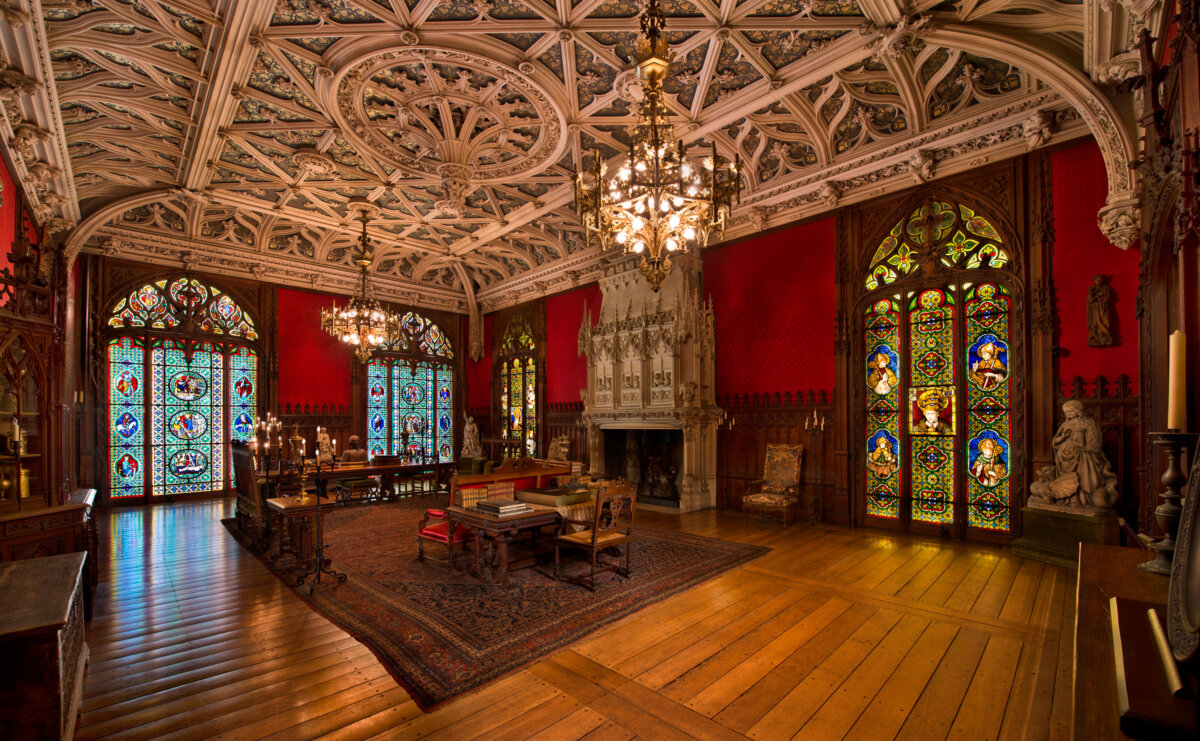
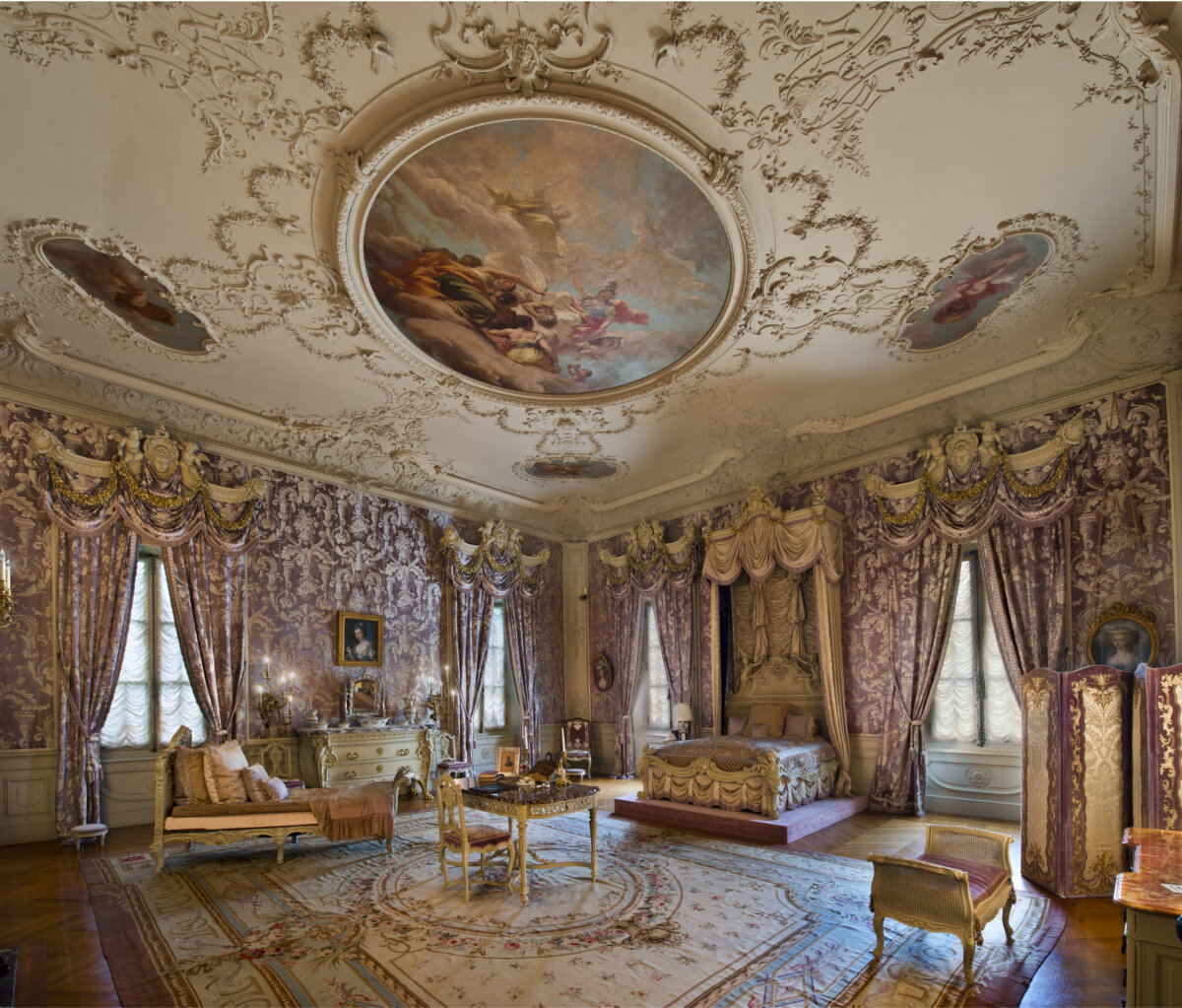
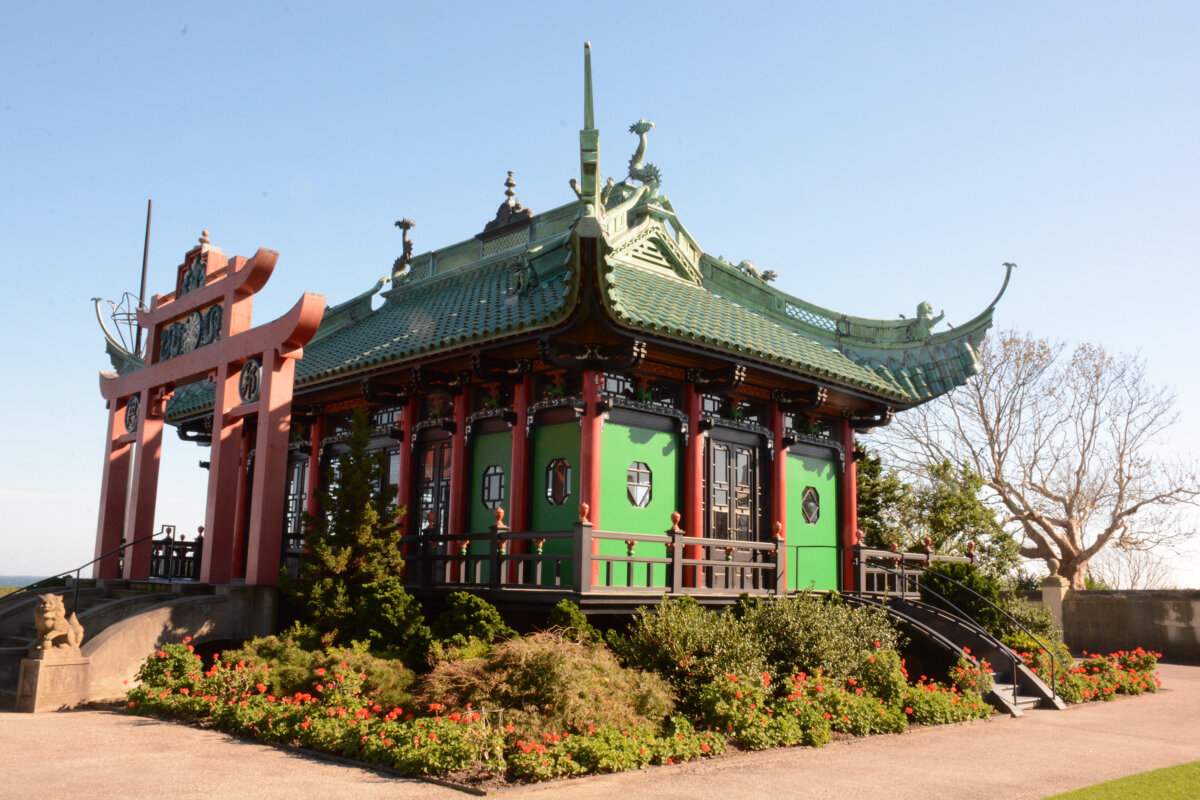
As one crosses the threshold through the grand 16-foot-high bronze doors, each weighing 3,000 pounds, Marble House immediately asserts its presence. Every detail speaks to a design built not merely to impress, but also to endure. Flanking the entrance, two late 18th-century Gobelins tapestries command the space. Woven with wool and silk at Paris’s legendary Manufacture des Gobelins, these painterly masterworks have graced the world’s most distinguished residences for centuries. (The Preservation Society of Newport County) The grand staircase in the foyer is constructed of imported yellow Siena marble, with a wrought iron banister finished in gilded bronze. At its base stands a bronze putti, or cherub, a motif cherished by Louis XIV that can be found throughout the Palace of Versailles. (The Preservation Society of Newport County) The ornate Dining Room is walled in pink Numidian marble from Algeria, with architectural details in gilded bronze. The fireplace is modeled after the one in Versailles’s Salon d’Hercule, faithfully reproducing its signature leaf and shell motifs. The Louis XIV-style chairs, upholstered in jewel-toned velvet woven with metallic threads, weigh 75 pounds to 100 pounds apiece. The chairs are so heavy that the Vanderbilts’ guests frequently required staff assistance to move them. (The Preservation Society of Newport County) The Gothic Room features a groin vault ceiling, paneled wainscoting, and filigree chandeliers, all reflecting the medieval and Renaissance collection that it was designed to display. Its limestone fireplace was modeled after one in the Jacques Coeur House in Bourges, France. The ornamental molding draws further inspiration from French Gothic interiors, although with a local twist—crabs and lobsters are woven into the foliage in homage to Rhode Island’s seaside setting. (The Preservation Society of Newport County) The Grand Salon, also known as the Gold Room, served as a ballroom for the Vanderbilts. Inspired by the Galerie d’Apollon at the Louvre, its carved wooden walls are covered in more than 500,000 sheets of dazzling 22-karat gold leaf. Images of Greek and Roman gods preside over the room, embodying the beauty, opulence, and grandeur to which the Vanderbilts aspired. (The Preservation Society of Newport County) The bedroom features a French Revival furniture suite centered on a luxurious double bed adorned with hand-carved beechwood sea nymphs and crowned with a 16 1/2-foot canopy. Presiding over the room is a painting by Venetian artist Giovanni Antonio Pellegrini, “Minerva, Goddess of Wisdom, Overcoming Time,” a fitting choice for Alva’s bedroom, as Minerva embodies the intellect, forethought, and craftsmanship she so admired. (The Preservation Society of Newport County) Built in 1914, The Chinese Tea House draws from 12th-century temple architecture, featuring projecting ribs and a jade green terra-cotta roof with curved eave tips. It served as both an ornamental retreat and a social gathering space. Inside, deep-toned wooden paneling lines the walls, and pilasters are inscribed with Chinese proverbs personally selected by Alva, including: “As for exaggerations of speech, they carry with them a cartload of demons.” (The Preservation Society of Newport County)
What arts and culture topics would you like us to cover? Please email ideas or feedback to features@epochtimes.nyc
Sarah Isak-Goode is a writer and art historian rooted in the Pacific Northwest. Her name—pronounced EYE-zik-good and meaning "good laugh"—hints at the warmth she brings to everything she does. Equal parts scholar and storyteller, Sarah brings the past to life through a distinctly human lens, exploring what connects us across the centuries. Away from her desk, she feeds her curiosity through traveling, painting, reading, and hiking with her dog, Thor.