



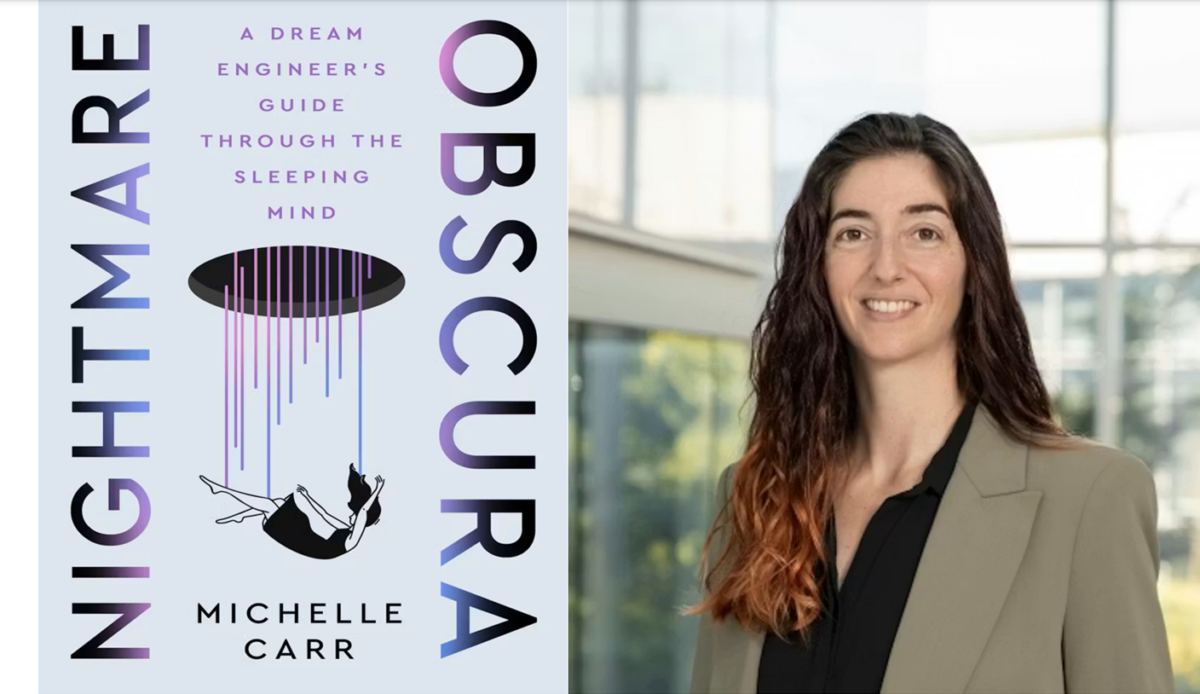
Michelle Carr remembers the first time she experienced dream paralysis. She was in high school and awoke to a terrifying sensation; she couldn’t open her eyes no matter how much she tried. Nor could she scream. A shadowy presence appeared in her bedroom. She couldn’t move. Then suddenly, she was able to open her eyes, and all was well in her empty bedroom.
Because of these experiences, and others that carried on for years, Carr chose to study the science of sleep in college, eventually becoming director of a dream lab at the Center for Advanced Research in Sleep Medicine.
Through more sleepless nights of monitoring sleeping patients, she’s become an authority on the subject. Her book, “Nightmare Obscura: A Dream Engineer’s Guide Through the Sleeping Mind” is a fascinating and deeply researched journey into the science of dreams and the study of nightmares.
Trauma and Nightmares
While there are countless books available on the subject of sleep, Carr’s approach centers on nightmares. She was intrigued by the prevalence of hospital workers exposed to trauma. They often have a higher frequency of nightmares, which is a risk factor for suicide. How can something that’s considered no more than an illusion have such an effect on our psyche?
In the introduction, Carr explained that dreams have a purpose in that they help us deal with events of the day; bad dreams provide what scientists call “overnight therapy.” But what purpose do nightmares serve?

The book is divided into three parts: why we dream; how our personality-types and daytime experiences influence our dream states; and why nightmares matter, ending with tips readers can try to dream well.
Dreams and Daily Life
Through her many experiments with a variety of subjects, Carr shows a similarity of dream themes with everyday happenings in daily life. Being chased, falling, or attempting and failing to accomplish something is be similar to rushing to catch a bus to the airport during waking hours.
This may relate to the subject’s desire to reach a goal. Another common theme is to appear nude, which may be connected to feelings of shame or embarrassment.
For those who dream of their teeth falling out, that is typically the result of grinding one’s teeth, or clenching the jaw. That last example, Carr explains, is “your dream’s way of making sense of the ongoing sensation.”
Carr’s intention isn’t to shed light on every sort of dream, whether good or bad and what they mean, but how our brains take information from our waking state. With that knowledge, she lists ways to train our brain to deliver a more consistent and restful night’s sleep.
A fascinating aspect of the dream experiments is the variety of ways Carr sets up and monitors her subjects, sometimes at their homes, sometimes in the lab.
Questions arise. Subjects will ask: Will the electrodes placed on their bodies influence the dream? Or will an unplanned sound during the session, like a microphone falling, interfere with the natural dream state? There’s much to consider.
Carr must rely on the subject’s ability to pay attention to the dream and recall what they observed. What information she gathers “require[s] skills of attention and memory.”
Through precise explanations of how experiments are conducted, readers see Carr’s unwavering commitment to the research and her patients. Though the topic can easily drift into heavy medical jargon, Carr keeps the explanations clear. She translates difficult vocabulary into everyday terms. It’s hard not to become fully engaged in these real human stories, and some readers may see themselves reflected in them.
Understanding Nightmares
Carr admits to not having all the answers, which gives her assertions and results credibility. While it’s known that our ability to function during the day is related to how we’ve slept the night before, it’s not clear whether the dream itself is the cause. There’s more research to be done.
As the title implies, the topic of the nightmare is at the heart of the book. In Part III, the author explains the need to pay attention to nightmares. Sufferers can experience a downward spiral of feeling helpless and trapped; some will avoid sleep or try to push it out of their minds. When nightmares aren’t addressed, Carr wrote, “the situation is untenable and unsustainable.”
With care and compassion, she walks the reader through the variety of techniques she uses on patients to improve their sleep. These include therapies like imagery rehearsal, where recurring nightmares can be rescripted to create a favorable outcome, and lucid dreaming therapy, where patients learn to rehearse or visualize positive dreams before going to sleep.

The Science of Sleep
Science has not paid enough attention to the topic of sleep, she says, stating the field of sleep medicine only began in the 1960s. Recently, there has been increased interest in understanding the science of sleep, especially since a poor night’s sleep can directly impact mental health.
Reading that the “sleeping brain is processing much more sensory information than previously believed” gives Carr and her colleagues the inspiration to continue and perhaps “revolutionize our sleeping and waking health.”
She points to the future of sleep study and the concept of dream engineering. This is where, within the safety of a sleep lab, patients receive exterior cues, like sounds and lighting, to train the mind to create positive dreams and calm the body.
Carr recalls a time when, at age 12, she presented a research project about dreams to her class. She demonstrated how the eyes moved and how ancient civilizations used dreams to predict the future.
When she concluded, Carr was flooded with questions from her classmates about their own dreams. This reaction has continued. It’s an occupational hazard she’s come to accept when telling people what she does for a living.
People love to discuss their dreams, and she writes “they are one of life’s great mysteries.”
‘Nightmare Obscura: A Dream Engineer’s Guide Through the Sleeping Mind’
By Michale Carr
Henry Holt and Co.: Nov. 18, 2025
Hardcover, 272 pages
What arts and culture topics would you like us to cover? Please email ideas or feedback to features@epochtimes.nyc
