A colorful character in Chinese legend, Zhang Guolao, rode his donkey facing to the back. When asked why, the Taoist immortal is reputed to have said that going forward was actually going backward. In his signature way, Zhang Guolao proclaimed that humanity is moving further away from what is true, good, and beautiful.
The first International Chinese Oil Painting Competition invites artists to go forward as the ancient Taoist. The last 100 years of art history have been one long, downhill trek, according to accomplished painter and sculptor Kunlun Zhang, who recently spoke with The Epoch Times about the competition which recently ended.
Epoch Times: Professor Zhang, why was this competition sponsored by New Tang Dynasty Television (NTDTV) focused on figure painting?
Zhang: Realistic figure painting is difficult. You can’t even be just a little off with proportion. The artist must also master sketching, color, perspective, and anatomy—basic skills. This is not like Impressionism or abstract expressionism where you can use any colors, and form is not precise.
They have to master all elements to express something. Modern art takes all these elements and exaggerates and deforms them to have a certain style. This damages art. The gods gave us art to express goodness. When someone views this art, they unwittingly improve themselves, and it makes human society brighter and better. Artistic expression must have clarity.
Epoch Times: How does art improve people in a society?
Zhang: Art is determined by the artist’s moral state. Nothing is isolated. People should detect societal degeneration from defective art. The return of true art is a cyclic process to what humanity ought to have. Art has a big impact on human thought. The current competition is very meaningful as a milestone in art history. The requirements are different from all other competitions. Artists doing realist art have a historical mission and carry a sense of responsibility.
Epoch Times: What’s the difference between the approach of Chinese and Western artists when they paint the human figure?
Zhang: When either a Chinese or Western artist paints a figure, in principle, the process is the same. That is, they must accurately depict and express the subject’s inner life. With different cultural backgrounds and notions, what they paint might be different, but the process should be the same.
Western art has come down from the Renaissance. The competition is to bring out the best and allow it to be passed down. Chinese painting is the best expression of an idea. Ideally, the artists will use Western technique with an Eastern way of thinking.
Epoch Times: Are there any schools in China that promote and train artists in realistic figure painting?
Zhang: Since the Qing Dynasty [the last imperial dynasty before China became a republic in the 20th century], realistic techniques have been used in China. After the Republic, China absorbed realistic techniques. At present, many schools teach oil painting and sculpture in the Western style but have been damaged by modern approaches.
Art is like a horse running off a cliff. We need to save the horse before it jumps into the abyss, and [we need to] rescue the arts.
Epoch Times: What values are expressed in the highest form of realistic figure painting?
Zhang: As a realist piece, it must be accurately proportionate anatomically, have correct perspective, and a good balance of light and dark. Proportions must be correct and harmonious. A composition must be balanced and steady and feel comfortable. It needs to have a certain rhythm, and express a healthy and right-thinking content.
The painting should express universal and natural truths, so it is beneficial to the mental and spiritual health of the viewer. The composition’s main point should be clear, its meaning profound, and [it] should make an impression.
Epoch Times: Can you explain your approach to painting?
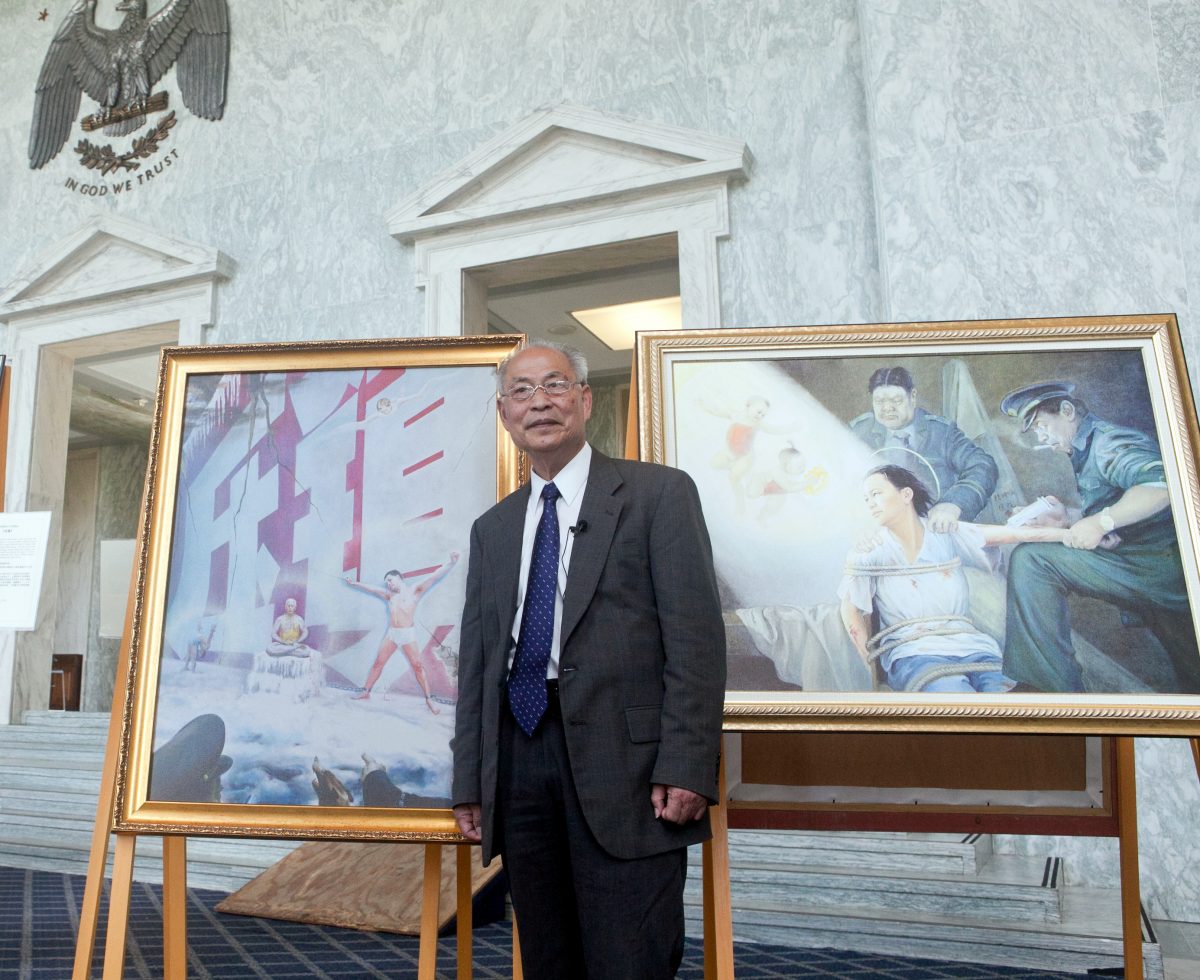
Zhang: My painting “Positioning” expresses the idea that good is rewarded with good. The subject is Tiananmen Square [in Beijing, China]. Falun Gong practitioners are killed … [by the Chinese regime] for defending the universal principles of Truth, Compassion, and Forbearance.
Their main spirit transcends, and many gods welcome them. In higher dimensions, bad gods get sent down and fall into hell. The main spirits of police who persecute them—even their dogs—must go to hell.
My painting “Red Wall” encompasses the totalitarian nature of the CCP [Chinese Communist Party] and also how sacred Falun Gong practitioners are. No matter how strong the CCP is, it will collapse. A BBC independent producer was inspired to make a documentary, “Beyond the Red Wall,” after seeing my painting.
Everyone wants to reclaim the best values for society but can’t do it. After I did this piece, I used my art to rectify society using Buddhist and Taoist thought but I still didn’t have the power, the ideal. Buddhist and Taoist thoughts had not clearly expressed it—it was only a hope. Only after I found Falun Dafa did I have the courage to have an impact with my art. Politicians and media professionals have been changed by my work.
The pursuit of art is a language, an expression of a universal truth. At the beginning, seeking an ability to express myself, I tried many ways—realism, abstractionism, installations, and so on. I tried everything in art history.
I left China to pursue artistic truth. In this process, I discovered that society had already reached its end point. Society is in a vicious cycle it cannot get out of. My installation “End of the 20th Century” expresses that humanity has reached a dangerous point. At McGill University, where it was displayed, a department head said, “This is what we are all thinking about, and your work expresses it.”
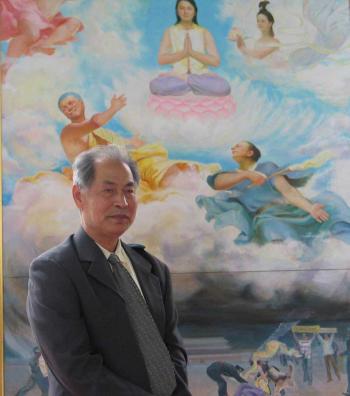
NTDTV’s International Chinese Oil Painting Competition invited Chinese artists to return to what really moves and uplifts the human spirit, according to painter and sculptor professor Zhang Kunlun. The competition, which recognized winning entries on Dec. 12, featured works of figure oil painting, expressing meritorious traditional Chinese virtues and values with classical Western realistic technique. Winning works are exhibited at the Ukranian Center of America in New York. To learn more, visit the Web site oilpainting.ntdtv.com/en/