



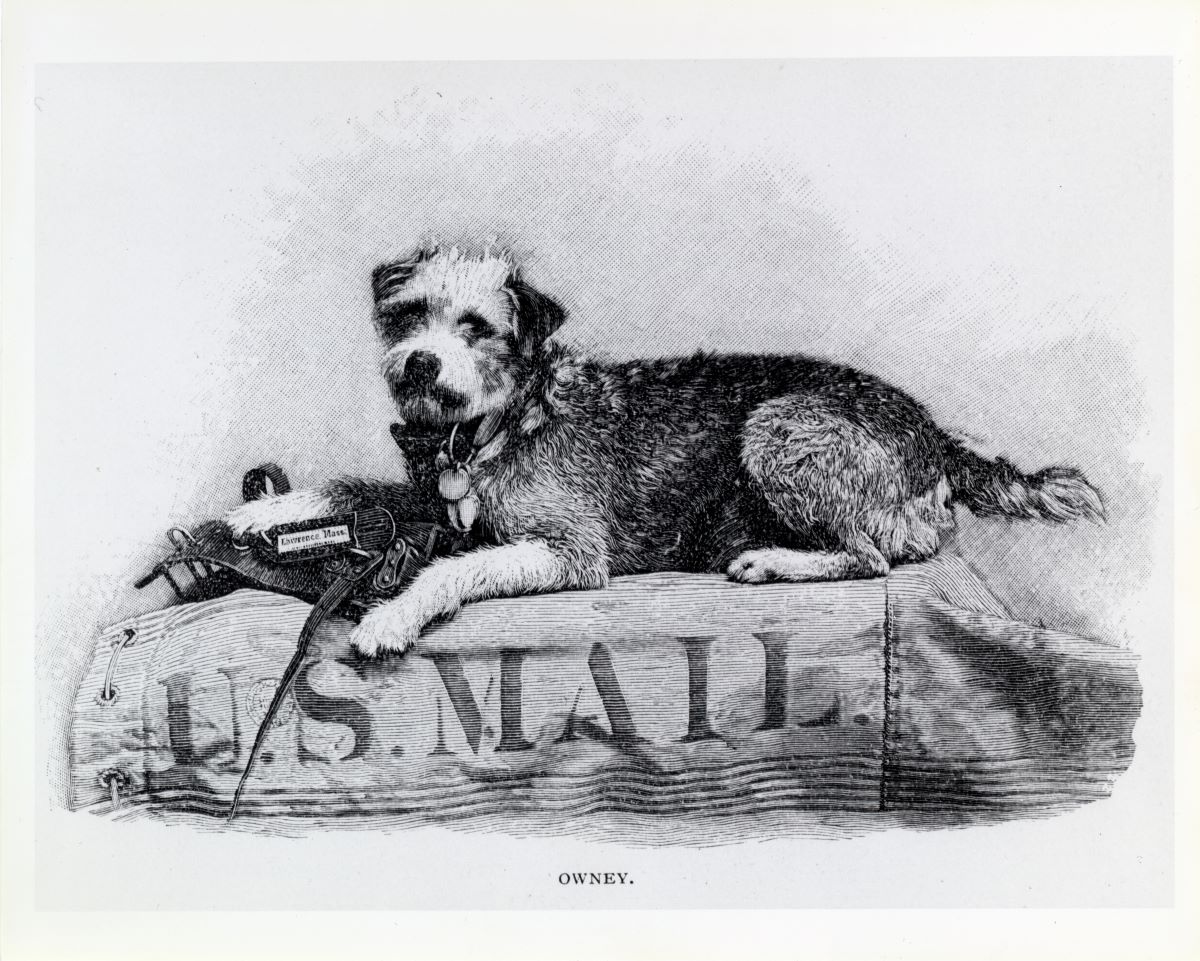
On a cold night in 1888, a bony and bedraggled terrier stray was looking for a place to escape from the rain. He squeezed through the open back door of an Albany, New York postal office and plopped down on a heap of mailbags. The staff discovered him the next day. He sniffed their wool uniforms. Mistaken for the dog of a postal clerk named Owen, he was given the name “Owney.”
That’s one story, at least. Another is that he accompanied a postal clerk to work, who then abandoned him at the station. No one knows exactly how old Owney was when he appeared there, though he was probably born around 1887.
He was not much to look at. An April 1894 edition of the Brooklyn Daily Eagle reported that Owney “would not take the five-hundredth prize” at a dog show.
But while his origins are mysterious and his appearance underwhelming, this mangy mutt’s life would become celebrated and extensively documented.
Unofficial Mail Mascot
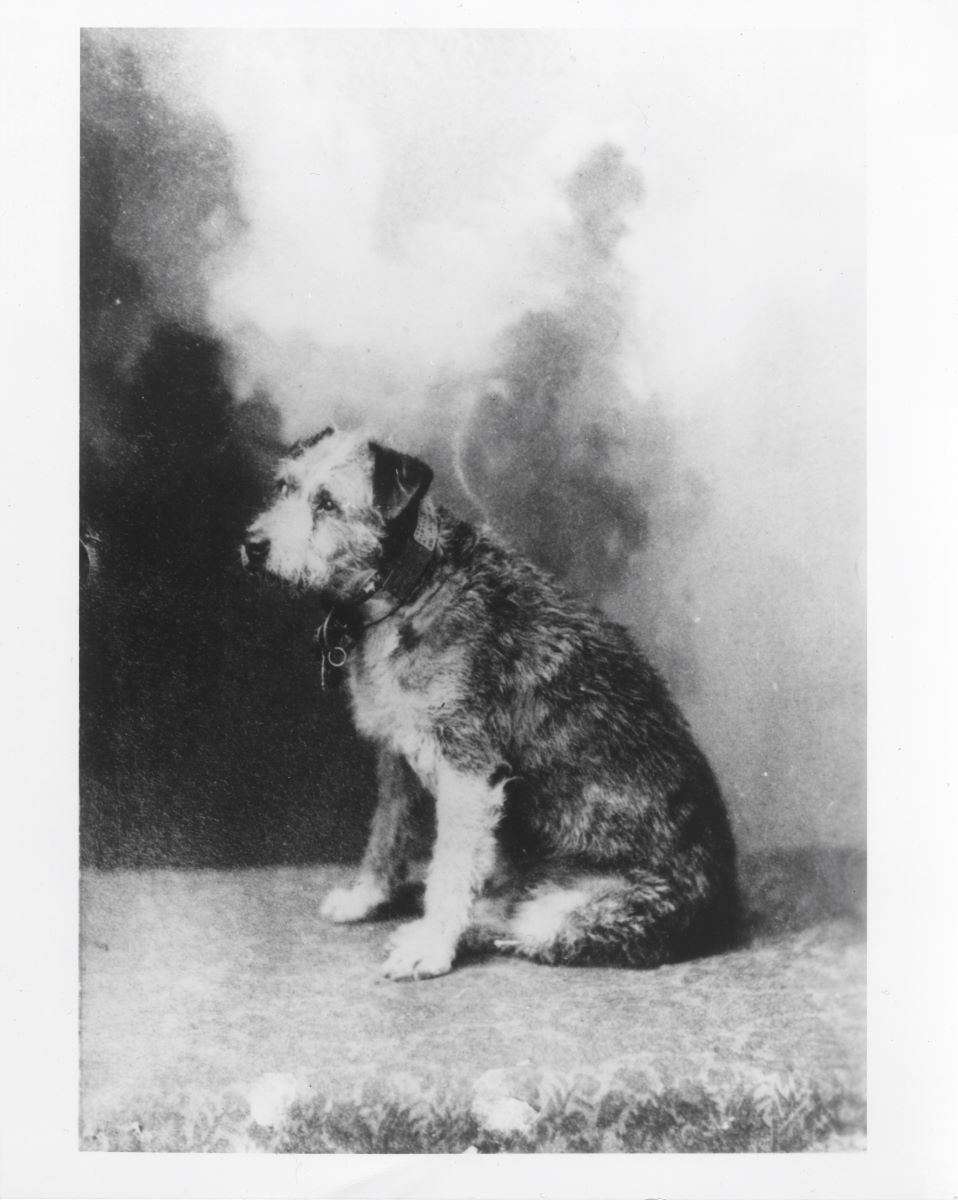
Owney took to his new home at the post office, sleeping on mailbags at first, then following them as they were transported to the train station. Once when a mailbag fell off of a wagon, the driver returned to search around and found Owney guarding it. In one version of the story, the driver wasn’t wearing a uniform and was unable to retrieve the bag from the growling dog until a more official-looking postal worker showed up.
At the train station one day, Owney jumped on a railcar and took off. A few days later, he returned to Albany, but soon left again. Worried he might get lost, the mail clerks gave him a collar with an Albany Post Office inscription.
Train voyages to the next city gradually stretched into cross-country trips. Railway accidents were common in those days, but the trains Owney rode never crashed. He began to be seen not only as a loyal dog, but a good luck charm.
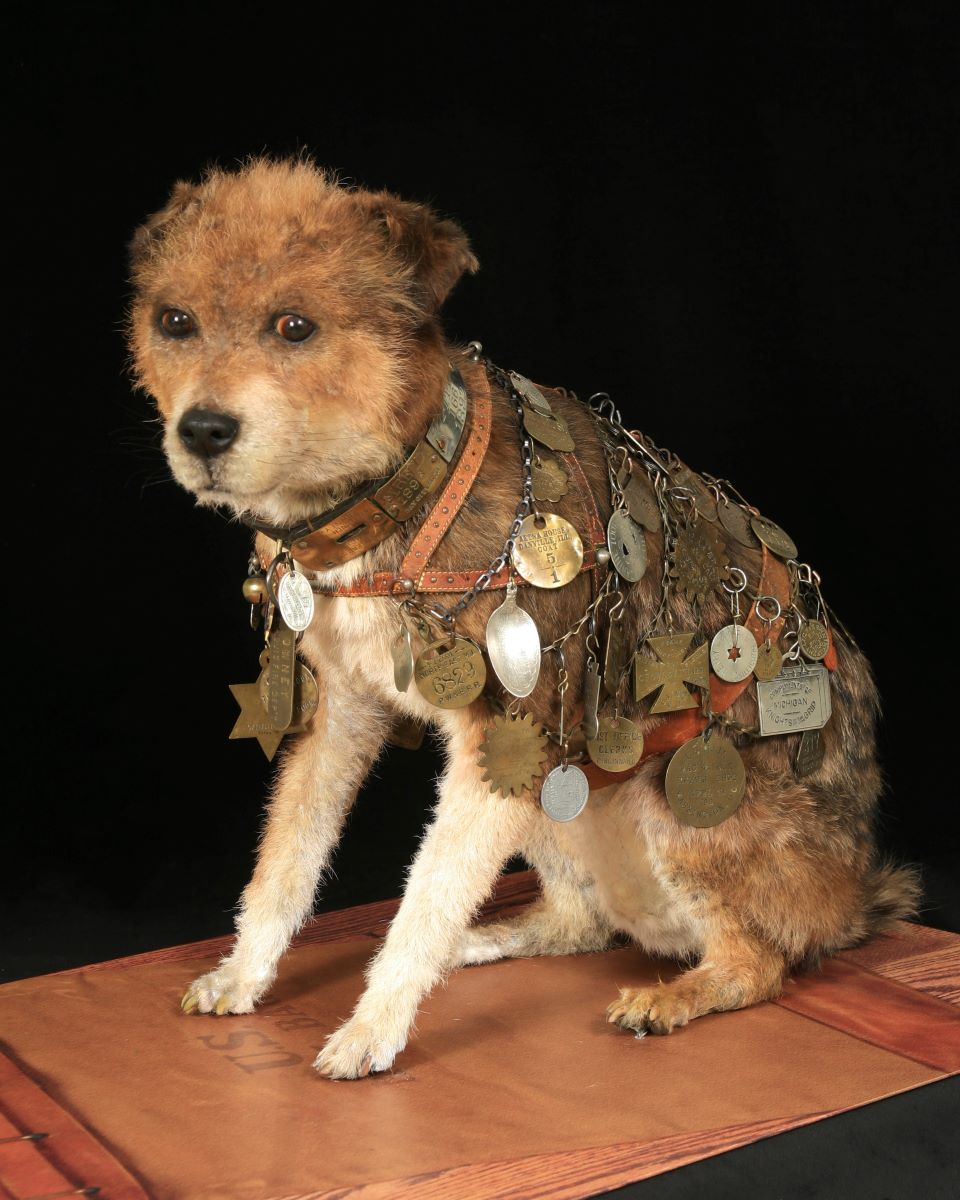
On his travels, postal workers attached baggage tokens to his collar bearing the names of railroads and places he passed through. Then other people started fixing their own tags, coins, and souvenirs. His collar was weighing down his neck, so it was exchanged for a harness to evenly spread his trinkets out. The Brooklyn Daily Eagle wrote that “as he jogged along, they jingled like the bells on a junk wagon.”
Crowds greeted Owney everywhere he went. Newspapers reported on his comings and goings. A column in the Moose Jaw Times, Feb. 15, 1895, gives a typical account of his travels:
“Owney will spend the winter months, as it is his custom, in pursuit of mild adventure on the railroads of the sunny South. He will be a welcome guest of Uncle Sam’s minions at the health resorts of North Carolina, Florida and the Gulf States, lingering for a few days at each of the famous sanitariums, working gradually over the country with the purpose of striking New Orleans during the Mardi Gras festivities.”
Going International
In 1895, Owney embarked on a voyage around the world, leaving Tacoma, Washington, on a mail steamer.
His arrival in Japan initially confused the customs officials. After examining his harness with its huge number of tags, “it was tentatively concluded that Owney must be either a dog of very high rank or the property of some distinguished person.” A few days later, Emperor Meiji presented Owney with a special passport bearing the royal seal.
From Japan, Owney went to China where the Chinese emperor also gave Owney a passport. He made his way over Asia, the Middle East, and Europe, piling up souvenirs from the dignitaries of those nations. After crossing the Atlantic, the world-famous dog was received home with fanfare in New York City.
Tears for a Terrier
A decade of continuous traveling took a severe toll on Owney’s health. The Milwaukee Journal reported that “[h]e has had many a knock in his time and looks it,” noting that he had gone blind in one eye.
In June 1897, he arrived in Toledo, Ohio, and bit a postal clerk who had chained him to a post. The postmaster called for a police officer, who fatally shot the dog. The act sparked national unrest and postal workers everywhere chipped in to quickly preserve Owney’s remains.
He is estimated to have journeyed 143,000 miles in his lifetime—enough distance to circumnavigate the earth almost six times. The National Postal Museum contains 372 of his tags today, though sources during his time claim he received more than 1,000 of them over the course of his travels.
Afterlife of an Underdog
In 2011, the mascot of the U.S. Railway Mail Service was honored with his own postage stamp. That same year, the National Postal Museum featured a special exhibit on him. Owney was even there in the flesh—or rather, in the fur.
After his fatal shooting, a local taxidermist stuffed the terrier with wood shavings, which at that time was used as packing material. This resulted in Owney having a slightly odd shape, especially where his facial features are concerned.
People probably didn’t quibble over these details, though. He drew more crowds than ever, as well-traveled in death as he was in life. In 1904, he left his display at the Post Office Department’s headquarters in Washington, and headed to the World’s Fair in St. Louis, Missouri. In 1911, he was given to the Smithsonian Institution. Fifteen years after that, he was exhibited in Philadelphia for the Sesqui-Centennial Exhibition. He spent almost 30 years in what is now the National Museum of American History before finally moving to the National Postal Museum in 1993.
Owney was restored for his 2011 exhibit: toes fixed, eyes and muzzle reshaped (within limits), missing hair replaced, and touch-up paint applied. He can still be seen at the museum today, garbed in his many medals of honor.
What arts and culture topics would you like us to cover? Please email ideas or feedback to features@epochtimes.nyc
