Traditionally, great art guides us to improve ourselves. Western artists often rendered the repentant Mary Magdalen to encourage others to choose a righteous path.
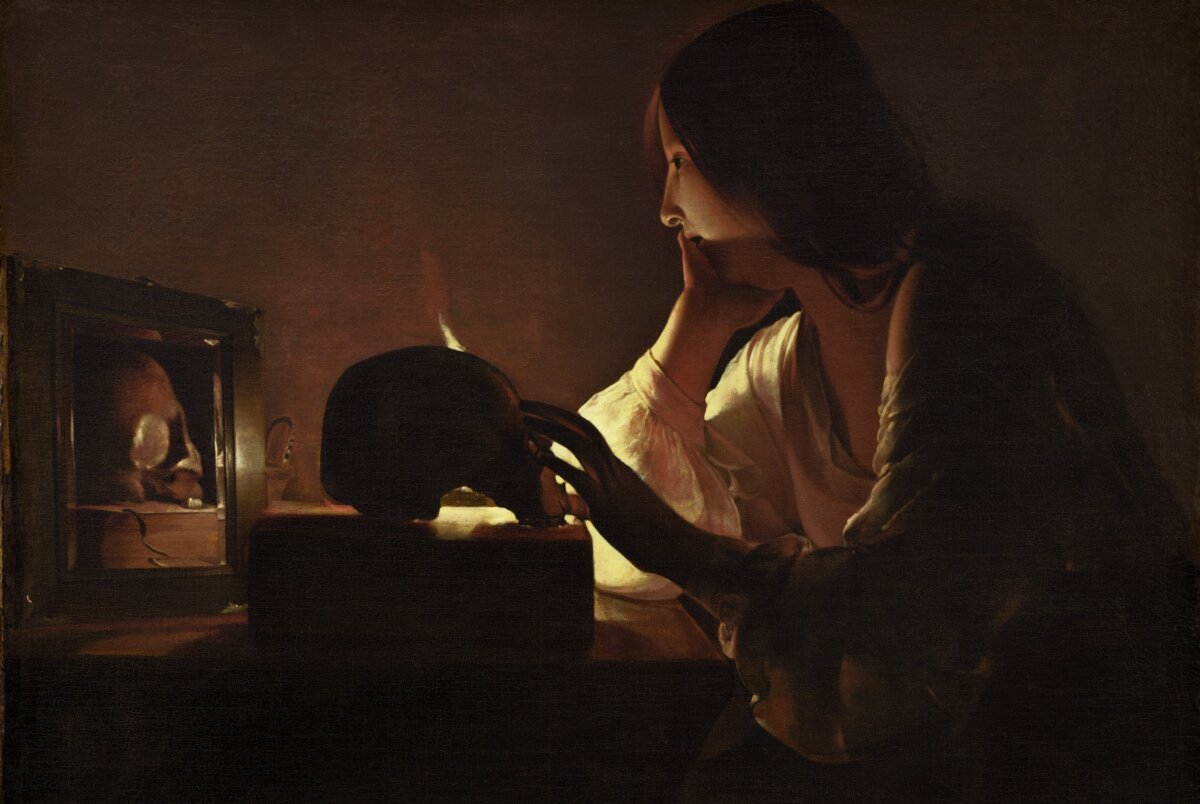
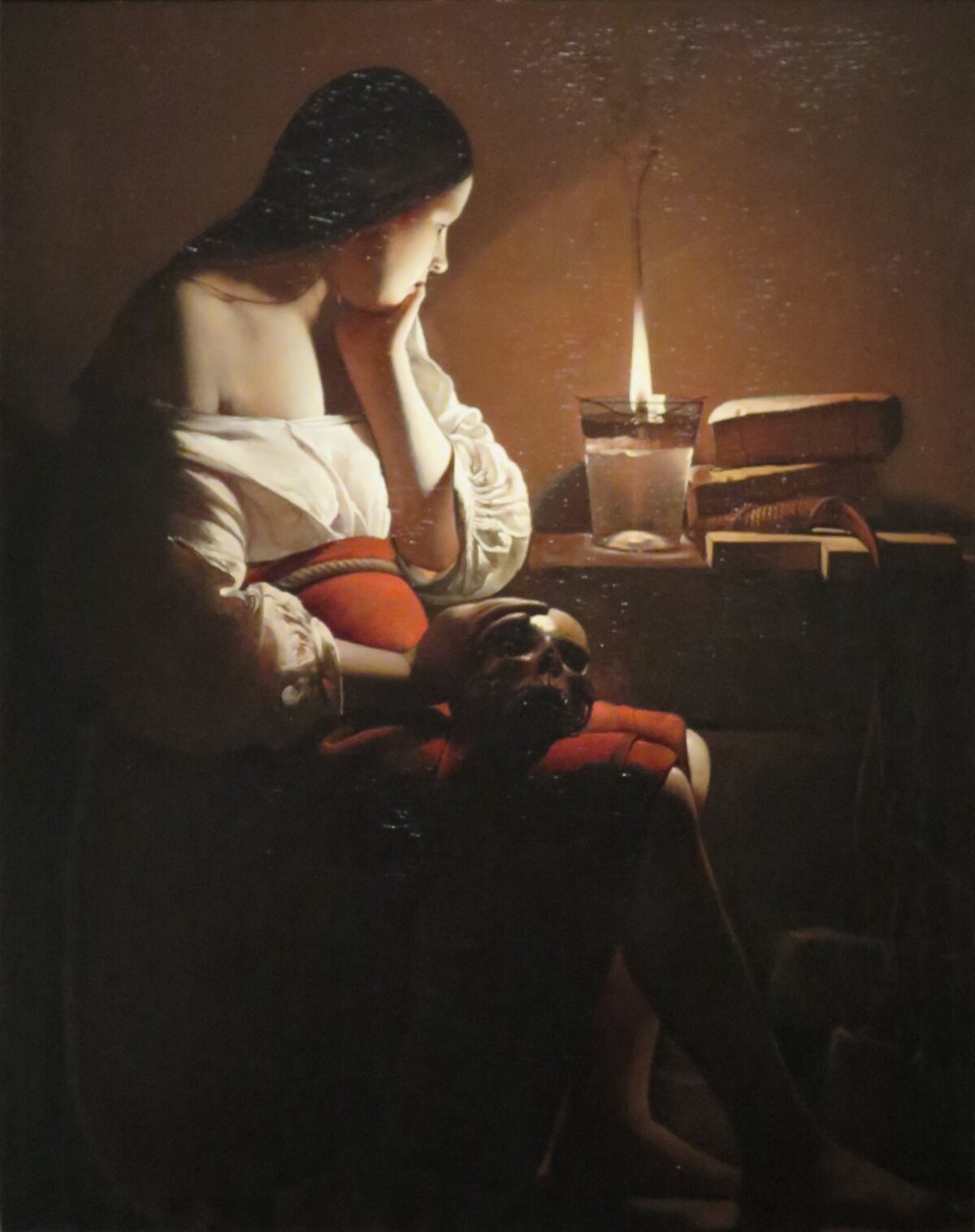
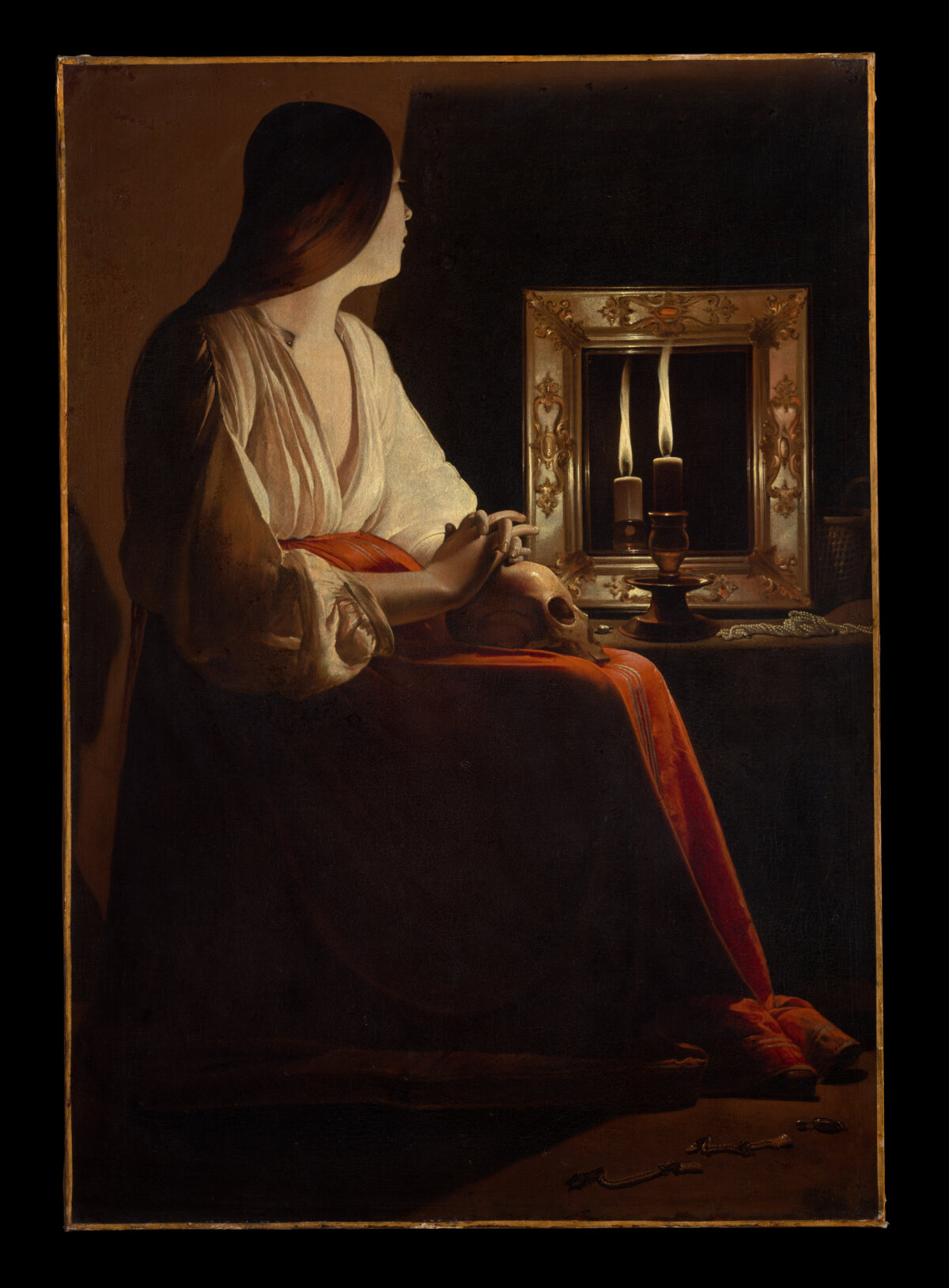
Three paintings in U.S. collections demonstrate how French baroque artist Georges de La Tour effectively illuminated Mary Magdalen’s redemption: “The Magdalen With the Smoking Flame,” “The Repentant Magdalen,” and “The Penitent Magdalen.”
Washington, Los Angeles, and New York
Washington’s National Gallery of Art holds La Tour’s “The Repentant Magdalen.” In this work, candlelight illuminates Mary’s profile as she sits at a table. La Tour also used the candlelight to draw the viewer to Mary’s left hand, which rests on a skull and a book, possibly Scripture, on the tabletop. A mirror represents vanity, and the skull represents mortality. La Tour reflected the skull in the mirror, perhaps hinting that Scripture is only available in one’s lifetime and that death will come to us all. These were popular motifs in vanitas paintings, reflecting the transience of life.

La Tour rendered a contemplative Mary in “The Magdalen With the Smoking Flame,” at the Los Angeles County Museum of Art (LACMA). LACMA describes as her sitting beside a table with books of Scripture and scourge, and a skull on her lap. She fixes her attention on the smoking, flickering candle flame. The flame “emits the light that followers of St. John of the Cross called ‘the living flame of love,’ toward which spiritual pilgrims are drawn out of the ‘dark night of the soul.’”
The skull and mirror recur in La Tour’s “The Penitent Magdalen,” at New York’s Metropolitan Museum of Art. La Tour’s candlelight sets the scene aglow and expertly highlights the objects and textures. The soft folds of Mary’s blouse, the heavy weight of her skirt, and how she rests her hands on the skull all indicate the weight of the human realm. She gazes at the flame reflected in an ornate gilded frame, as if meditating on her repentance. A knotted string of pearls on the table alludes to purity and wealth.
Georges de La Tour
In the 17th century, those in the highest echelons of French society—Henry II of Lorraine, the Duke de La Ferté, and Cardinal Richelieu—collected La Tour’s genre and religious paintings. Around 1639, La Tour acquired the title “painter in ordinary” (the king’s painter) from King Louis XIII.
Louis XIII famously removed all paintings from one room, just so he could see La Tour’s painting “Night Scene With St. Sebastian” on its own. The location of the painting is now unknown.
La Tour’s work fell into obscurity until 1915, when German art historian Hermann Voss confirmed the artist’s body of work. The chronology of the work is debated, mainly because of the many unsigned works and that most of his paintings perished in a fire.
Experts generally divide La Tour’s work into daylight genre scenes painted around 1630 and intimate candlelight scenes that he painted late in his career, around 1645.
Caravaggio most certainly influenced La Tour’s candle and torchlight scenes. But whether he saw the Italian’s work in Rome or indirectly through Caravaggio’s northern followers, such as Gerrit van Honthorst (1592–1656) and Dirck van Baburen (circa 1595–1624), is unknown. Both Honthorst and van Baburen lived in Utrecht, in the Netherlands, and developed their own version of Caravaggio’s style. According to LACMA, La Tour was influenced by another of Caravaggio’s followers, Jean LeClerc (circa 1587–1633), in the French duchy of Lorraine, where La Tour lived.
La Tour differs from Caravaggio’s dramatic lighting technique in that he used simpler, rounded figures and delicate lighting, giving his works an introspective effect. His quiet candlelit dramas also belied the era’s characteristically flamboyant and expressive art style.
According to “The Oxford Companion to Art”: “In his own way [La Tour] is considered to represent the spirit of 17th-century French classicism no less than Phillip de Champaigne and [Nicolas] Poussin in their different fields.”
La Tour’s candlelit scenes of the repentant Mary Magdalen highlight her steadfast faith and remind us that it’s never too late to repent.
What arts and culture topics would you like us to cover? Please email ideas or feedback to features@epochtimes.nyc.