As soon as the 100-pound bale of hay toppled from a stack high above and hit her back, Lauren Barwick knew. Everything going forward would be different.
It was the 22-year-old’s second day working at her dream job at a Canadian ranch training horses for work in commercials and film. And in one cruel instant, everything had changed. As she screamed for help from the barn floor, unable to move, she knew. She was paralyzed.
But what she couldn’t know yet was how the catastrophic injury would make a way for her to reach even greater levels of success than she’d ever imagined—not only in riding competitions, but also in her ability to teach, inspire, and empower other horse enthusiasts around the world to overcome problems and communicate better with their 1,000-pound partners.
Growing up in British Columbia, Canada, Barwick passionately pursued sports, competing successfully in equestrian disciplines, cross-country running, and skiing.
Horses made up the biggest part of her life. She knew them, understood them, and would confidently climb aboard animals too challenging for others. And she dreamed of working with them in movies.
Then, after a successful internship, she accepted a job at the same ranch that would allow her to pursue that dream. It was day two when she went to collect hay from a massive barn where bales were stacked high like a tower of Jenga blocks.
Determined to dislodge one from the top without asking for help, up she climbed. The stack teetered. She jumped. As she landed 10 feet below in a crouch, a falling bale slammed into her back, knocking her flat.
“I felt nothing,” she recalled 25 years later, telling the story to The Epoch Times at a picnic table under a sprawling oak on her Florida farm. “I grabbed my legs and felt nothing. It was just an instant, and it severed my spine.”
The falling bale hit with thousands of pounds of force, she was told later. It took 10 minutes for anyone to find her. Fellow workers heard her cries and, assuming that she’d been attacked by an aggressive stallion, ran to another barn full of horses.
Her spine was crushed, but her spirit wasn’t. As she was carried toward an ambulance, she quipped: “I’ll be back tomorrow.
“But just so you know, I haven’t fed the buffaloes yet.”
Road to Recovery
For months, Barwick struggled through physical therapy, desperately hoping to regain the use of her legs. It wasn’t to be.
“You know your horse is out there waiting for you,” her mom urged one day.
Barwick had been avoiding horses. But this time, she rolled outside toward the paddock fence. And there was her horse, her friend. Waiting.
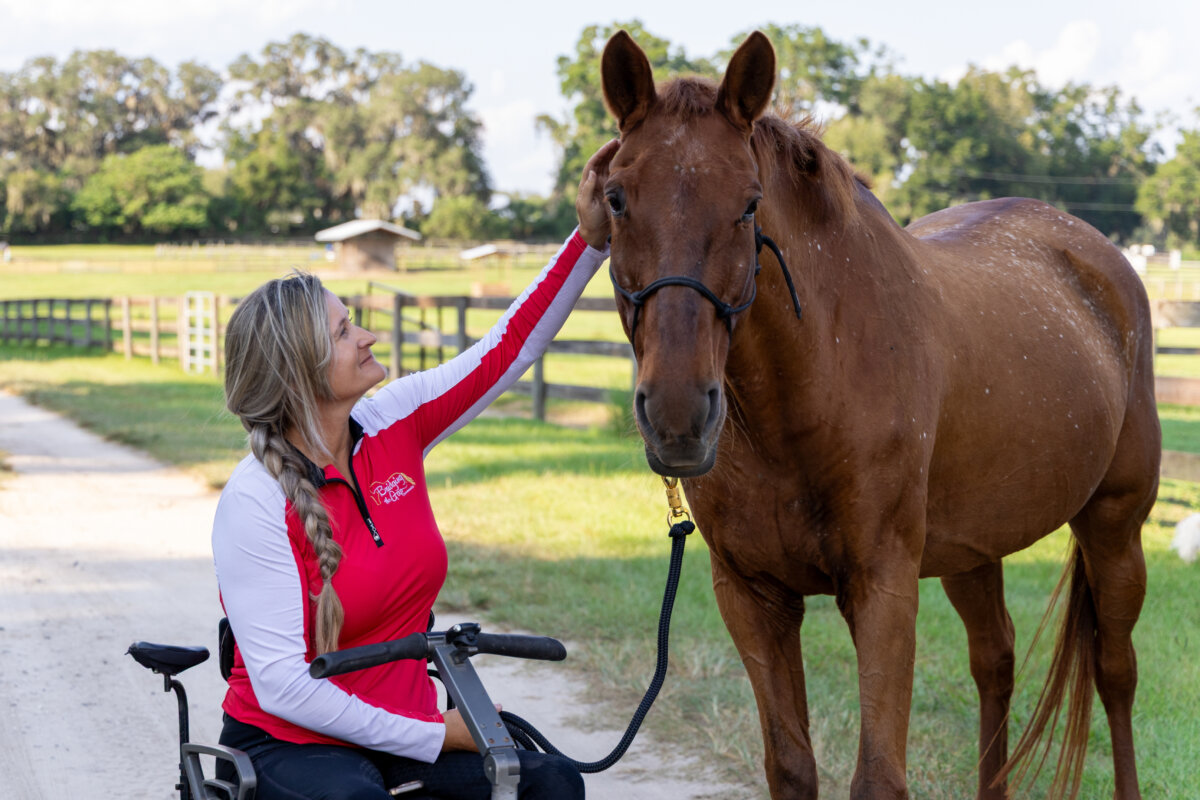
Instead of backing away from the unfamiliar wheelchair, the mare stretched out her velvety nose and nuzzled her former rider’s legs.
“[It] made me cry,” Barwick said. “A lot. It was like she knew.”
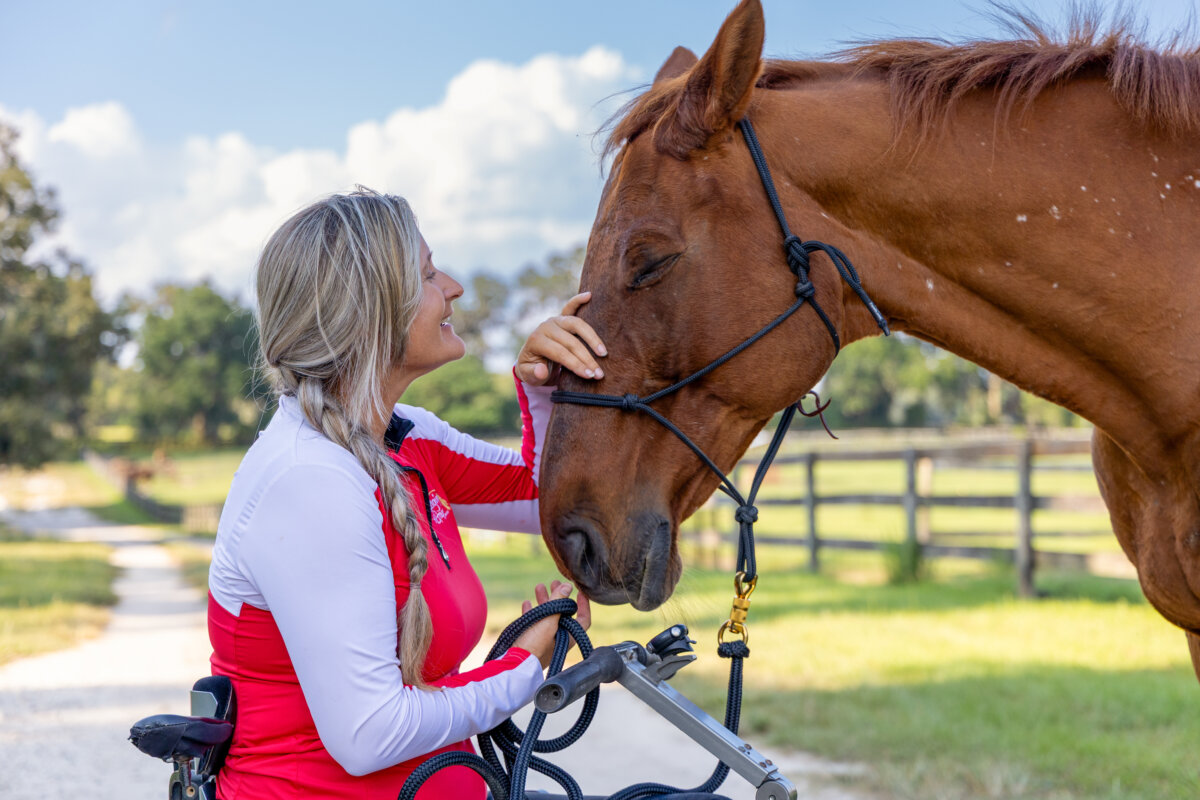
She reached up and slipped a halter onto her horse’s face and rolled forward, leading the animal, known around the barn as Peanut, out of the pasture.
For Barwick, riding had always been about more than just sitting on a horse’s back and being carried. It was about developing a partnership.
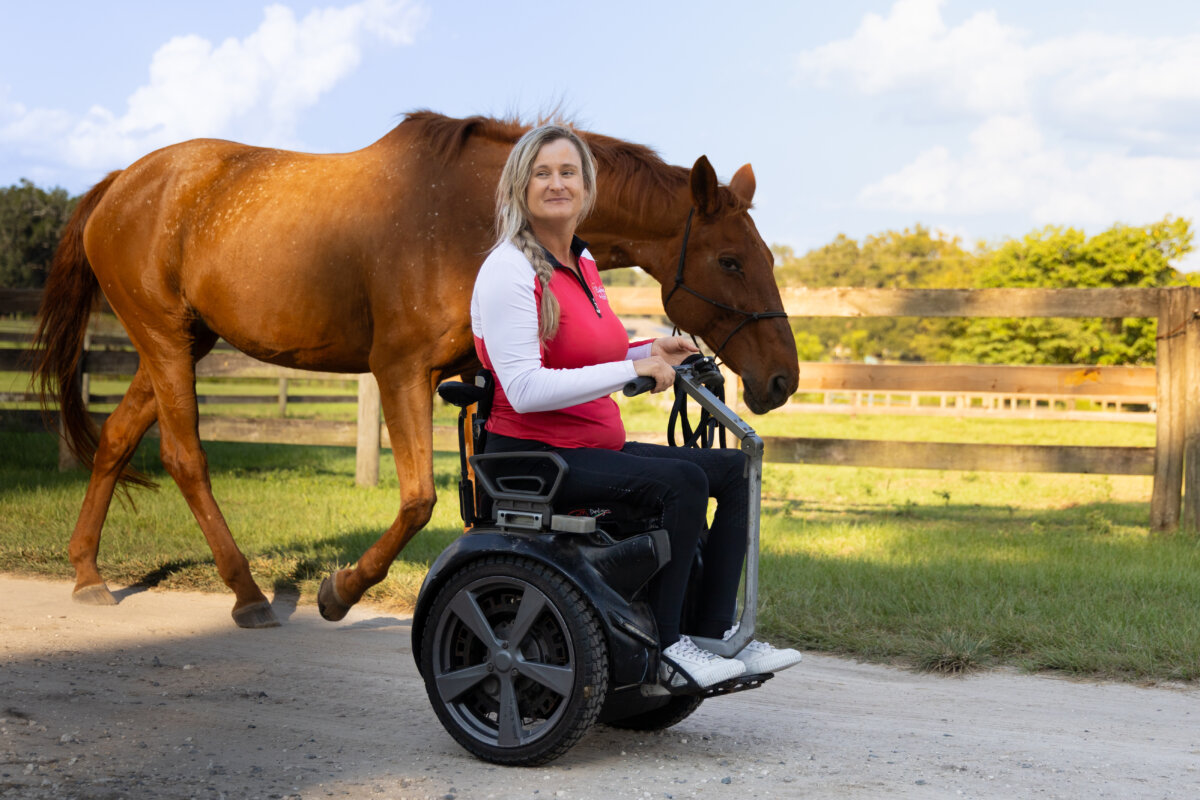
She asked her old friend to back up. The mare did. She motioned for her horse to circle around the wheelchair. The mare did that, too. Eventually, Barwick urged the mare to pull her along in her wheelchair, as if she were riding in a chariot.
But riding—really riding—seemed impossible now. At least the way she wanted to ride.
Barwick’s mother urged her to try “therapeutic riding,” a practice that allows people with a range of physical, emotional, mental, or developmental disabilities to experience the healing benefits of being carried by a horse. Therapy horses often travel no faster than a walk, and riders often are steadied by helpers walking next to them.
Barwick flatly refused.
“There will be nothing therapeutic about that for me,” she said. That would only bring more pain, she told herself.
She’d always been the one who helped others who were struggling with their horses. Her mom would proudly offer: “I’ll put my daughter on. She can ride anything.” Barwick couldn’t accept riding with assistance now.
Choosing a New Way Forward
One day, as she watched riders and horses moving in partnership, feelings of loss overcame her. She wept uncontrollably and began to wheel herself away. But friends intervened. And moments later, they were lifting her onto the back of a horse.
“It was my worst nightmare come true,” Barwick said. “There I was, slouched over the saddle with absolutely no sensation of sitting on a horse and being led around the ring.”
That night, she thought about what had happened. She contemplated how she could move forward. Then she realized that she had a choice.
“I couldn’t say in the future, ‘Well, you know, I broke my back so I couldn’t ride,'” she said. “That had been proven untrue. Now I’d have to say, ‘I broke my back, and I choose not to ride.’ And I wasn’t willing to live with that statement.”
She returned to the barn the next day with fierce resolve. And she rode—slouched at first, but with increasing strength and balance with every daily attempt. Friends at her barn helped, experimenting with ways to secure her in the saddle so that she eventually could ride unassisted.
Climbing to the Top
As her confidence and skills grew, people participating in para-equestrian sports—riding competitions for people with disabilities—encouraged her to get involved. She refused.
“I wanted nothing to do with the Paralympics because I didn’t want to be put in a category with a bunch of other paralyzed people,” Barwick said. “I didn’t know it was parallel to the Olympics.”
The Paralympic Games follow each Olympic competition, using the same facilities and attracting top athletes from around the world.
Barwick learned that people with a range of impairments compete in para-equestrian sports through the highest levels, including in dressage. That sport—named for the French word for “training”—showcases horses and riders practically dancing together in complicated routines scored for accuracy and beauty.
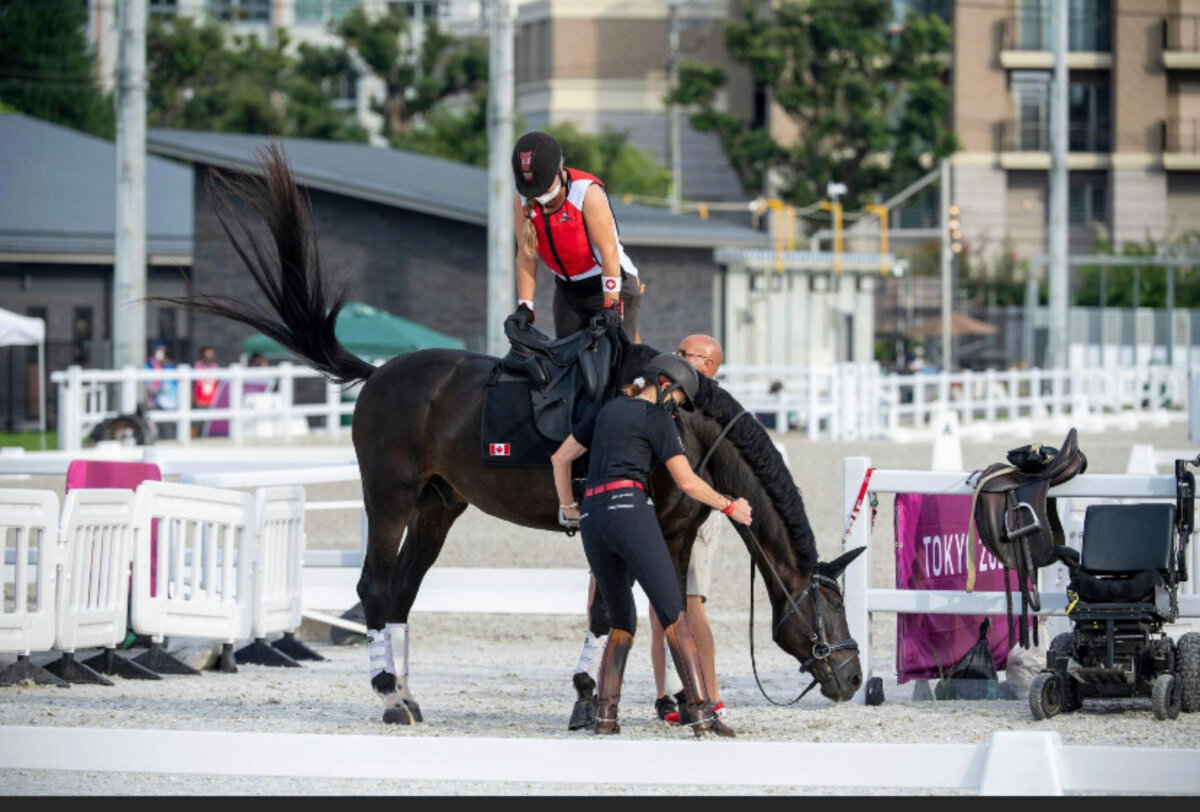
Para-riders are classified based on five levels of impairment. They compete against riders at a similar disability level. Grade I riders have the most impairment. Barwick, who is paralyzed from the waist down, was classified for years as Grade II. After rule changes, she’s now considered a Grade III rider.
To help her train for competition, a handle was added to the front of her saddle to help her mount, dismount, and steady herself. Leg straps were added to help steady her legs. She learned to cue her horse with her voice. She also learned to signal commands with gentle taps on the horse’s body using two slender sticks, one in each hand.
Just four years after her accident, Barwick represented Canada at the 2004 Paralympic Games in Athens, Greece.
Being a good enough rider for a top international competition such as that is only one of the challenges, said Eleanor Brimmer, a para-equestrian athlete and president of the United States Para-Equestrian Association.
“You have to have the talent, funding, equine partner, and team around you to be able to compete at the highest level,” Brimmer told The Epoch Times.
Barwick finished sixth and seventh at the Paralympic Games that year. Leaving without a medal only made her more determined.
Best in the World
To learn more about her sport, she attended a seminar taught by American Pat Parelli, one of the world’s most famous horse trainers. For more than 40 years, he’s taught people around the world to communicate and “connect” with their horses in a method that builds on trust. It’s known as “natural horsemanship.”
There, Barwick made another life-changing decision.
“She rolled down the hill after it was over, introduced herself, and asked me if I could help her get to the next Paralympics and win gold,” Parelli told The Epoch Times.
“And I said, ‘First of all, what makes you think I’m the right person to help you? And second of all, what would make me think that you’re the right person that I could help?’
“So that’s how it started. She just said, ‘Well, I know I can do it.’
“I said, ‘Well, then, you have to prove it to me.’”
During what amounted to a two-week-long interview at Parelli’s farm, Barwick helped with work and rode horses with able-bodied riders, sometimes over craggy mountain terrain. It was nothing like the riding she’d been doing in closely monitored arenas. For Barwick, for the first time in a very long time, it felt like … freedom.
It’s expensive to sponsor a Paralympic hopeful, and the demands of a horse show campaign to qualify would take a huge time commitment. Parelli needed to know that she had grit, he said. And he needed proof of three things: Was she a good enough rider? Was she a good enough student? And was she a “show person” with “the brain for competition”?
“The two weeks she came down, she proved it all to me, and we went forward from there,” he said.
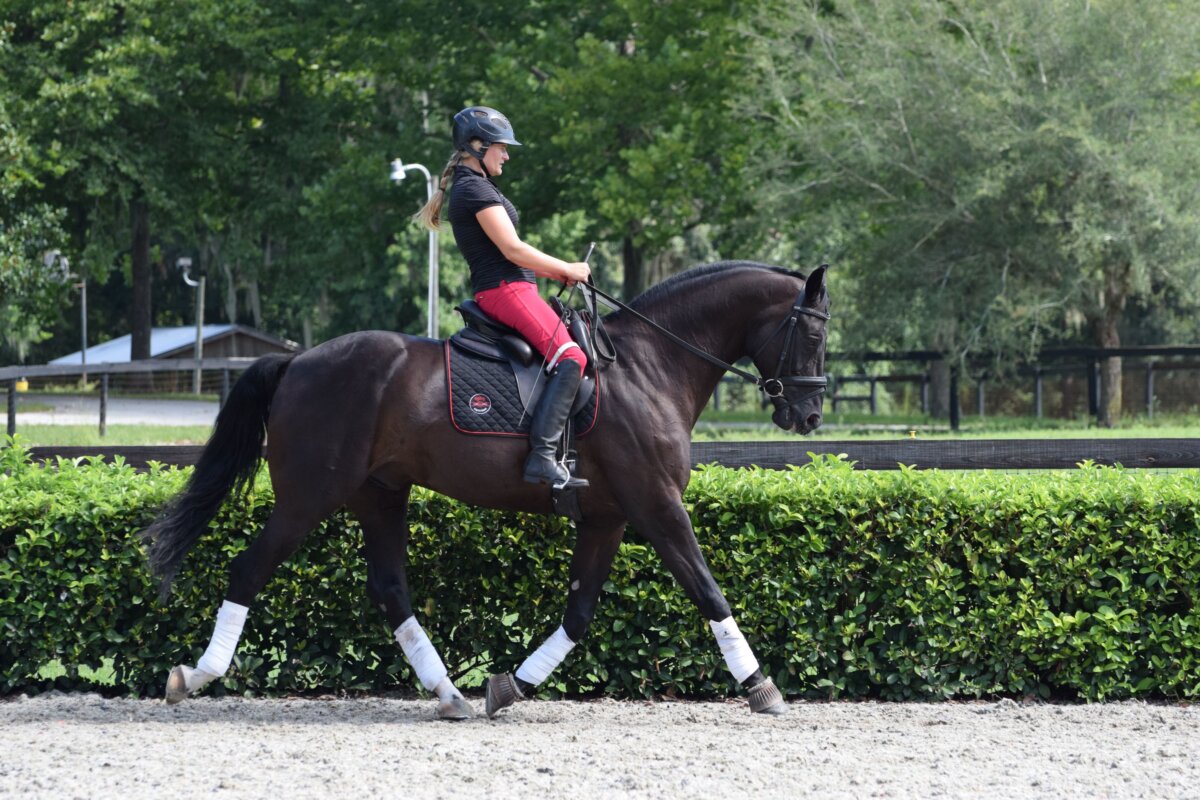
Parelli wasn’t surprised that, from her wheelchair, Barwick could excel as a horsewoman and a teacher of other horse enthusiasts. It didn’t matter that the horses towered over her as she sat in her wheelchair.
“The wheelchair’s just a harness,” Parelli said. “Freedom is learning to move freely within our own harness. We all have our own harness.”
His sponsorship covered the costs and provided the high-quality horse needed for competition. And after a slew of successful horse shows, she earned a slot on the team bound for the 2008 Beijing Paralympic Games. There, judges scored her dressage test high enough to win a silver medal. In the freestyle competition performed to music, she and her dancing horse, Maile, earned the gold.
In 2012, with another sponsor’s help, Barwick competed in the Paralympic Games in London, riding a horse called Off to Paris. They finished sixth and eighth.
Two years later, Barwick earned silver for her freestyle and bronze for her individual test at the 2014 World Equestrian Games in Cannes, France. The International Equestrian Federation ranked her as the best para-rider in the world.
Eyes on LA
Meanwhile, she’d purchased land in Reddick, Florida, and, with her father’s help, built a training facility one fence post at a time. Then, in 2013, the brother of one of her students flew in from Sweden to learn from her. Fabian Brandt was a professional dancer with a desire to work in horse training.
Soon, he and Barwick found that their shared love of horses had forged an even deeper connection between them.
In 2025, they celebrated 10 years of marriage and are now parents of two budding equestrians: 8-year-old Viola and 3-year-old Braxen.
But as life changed, one thing remained constant: Barwick’s determination.
She rode again at the Paralympics in Rio de Janeiro in 2016, earning sixth and seventh place in her divisions on Onyx. And she competed in Tokyo’s rescheduled Paralympic Games in 2021 on Sandrino, placing sixth and ninth.
Onyx is retired now. And Sandrino, now available to her through a lease, isn’t capable of competing at the Olympic level anymore because of an old injury she doesn’t want to push.
Barwick holds out hope to compete at the 2028 Summer Paralympics in Los Angeles. She’ll need a sponsor to help cover bills, she said, and a very special horse. But she’s learned to never think of anything as impossible.
She hopes that someone who would enjoy the thrill of chasing an Olympic dream will come forward to help and join her “on the journey.”
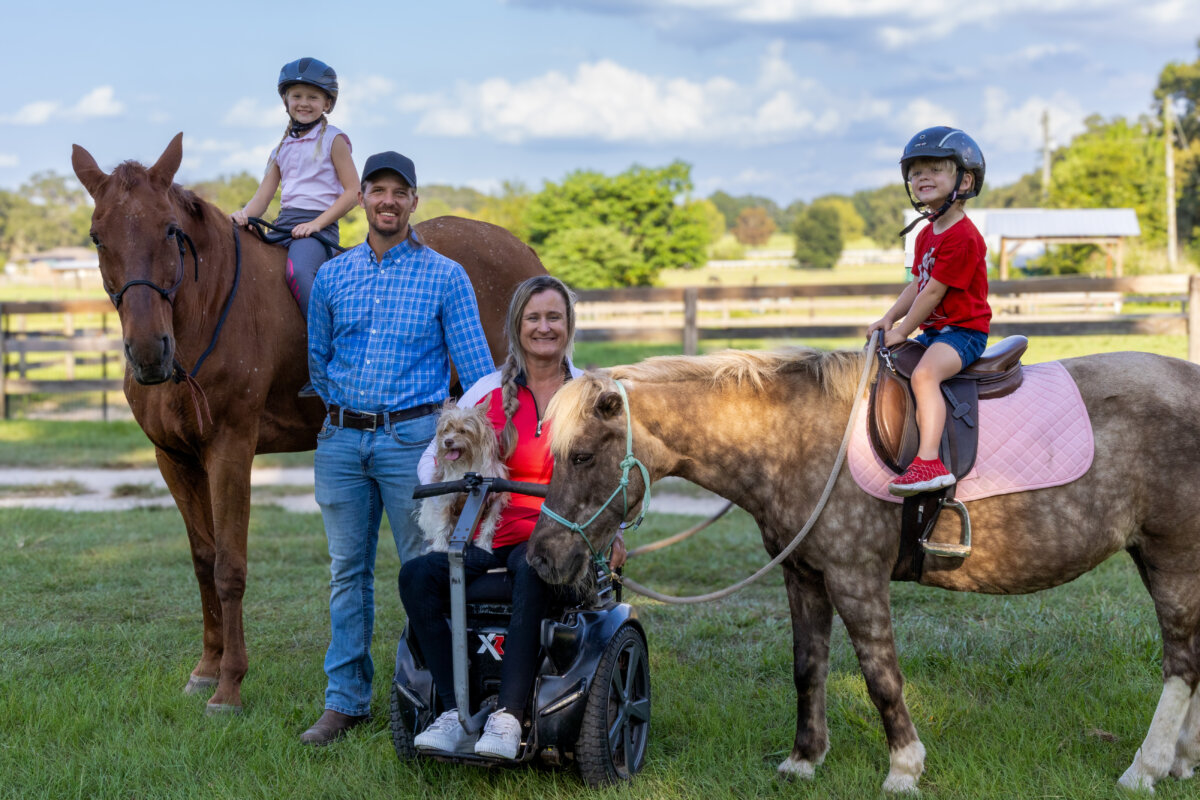
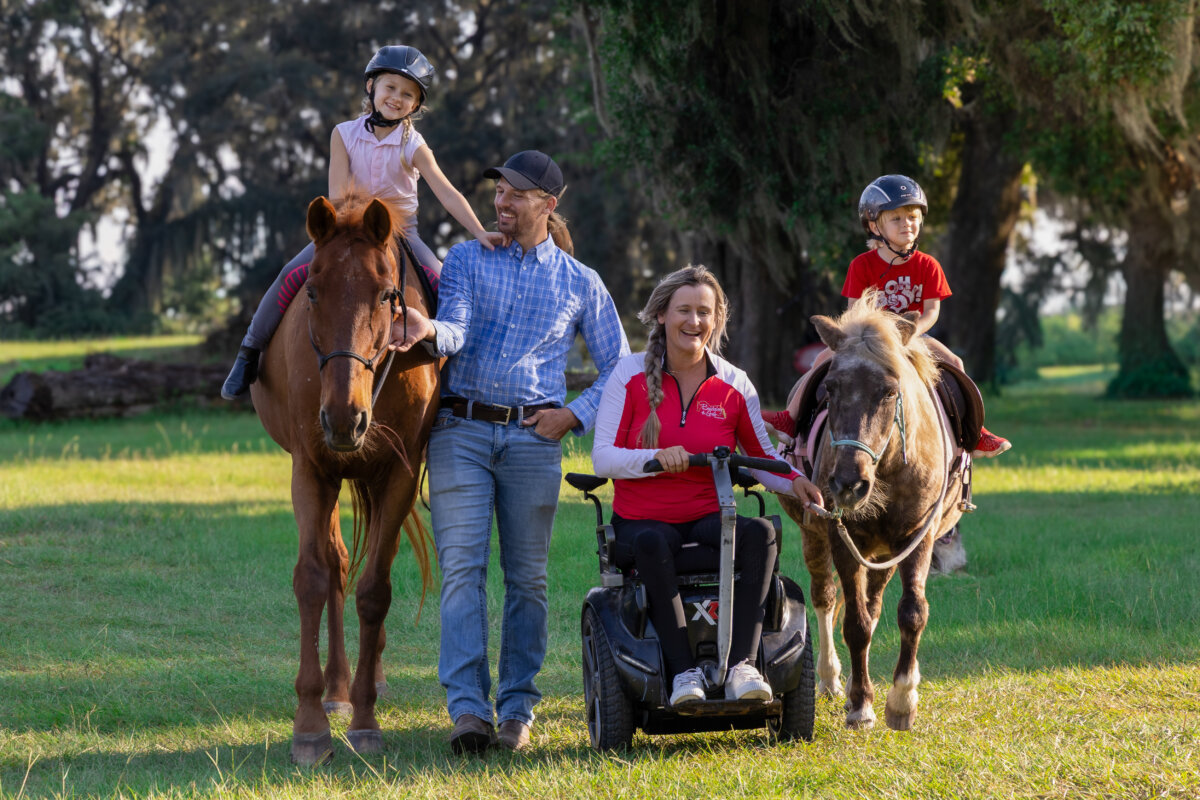
Meanwhile, she continues to appear with Parelli at some of his seminars. Watching her establish a bond of trust and communication with a horse from her wheelchair inspires others, he said.
“You can train a dog with a pork chop, but horses are the opposite,” he said. “You can’t bribe them into behavior. People think they can, but they can’t. So we’ve got to teach people how to get horses to want to connect with them. That’s what Lauren learned—how to have that connection, that bonding. That’s where it starts.”
Even barn manager Franky Muller is amazed by how Barwick cares for the farm’s horses and does chores just like everyone else, as well as how she’s back to riding the difficult animals that cause other riders to struggle.
Barwick mystifies those around her every day, according to Muller.
“We forget how disabled she is because she is so able,” he said.
Barwick shrugs it off when people call her “an inspiration.”
“I would prefer to empower people, because empowering gives them a pathway,” she said. “Inspiration goes away after a week.”
The goal, she said, is to be “the best” you can be in the situation you’re in that day.
She’s quick to point out that life is full of challenges. For everyone.
The real question, she said, is: “How do you figure out how to get through them and come out on the other end with a smile on your face?”