



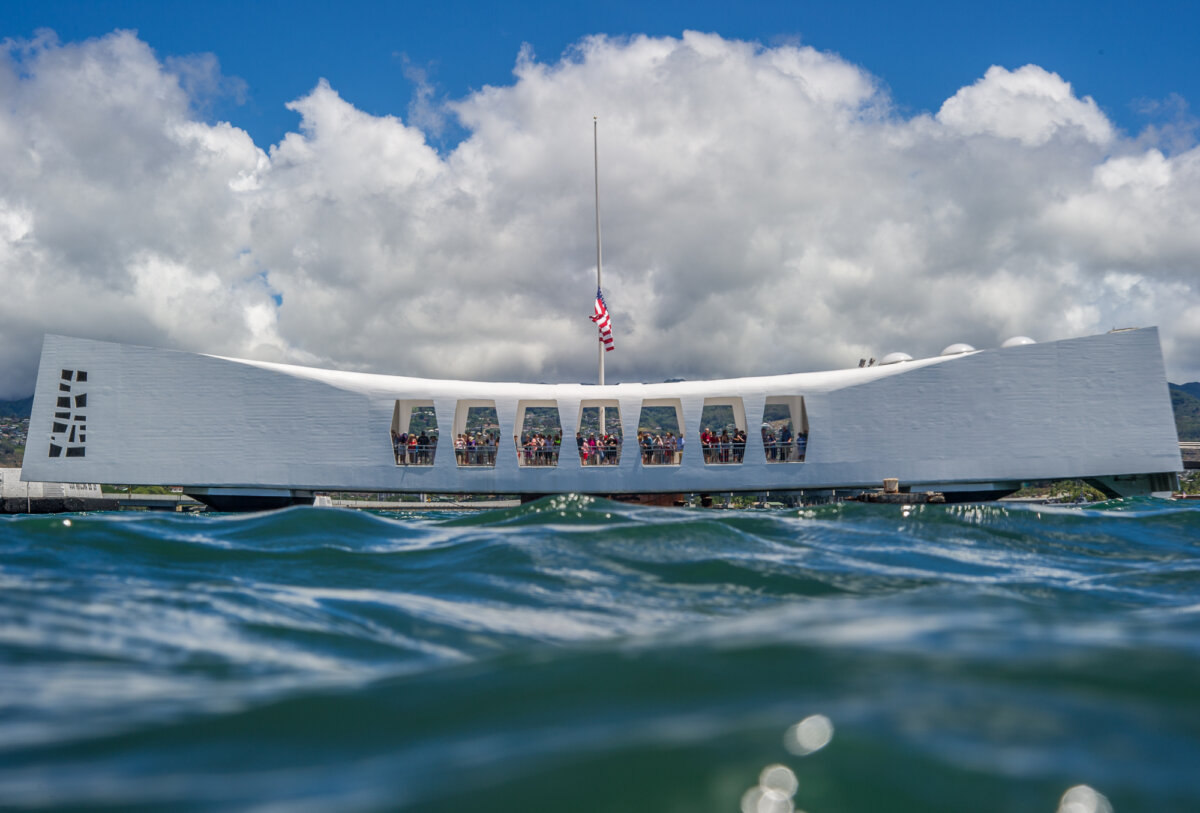
At the ripe old age of 103, Ken Hartle had lost count of how many times he’d cheated death. Hartle was fond of retelling many of these tales; he could recount surviving rattlesnake bites and scorpion stings, sailing accidents, car crashes, multiple broken bones, colon and prostate cancer, and sextuple cardiac bypass surgery.
There was, however, one memory he avoided sharing—his harrowing diving missions to retrieve the bodies of the fallen sailors at Pearl Harbor.
The Attack
At 6:45 a.m. on Dec. 7, 1941, the USS Antares spotted a Japanese submarine and notified the destroyer USS Ward, which was patrolling outside the entrance to Pearl Harbor. The Ward attacked and sunk the submarine.
The attack was reported to command, but no alerts were issued. At 7:15 a.m., Oahu radars detected a large flight of planes heading for Honolulu. The incoming Japanese air raid was mistaken for a returning flight of B-17s, and radar operators were told not to worry.

At 7:55 a.m., the attack commenced. Taken completely by surprise, both the USS Oklahoma and USS Arizona were sunk within 20 minutes. A Japanese armor-piercing bomb ignited the USS Arizona’s powder magazine creating an explosion powerful enough to lift the ship into the air and rip it in half.
Because the fleet had recently been moved to Pearl Harbor from California. The majority of the Arizona’s crew was on board for operational readiness. As both ships were not completely manned at the time of the attack, 429 of the 1,353 crewmen on the USS Oklahoma and 1,177 of about 1,500 on the USS Arizona were lost.
At 8:55 a.m., a second wave of Japanese planes arrive and were met with more resistance. The attack continued until 9:45 a.m., and, before the last Japanese planes had gone, rescue divers were already in the water. The Japanese estimated the success of the attack would cripple the U.S. Navy for six months. They grossly underestimated the speed with which all but three of the 21 ships would be restored.
The Call to Arms
Mare Island Naval Shipyard in Vallejo, California received the first stateside news of the attack. As the Navy’s oldest Pacific shipyard, it subsequently became a crucial submarine port and part of the largest ship-building complex in the world at its peak. It was also where Hartle had been working as a civilian shipwright.
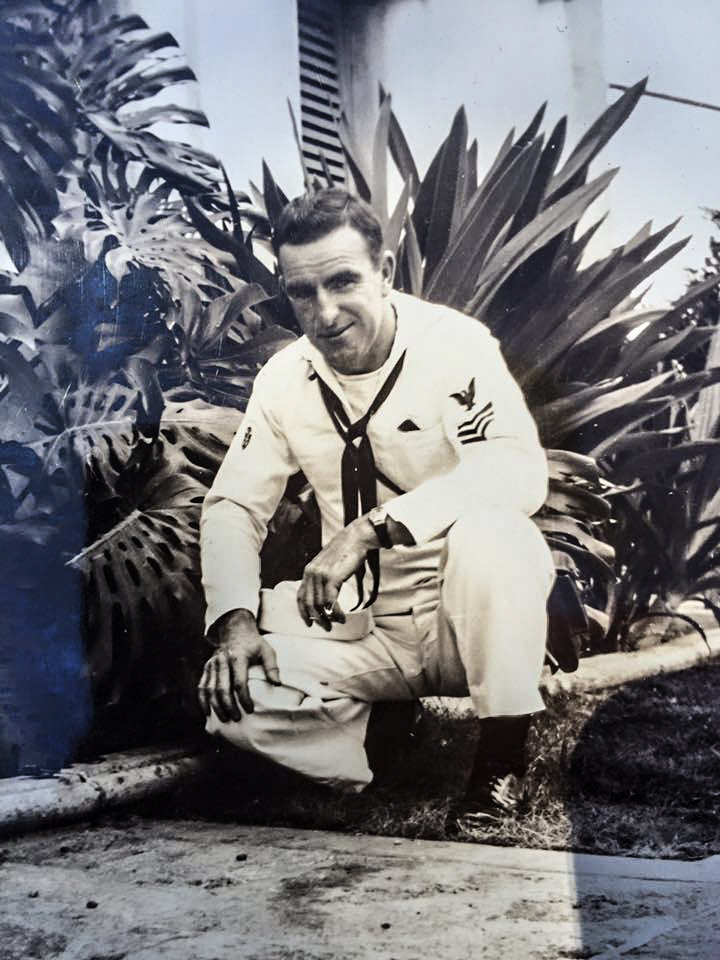
Though he was eager to enlist, the Navy felt he was too essential to release. Over the next four years, the civilian crews of Mare Island would repair more than 1,200 vessels; 17 submarines and 31 destroyer escorts were also built there. Among this inventory were several of the ships damaged at Pearl Harbor, as well as the USS Indianapolis which would carry the first atomic bomb to Hiroshima.
Hartle was determined to enlist. He took several extended vacations, forcing his superiors to constantly find replacements; he made his point clear and was allowed to enlist. After completing boot camp at Camp Perry in Virginia, Hartle was sent to Gulf Port, Mississippi, part of the 105th Naval Construction Battalion, also known as “Seabees,”
When word traveled throughout the service that the Navy was in need of salvage divers, he quickly volunteered. His only previous diving experience had been scuba diving with friends.
Suiting Up
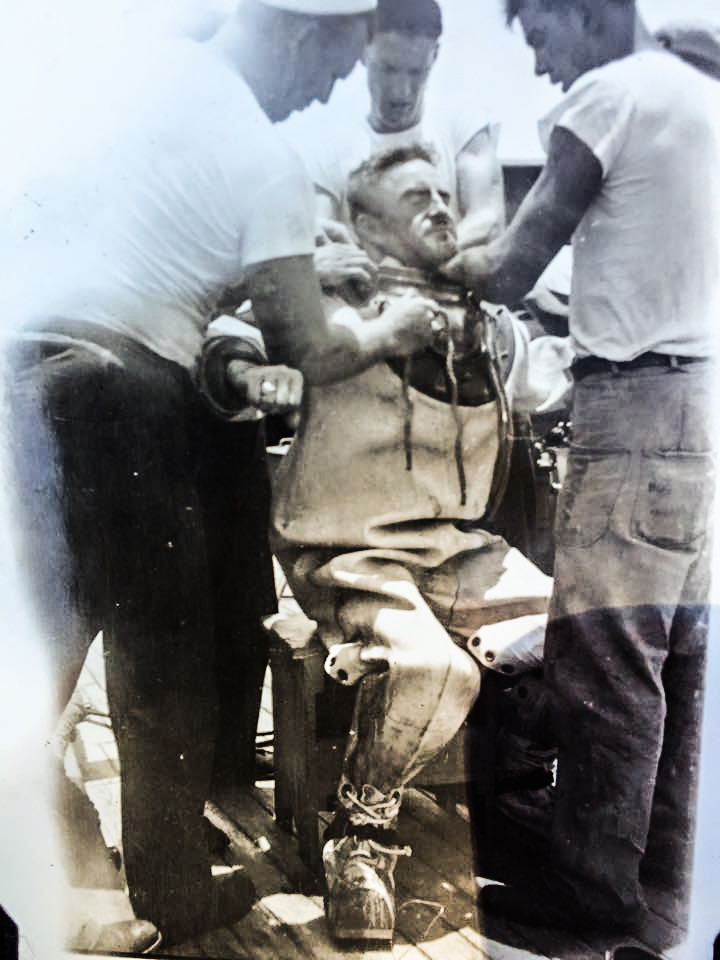
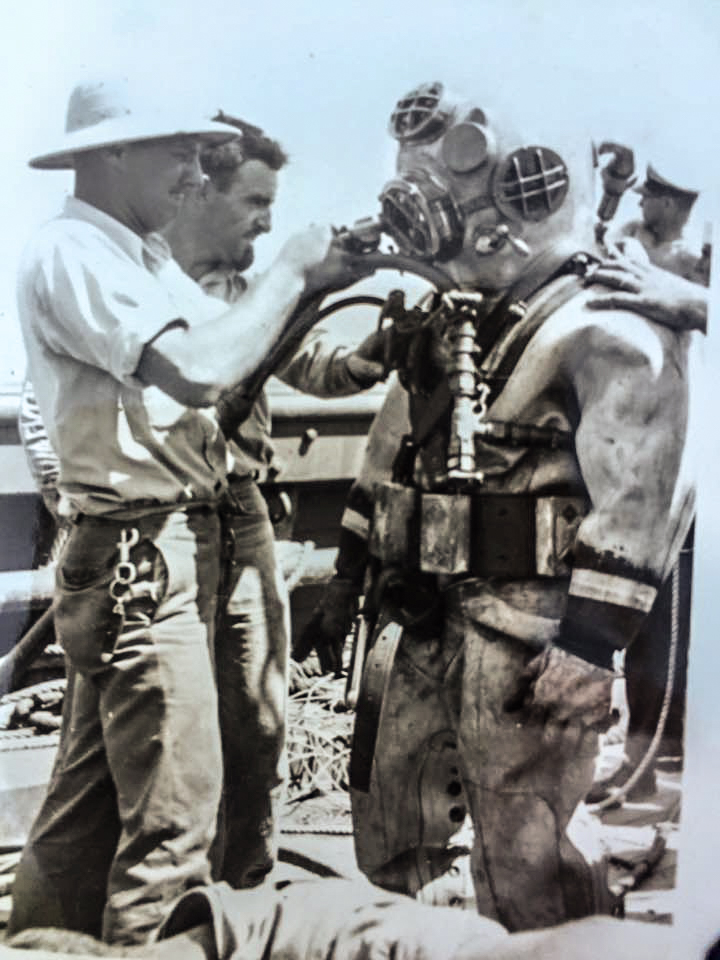
Sent to New York for training, Hartle was introduced to the diving suit that outweighed him by 40 pounds. Over the rubber coveralls and gloves fit a lead-weighted belt weighing 84 pounds, boots weighing 36 pounds each, and the copper helmet and breastplate weighing another 55 pounds.
Attached to the helmet was the air tube delivering a mix of oxygen and helium. Since 1924, this formula had been utilized by the Navy allowing divers to remain at greater depths. They could dive for longer intervals of time without cognitive impairment and with shorter decompression periods. Hartle’s deepest dive would take him to 288 feet.
Divers had to prepare for the salvage missions to navigate in pitch-black waters and through labyrinthine remains of metal and debris. They memorized blueprints of ships to find their way in the dark. Divers then set about their tasks.
During their dives, they communicated with the surface via telephone cables wired into their helmets. They welded and plugged holes to refloat the sunken battleships, towed away unexploded torpedoes, and retrieved the bodies of soldiers trapped in the wreckage.
The conditions were so perilous that many divers died in the process, enough so that the efforts to retrieve the bodies were eventually ceased. The USS Arizona had been so badly damaged that only the guns of two turrets were removed along with the mast and superstructure for scrap. Out of 1,177 crewmen who perished, a little over 100 could be positively identified. The USS Arizona was preserved as a memorial, where nearly 1,000 sailors remain entombed.
The Greatest Generation
The casualties of Pearl Harbor reached 2,400 dead and another 1,000 wounded, with nearly 20 naval vessels of the fleet destroyed. Japanese casualties totaled 129 killed and 1 taken prisoner, 29 planes, and five midget submarines. Yet the attack failed to carry out its objective of crippling the U.S. Navy.
When salvaging efforts proved enormously successful within the first two months, the Japanese attempted a second attack in March of 1942 which proved a complete failure.
By the end of the salvage operations, Navy divers had completed 4,000 dives totaling 16,000 hours in the water; they restored 18 out of 21 sunken ships.
After Pearl Harbor, Hartle continued diving missions at Eniwetok Atoll and the Philippines until his discharge in December of 1945. Of all his favorite stories, he spoke most proudly of his time in the Navy.
At the time of his passing in January 2017, he was the oldest living of the World War II Navy salvage divers.
What arts and culture topics would you like us to cover? Please email ideas or feedback to features@epochtimes.nyc
Correction: A previous version of this article misidentified the vessel that destroyed a Japanese submarine. The USS Antares spotted a Japanese submarine and notified the destroyer USS Ward which destroyed the submarine. The Epoch Times regrets the error.
