
You receive a friendly text from a stranger who seems to have the wrong number. You reply out of courtesy. That small decision, responding to what looks like a harmless mistake, is how some insidious financial crimes begin.
Back in 2023, cybersecurity firms claimed that AI voice cloning had advanced to the point where scammers could generate a convincing copy of a family member’s voice from as little as a few seconds of social media audio. Technology has advanced significantly since then.
This year, the FBI’s Internet Crime Complaint Center reported that cryptocurrency investment fraud losses, driven primarily by “pig butchering” schemes, exceeded $7.2 billion in 2025. And for the first time, they included a section dedicated to artificial intelligence as a cybercrime tool, logging 22,364 AI-related complaints and nearly $893 million in losses.
The largest single AI-related loss category in that report was investment fraud at $632 million, and the FBI explicitly identified voice cloning as one of the tools criminals are now using to scale those schemes.
Here’s what you need to know about how pig butchering and AI voice cloning works, and how you can recognize them while they are still happening.
Quick Answer
“Pig butchering” is the term used to describe a long-con investment scam that begins with an unsolicited text and ends with a fake crypto platform that steals your money. AI voice cloning scams use a synthetic copy of a family member’s voice to pressure you into sending emergency funds. Both scams depend on manufactured trust and urgency. You can interrupt either one by slowing down and verifying through an established, trustworthy source.
5 Moments to Stop Pig Butchering
The term pig butchering comes from a Chinese phrase, shāzhūpán, a metaphor about fattening a pig before it’s slaughtered. The scammer spends weeks building a genuine-feeling relationship before the financial trap closes.
These are the five most common techniques used for pig butchering, where you still have a chance to recognize what is happening.
1. The ‘Wrong Number’ Opener
The initial contact feels accidental and low-stakes. A stranger reaches out via text, WhatsApp, or LinkedIn. They are friendly, not pushy, and ask for nothing. This is the grooming phase. Its only purpose is to lower your guard.
Red flag: An unsolicited stranger who quickly becomes warm and personal online.
2. The Gradual Conversation Shift
Over days or weeks, the conversation drifts toward investment. Your new contact mentions impressive returns they have been making on a platform. They share this casually, not like a pitch. That is intentional. Organic-feeling money talk is far more persuasive than a direct sales approach.
Red flag: An online contact you have never met in person who steers conversations toward crypto or investment opportunities.
3. Screenshots of Fake Returns
The scammer shares screenshots showing large, consistent profits. The platform looks professional. The numbers look real, but everything is fabricated. The images exist to create urgency and make the investment feel validated.
Red flag: A platform that is supposed to be legit, based solely on the recommendations of a stranger. Screenshots, the data, and the site itself can easily be faked. Check the entity’s state registration independently at brokercheck.finra.org or adviserinfo.sec.gov.
4. The Request to Download a Specific App
The scammer directs you to a particular app or website to open your account. The platform may even appear in app stores and look completely legitimate. The returns you see accumulating inside your account are fabricated numbers on a fraudulent interface.
Red flag: Any investment app recommended exclusively by someone you have never met in person.
5. Pressure to Deposit More After a Small Withdrawal Works
The platform lets you withdraw a small amount after you’ve invested. This is a strategic move. It builds confidence and makes the operation feel real. After you deposit a larger sum, withdrawals are blocked. You are told you owe taxes or fees before your funds can be released.
Red flag: Any platform that demands upfront fees to release your own money is stealing from you. Stop all deposits immediately.
Note: Keep in mind that pig butchering can also be executed through romance scams and other fraudulent ventures.
3 Defenses to AI Voice Calls
You receive a frantic call from someone who sounds exactly like your grandchild or a close family member. They describe a sudden emergency: an arrest, a car accident, a hospital bill they cannot cover. They need money sent immediately, before anyone else finds out.
The voice is convincing because it was built by AI using audio pulled from social media videos, voicemail greetings, or public content posted online. Urgency is the actual weapon.
Scammers hate it when you stop and think.
These three defenses interrupt that urgency before any money moves.
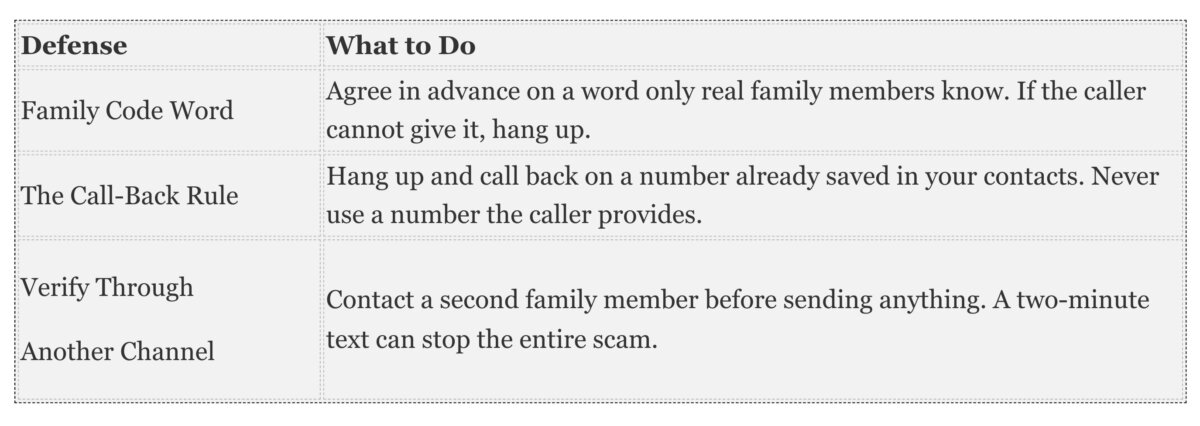
None of these steps takes more than two minutes. The pause is the first, best defense.
Frequently Asked Questions
What Should I Do if I Think I Am Already in a Pig Butchering Scam?
Stop all deposits immediately and do not pay any fee to unlock your funds. Those demands are part of the theft, and paying them will not release your money. File a report with the FBI’s Internet Crime Center at ic3.gov and contact your bank right away to flag any recent transfers. You should also report the fraud to the FTC at reportfraud.ftc.gov. Recovery is difficult, but acting quickly gives you the best chance of limiting your total losses.
Can a Pig Butchering Scam Really Drain Someone’s Entire Savings?
Yes. The FBI has documented individual pig butchering losses well into six figures, including cases where victims withdrew retirement funds, took out home equity loans, and borrowed from family members before realizing the platform was fraudulent. Because the grooming phase can last months, victims are often deeply emotionally invested in the relationship before significant money is ever involved, which makes early warning signs easier to rationalize and harder to act on.
How Little Audio Does a Scammer Need to Clone a Voice?
McAfee Labs found that three seconds of audio is enough to produce a voice clone with an 85 percent match to the original, and that with additional training data, that accuracy can reach 95 percent. A peer-reviewed PLOS One study from Queen Mary University of London found that AI voice clones were mistaken for real human voices in 58 percent of cases, and that some cloned voices were rated as more trustworthy than the authentic recordings they were modeled on.
A strong defense is a verification step the scammer cannot pass.
The Epoch Times copyright © 2026. The views and opinions expressed are those of the authors. They are meant for general informational purposes only and should not be construed or interpreted as a recommendation or solicitation. The Epoch Times does not provide investment, tax, legal, financial planning, estate planning, or any other personal finance advice. The Epoch Times holds no liability for the accuracy or timeliness of the information provided.