The wonder of Christmas is inexhaustible. My previous articles on Christmas focused on the meaning of advent: the first, on God coming down to us and the humility it inspires; the second, on Christmas as the renewal of hope—the birth of the divine in the human and of possibility in the midst of hardship. Now, I’d like to consider Christmas as the re-enchantment of the world.
The world—our world—has grown cold, cynical, and materialistic. Despite the commercial interests that convert every Christmas season into an opportunity to make another dollar, Christmas remains magical, wondrous, and a time of good cheer. It still offers the hope of peace and goodwill to all people everywhere.
In his book “The Re-Enchantment of Everyday Life,” Thomas Moore observed: “The soul has an absolute, unforgiving need for regular excursions into enchantment. It requires them like the body needs food and the mind needs thought.” But clearly, the soul is not getting it, or rather, seems to be getting less and less of it as society progresses.
Scientific materialism seeks to explain everything, even that which is really beyond its remit to explain. For example, it’s all very well to explain that the universe began with the Big Bang, but it’s not scientific to then pretend to explain why it began at all.
Why it began is where myth and religion kick in, not science. This, of course, is also where wonder and the miraculous kick in.
Disenchantment
One of the least remarked upon but most corrosive features of modern life is disenchantment. As sociologist Max Weber famously observed, we’re inside an “iron cage”: a world increasingly explained, measured, optimized, and managed, yet curiously drained of wonder. The cosmos has become machinery; nature, a mere resource; and human beings, biological accidents or economic units. Even meaning itself is treated as something subjective, provisional, or privately invented.
In such a climate, cynicism passes for sophistication, and reverence is quietly dismissed as gullibility. Bureaucracy—a ruling passion of our age—brings order and progress, but it also creates a rigid, steel-hard casing that confines the human spirit. It prioritizes technical logic over human values, leading to, as Weber expressed it, a “polar night of icy darkness” for the soul.
This concept is as relevant now as it was when Weber wrote it 100 years ago. Today, we have even greater modern technology and systems, artificial intelligence, and digital platforms that further standardize experiences and reinforce bureaucratic control, that extend the cage into our personal lives. How we escape from all this is too big a question for one article, except to say that Christmas is a timely antidote at a timely time of year.
Against this time when our days are darkest and coldest, Christmas appears, year after year. It stubbornly resists reduction. However much we insist that the season is really about consumerism, or family nostalgia, or winter festivals recycled from paganism, Christmas refuses to stay flattened. It persists as a moment when people speak, however tentatively, of light in darkness, of peace on earth, of goodwill, of hope that cannot quite be justified by the headlines.
Even those who reject the theology often confess to being moved by the story. Something is going on that exceeds explanation.
This is because Christmas is not merely a doctrine or a date. It is a mythic event in the deepest sense of the word. A “myth” is not a falsehood but a truth too large to be contained by literalism alone.
In a disenchanted world, myth is often misunderstood as make-believe. Yet for most of human history, myth was precisely how meaning entered the world. Myths named realities that could not be reduced to data: love, sacrifice, destiny, evil, and redemption. It told us not just what the world was, but what it meant. As it says in John’s gospel: “In the beginning was the Word.” Closely related to the word “word” is “meaning.” And this is what we want: meaning.
Modernity, by contrast, has been suspicious of such language. We have trained ourselves to ask “how” and “what,” but not “why.” The result is efficiency without purpose, knowledge without wisdom, and progress without direction. Indeed, progress to where, one might legitimately ask?
As G.K. Chesterton once warned, “When men choose not to believe in God, they do not thereafter believe in nothing, they then become capable of believing in anything.” Effectively, superstition rushes back precisely where reverence has been expelled.

Light in the Darkness
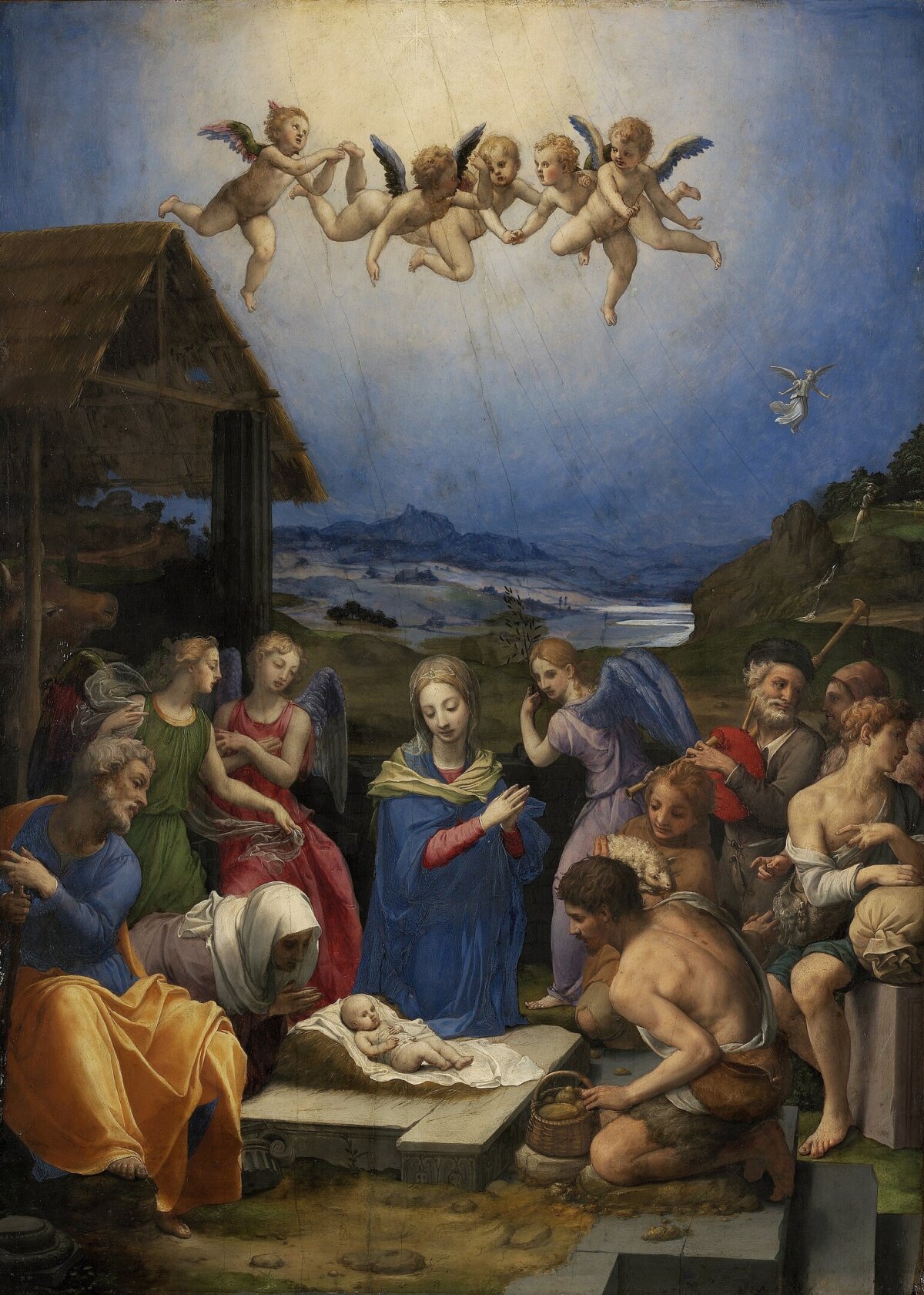
Christmas offers a quiet but radical reversal of this process. It does not argue its case; it tells a story. A child is born in obscurity. Power is displaced by vulnerability. Glory appears not in conquest but in humility. The structure itself is mythic, even shocking: The divine does not remain aloof but enters history, time, and flesh. This is not enchantment as escapism, but enchantment as recognition—the sudden realization that reality is deeper, stranger, and more meaningful than we understood.
C.S. Lewis captured the essence with a famous phrase. In Christianity, “myth became fact.” The longing stirred by ancient stories—of dying gods, of miraculous births, of light returning after darkness—was not denied, but fulfilled.
J.R.R. Tolkien went further, describing the Christmas story as the ultimate “eucatastrophe” (eu-, “good”; katastrophe, “sudden turn”). He coined the word to express the concept: The moment in which, when all seems lost, joy breaks in unexpectedly. Not by denying suffering, but by passing through it and transforming it from within. (Tolkien applied such a principle in his greatest work, “The Lord of the Rings.” The moment when, in the heart of Mount Doom, Gollum slips the ring onto his finger and all seems lost … but then rescue is at hand.)
To speak of re-enchantment, then, is not to advocate a return to superstition or the abandonment of reason. It is to recover a sense that reason itself rests upon something deeper: on meaning, order, and a gift. As Chesterton noted: “Reason is itself a matter of faith.” Christmas insists that the world is not merely something we manipulate but something we receive; it’s not merely a problem to be solved but a mystery to be entered.
In an age weary of explanations but starving for significance, this may be Christmas’s most urgent gift: the reawakening of wonder. With it comes the possibility that the world is not closed, but open and charged with meaning, alive with promise, and still capable of joy.
Certainly, it’s a primary opportunity for re-enchantment, and I, for one, while awaiting a Christmas Day visit from my nearly 3-year-old granddaughter, expect a massive charge of wonder, magic, and yes, re-enchantment. Make sure you get your dose of it, too—Christmas is for everyone.
What arts and culture topics would you like us to cover? Please email ideas or feedback to features@epochtimes.nyc.