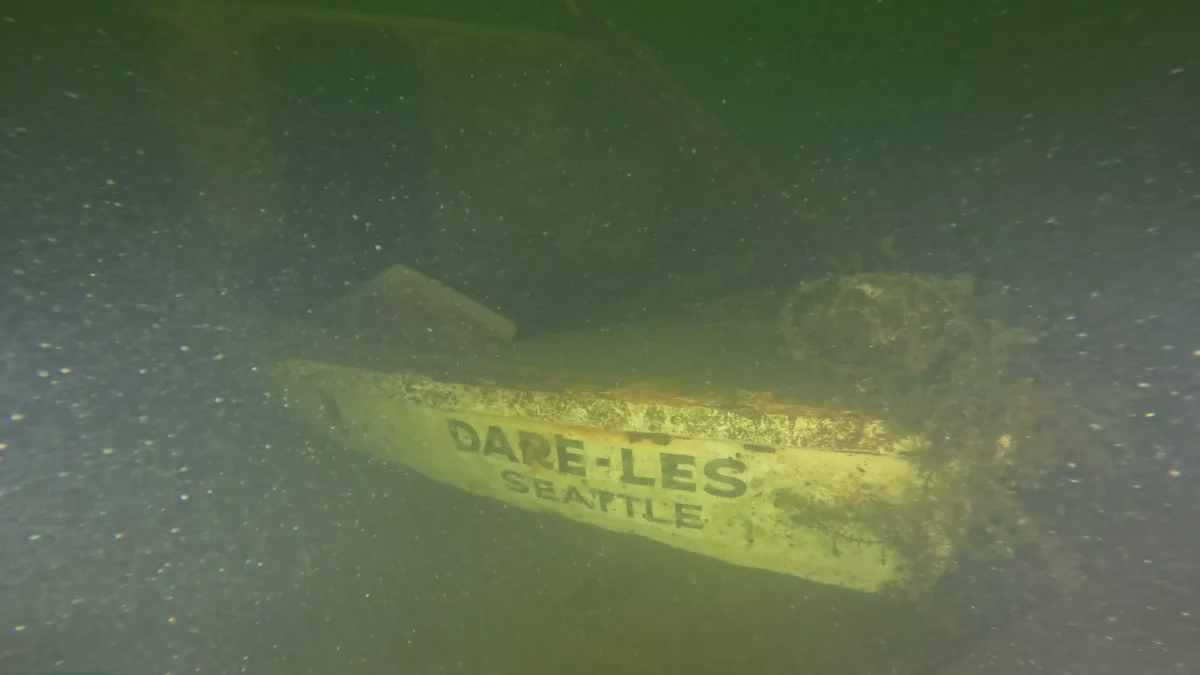
Researchers are exploring a ghostly realm hidden beneath the rippling surface of Seattle’s busy Lake Union. Using a remotely operated vehicle (ROV), a team lead by ocean engineer and robotics specialist Phil Parisi has begun exploring and documenting dozens of forgotten shipwrecks lying in the lake bottom’s green haze. Parisi is assisted by Libbie Barnes, a curator of exhibits and engagement at Seattle’s Museum of History & Industry.
The team plans to investigate over 100 targeted sites within this “Shipwreck City.” Among them are sailboats, transportation barges, a fishing tender, as well as a World War II minesweeper, landing craft, and submarine chaser. So far, the project has explored 34 wrecks in 21 hours of underwater sleuthing.
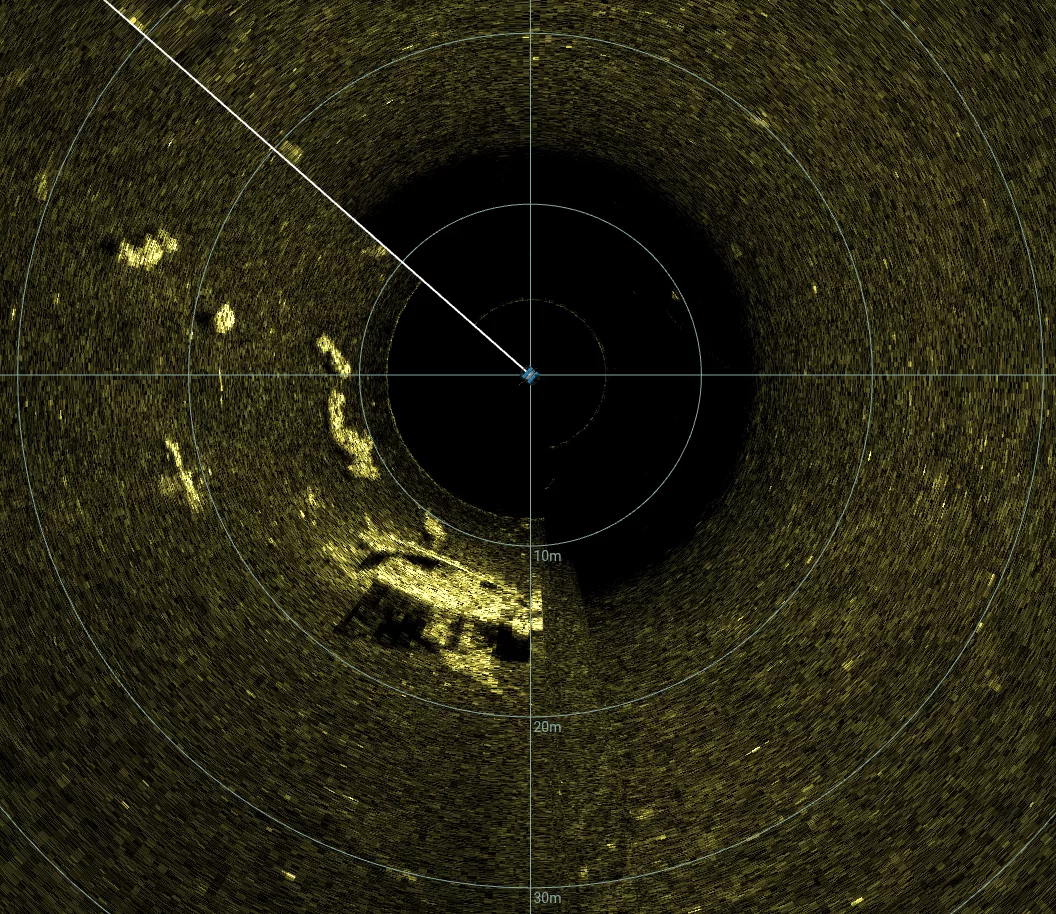 Sonar gives the explorers an idea of where to look and what to look for, in Lake Union, near Seattle. (Shipwreck City)
“Many of these submerged sites are unknown to the people who swim, paddle, sail, and fly above them each day,” the project’s official site explains. “Shipwreck City brings this hidden world into view. By creating a visual archive of each site, the project shows how the lake continues to evolve.” The Shipwreck City initiative uses sonar, robotics, photography, and video to “make these underwater stories accessible” and promote better stewardship of the lake and its waterways. The project “invites us to think about preservation, pollution, and our shared responsibility to care for urban waterways.”
The project has enlisted an ROV—nicknamed “Finn”—to go further and deeper than human divers ever have. It’s a BlueROV2 manufactured by BlueRobotics and fitted with lights, cameras, and sonar.
Roving through the murky depths, the underwater robot has been able to provide the researchers with unprecedented, up-close views of the lake’s hidden encrusted artifacts. GPS data collected by Ben Griner around 2017 helps guide the robot toward the targeted wreck, which it zeroes in using its side-scan sonar apparatus. Then, the ROV’s lights and camera record photos and videos.
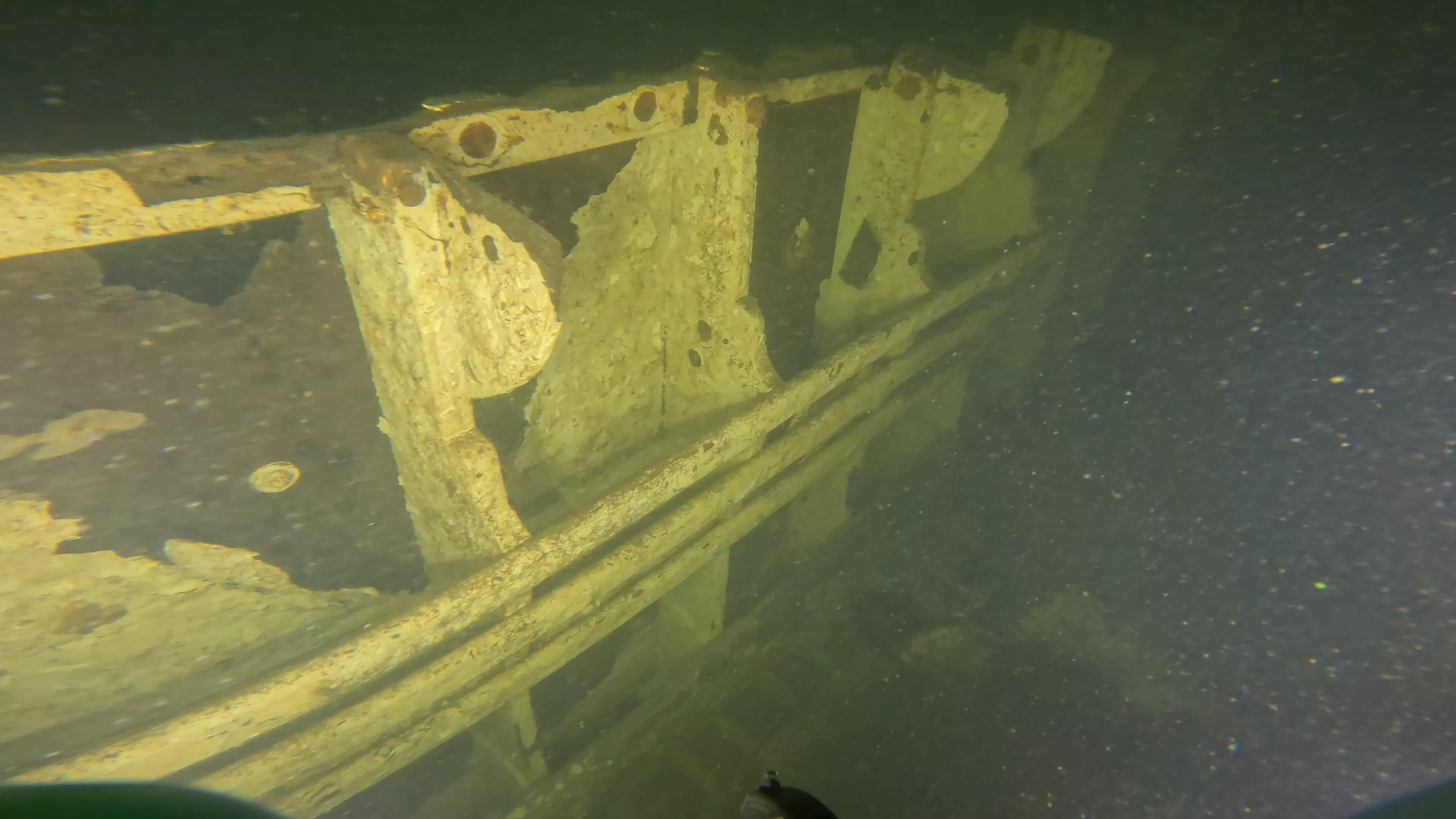 The ROV2 discovered a 25-foot landing craft 40 feet under the water in Lake Union. (Shipwreck City)
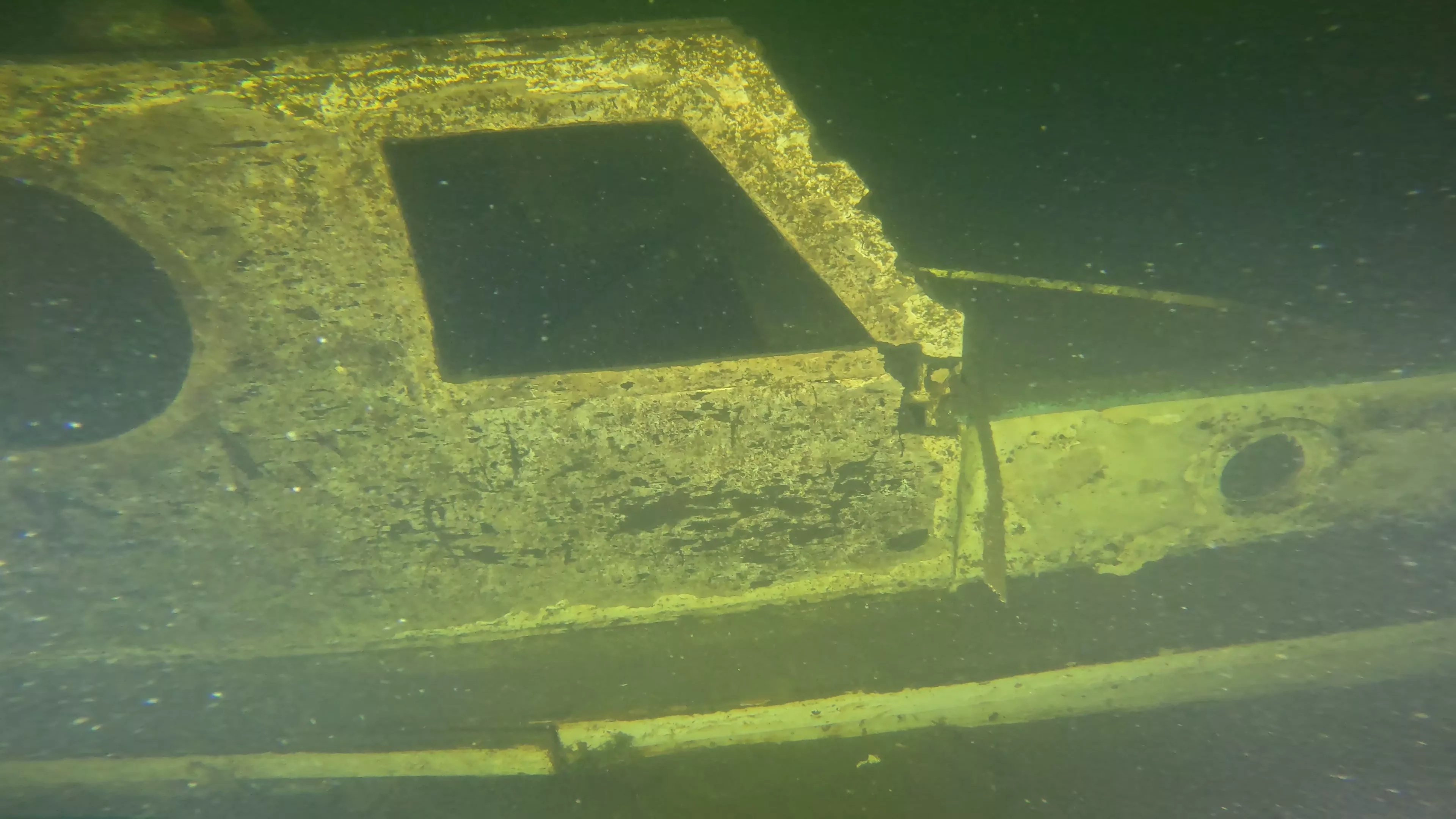
The team uses the ROV to try to find a visible name or other identifiable feature of the wreck, though often rust, damage, and biofouling leaves the vessel’s identity cloaked in mystery. The robot doesn’t disturb the wrecks or surrounding environment.
One key reason to use the robot has to do with the lake’s polluted waters, unsuitable for human divers. “You hear stories of pollution, Gas Works runoff. That’s why diving isn’t really allowed,” Parisi told KING-TV. “It’s not a healthy ecosystem. That has been the weirdest thing.”
“It’s kind of a ghost town down there. There is a harsh lack of life.”
Given the extensive human use of the waterway throughout history, the pollution isn’t entirely surprising.
A Lake’s Storied History
Lake Union formed about 12,000 years ago due to the drift of a 3,000-foot-thick ice sheet. The native Duwamish people originally inhabited the area around Lake Union. Their term for it was “meman hartshu,” meaning “little lake.”
Most of the Duwamish moved onto reservations after the treaties of the 1800s, but a few of them stayed and tried to adapt to the Europeans.
“They approached things from a survival standpoint. They could see into the future and they knew that ‘yes’ they could go down fighting, but at the same time there wouldn’t be any people to follow them,” Jacqueline Swanson, a descendent of the Duwamish, observed.
Cheshiahud, a Duwamish chief who lived from the mid-19th to early 20th centuries, was one of the last native Americans to live on Lake Union by Seattle, where he worked as a water guide. He also served as an intermediary between the Europeans and his own people, in part through the friendship that he developed with pioneer David Denny. Denny took the time to learn the native people’s language, forming a connection and friendship with the Duwamish, particularly Cheshiahud.
 Mrs. Tleboletsa “Madeline” Cheshiahud and her husband Lake John “Old Tom” Cheshiahud in 1904, perhaps the last remaining Native Americans living around Lake Union. (Public Domain)
Denny opened the Western Mill on Lake Union’s shores in 1882, marking the inauguration of a new industrial era. By the early 1900s, business and industries bristled along the shoreline, including a natural gas plant built in 1906. It was later subsumed into Gasworks Park, one of the potential polluters of the lake.
Shipwreck City provides a silt-entombed record of Seattle’s maritime history, which in turns points to the broader history of the region and its evolution. Parisi’s project offers a clearer, deeper picture of that maritime record and its implications for the story of Seattle.
“Every place holds incredible landmarks and hidden treasures, yet we’re often distracted by the humdrum of life,” Parisi said. “When you get the chance, allow curiosity to take over and do a deep dive into your local city or town’s history—it is amazing what happened not so long ago!”
 The wreck of the Dare-Les is easily recognizable as a boat thanks to the preserved exterior. (Shipwreck City)
Shipwreck City—and the efforts to explore it—are reminders not just of the importance of this particular waterway, but also how easily relatively recent history can slip from our view, like a vessel silently sinking beneath the waves.
What arts and culture topics would you like us to cover? Please email ideas or feedback to features@epochtimes.nyc