




Michael Curtis is a sculptor, painter, historian, architectural designer, and poet who has taught and lectured at institutions that include the Institute of Classical Architecture and Art and the National Gallery of Art. His paintings and statuary are held in over 400 public and private collections, including the Library of Congress, the National Portrait Gallery, and the U.S. Supreme Court. Curtis has created statues and medals of major American historical figures, including Davy Crockett, Dwight D. Eisenhower, and Justice Thurgood Marshall.
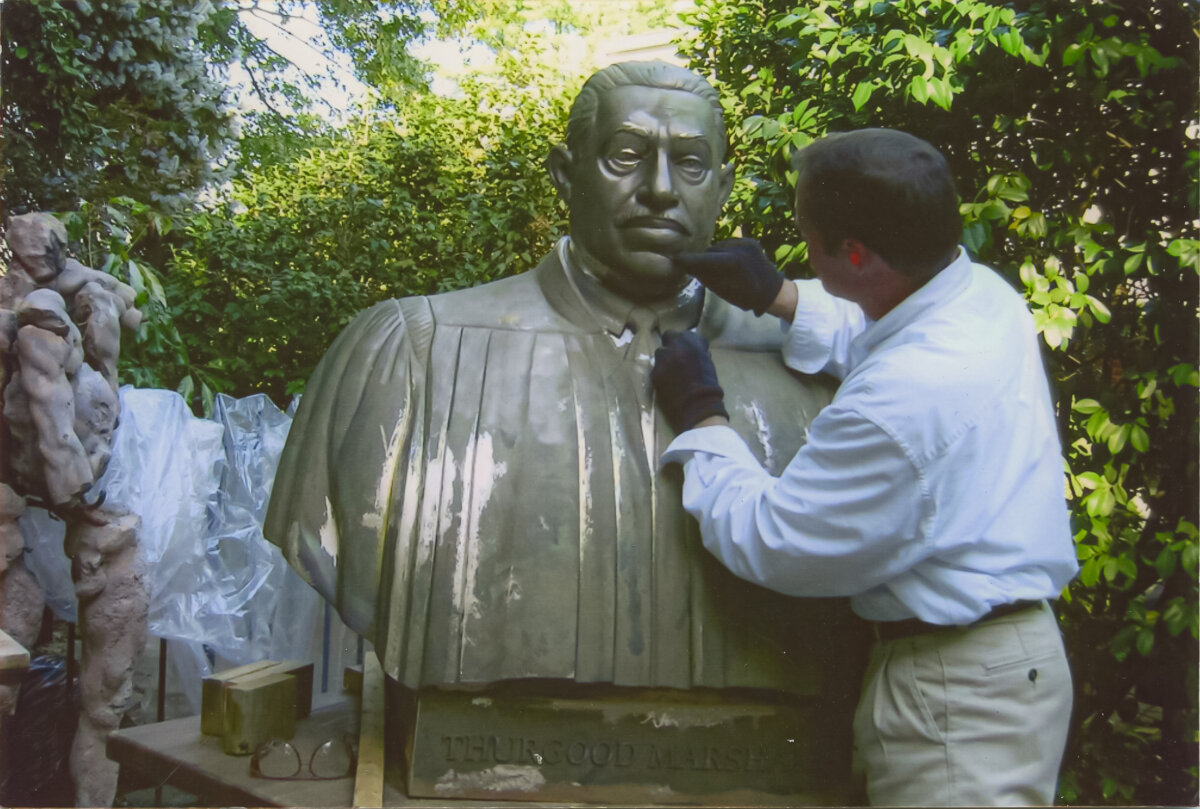
His monumental “History of Texas,” installed at the Texas Rangers ballpark in Arlington, Texas, is the largest American frieze of the 20th century. Current commissions include sculpted portraits of Pope Benedict XVI and James Madison, as well as residential architectural designs in classical styles.

Curtis’s plays, essays, verse, and translations have appeared in more than 30 journals. He is the author of numerous books of criticism, history, and translation, including the verse satire “Modern Art: An Exhibition in Criticism” and a verse translation of “The Priapeia” from Latin. His most recent book is the American edition of “Land of Sunlight and Stars: Afrikaans Verse in Translation.”
The Epoch Times: Your statues stand in some of the most symbolically important spaces in America—from the Library of Congress to the Supreme Court. How has working at that scale of national memory shaped your understanding of what public art ought to do?
Michael Curtis: Pardon me for saying “civic art.” Public art and art in public places are other things—inferior things—things having no purpose.
My purpose in statuary is to memorialize, to honor those who led exemplary lives, to recall us to our civic selves, and to embody not merely a likeness but some particular virtue, if not virtue itself. All art is an idea made real, yet more than this, the best pictures and statues are the most virtuous pictures and statues. Moment after moment from conception to full realization, an artist must be true in thought and action with brush or hammer. Any misplaced move of hand or absence of mind will cause the hammer or brush to go wrong. Each idle thought or careless slight is a vice that corrupts a statue, picture, building, or song, as sin corrupts a soul.
In all things, we should aim toward beauty, goodness, and truth. I think it best in civic art to look to heaven. It seems to me that civic art should strive for something like heaven on earth.
The Epoch Times: Your career spans sculpture, painting, architecture, poetry, history, and teaching. How would you describe what unifies all the work you do across these different fields?
Curtis: Defense. I entered art school at 17 and was immediately challenged, sometimes attacked by progressive modernist professors. … I didn’t blame them. They, too, suffered the soul-crushing liberation of modern art schools as both student and teacher. … Because I was Catholic-schooled, I had sufficiently absorbed the best of all that has been thought, said, and done. Around this age, I made an avowal to defend my artistic fore, an avowal to which I remain true.
In the days before the internet, there was no effective way in the modernist hegemony for “classive” artists to meet other classive artists, nor poets, poets, architects, architects, et alia. To be true to my avowal, there was no way out. I attempted to master every art and craft. Yes, I was young and all things seemed possible. Now here I am, nearly 70, and tolerably skilled in numerous disciplines.
The Epoch Times: You often use the term “classive” rather than “classical.” What does classive mean and why is it the right word for the aesthetic tradition you defend?
Curtis: Well, there it is, the inquiry into the nature of the creature we are. In brief, we are souled or we are soulless. We are either souls in material bodies, or we are material bodies, nothing more.
Plato and Socrates posited a soul-like psyche or daimon and a purposeful unchanging eternal being. Democritus speculated that all is but atoms and the void, and that all which happens is mere chance. The universe is either purposed and constant or the universe is random and ultimately meaningless. You see the conflict. Plato, too, saw the conflict and recommended that all of Democritus books be burned. None of Democritus’s books survive. As you know, however, ideas cannot be burned.
So here we are at sixes and nines, teeth and claws, some half of us certain of our souls, some other half certain of their soullessness. Trouble is we build for souls differently than we build for bodies, we legislate for souls differently than we legislate for bodies, and we educate for souls differently than we educate for bodies.
Souls and bodies have different needs, different wants, and different desires. The soul needs God, wants beauty, and desires union. The body needs feeding, wants filling, and desires pleasure.
The drunk ritualist Jackson Pollock splattered synthetic wall paint on things that meant nothing but material. The devout Catholic Michelangelo Buonarotti imbued his Old Testament pictures with divine heroes interacting with the ultimate being in a purposed universe.
The souled ascend toward God. Material descends, as in the “Descent of Man” to mud, Darwin-like. You will notice that we ascend into classive buildings, into buildings formed like us (bottom, middle, top, sides and center, bilaterally symmetrical or as symmetrical parts of a whole). In a reasoned and logical classive building, you know where you are and where to go. Yet more than this, you are at home in a classive building because it is friendly to your soul, fitted to your body.
You will notice that we often descend into unfriendly, ugly progressive buildings, places where our souls feel alienated and our bodies get lost.
We are souled classive, or we are soulless progressive. “Classical” is either a high standard or a style from antiquity. “Modern” is merely a word that means “just now,” a word that is 1,500-some years old. You might have a classical progressive building as in the Gugenheim Museum, or you might have a modern classive building as in the National Archives.

The Epoch Times: You founded the National Civic Art Society more than 20 years ago for the purpose of promoting classical architecture. What problem did you see then that others were ignoring?
Curtis: In truth, the National Civic Art Society was formed to reunify the sister arts—statuary and “pictuary”—with civic buildings. Sculpture, architecture, and physics cannot be made. Statues and buildings and equations can be made. We do not make classifications, we understand by classifications. We make things.
As mentioned a bit ago, there are public things and civic things, there are also personal things and private things. The trouble was that we confused classifications with things, confused one thing with another thing, and put the private thing in place of the public thing.
Never did we intend to promote classical architecture. Our intention was, and yet is, to return the nation to civic health through beautiful, nourishing civic art. I like to think we are reviving civic art and renewing our republic of virtue. For those unfamiliar, Adams, Jefferson, and most of the Founders intended to establish a “republic of virtue” because a virtuous citizenry is necessary to the creation and continuation of a republic.
The Epoch Times: What is the “Make America Beautiful Again” movement about?
Curtis: Beauty, goodness, and truth form that triune existence that is the constant eternal reality, ever verdant, ever fresh, ever new. Ugliness, evil, and lies are old things that reoccur in deviantly stale ways. This past half-millennia we have disordered civic union because we disagree about the nature of the universe and of ourselves. We have increasingly loved ourselves and loved our opinions before all else. We have assumed ourselves good, even beautiful, because we like to think it so.
In 1789, the French revolted against order and authority, God, royalty, the laws of nature, and the laws of man. Law was perverted, God was cursed, and the heads of the king and queen were divorced from their bodies by a new clean and efficient technology: the guillotine.
We Americans did not revolt in 1776. Ours was a war of independence, a war in the correct order of existence.
“To assume among the powers of the earth, the separate and equal station to which the Laws of Nature and of Nature’s God entitle them, a decent respect to the opinions of mankind requires that they should declare the causes which impel them to the separation.
We hold these truths to be self-evident, that all men are created equal, that they are endowed by their Creator with certain unalienable Rights, that among these are Life, Liberty and the pursuit of Happiness.”
I must admit that Jefferson, a classive scholar who, when yet a teenager, could speak Latin and read Greek, intended “Happiness” not as pleasure but as “Eudaimonia,” that flourishing born by the practice of, the mastery of, virtues which lead to fulfillment, which is itself “Happiness.” The Declaration of Independence was a declaration of right order, a respect for God and the children of God, our neighbors.
A lesser known, though in this instance an equally important Jeffersonian recognition, is that civic buildings “should be more than things of beauty and convenience, above all they should state a creed,” and this as in a religious creed. It is notable that many Americans treat our Declaration of Independence as a creed which they memorize and recite.
Jefferson understood that civic art should be beautiful in the way of God. Our houses of God, our churches, are modeled upon 2,500-year-old Greek temples and 2,200-year-old Roman basilicas, the first great objects of civic art. Jefferson in his designs of Monticello, the University of Virginia, the President’s House [now the White House, designed by Benjamin Latrobe], et cetera, preferred “the adoption of some one of the models of antiquity which have had the approbation of thousands of years.” Jefferson understood that “from architecture would flow education in taste, values, and ideals,” as it has. From the classive has flowed beauty, goodness, truth, and the resulting civic harmony.
Make America Beautiful Again is the return to transcendentals, to a rightly ordered republic, our republic of virtue, to the correct order of existence, love of God, then love of neighbor as of oneself.
We build either for the ascent of the beautiful soul or we build to achieve soulless descent. There is no in-between. Let’s Make America Beautiful Again.
The Epoch Times: You have lived long enough to see ideas you championed in the wilderness now gaining institutional traction. Do you feel we are at the beginning of a new artistic renaissance—or only the end of a decline?
Curtis: We are in a period of renewal, I think. I do not expect the decline to end. I expect the decline to quicken and spread.
Those who know themselves to be souled are steadily returning to tradition, to services, to reality, to life-affirming family, to God.
In the final decades of the past century, after exclusion from all progressive institutions, we classives formed our own ateliers, schools, colleges, societies, institutions, newspapers and publishing houses, networks and stations. Some of these classive organizations have reached maturity and are beginning their third generation of leadership. They will not be stopped. Classive civilization will be renewed. What forms this renewal will assume I cannot say, though I can say that it will ascend from Greek beauty, Roman order, and Christian virtue.
I expect that in a civilizational battle, the souled classive will triumph because it is healthy and verdant and beautiful, the force of nature, life, and God himself. Because evil is ugly and gelded, the soulless progressive will wither and die away, as it does from time to time.
What arts and culture topics would you like us to cover? Please email ideas or feedback to features@epochtimes.nyc.
