Out of the many schools of philosophy from the ancient world, Stoicism enjoys the most contemporary popularity.
Stoics developed intricate conceptual systems, but their main concern was how to live well. The philosopher Epictetus (circa A.D. 50–circa 135) was especially interested in this topic. His tenet was simple: Well-being is a choice.
Here are Epictetus’s three key lessons for learning how to choose.
Understand Human Nature
Stoicism began in ancient Greece around the end of the fifth century B.C. Most texts from that period haven’t survived. To figure out what Stoics believed, scholars usually consult later Greek and Latin thinkers from the Roman Empire. Epictetus is prominent among them, even though every text that cites him as an author is a compilation of classroom notes by one of his students.
Born a slave in the Roman town of Hierapolis, located in modern-day Turkey, Epictetus spent most of his life in Rome, where he reported directly to one of the emperor Nero’s (A.D. 37–68) secretaries. Epictetus got to know firsthand the emotion-driven world of political elites. Once he gained his freedom, he became a teacher and founded a school in Western Greece. Many of his pupils were politicians in search of effective ways to manage busy and often turbulent lives.
Whereas some Stoics preferred studying nature and logic, Epictetus was mostly concerned with how to live well. His life and works were so instructive that Emperor Marcus Aurelius (A.D. 121–180), born at the extreme opposite of the social hierarchy, credited him extensively as an intellectual mentor.
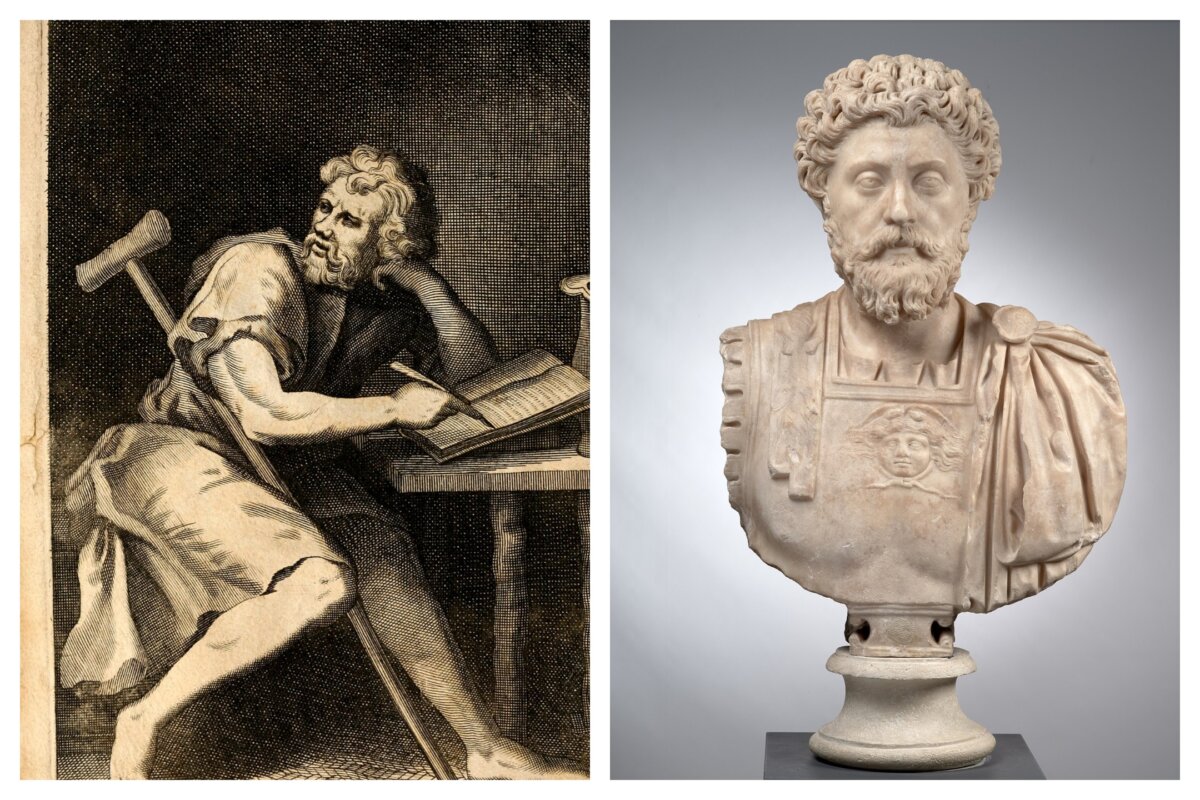
Epictetus’s teachings began with an exhortation to understand human nature. What’s our defining quality? Is there anything without which we wouldn’t be human?
Epictetus thought that quality was reason. As was recorded in the first section of the intricate “Discourses,” “The gods have placed [reason] in our power … the best faculty of all, the one that rules over all the others.” For a Stoic, reason is the divine spark in all of us. It enables us to understand and control our reactions to the world.
Before we can apply reason effectively, we need to incorporate another crucial lesson.
Internalize the Control Dichotomy
In addition to the “Discourses,” Epictetus’s teachings were also compiled in a more user-friendly “Handbook,” the second important volume of sayings by the Greek-speaking Roman. The third text that survives is a short collection of fragments.
The first paragraph of the “Handbook” articulates Stoicism’s simplest and most fundamental message: “Some things are within our power, while others are not.”
Epictetus counted opinions, motivations, desires, and aversions as things within human power. However, he considered things like the body, property, and reputation outside personal control. We seem to have some control over them, but it’s severely limited. We can prioritize health and wellness all our lives, but a serious illness could still strike. Hurricanes don’t care how much we strengthen our home’s foundation. Our coworkers’ perceptions of us depend on factors over which we have no say.

This dichotomy of control is essential. For the Stoic, regarding our body, house, and status as things we can control is a terrible mistake. It’s the source of anger, regret, and other emotions that obstruct peace of mind. To avoid these disturbances, Epictetus suggested we focus only on things we can control.
Reason is most useful to organize our lives around this dichotomy. It helps us assess the validity of our emotions, empowering us to reframe our opinions about them. Indeed, the Stoics believed emotions were just opinions, and their effects completely avoidable.
Assess Impulses, Repel Emotions
The Stoics didn’t use the word “emotion” like we do today. Their trust in reason’s power to repel obstructive emotions hinges on a crucial difference between “impulse” and “emotion.” An impulse is an instinctive reaction. An emotion is a judgment that confirms that reaction as appropriate, or denies it as inappropriate.
Say a shiny Ferrari dashes by your modest car at a traffic stop. Lured by its roaring engines, your eyes might turn impulsively toward it. There’s nothing bad about this reaction. Epictetus might say that your body is responding automatically to a stimulus you can’t avoid.
That immediate reaction could turn into envy, which the Stoics defined as distress provoked by another’s material prosperity. Envy is an emotion. Here it stems from the assumption that a Ferrari can increase your well-being and is therefore worth having.
Since you don’t have a Ferrari, you might long for one. This longing might turn into an endless series of anxiety-inducing desires. Purchasing the car won’t solve the anxiety. It will probably unleash another cascade of desires, fueled by the prospect of gaining yet another thing to increase your well-being. Today it’s Ferraris; in Epictetus’s world it would’ve been chariots, banquets, or monumental marble statues.
The Stoics classified all emotions into four primary types: distress, fear, lust, and delight. They believed that feeling elated by something that seems good when it isn’t was equally as pernicious as envy. In other words, Stoics were convinced that all emotions were detrimental because they result from mistaken beliefs about the world and the things that matter for well-being.
From the belief that emotions are opinions, the Stoics concluded that emotions are also within our control. As Epictetus summarized in the fifth section of the “Handbook,” “It isn’t the things themselves that disturb people, but the judgments that they form about them.”
Judging a Ferrari as irrelevant to well-being isn’t only a correct judgment, the Stoics might say. It also undermines envy. Once we recognize that emotions begin with assumptions that reason can correct, we can stop them before they even begin, and eliminate their obstructions to peace of mind.
Stoicism Today
Scholars argue about the extent of the Stoics’ repudiation of emotions, but it’s generally agreed that they deemed emotions incompatible with well-being. Is there merit to the idea that treating emotions as mistaken opinions can dissolve their intensity and eventually eliminate their destabilizing consequences completely? Was Epictetus just exhorting people to talk things away? Scientists and philosophers continue to question whether the Stoic path is as beneficial as he implied.
A similar interest in managing emotions inspired the pioneers of Cognitive Behavioral Therapy (CBT), who openly admitted its resemblance to Stoicism. CBT relies on the assumption that rational and positive “self-talk” can effectively rectify “cognitive distortions,” a term for thoughts or beliefs that misrepresent, exaggerate, or catastrophize reality. This psychotherapeutic method is reserved for abnormal thought patterns, whereas Stoics took it for granted that anyone could benefit from their practice. CBT also accepts emotions as essential parts of a healthy life. The Stoics’ bold, controversial rejection of emotions has no place in CBT.

Still, CBT borrows its understanding of the relationship between thought and emotions from the Stoics. Today, it remains among the most scientifically validated methods for addressing depression, bipolar disorder, and related mental health problems.
Social Responsibility
It’s tempting to dismiss Stoics as cold-hearted individuals who only cared about themselves. Epictetus might have encountered this prejudice often. That’s why he carefully denied it. As he said in the third section of the “Discourses,” “I ought to maintain the relations natural and acquired, as a pious man, as a son, as a father, as a citizen.”
For the Stoics, falling short of social responsibility was a grave mistake. They thought we’re all social by nature. They were the first to regularly use the word “cosmopolitan,” which means “citizen of the world” in Greek. As the Greek philosopher Aristotle noted three centuries before Epictetus, “He that is incapable of society, or so complete in himself as not to want it, makes no part of a city, as a beast or a god.”
To live well as a Stoic, then, social relationships are indispensable. The Stoic’s duties to family, friends, and country came first and foremost. Behind their attempts at finding equanimity was always an unwavering commitment to serving the greater good of their human community.
Cosmic Connectedness
The Stoics valued theology highly. They openly supported the polytheistic customs of their day, and their frequent mentions of one benevolent God above all others resembled claims made by early Christians, who were contemporaries of Epictetus.
The Stoics’ moral teachings sprang from complex beliefs about the mind, the natural world, and their divine origins. They believed that everything and everyone is part of an endless, inescapable chain of cause and effect initiated and maintained by a divine designer. Just like we inherit traits from our parents and they inherit traits from theirs, so the entire universe inherits its traits from its creator. Recognizing that “we’re all first and foremost children of God,” as Epictetus’s student put it in the “Discourses,” is a necessary first step toward cultivating the divine spark in us; that is, reason.
Central to the Stoics was also the idea that the world’s creator is benevolent and providential. For the Greek Zeno (circa 335 B.C.–circa 263 B.C.), founder of Stoicism, this providence was most palpable in the world’s outstanding harmonious beauty, which seemed to him to display the perfect handiwork of a divine artist.
For the Roman statesman Seneca (circa 4 B.C.–A.D. 65), divinity became even more personal. As he wrote in an essay titled “On Providence,” “God bears a fatherly mind towards good men, and loves them in a manly spirit. ‘Let them,’ says He, ‘be exercised by labours, sufferings, and losses, that so they may gather true strength.’”
The Stoics’ emphasis on providence and determinism often unsettles modern audiences. But it’s an essential part of Stoicism, at least as its founders formulated it. Whether it’s possible to embrace their moral teachings without espousing their theology is a question Epictetus and his students might invite all of us to ponder.
What arts and culture topics would you like us to cover? Please email ideas or feedback to features@epochtimes.nyc