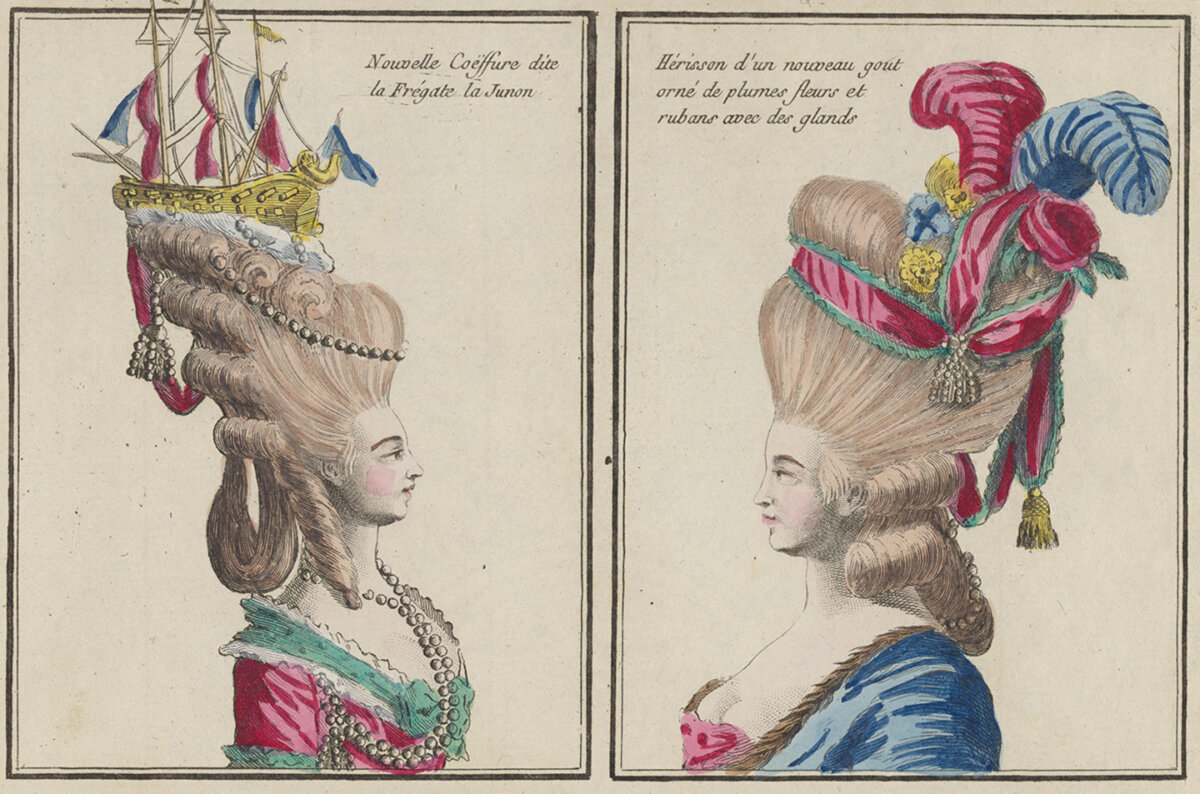
Beginning April 1, The Frick Collection in New York City will present “Ruffles & Ribbons: Fashion Plates from the Time of Marie Antoinette” in the Cabinet Gallery. Organized by Anne L. Poulet Curatorial Fellow Yifu Liu, the exhibition features 24 hand-colored engravings, known as fashion plates, that illustrate French dress in the late 18th century. Liu notes that the exhibit “brings to life the rapid expansion of the French fashion industry, revealing how global trade, colonial expansion, and cross-cultural exchange sparked a wave of creativity that established Paris as the fashion capital of Europe.”
Parisian Plates
The exhibit features meticulously rendered prints from the Frick Art Research Library’s copy of “Gallerie des Modes et Costumes Français” (1778–1787), the most celebrated fashion plate series of its era. Created by Parisian designers and engravers, the publication includes more than 400 large-format prints.
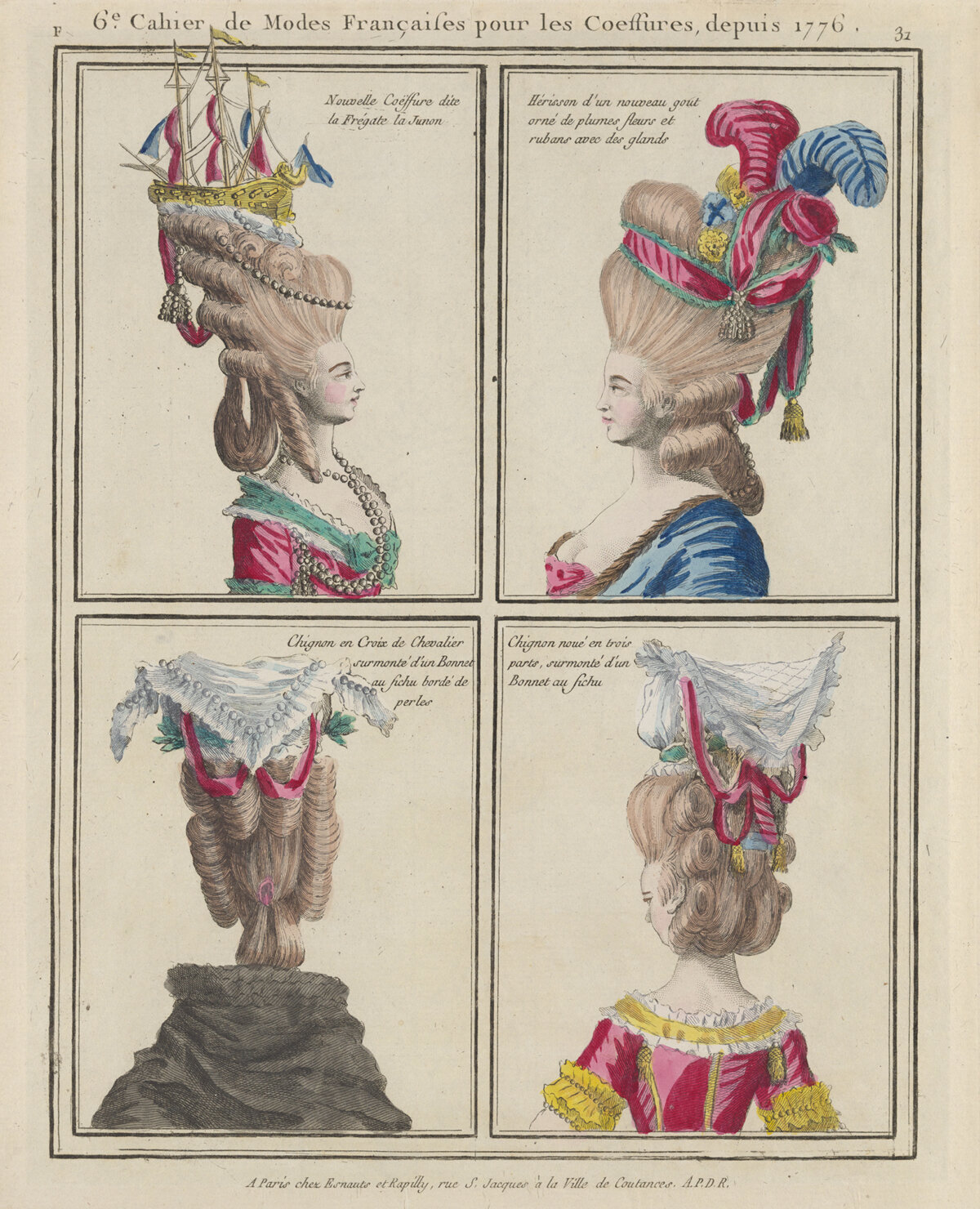
The series captures the evolution of French fashion through finely detailed engravings and precise descriptions of hairstyles, garments, footwear, and accessories. One print portrays a woman wearing a formal court dress, the habit de cour, described as crafted from “cherry satin,” with a neckline adorned with white diamonds, pearls, and ribbons. Another plate, devoted to hairstyles, describes a coiffure as a “bun tied in three parts, topped with a bonnet and kerchief.”
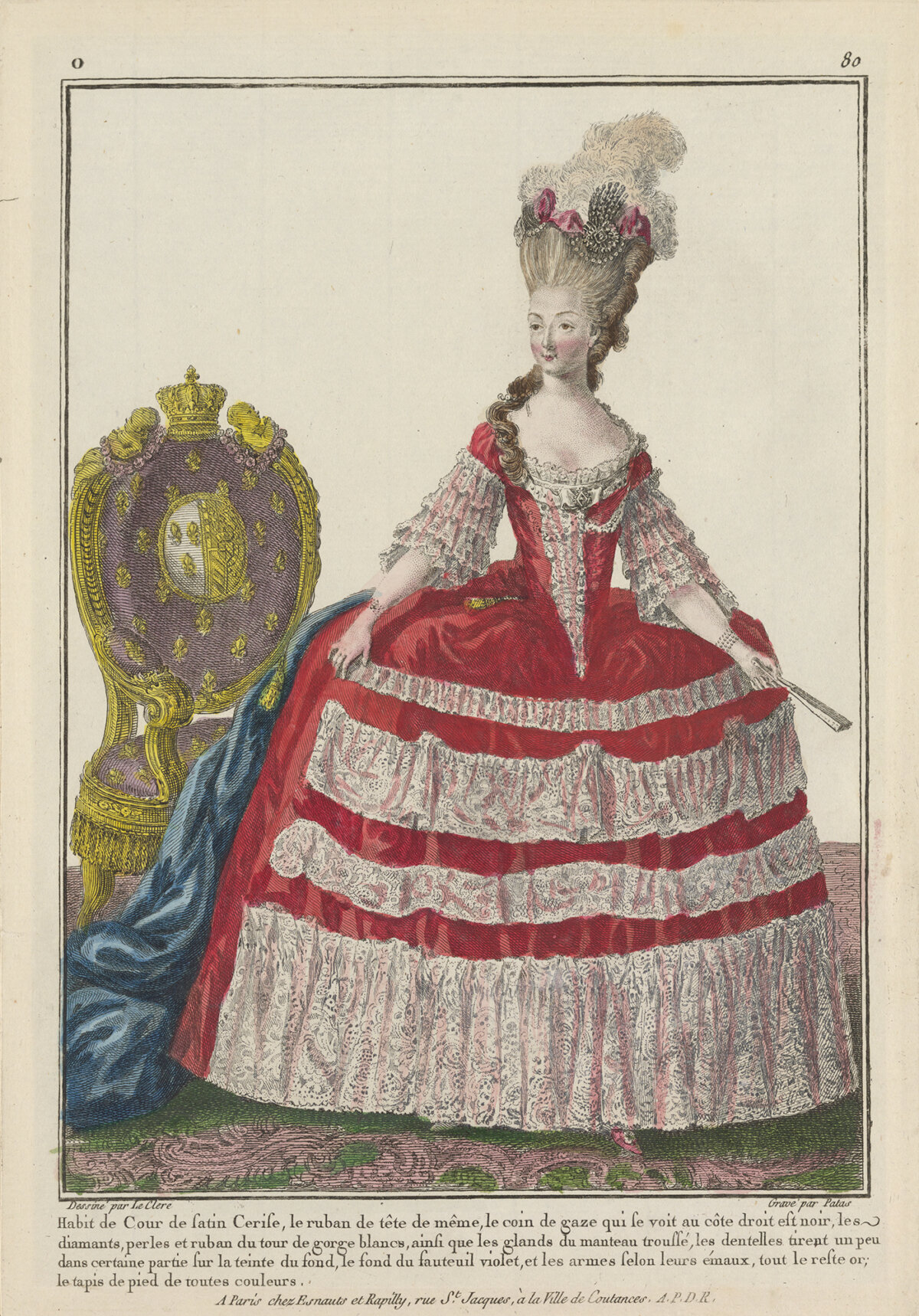
Wealthy audiences eagerly collected these prints as models of fashionable dress during the reign of King Louis XVI and Queen Marie Antoinette. The series’ popularity inspired numerous rival editions across Europe, yet no complete set remains today. Many prints were discarded over time, while others may have been destroyed during the French Revolution.
Marie Antoinette’s Style, Influence, and Controversy
Queen Marie Antoinette was the defining fashion figure of the late 18th century. Her clothing and hairstyles were closely observed and widely imitated at the court of Versailles and throughout Europe. From the mid-1770s through the early 1780s, she set many of the trends that shaped elite dress. Her devotion to fashion was famously extravagant, with spending that often exceeded the annual clothing allowance of 120,000 livres, over $26 million today. The habit fueled criticism and helped shape the negative public perception of her reign.
The queen’s wardrobe reflected her keen eye for fashion and refined taste. She had a particular fondness for the redingote, a coat-dress shaped by the clean lines of men’s tailoring, and the robe à la turque, a decorative overgarment that draped gracefully over her dresses. Its smooth front, folded-back collar, and funnel-shaped sleeves lent a subtle air of sophistication.
One of the garments most closely tied to her controversial style was the chemise à la reine: a simple, flowing muslin gown. In 1783, portrait painter Élisabeth Vigée-Lebrun portrayed Antoinette in a white chemise à la reine, a choice that was considered scandalous because it resembled an undergarment rather than formal court attire. The portrait was replaced the same year with a more conventional version, showing the queen in a blue silk robe à l’anglaise trimmed with lace.
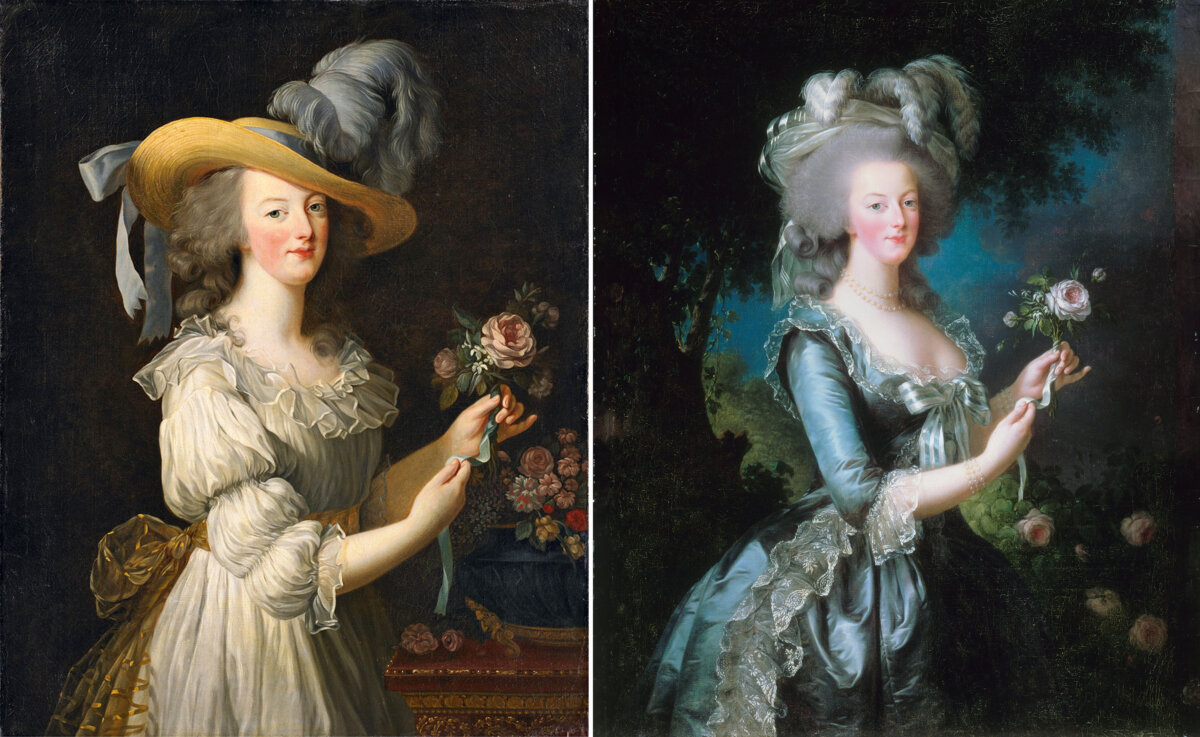
Despite the controversy, the style proved highly influential. Many women, including members of the elite, embraced the white chemise à la reine. Its simple silhouette became a defining fashion at the turn of the 19th century. The growing popularity of cotton garments also influenced a decline in the French silk trade and an increase in cotton production abroad.
Antoinette’s influence extended beyond clothing to the elaborate hairstyles that defined courtly fashion. She shaped not just what women wore, but how they presented themselves. Working closely with professional hairdressers and dressmakers, Antoinette popularized the towering pouf, an elaborate hairstyle adorned with feathers, ribbons, flowers, and occasionally fruit.
Constructing these styles could take hours, and once completed they were often worn for several days or even weeks. To preserve them at night, women often wore sleeping caps and used supportive pillows. When outdoors, they protected the towering hair with a calash, a collapsible silk bonnet so named for its similarity to the folding top of a horse-drawn carriage.
Fashion, Portraiture, and Floral Design
Presented alongside “Gainsborough: The Fashion of Portraiture,” “Ruffles & Ribbons” offers a vivid glimpse into late 18th-century fashion, when clothing and textiles spoke volumes about social, cultural, and political life. The exhibition runs from April 1 through Aug. 3, 2026, and features public programs including a lecture by Liu and a symposium on early modern European fashion.
Beyond the galleries, the Frick’s Fifth Avenue Garden brings the exhibition to life with floral displays inspired by “Ruffles & Ribbons,” designed by Maeve Turner, creating a dialogue between fashion, art, and nature.
“Ruffles & Ribbons: Fashion Plates from the Time of Marie Antoinette” exhibition at the Frick Collection in New York City is on view from April 1, 2026 to Aug. 3, 2026. To learn more, visit frick.org.