



In the film “The Red Violin,” an instrument created by a luthier in Cremona passes through different hands over the centuries, eventually making its way to Shanghai during the Cultural Revolution. There, this object of beauty and spiritual meaning is almost destroyed when it encounters a dangerous political ideology.
“Let’s challenge degenerate Western art!” says a CCP spokesperson, before a music teacher is forced to throw one of his instruments onto the burn pile.
A culture that does not recognize a divine order has no use for beauty. Inversely, great artists have always seen themselves as doing more than honing their technique to create beauty. In the case of the great classical composers, their work exudes a sense of divine proportion.
Bach signed his name in numbers and used mathematical principles to create symmetry in his works. Mozart’s music has been linked with the golden ratio. The number three plays a notable role in several works from Beethoven’s middle “heroic” period that engage the theme of fate.
A basic connection between music and math makes this possible. But far from being just an academic exercise in scales and rhythms, this has deep implications for how the universe is organized and the moral meaning that can be drawn from this.
It was a connection the Ancient Greeks understood.
Pythagoras Meets a Blacksmith
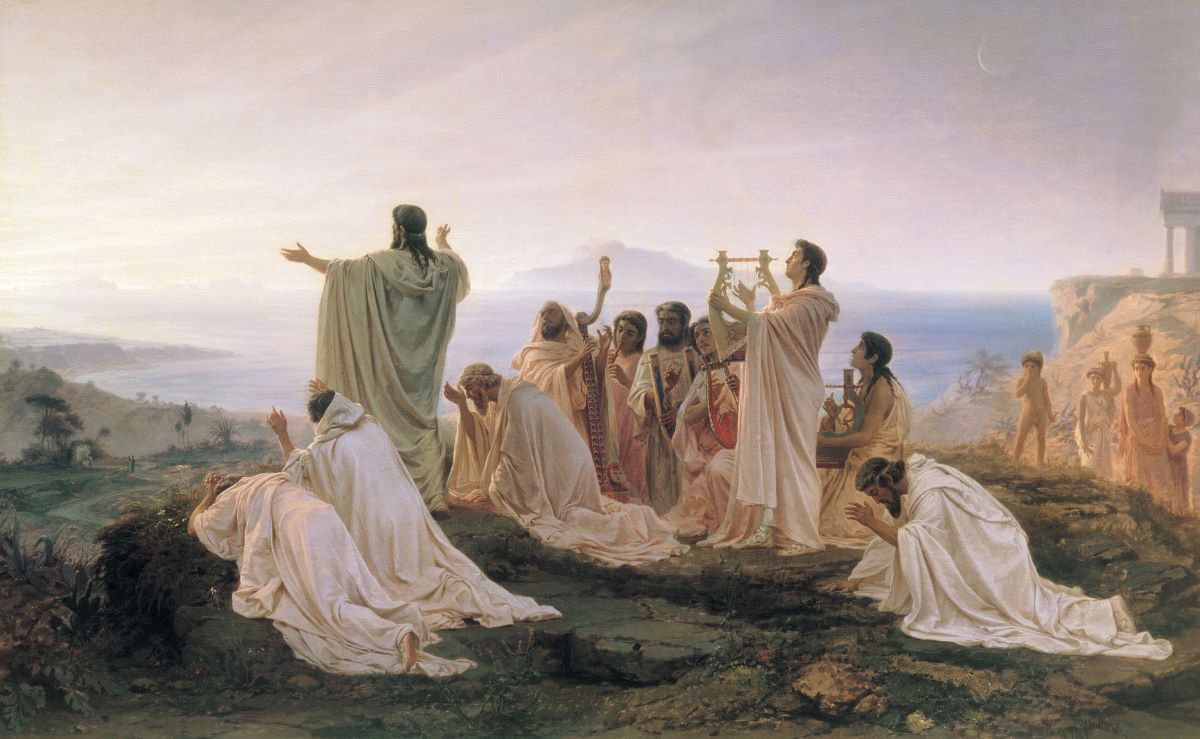
Picture a bearded mystic who always put his right shoe on first, discouraged eating beans, and claimed to have been a Trojan warrior in a previous life. This strange character, Pythagoras of Samos, founded a school of thought and is still known to everyone who’s studied basic geometry.
Pythagoras has been called both “the Father of Music” and “the Father of Mathematics,” since his followers credited him with making foundational discoveries in both fields.
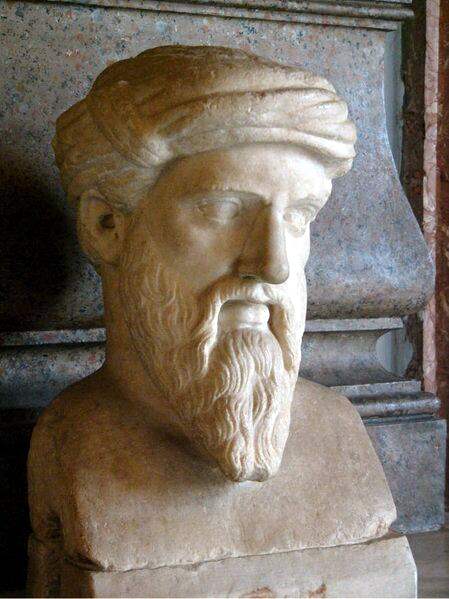
None of his own writings survive. The 3rd-century philosopher Porphyry tells us that “it was Pythagoras who discovered that the musical intervals also come about inevitably because of number,” and “what factors are responsible for harmony and disharmony.”
As the legend goes, the inspiration for his discovery of harmonic ratios came from listening to hammers striking iron. While passing a blacksmith’s shop, Pythagoras noticed that different hammers produced different tones based on their weight.
Musica Universalis
Like Isaac Newton’s apple or George Washington’s cherry tree, Pythagoras’s blacksmith makes a deeper point about how creative inspiration works even though the story itself may be false.
Inspired by the harmony he heard in the blacksmith’s forge, Pythagoras tested the idea using strings. As the story goes, he divided different strings into lengths proportional to the differing weights of the hammers. Struck in this fashion, the strings produced the same musical intervals: A two-to-one ratio yielded an octave, a three-to-two ratio an interval of a fifth, and a four-to-three ratio a fourth.
The numbers that go into these ratios—one, two, three, and four—are each symbolic. For the Pythagoreans, one was the point, the source and unity of all things. From two came the line and the realm of duality. Three resolved duality into harmony, forming the plane. And four represented the solid body extended in space.
One plus two plus three plus four equals 10, the perfect number and the completion of the sequence. Around this number the Pythagoreans arranged a triangular figure, the “tetractys,” which they revered as the numerical symbol of the universe.”

It was Pythagoras who first conceived of the “Musica univeralis,” or the “Harmony of the Spheres,” the idea that the same ratios governing music also govern the motion of celestial bodies. Unlike Democritus, who famously wrote that “all is but atoms and the void,” Pythagoras believed that numerical truth pointed to an eternal, unchanging structure of the universe.
The “Harmony of the Spheres” prevailed in Western music theory for more than 2,000 years.
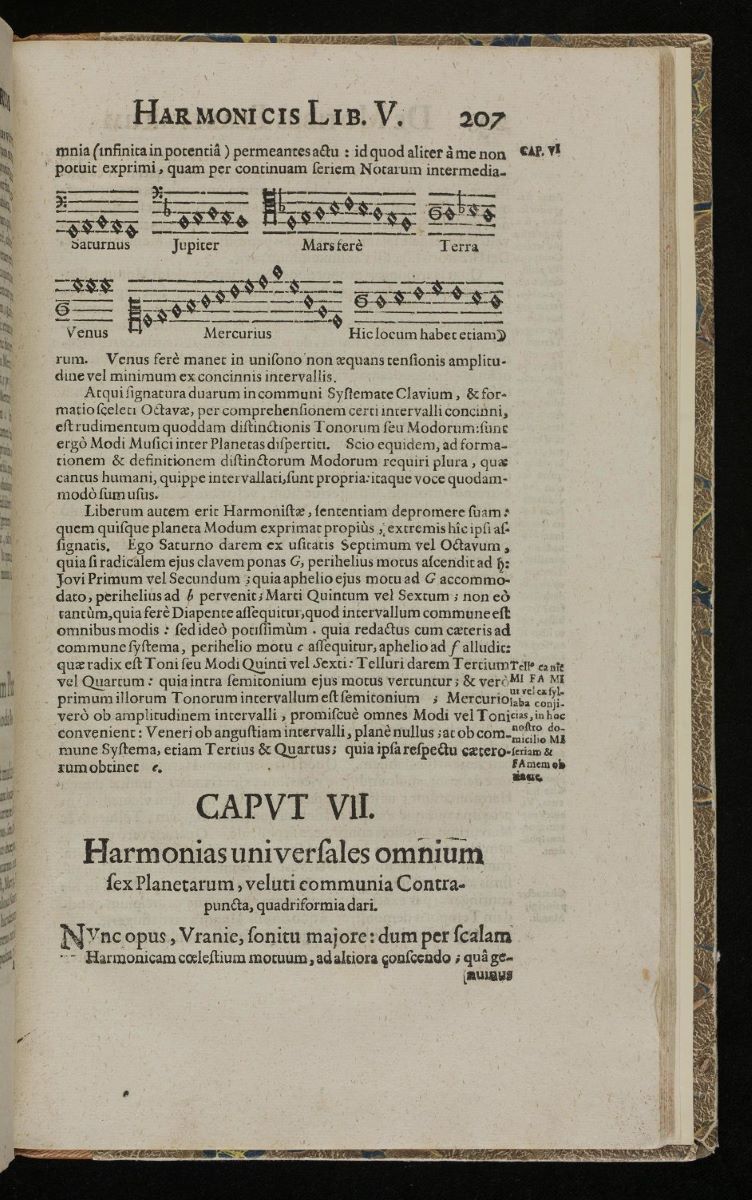
As late as the 17th century, Johannes Kepler wrote a book called “The Harmony of the World,” proposing that the planets emit different tones in their motion around the sun. He thought they functioned something like a choir, so he diagrammed their “voices” on musical scales. Mercury sang high soprano and ranged more than an octave. Venus and Earth were altos, but barely changed. Mars was a tenor, while Jupiter and Saturn sang bass, with Saturn having the lowest register. While this may sound ridiculous to us today, Kepler’s studies directly led him to discovering the laws of planetary motion.
Divine Order or Randomness?
Like the Ancient Greeks, we still see numbers as essential to understanding the universe. But that universe is no longer thought to be unchanging and eternal, or to operate according to any sense of divine proportion—at least according to many science popularizers.
In our time, the idea driving mainstream science education is that the universe is governed by randomness. It’s a repackaged version of Democritus’s old ideas on “atoms and the void.” Being random, the universe is devoid of inherent value. “The universe is under no obligation to make sense to you,” says astrophysicist Neil deGrasse Tyson.
But is that true? A universe without meaning is a tidy home for equations, but a dispiriting one for human beings. Is it any wonder that suicide rates have been rising over the last few decades in direct proportion to increased beliefs in existential nihilism?
Reviving an Old Theory
As it turns out, the rigid materialist view of the universe does not withstand scrutiny. Many recent scientific discoveries seem to point toward a spiritual realm.
Take, again, this outdated idea of universal music. On the surface, the fact that space is a vacuum would seem to contradict this ancient theory. Interestingly, though, Pythagoras understood the music of the spheres to be inaudible, existing in a realm beyond the human senses. As Kepler wrote, the planetary choir is “to be perceived by the intellect, not by the ear.”
In fact, though, spacecraft instruments have captured radio waves emitted by celestial bodies that can be converted into audible sound. Large stars make deep, low-frequency vibrations that have been described as resembling a tuba’s sound while small stars make sounds with shorter wavelengths more akin to flutes.
This data is eerily similar to Kepler’s planetary tones, though made up of symphonic instruments rather than choral voices.
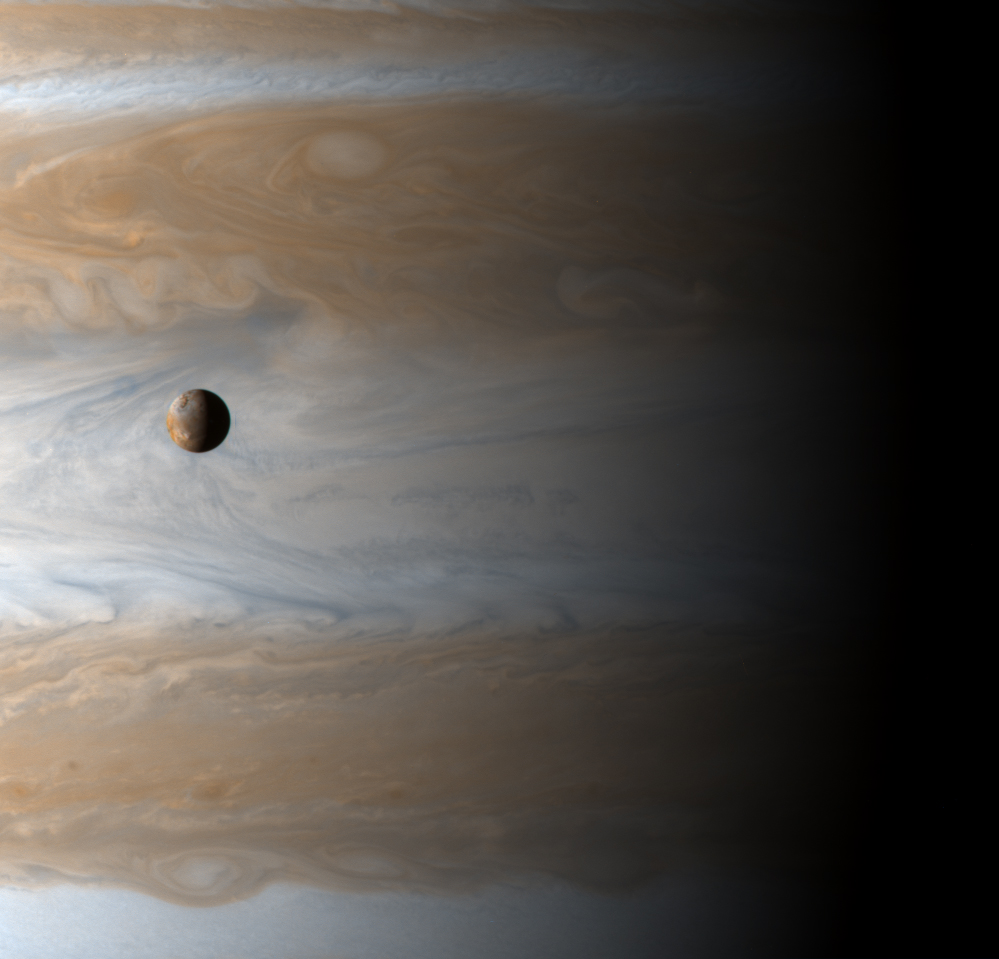
In 2001, NASA’s Cassini spacecraft collected radio waves near Jupiter, a recording which can now be heard on the CosmoKnowledge YouTube channel. Instead of singing bass as Kepler thought, the top comment describes the sound as “wind chimes by the ocean.”
In “Light of the Mind, Light of the World,” scholar Spencer Klavan writes that, “the world described by science increasingly looks like the world revealed by faith.” The ancient models of the universe were meant to be “depictions of a higher and purer reality whose nature could only be known indirectly … [like] sensory glimmers of an invisible truth.”
The invisible—and inaudible—truth is that the haunting music of the cosmos is not a random mistake, but points to something larger. If you have a mundane and repetitive job, just think of the humble blacksmith who once inspired Pythagoras. If that can provide you with meaning, it just might save your life.
What arts and culture topics would you like us to cover? Please email ideas or feedback to features@epochtimes.nyc
