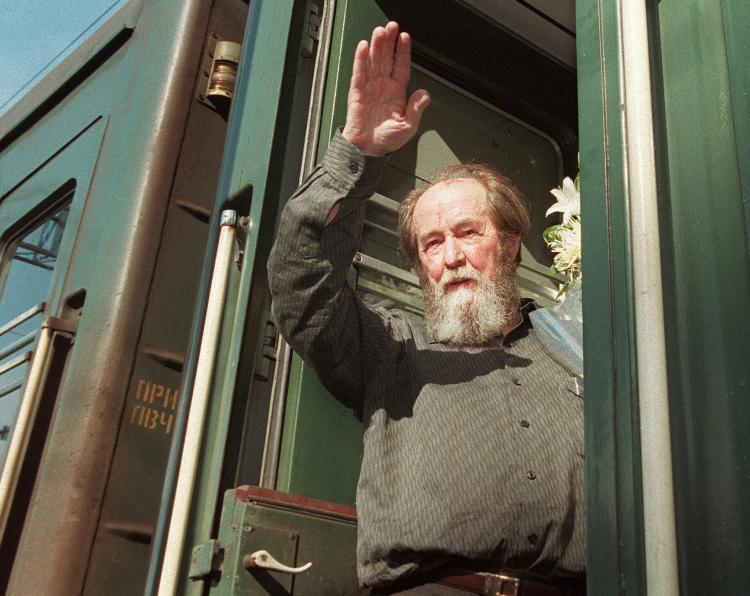
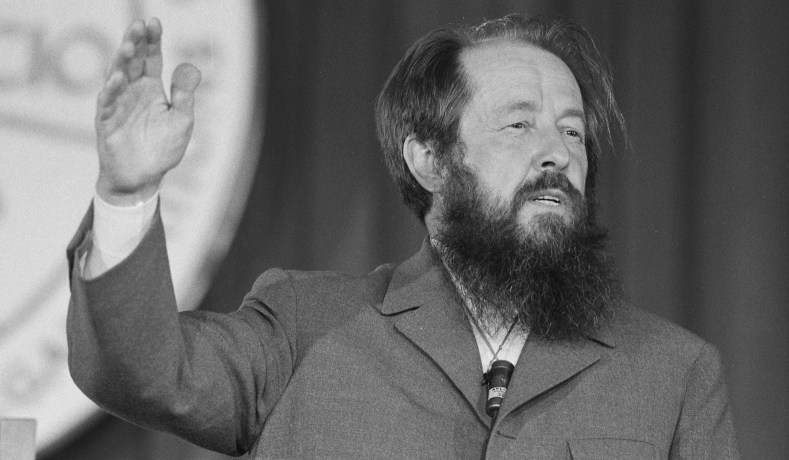
On June 8, 1978, exiled writer and Nobel Prize laureate Aleksandr Solzhenitsyn delivered a commencement speech at Harvard University. His remarks provoked a blast of criticism then and would likely elicit the same response today.
The speech, later titled “A World Split Apart,” took approximately an hour to deliver, much longer than the ordinary commencement day address both because of its length and because Solzhenitsyn spoke in Russian with an interpreter, Irina Ilovaiskaya-Alberti, translating as he proceeded.
Yet it wasn’t the length of the speech that aroused backlash from attendees and commentators, but its content. Rather than attack the Soviet Union and praise the freedom he’d found in the United States, Solzhenitsyn fired a barrage of criticism at both communism and liberal Western democracies. He accused the West, its leaders and citizens, of “weakness and cowardness,” of becoming a legalistic society while abandoning morality, a society whose citizens demanded freedom without responsibility, whose media was sensationalist and sloppy in reporting the news, whose loss of will and embrace of secular humanism had eroded its soul.
Had those critics who professed shock at this critique read the speeches Solzhenitsyn had delivered in the six years prior, such as his Nobel Lecture, his acceptance speech for the American Friendship Medal, or his BBC radio talk, they might have better anticipated what he would say.

A Collection of Common Themes
Published by Notre Dame Press and edited by Solzhenitsyn’s middle son, Ignat, “We Have Ceased to See the Purpose” is a collection of 10 of Solzhenitsyn’s speeches from 1972 to 1997. It’s a slim volume, in part because Solzhenitsyn believed that writers should write and not waste words on speaking.
As we read through these pieces, we find that the Harvard address was not just a shot across the bow. The themes found there run through all of Solzhenitsyn’s speeches. He clearly had a message he wished to convey to the modern world. And while different addresses emphasized different issues, such as the crumbling of Great Britain, or a salute to the resistance of the Vendée during the French Revolution, certain topics dear to Solzhenitsyn were always present.
Before examining three of these themes, we should bear in mind the either-or fallacy—the false dichotomy that presents only two alternatives. Some of those offended by Solzhenitsyn’s Harvard speech, perhaps with good reason, regarded it as a betrayal of etiquette toward a host country that provided him refuge. Others, however, engaged in a classic false dichotomy: Soviet Russia bad, America good.
“No,” Solzhenitsyn said. There’s a third pathway, a better alternative. Both the materialism of the West and the materialism of communist Russia are dead ends, downplaying virtue and mankind’s deep thirst for the spiritual. As he stated in the Harvard Address,
“[The task is] not to gorge on everyday life, not to search for the best ways of obtaining material goods and then to consume them eagerly, but to bear perpetual, earnest duty, so that one’s entire life journey may become, above all, an experience of moral ascent—to leave life a better human being than one started it.”
With enough men and women making this ascent, Solzhenitsyn said, mankind can “rise above the world stream of materialism.”
This is the first of the three themes we’ll examine here, a primary reason for the diminishment of the spiritual and human values and virtues in favor of material goods and monetary wealth.
‘Men Have Forgotten God’
In 1983, Solzhenitsyn delivered his Templeton Lecture in London, where he received the Templeton Prize for Progress in Religion, a name rich with irony given the writer’s conservative approach to faith. He began with this observation: “More than half a century ago, while still a child, I heard several older people offer the following explanation for the great disaster that had befallen Russia: ‘Men have forgotten God; that’s why all this has happened.’”
In this lecture, Solzhenitsyn briefly reviewed the history of religious persecution under Soviet communism and the many people who were martyred for refusing to abjure their faith. As in the Harvard speech, he then turned to Europe and North America: “Imperceptibly, through decades of gradual erosion, the meaning of life has ceased to be seen, in the West, as anything more lofty than the ‘pursuit of happiness.’ … The concepts of Good and Evil have been ridiculed for several centuries; banished from common use, they’ve been replaced by political or class categorizations of short-lived worth.”
Here, too, as in other addresses, Solzhenitsyn addressed the deleterious effects of this loss of faith on the arts. “In the East art has declined because it’s been knocked down and trampled upon, but in the West it has declined voluntarily, into a contrived and pretentious quest where the artist, instead of attempting to uncover the divine plan, tried to replace God with himself.”
In a 1993 speech in Liechtenstein, delivered upon receiving an honorary doctorate, the writer noted the double-edged nature of technology: “Certainly, its gifts enrich, but enslave us as well. … All is a struggle for material things; but an inner voice faintly prompts us that we’ve lost something pure, elevated—and fragile. We have ceased to see the purpose.”
He followed with a question: “Let us admit, even if in a whisper, and only to ourselves: in this bustle of life at breakneck speed—what are we living for?”
Decadence
Closely related to this general amnesia is Solzhenitsyn’s view of decadence.
In the Harvard speech, he used the term only once, describing a legalistic culture as opposed to one based on truth and morality:
“Society has turned out to have scarce defense against the abyss of human decadence … such as motion pictures full of pornography, crime, and horror. This is all considered to be part of freedom and to be counterbalanced, in theory, by the young people’s right not to look and not to accept.”
In other addresses, he spoke more directly about modern decadence—the constant demand for freedom, pleasure, and ease while evading responsibility. Speaking in London in 1976, he said: “And what of Europe today? It is nothing more than a collection of cardboard stage sets, all bargaining with each other to see how little can be spent on defense in order to leave more for the comforts of life.”
Generally a writer in control of his prose and his emotions, in “The Shallowing of Freedom” he broke into sharper rhetoric, condemning the excesses of unbound freedom: “Freedom!—for publishers and film producers to poison the young generations with depraving filth. Freedom!—for teenager to revel in leisure and amusements instead of devoting themselves to concentrated study and moral growth. Freedom!—for young adults to seek idleness and to live at the expense of society.”
History and Deep Culture Ignored or Forgotten
Solzhenitsyn frequently references history in his speeches, especially of the 20th century, which he believed “has proved to be crueler than its predecessors.” He recounted, for instance, the brutal forced repatriation of Russian citizens and soldiers by the Allies following World War II, sending those men and women almost certainly to death or the gulag. For years afterward, he noted, the Western press suppressed the story.
In his Nobel Lecture, he also spotlighted the young’s ignorance of history and politics: “The recently manifested degradation of human beings into nonentities, as practiced in China by the Red Guards, is taken by the young as a joyous model. What frivolous lack of understanding of timeless human nature, what naïve confidence of inexperienced hearts.”
In “The Depletion of Culture,” his 1997 address in Moscow, Solzhenitsyn circled back 25 years to themes of his Nobel Lecture. Though he was addressing the Russian Academy of Sciences, the refrain remains universal. He argued that “the substance of historical processes lies not on the visible surface but in the spiritual deep” and that “culture will not again throw open to us its undistorted depths until the regeneration of a morally predisposed soil should occur.”
He warned that until that regeneration takes place “our people’s survival or extinction will depend on those who persist through these dark times … in shielding from ruin, in lifting up, in strengthening and developing the inner life of our minds and souls—that life which is culture.”

More Relevant Than Ever
Now, even a cursory examination of Solzhenitsyn’s speeches reveals that their content and counsel remain just as pertinent to our time, perhaps even more so. Change the names and dates, modify the circumstances, and we find our culture, and ourselves, battered by the same winds and rain he described a half-century ago.
That some of us still find wisdom and direction in his speeches pays homage to his vision. Solzhenitsyn’s analysis deepens our understanding of today’s impoverished and often crude culture. In an odd way, this comprehension brings hope. We may be unable to calm the stormy waters around us, but we can swim to the shore of truth, beauty, and goodness to which he points. In doing so, we can become more fully human.
We can join those who “persist through these dark times.”
What arts and culture topics would you like us to cover? Please email ideas or feedback to features@epochtimes.nyc