



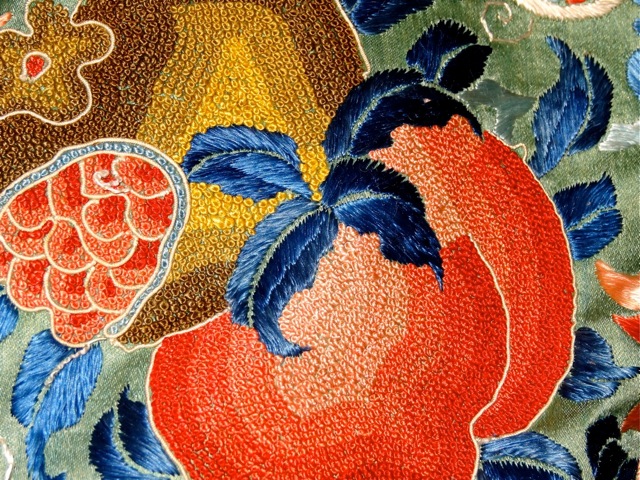
Chinese embroidered textiles often cause gasps among Western needle workers because their beauty and the obvious skill of their workmanship are simply astonishing.
Antique Asian textiles in good condition are becoming increasingly difficult to find. When a textile is found in good to excellent condition, it is a near miracle.
The Ku Hsiu method of embroidery that was perfected during the Ming Dynasty by the Ku family in Shanghai is recognized as the superior type for its exquisitely realistic pictures of flowers, birds, insects, and butterflies. Skillful artists even embroidered fine portraits.
For portraits, large frames were covered with pure silk satin and then mounted on turntable pedestals. Next, the subject to be embroidered was penciled in very lightly. The embroiderer used tufts of floss dyed in a wide range of colors and needles so fine that they could only be gripped if the fingers were soft and uncallused.
The shading that makes this embroidery spectacular was the result of using the embroidery floss like a paintbrush, overlapping strokes and changing shades or colors at will. The front and reverse sides are almost indistinguishable because the embroiderer carefully covered the ends where different colors were introduced, making knotting unnecessary.
This work was so fine that much of the clothing and embroidered scrolls that have been hung in daylight have disintegrated, making such a piece a rare find today.
More readily available and equally beautiful in its own way is the embroidery done in Peking (Beijing), Canton, and Hunan. The Chinese employed all the known embroidery stitches. This embroidery was exported to Europe as early as the 16th and 17th centuries and later made its way to the United States.
Forgotten Luxury, a San Francisco-based company, had in its collection an exquisite embroidered panel of deer and birds drinking at a stream by pine trees. The pine trees were so finely worked that the bark and needles look almost alive. An Australian bought it for $5,000.
Embroidery on the Mandarin garments found at antique shops today in coats, skirts, and rank badges, was mostly done in Peking. The “forbidden stitch” was employed in much of this work.
A lingering mystique revolves around this stitch. It has been said it was forbidden to all but royalty, or that it was forbidden because it made embroiderers blind, but the term simply refers to a stitch developed in Peking’s Forbidden City—the area that was off limits to all but the emperor and his court.
The Forgotten Luxury collection included some pillows of exquisite workmanship in which delicately rendered butterflies and flowers were embroidered on top of pleated silk without having the thread pass through the entire pleat. As a result, the embroidery appears to float on the surface.
I marvel at this process, for even though I have been a needleworker since I was 5 years old, I have no idea how this feat was accomplished.
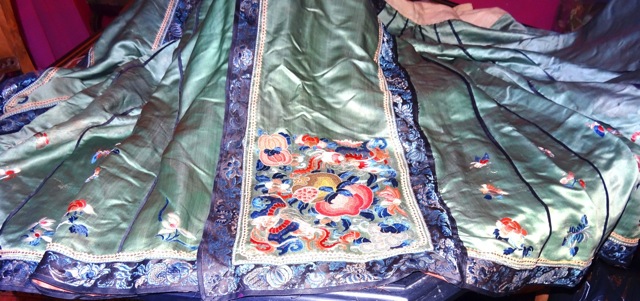
As we pull on our denim jeans and toss on a sweatshirt, we are light years away from the exquisite clothing of old China. A woman’s winter dressing is described in great detail in the book The House of Exile, by Nora Waln.
Beginning with a binding of strong flesh-colored silk from armpits to hips, a woman would next put on a type of pajamas of peach silk that wrapped over in pleats in back and front. Over this, she wore a second suit of heliotrope-colored satin lined with white rabbit fur and cut to the same pattern.
Next came white socks tucked around the legs of the pants. Ankles were then wrapped in puttees of apple-green silk satin. Then came a third pajama suit fashioned of wine-red silk brocade warmed with an inner lining of grey squirrel fur.
For outerwear, a sleeveless cobalt-blue silk jacket lined with beaver fur completed the winter garb. All these garments were embroidered with elaborate renderings of birds, flowers, butterflies, bats, phoenixes, or dragons.
Today, few of us could afford to live in such luxurious attire, but we can still bring a little of its beauty into our lives, perhaps by using an antique Mandarin coat as evening wear, or adding the exotic touch of a beautifully embroidered Chinese silk collar.
Japanese Textiles
Japanese embroidered textiles and brocades can also lend a touch of exotic elegance to the home in the form of pillows and wall hangings.
Japan has a long history of the textile arts. As early as the Jomon Period (circa 11,000–300 B.C.), people used fish-bone needles for simple stitchery. By the 7th century, creative stitching decorated ceremonial robes for the emperor and the nobility.
However, most of the early embroideries were used for Buddhist banners, which were sewn by friends and relatives of a deceased person in order to help him along on his way to heaven.
During the Muromachi period (A.D. 1392–1568), embroidery was used as a substitute for the more expensive brocades. This versatile form of fabric decoration appeared on kosode (an ancient form of kimono) and Noh theater costumes, which glittered with nuihaku (a combination of embroidery and imprinted gold or silver leaf).
The softer silks of the Momoyama period (A.D. 1568–1615) were embellished with stitchery, using untwisted silk and gold or silver thread to create small, simple designs. By the end of this affluent era, embroidery had reached its height.
In the isolation of the Edo period (A.D. 1615–1868), the popularity of embroidered motifs increased. Embroidery was in such high demand that one shogun (military commander) ordered 32 elaborately embroidered kimonos over a period of 16 years. When we consider the work involved, the task must have been formidable.
The popularity of this decorative form soon declined, however, because of its extravagance, and the simpler and less expensive method of appliqué emerged.
Religion played an important part in the preservation of Japanese textiles. Kosode and other textiles that were considered extremely valuable and of the finest quality were donated to Buddhist temples on their owner’s death and were often inscribed on the lining or on the presentation cover by one of the temple priests.
Antique Japanese and Chinese textiles are becoming scarce today. There are a fair number of mediocre reproduction pieces around from the 1920s and later, but the fine old pieces are rare and always in demand.
Chinese and Japanese embroidery lends itself well to home decor. Panels can be framed on acid-free mounting board to protect the silk from deterioration, and then framed using an ultraviolet protective plastic instead of glass to prevent sun rot.
There is a near magic to the way Asian textiles can mix remarkably well in modern and traditional interiors. For example, a pine daybed looks wonderful mounded with a combination of Chinese, Japanese, and Western textiles turned into cushions, as long as the colors blend well together.
An added sense of richness is created by mixing different periods, textures, and cultures as if one has returned home after a long trip, bringing treasures from an excursion down the exotic Silk Road.
Cherie Fehrman is part of ForgottenLuxury.com, a San Francisco-based company of designers and collectors offering their treasures online. Fehrman is a designer, color consultant, antiques dealer, author, and avid collector.
The Epoch Times publishes in 35 countries and in 19 languages. Subscribe to our e-newsletter.
