Before the geocentric understanding of the universe was dismantled by Nicolaus Copernicus and Galileo Galilei’s observations, people believed the Earth was the center around which the planets, stars, sun, and moon revolved. This conception of the universe originated the Pythagorean philosophical concept of “musica universalis” (“universal music”), also known as “music of the spheres.”
Although this universal music was not audible to human ears, the idea was that the celestial bodies moved in such a way that produced frequencies and hums based on their orbits, and that the soul could perceive this inaudible musical harmony.
In the sixth century, Boethius, a Roman polymath and philosopher, wrote a treatise on music titled “De Musica.” Boethius broke music down into three classifications: “musica instrumentalis” (instrumental music), “musica humana” (music of humans), and “musica mundana” (also known as music of the spheres). Musica mundana is a proportional, mathematical harmony that exists in the celestial realm. Musica humana conveys the sense that the human body, like the celestial bodies, is governed by a harmonious order found in the relationships among body, mind, and soul and makes audible the inherent harmony of the human spirit.
Tonal Mood of ‘Gloria’
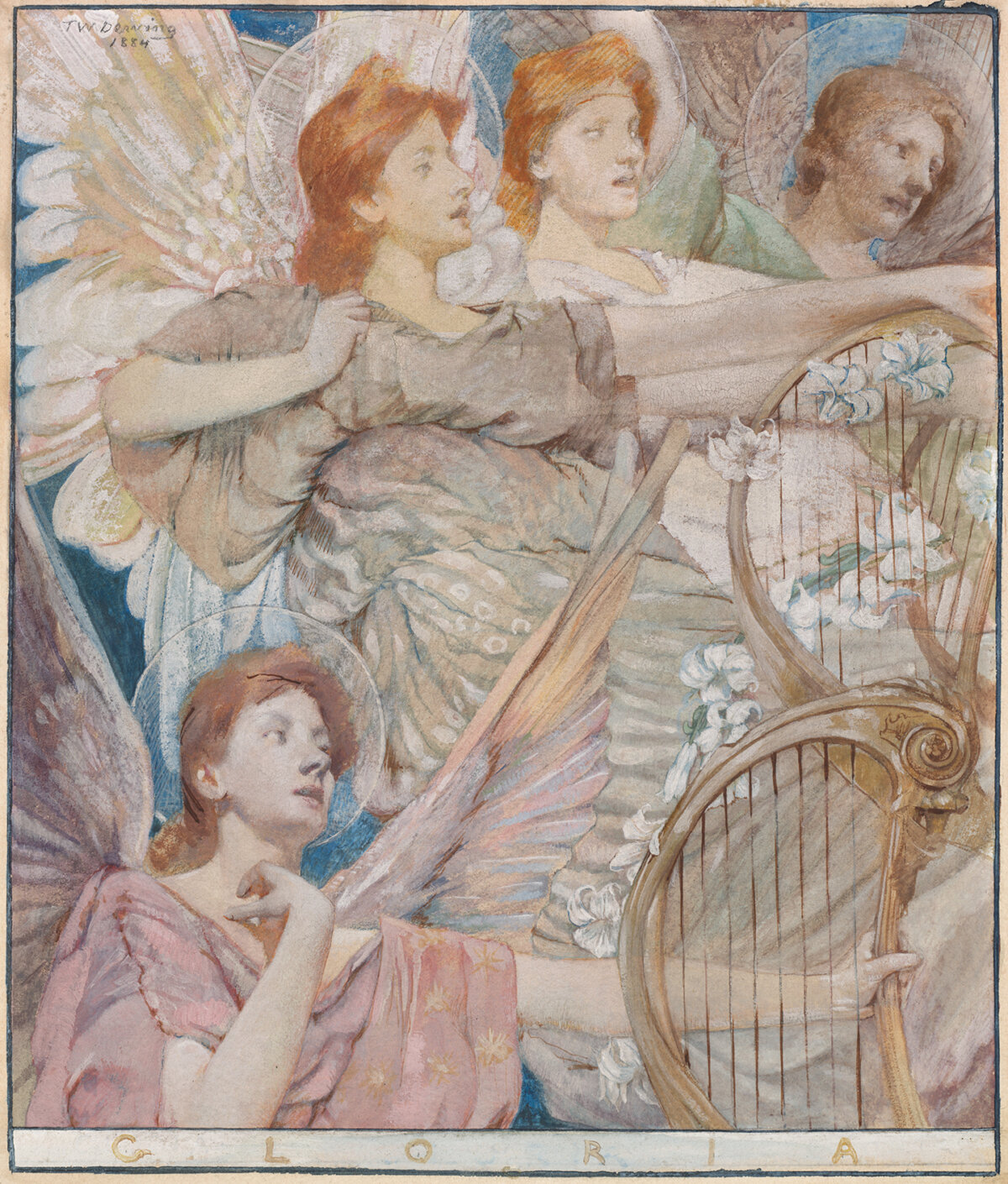
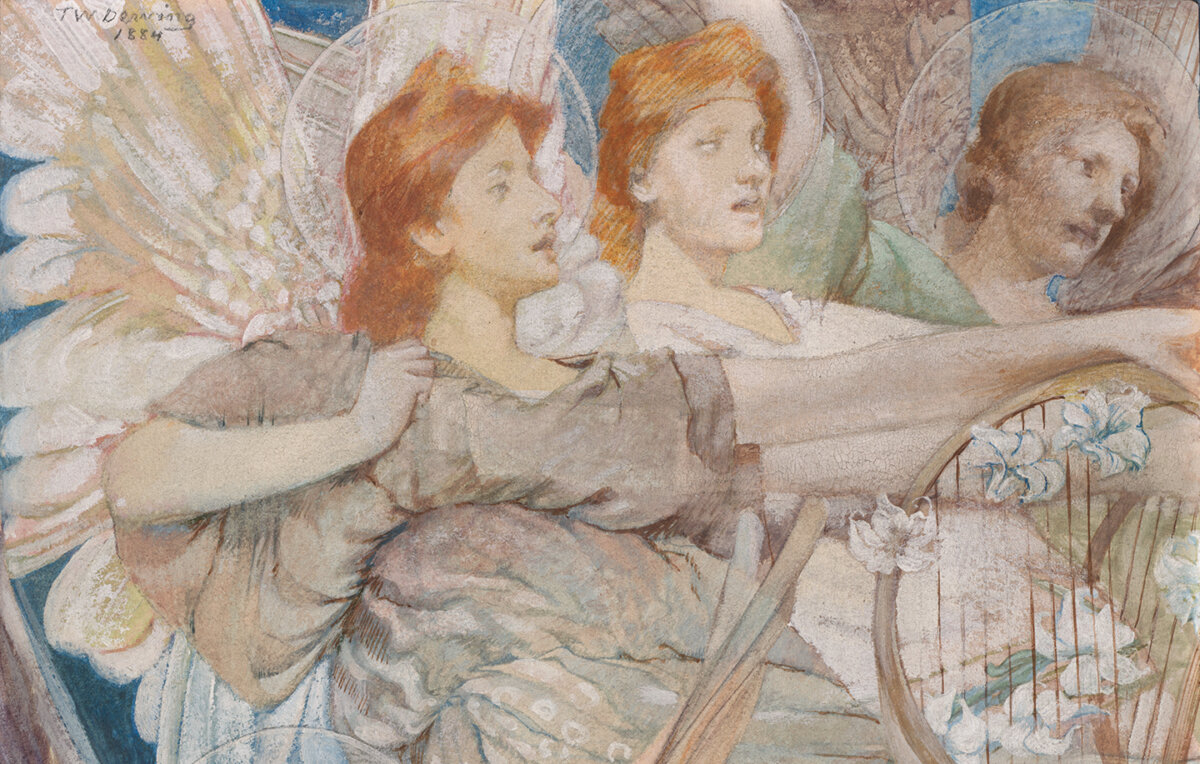
In Thomas Wilmer Dewing’s 1884 composition “Gloria,” four singing angels wielding harps are depicted in a manner reminiscent of 14th-century medieval manuscripts. The compressed, small-scale drawing uses pastel tones in gouache over graphite to portray the angels who each don a patterned, flowing dress and have a large set of wings.
While the composition is flat and chalky, what it lacks in dimensionality it makes up for in harmony of design elements. A hypnotic, soft interplay of textures invokes musical harmony. The artist uses the soft interplay of textures of white flower petals, wings the color of muted rainbow sherbet, and whimsically patterned dresses with repeating motifs.
Each angel has a halo encircling her head, which visually resonates with the sinuous curve of the harps they hold. Compositionally, the elegant, fluted spirals of the soundboard and pillar of the wooden harps are echoed in the helical arrangement of angels, each one overlapping the next. The manner in which the angels hold their harps—the strings that are threaded with garlands of delicate white lilies—is reminiscent of an archer drawing a bowstring.
Harp and Heavenly Harmony
The harp’s association with heavenly or celestial music can be traced back to ancient civilizations and is found in the artistic traditions of ancient Egypt and Greece. In ancient Egypt’s mythology, the harp was associated with the goddess Hathor, a deity of many realms, including maternity, beauty, and music. In an epitaph used to praise Hathor, the goddess is described as the “mistress of music,” the “queen of harp playing.” In ancient Greece, the god Apollo was often depicted playing a lyre, a stringed instrument comparable to a harp. Apollo’s lyre is an image of celestial harmony, or the music of the spheres.
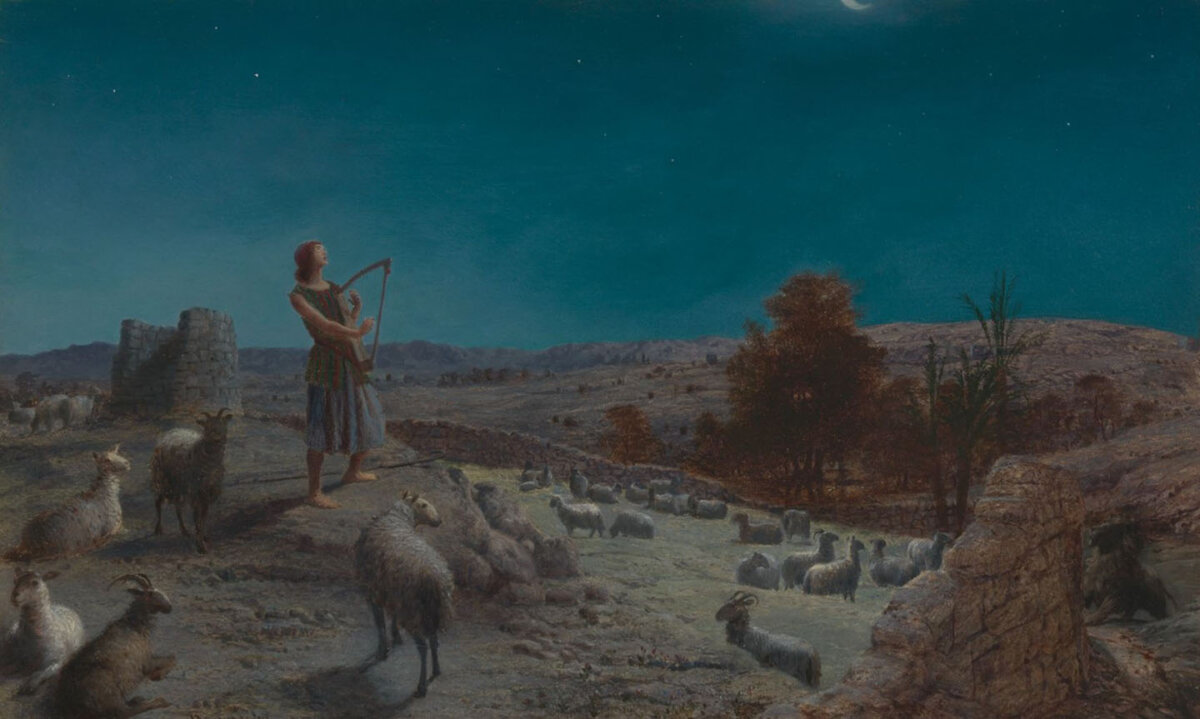
In the Christian tradition, particularly the Old Testament, the harp is mentioned many times in association with spiritual healing and worship. David, known for his musicality, used his harp to banish evil spirits from King Saul. This is one of many instances in the Old Testament where David plays the harp to induce the divine realm’s healing properties.

In the “Book of Job,” Job laments his suffering, expressing how his “harp also is turned to mourning, and [his] organ into the voice of them that weep.” (Job 30:31) The idea this conveys is that the harp can musically express the sentiment of sorrow, acting as a direct channel for the transformation of emotion into sound.
The Psalm mentions: “Praise the Lord with harp: sing unto him with the psaltery and an instrument of ten strings” (Psalms 33:2). In this verse, the harp is an instrument of praise and worship befitting the exaltation of God.
Celestial Movement
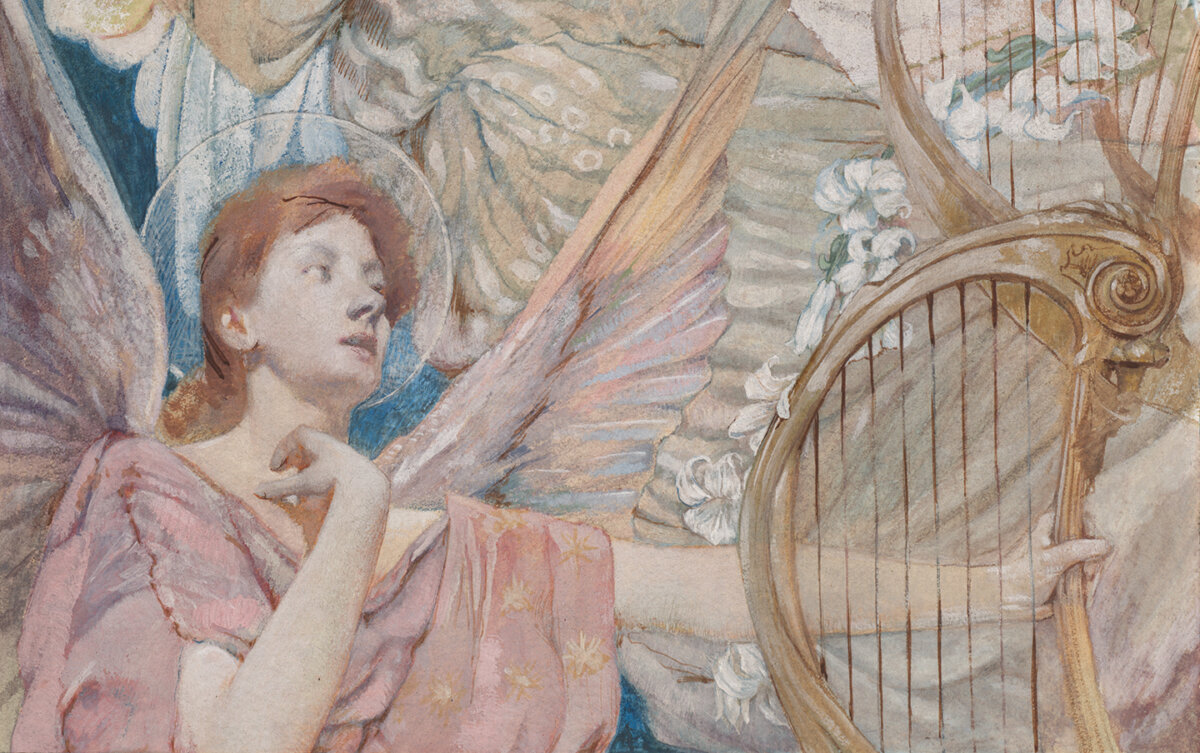
“Gloria” conveys the effect of being swept up in an eddy of air and held aloft by soft, melodious notes of heaven. Not painted as grounded, the angels appear to be whirling about in a spiral. The bottom right corner of the drawing is especially effective at expressing this sense of movement. Dewing simulates the crinkly, blurred effect of taffeta in motion by layering the windswept fabric behind the harp strings, where differing patterns converge harmoniously. Aurally evoked is the sound of dresses brushing up against each other in a ballroom. Within the seemingly disordered textures and decorative elements, there is an order to the composition brought about through color harmony and the arrangement of abstract shapes.
Dewing uses a variety of techniques, drawing from both painting and draftsmanship, to create a whimsical and captivating image. He commonly hatches layers over a subdued, abstract shape to express depth. See a notable example of this layering technique in the foreground angel’s hair. While her ginger locks are a vague mass appearing like muted, rubbed chalk, Dewing added several brown lines to offer structure to her hair. The interplay of textures and patterns results from Dewing’s use of the various techniques of etching, drawing, oil painting, and watercolor.
Dewing also plays with line and pattern by subtly varying the weight of his lines. The harp strings fade in and out of focus—their relative opacities and transparencies creating the effect of a glossy or reflective surface catching the light.
Drawn on beige wove paper, the middle tone allows the painter to increase or decrease value (lightness or darkness of color) by adding white or darker values such as the blue in the background.
In some parts of the composition, Dewing uses the beige tone to his advantage, purposely leaving sections of the composition unfinished to let the drawing breathe. He uses artistic methods in this way to visually convey the harmony of the music of the spheres.
Music-Making Angels
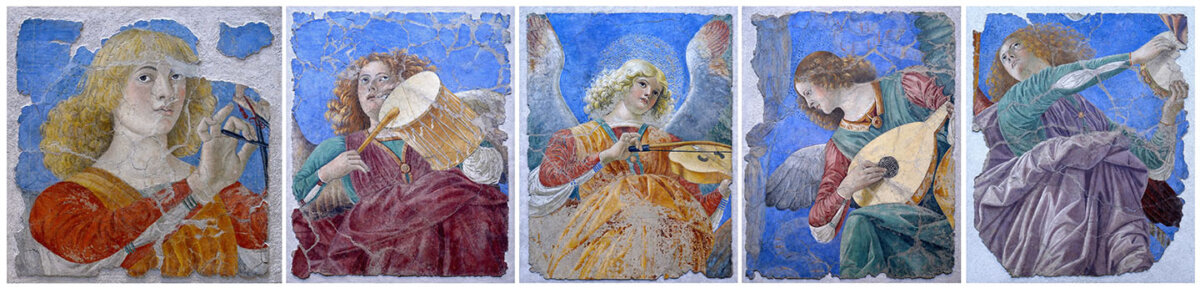
Another example of the association between music and the heavenly realm can be found in Melozzo da Forlì’s fresco fragments of angels playing instruments. Between 1480 and 1484, da Forlì, an Italian Renaissance painter and architect, painted the vault of the apse at the Santi Apostoli church in Rome—a project commissioned by Cardinal Giuliano della Rovere.
The subject of the commission was the “Ascension of Christ,” and the fresco is one of the first extant examples of perspective being successfully applied to the human figure on ceiling decorations. In 1711, under Clement IX, the fresco was removed and divided into 16 fragments when the apse was dismantled to renovate the church. Today, only these 16 fragments of the original fresco remain, some of which depict music-making angels. These, along with paintings of the Apostles, are now on exhibition in the Vatican Pinacoteca and Museo del Prado.
Giorgio Vasari, the 16th-century Italian Renaissance painter and historian (best known for his artistic biographies “The Lives”), described da Forlì as having an aptitude for perspective, a novel skill at the time. Da Forlì was particularly skilled at the foreshortening “di sotto in sù” technique, which translates to “from below looking up.” He employed this perspectival skill in the music-making angels, which fit the environment where the paintings were originally located: the apse of the Santi Apostoli. Worshippers would have entered the Roman Catholic parish and circumambulated the nave before arriving at the apse, where, looking up, they would gaze upon the “Ascension of Christ” and the angelic choir created by da Forlì.
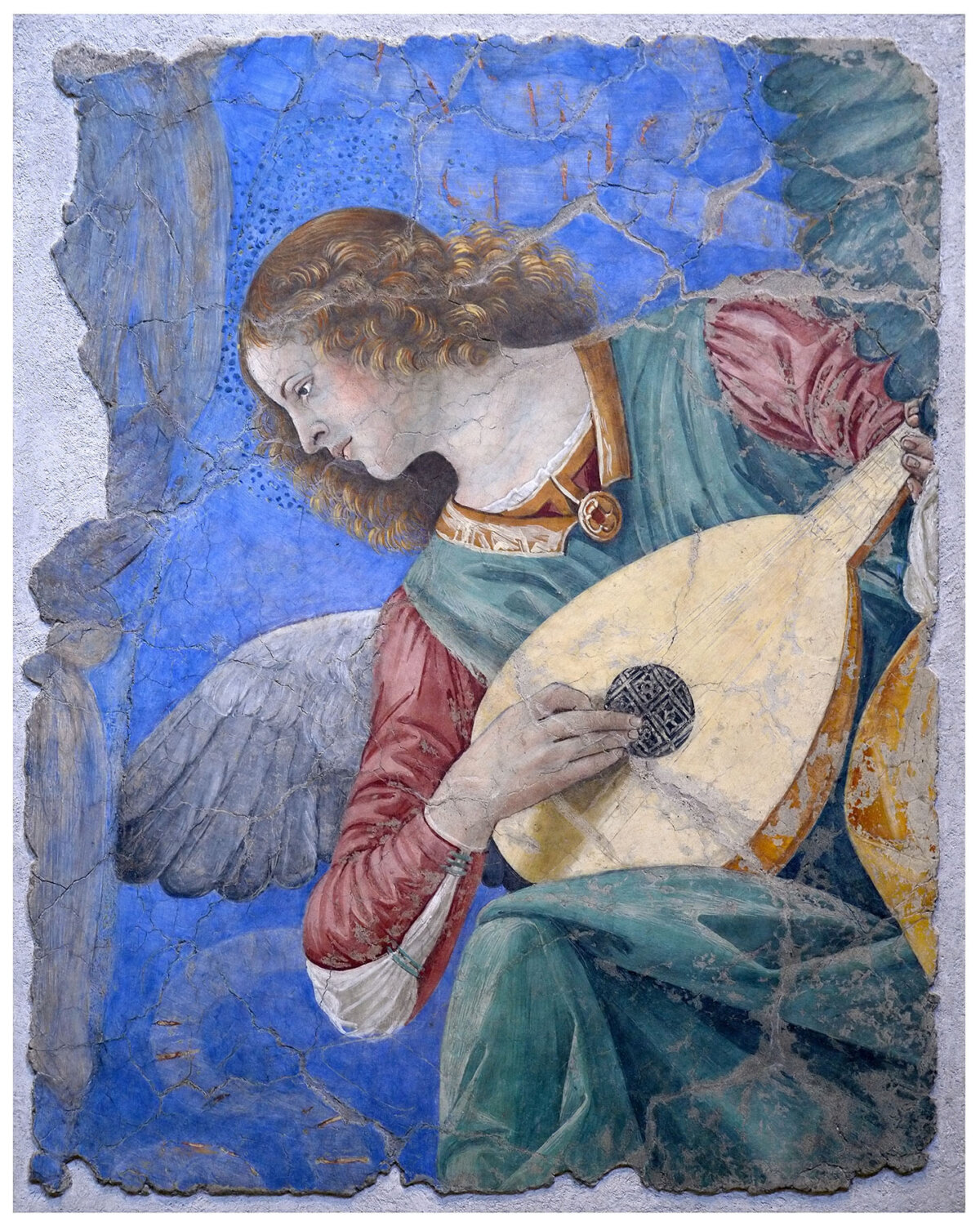
In one of the fresco fragments, an angel in profile plays the lute, his gaze focused on a scene beneath him. The vibrant, gemlike tones used to portray the angel’s hair, clothing, and the fresco’s background create a shared color harmony with the other four angels in the collection.
In 1415, music theorist Nicolaus de Capua wrote a treatise called “Compendium Musicale.” He replaced “musica mundana,” which had originated in ancient Greece and survived through Boethius’s codification, with “musica angelica,” or angelic music. In this way, the concept of universal music—which had its roots in Pythagorean thought—was replaced in the Middle Ages with the Christian notion of angelic choirs, or the song of the angels.
“Musica angelica” is what da Forlì portrayed in his fresco. The sense of the heavenly realm would have been augmented by the fresco’s place in situ, where worshippers would gaze upward toward the heavens, their eyes met by the painter’s skilled foreshortening. The angelic choir expressed in chromatic pigments heightened the expression of the instrumental music played during the liturgy, invoking the presence of the angelic choirs from on high.
The Scripture is from the King James Version.