



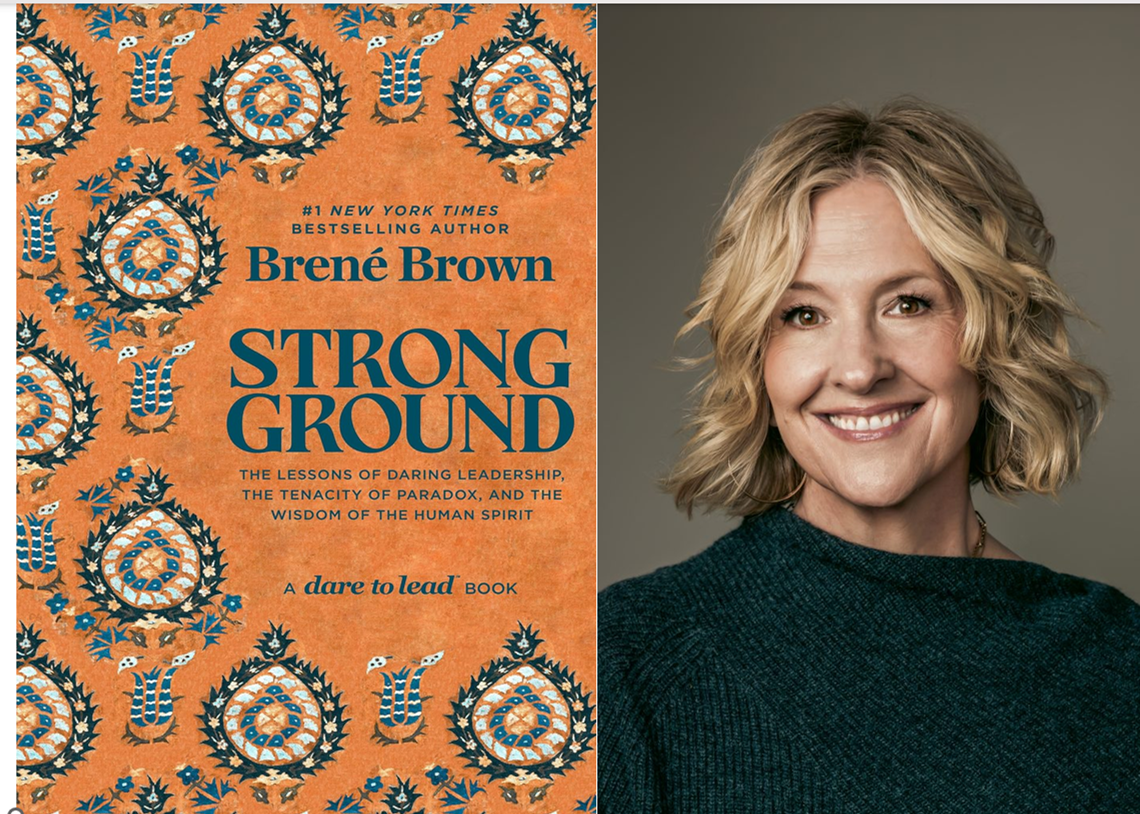
Brené Brown, the renowned research professor, became a household name overnight following her 2010 TED Talk on the power of vulnerability. It became one of TED’s most widely viewed presentations and catapulted Brown’s writing career to great heights. Audiences embraced her themes of accepting human imperfections to live a more courageous life.
After writing six bestsellers, Brown gathered the material for her latest book, “Strong Ground: The Lessons of Daring Leadership, the Tenacity of Paradox, and the Wisdom of the Human Spirit,” from working with and coaching business leaders around the world.
She’s included insight from well-known behavioral experts. These experts share their guidance on keeping one’s humanity in the face of “growing instability, personal disconnection, and the disorienting integration of AI technologies.”
The Pickle Ball Court
The inspiration for this book stemmed from a stumble on the pickle ball court. Eager to impress the other players, the overzealous Brown lost her footing and fell to the ground. The pain was “searing,” she writes, as if she’d been stabbed.
What followed was a series of physical therapy sessions, which frustrated the irritable patient. At one point, her physical therapist asked her to “find the ground,” a term which meant to connect her mind and body in her approach to the therapeutic exercises.
Brown writes that she was someone who always “lived in her head.” Because of this, she wasn’t fully engaged in the physical movements required to regain her strength and mobility.
The “find your ground” notion clicked with her. From then on, whenever she needed to be laser focused on something, she’d repeat the phrase like a mantra: “strong ground, Brené, strong ground.”
Using another sports analogy, she describes how an NFL team uses a version of the grounding theory on the playing field. When the team needed to move the ball just a tiny bit, all the players would line up behind the quarterback and push together to propel him forward. Even Neil deGrasse Tyson, the astrophysicist, confirmed this, calling it an example of “ground force,” a fundamental physics principle.

‘Metacognition’
It’s in these accounts that Brown works her magic; she uses everyday examples, which are easy to visualize, to define complicated theories. She writes with a lively, self-effacing style, often referring to the blunders and foibles in her life and marriage.
Later in the book, Brown introduces “metacognition,” which may be a new term to readers. She admits it’s a bit off-putting but breaks it down into simple terms, defining it as “thinking about how you think and learn.”
One of the core ideas for leaders is to find their strong ground or foundational footing when faced with confusion and chaos. Reacting impulsively or making decisions under pressure may put them or their organizations at risk.
The author shows her command of the subject when she combines research findings with personal stories, translating them into theories that have proven successful in her Dare to Lead coaching program.
Brown utilizes the term “paradox” often, as studies have shown that success can exist even when the goals seem contradictory. To illustrate, she refers to the Stockdale Paradox. It’s named after Adm. James Stockdale, who kept fellow POWs alive during the Vietnam War. The prisoners who believed they’d be home by Christmas would fall apart when they weren’t released. Those who kept their faith survived, said Stockdale, when they understood the brutal fact that their freedom wasn’t something calculable or guaranteed.
The Human Spirit
In this age of ever-advancing technology, Brown recalls the wisdom of the human spirit in all things. “We’re neurobiologically hardwired for connection,” she writes in the early chapters.
Ways that a company can find their ground is to respect and protect “human wisdom and connection.” This is true, she says, even when the computer code is genius and the algorithm perfect.
It’s Brown’s way with words, and her use of visual examples that will keep readers engaged. She’s unafraid to share her failures and vulnerability to prove a point.
Readers will feel connected as they read about the time she sent an unnecessarily harsh email to colleagues when a kinder one would’ve been more productive. She writes of how, during family board game nights, the game doesn’t begin until she’s read all the rules aloud. She also admits that when she’s scared, she “can be really scary.”
For fans of Brown’s previous works, “Strong Ground” may seem repetitive, and some of her theories may be familiar. For new readers, her suggestions may come across as abstract, leaving them unsure where to start. Having an addendum with questionnaires or worksheets may have helped by laying out a practical plan.
However, this doesn’t take away from the value of her teachings. CEOs of large companies, corporate department leaders, coaches, and heads of households should find these data-driven theories worthy of discussion and experimentation.
Strong Storytelling
When not writing, Brown is a professor at the University of Houston, a member of the faculty at the University of Texas, and Executive Chair of the Center for Daring Leadership at BetterUp. Her bio also describes her as a “researcher, storyteller, and Texan who spent the past two decades studying courage, vulnerability, shame, and empathy.”
She’s most definitely a storyteller, incorporating not only herself but family, friends, and colleagues into scenarios readers can connect with. Some stories are sentimental, and some are downright hilarious.
Think of Brown like your favorite lecturer in school; though the subject matter may be difficult, it’s that one class you’d never skip.
‘Strong Ground: The Lessons of Daring Leadership, Tenacity of Paradox, and the Wisdom of the Human Spirit’
By Brené Brown
Random House: Sept. 23, 2025
Hardcover, 448 pages
What arts and culture topics would you like us to cover? Please email ideas or feedback to features@epochtimes.nyc
