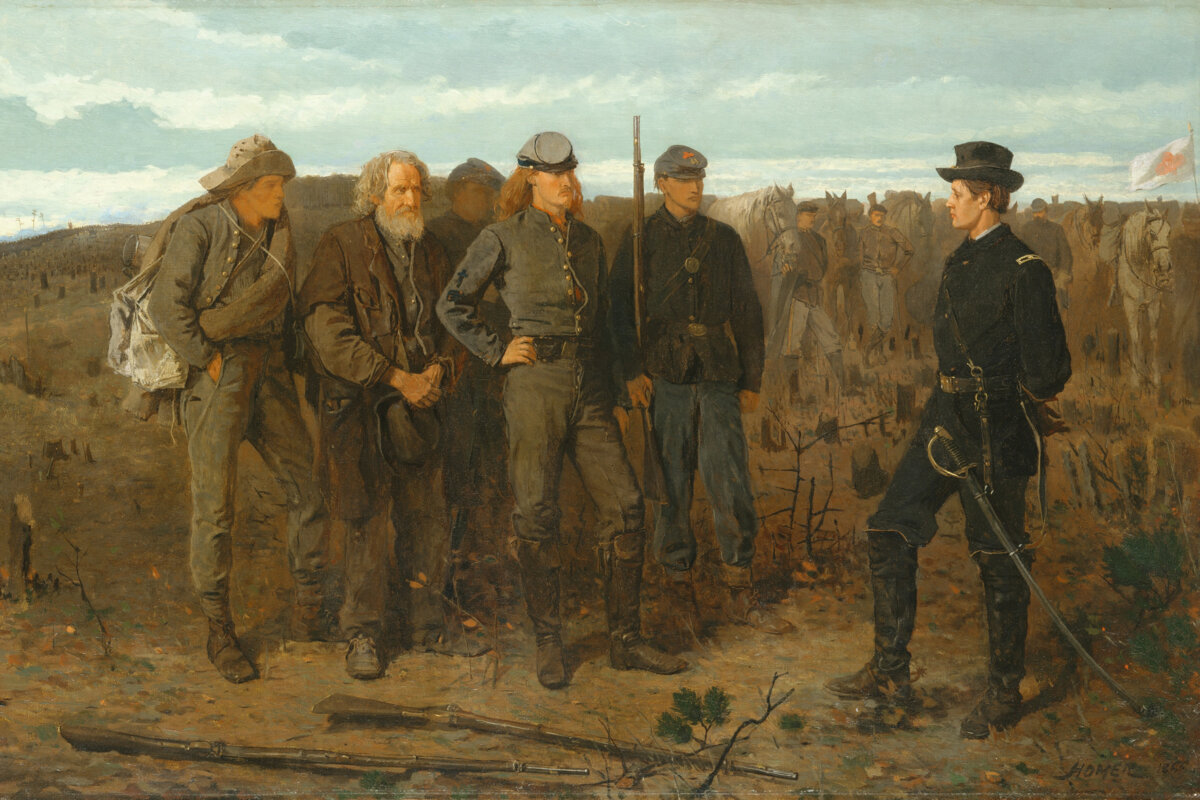
Winslow Homer (1836–1910) is arguably the greatest 19th-century American artist. Mostly self-taught, he mastered illustration, oil painting, and watercolor media. His innovative and resoundingly original oeuvre explores timeless, epic themes. These include conflict, the power of nature, and the fragility and transience of life.
As an artist correspondent early in his career for the illustrated periodical Harper’s Weekly, Homer crafted some of the quintessential visuals of the American Civil War (1861–1865). His 1866 painting “Prisoners From the Front,” now at The Metropolitan Museum of Art, is one of his pivotal creations; its critical acclaim established Homer’s fine art reputation.
Homer’s Pictural War Scenes
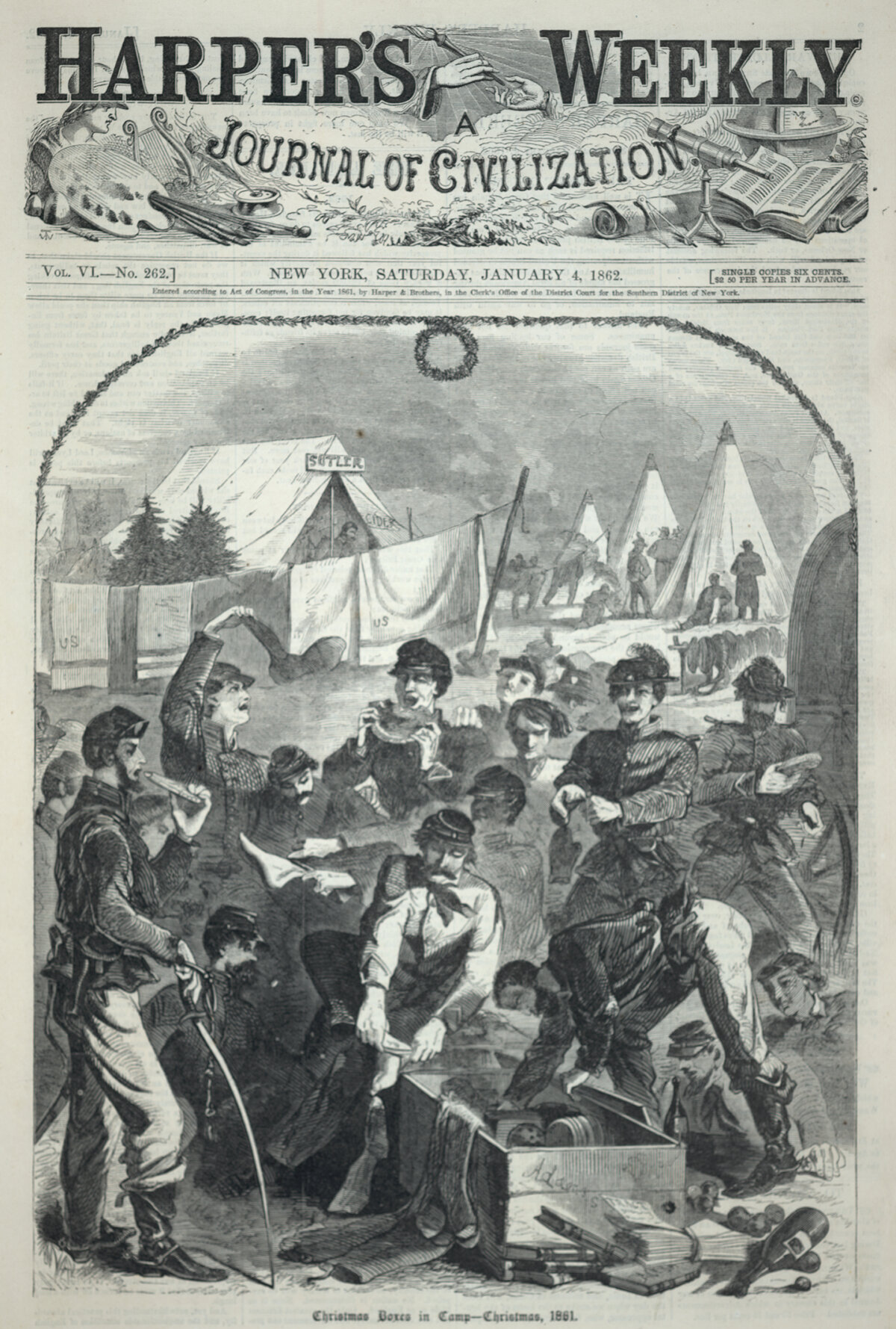
Homer was born in Boston, Massachusetts. He began his career in the graphic arts, first as a commercial printmaker and later as a freelance magazine illustrator. In 1857, Homer commenced an 18-year tenure at Harper’s Weekly, which had just launched that year.
Quickly, Harper’s became the nation’s premiere illustrated newspaper. Its success was facilitated by advances in wood-engraving technology, which allowed for images in weeklies to be printed inexpensively, swiftly, and on a mass scale. At the height of its circulation, Harper’s had as many as 200,000 subscribers.
Harper’s hired Homer as a full-time artist-reporter during the Civil War. His resulting images ranged from scenes of the home front to battlefields and camp life. Homer developed pictural strategies to capture wartime scenes with compelling narratives and honed his powers of acute observation.
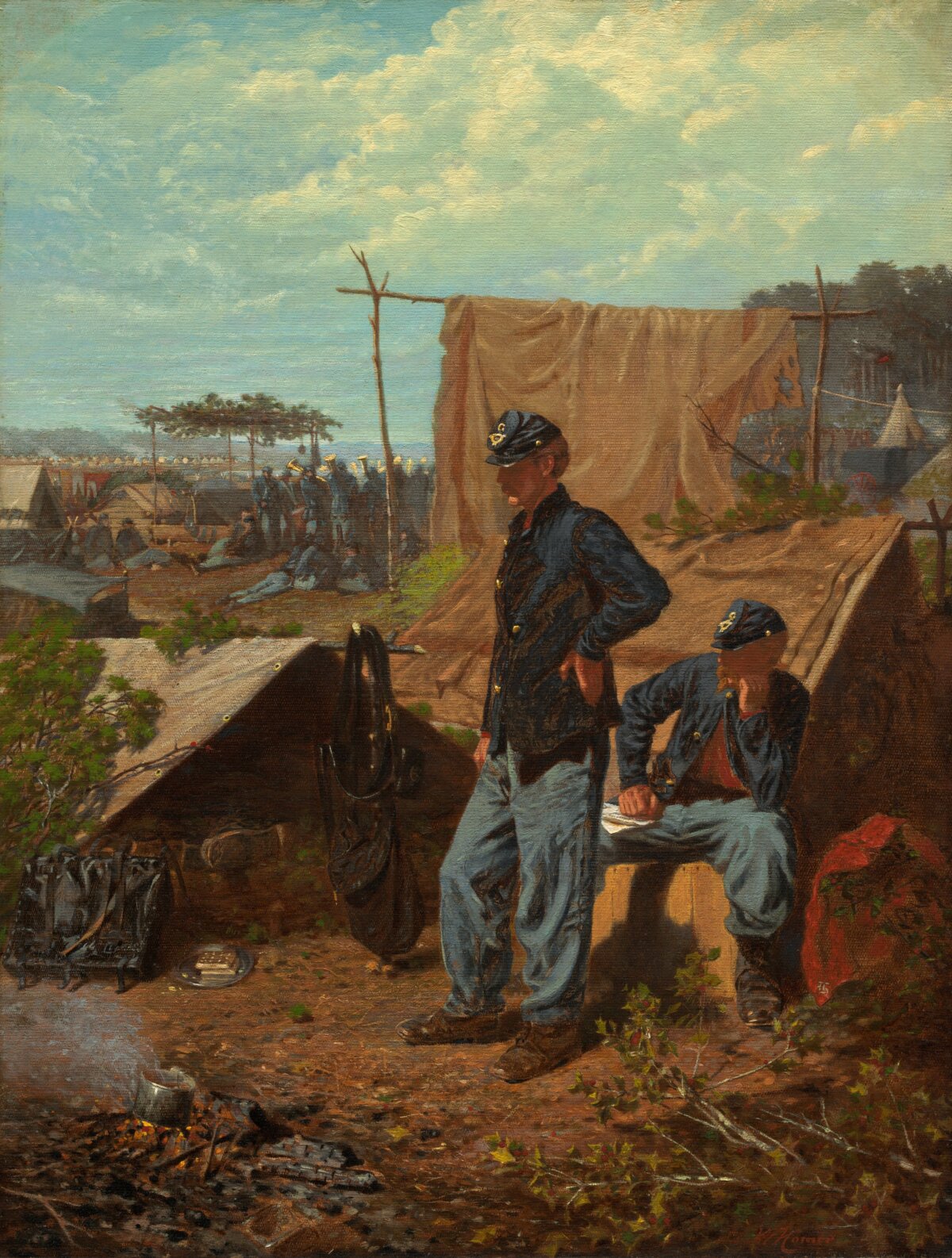
In addition to his Harper’s reportage, he made onsite sketches of Union soldiers for paintings that were completed in his studio. The National Gallery of Art’s “Home, Sweet Home” oil painting from 1863 is among Homer’s first paintings. It was praised for its conveyance of emotion without sentimentality. Throughout his career, Homer was brilliant at presenting dramatic scenes that never veered to bombast.
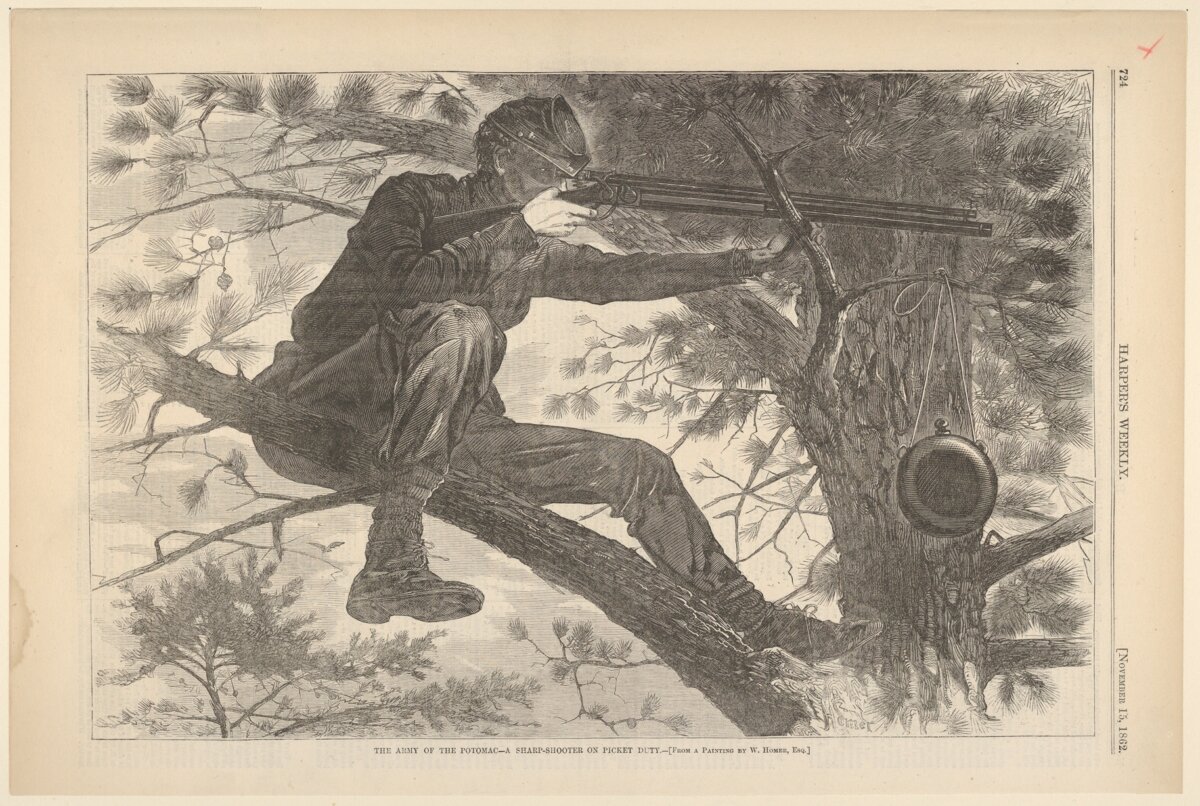
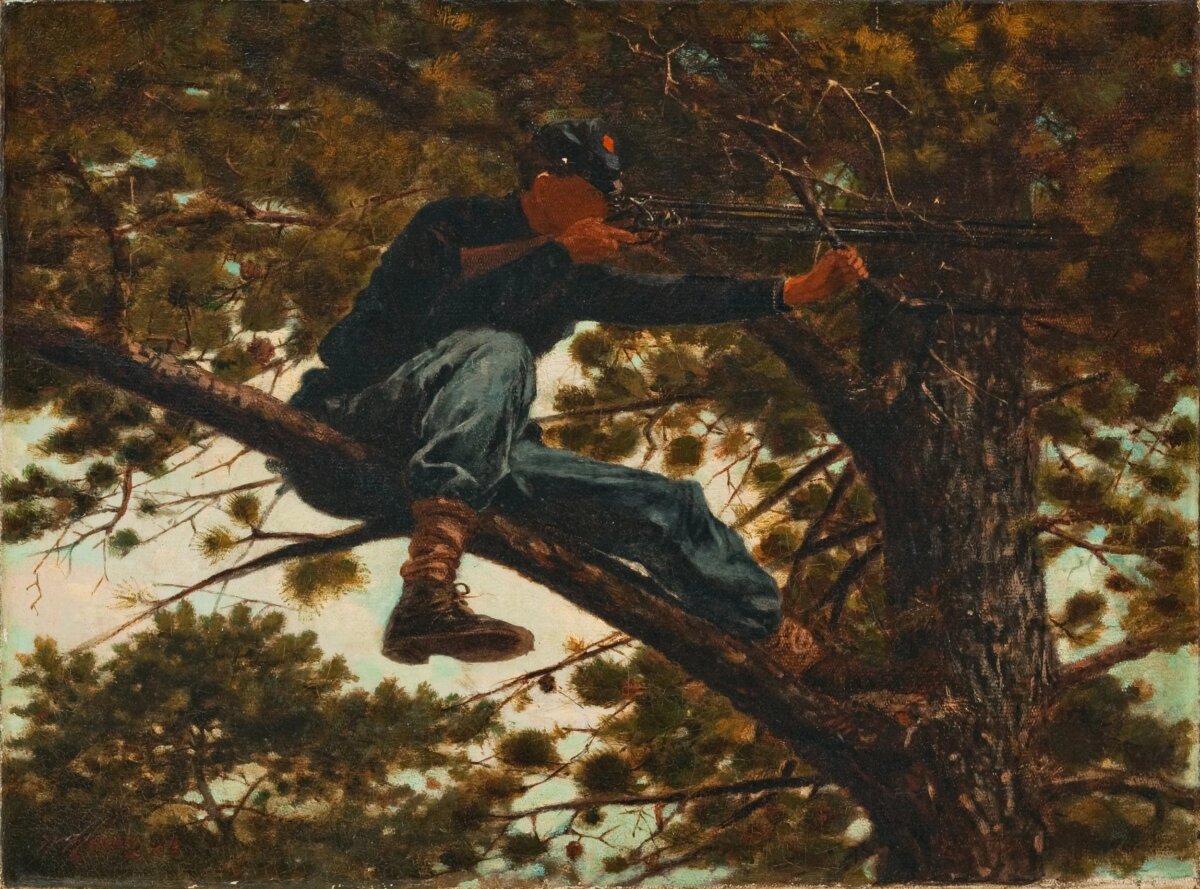
One of Homer’s most famous Civil War images is of a sharpshooter. He made it as both an illustration, which was published as a Harper’s wood engraving in 1862 and as an oil painting finished the following year. Both haunting compositions depict a Union rifleman, balanced precariously on a tree limb, taking aim at a Confederate mark. The painting, housed in the Portland Museum of Art, is considered Homer’s first significant oil.
‘Prisoners From the Front’
Homer painted “Prisoners From the Front” in New York immediately after the end of the war. The inspiration was a real-life event: the 1864 heroic capture of a division of Confederate soldiers at Spotsylvania, Virginia, by Brig. Gen. Francis Channing Barlow, a friend of the artist. The landscape, an integral element to most of Homer’s art, is rendered as ravaged. Tree stumps and churned-up fields speak to the environmental toil of human conflict. The setting’s muted tones are echoed in the gray Confederate and blue Union uniforms.
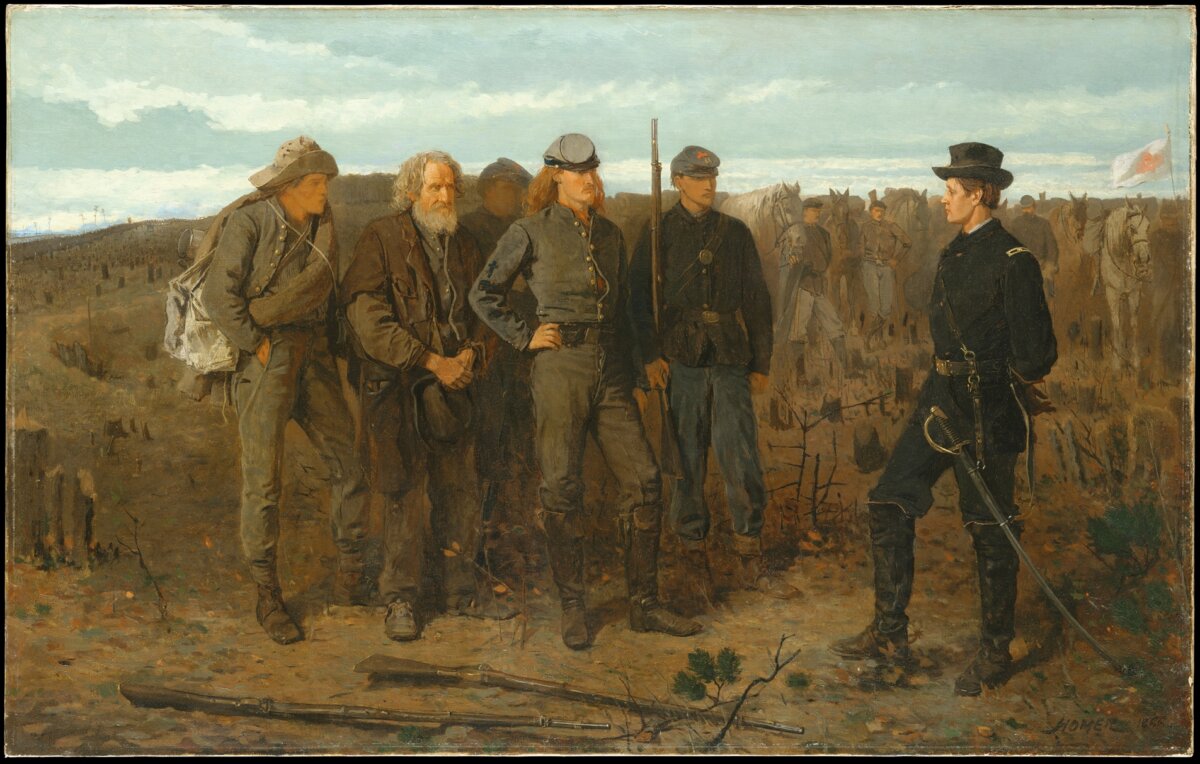
The center of the painting juxtaposes the worn, disheveled, and captured soldiers with the dignified victorious officer. The Confederate figures include a stoic elderly man and an uncouth youth. The most prominent Southerner of the group has a cocky, defiant posture, which is contrasted by Barlow’s restraint. They are positioned as foils: Regarding each other directly, both stand with one knee bent.
Multiple themes of the war’s impact and significance are vigorously explored in this canvas. The Met notes that a contemporaneous critic “suggested that the painting transcended a specific event to portray the entirety of the war.” While there is confrontation between the two sides, the figures are also clustered together and their heads line up at equal height. This speaks to a shared thread between the two sides—of everyone being American—and offers the possibility of reconciling.
“Prisoners From the Front” made Homer’s reputation upon its 1866 exhibition at the National Academy of Design in New York, establishing him “as a painter of pathos,” The Met wrote. The Museum explains that the artist “was fundamentally changed by the experience of war and carried its aftereffects throughout his career.” Appreciation and understanding of his later masterpieces, including intense depictions of rescues, hunting, and struggles at sea, are enriched by exploring his profound and poignant Civil War works.
What arts and culture topics would you like us to cover? Please email ideas or feedback to features@epochtimes.nyc.