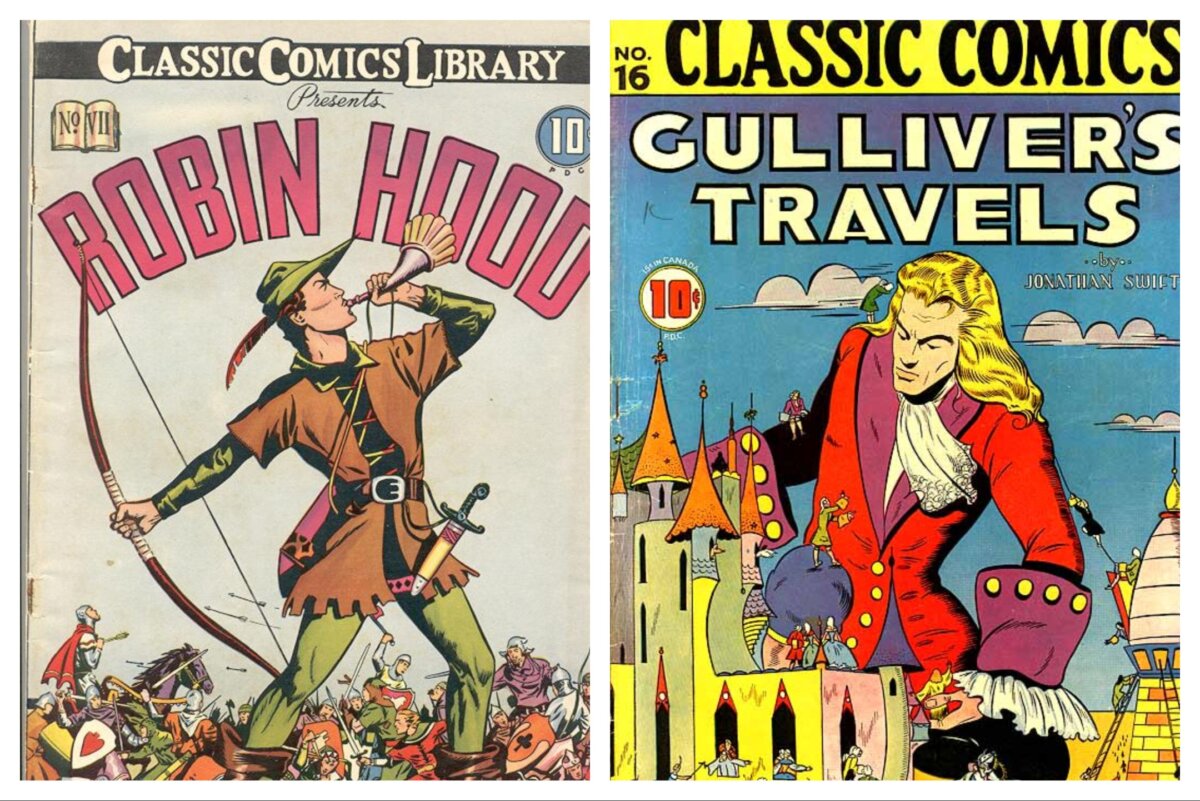
One evening just before Christmas 1955, 5-year-old Bill Jones and his father entered Hall Drug Store in Little Rock, Arkansas, to pick up a prescription. While Mr. Hall and his father visited, Bill looked over a spinner rack of comic books, each with a bright yellow rectangle in the upper left-hand corner. He quickly spotted one titled “Davy Crockett.” Every American boy would have recognized that coonskin-capped hero because of the television show starring Fess Parker, and Bill begged his father to buy him the comic.
In the introduction to his book, “Classics Illustrated: A Cultural History,” now in its third edition, William B. Jones Jr. writes of that magical, life-changing moment.
“I asked Dad what the large black letters in the yellow rectangle spelled, and he said, ‘Classics Illustrated.’
“‘What does that mean?’
“‘Good stories,’ he replied.”
“Davy Crockett” led Bill to “Moby-Dick,” “Robin Hood,” “Treasure Island,” and as many other titles in the Classics Illustrated series as he could lay his hands on.
“By the time I was eight,” he wrote, “the series had become the fulcrum of my imaginative life.”
Rather than playing at other comic book superheroes such as Batman, Bill and his boyhood friends acted out “The Three Musketeers” and “The Last of the Mohicans.”
“Those stories led me to the originals,” Jones told The Epoch Times. “They also enlarged my sense of human character and purpose and ideals.”
A Man With a Dream
In this interview as well as in his book, Jones recalled at length Albert Kanter (1897–1973), who as a boy had emigrated to the United States with his family and worked hard in sales as an adult. While working in New York City for a publisher of remaindered comics and dismayed by the reading habits of his children, who preferred comic books to the beloved timeless stories sitting on his bookshelves, Kanter came up with the idea of wedding great literature and the comics.
The result of this unlikely union, Jones said, was the Classics Illustrated of his childhood.
“Kanter wanted to get his children interested in reading classic literature and looking to D’Artagnan or Natty Bumppo as heroes rather than Superman or Captain America,” he told The Epoch Times. “So he got two of his friends together. They were all commuters from Long Island, and they invested in producing the first classic comics edition, which was the ‘Three Musketeers’ because Kanter loved that story. They contracted with one of the comics art shops in New York to provide the artists, and they were off.”
As the series grew in number and became ever more popular during the 1940s and 1950s, Classics Illustrated drew some critical fire from educators and others who feared that students would use comics to replace school reading assignments or that they would never go on to read the real literature. The proprietors of Classics Illustrated tried to allay these fears by refusing to solicit or allow outside advertising in their products, as most other comic books did. They also added stories and histories to the books. “Mutiny on the Bounty,” for instance, treated readers to a biographical page devoted to authors Charles Nordhoff and James Norman Hall, an article describing an assassination attempt against Franklin Roosevelt, another telling the story of an early American duel, and a short biography of football coach Knute Rockne.
And always, at the very end of each story on the bottom of the page were these words of encouragement: “Now that you have read the Classics Illustrated edition, don’t miss the enjoyment of reading the original, obtainable at your school or public library.”
Things Are Different Now
For parents and teachers today, Kanter’s hope for steering young people toward the classics is much less an issue than getting them to read books at all. Reports abound on a decline in reading ability in American elementary and secondary schools and even on the inability of college students to tackle a novel or a long poem. Explanations for this downturn in literacy and comprehension run from the failed whole language approach to reading, which is still being taught in some schools, to the near addiction of many young people to digital screens and social media.
Nevertheless, plenty of students are prepared for an introduction to the classics. Moreover, as was true in the middle of the 20th century when Jones was a boy, many parents and teachers are looking for ways to spark their interest in the best of our literature.
Here are a few resources that will acquaint the young with the characters and stories of the great books while at the same time reinforcing and enhancing their reading abilities.
Classics and Graphics
In “Classics Illustrated: A Cultural History,” Jones traces the tangled publishing history of these comics, which might have led to their demise. Fortunately, First Classics and Britain’s CCS Books have reproduced many of these works, either as replicas or with some changes. These reproductions remain a fine way for introducing young readers to the classics.
Saddleback Educational Publishing offers a number of classics geared toward different reading levels. Some of the books feature a classic with simplified prose, others with striking full graphics, including the works of Shakespeare. They also include notes and student activities. You’ll need to explore this site a bit to detect the differences and decide what is best for your child or student. Saddleback does allow free online samples of its books, allowing visitors a look inside.
For other classics in a graphic format, it’s best to search online by title with the added word “graphic.” One note: Be careful about buying one of these classics unless you’re permitted a look inside the book. Some graphic novels can be overly violent or otherwise unsuitable for the younger crew.
More Classics for Kids
Baronet Books, an imprint of the Waldman Publishing Corporation, publishes the Great Illustrated Classics series. These simplified texts with illustrations have the twofold purpose of building reading skills in adolescents while introducing them to the Western literary canon. The books contain a laudable selection of what might be unfamiliar words and follow the storyline of the original classic.
Here, for instance, are the opening sentences of the company’s “Oliver Twist”: “So long ago that now the date is forever obscured, the sound of a woman screaming silenced the quiet of the night. And then her cries fell dead.”
The story drops us straight into a London hospital ward and Oliver’s birth.
Published by Union Square Kids, Classic Starts aims its books at children in second to fourth grades. Among its offerings are those books that have traditionally appealed to the young, such as “Anne of Green Gables,” “Call of the Wild,” and “The Jungle Book,” as well as those usually associated with older readers, such as “Moby-Dick” and “Around the World in Eighty Days.”
Jones’s boyhood love of Classics Illustrated led him to read the originals as he grew older, both in school and later. His lifelong love of this series also induced him not only to write the best history of Classics Illustrated, its editors, writers, and artists, but also to edit and compile a book of essays about Robert Louis Stevenson.
Like him and countless others, I discovered Classics Illustrated in elementary school. And like Jones, my first encounter occurred in a drugstore in the mid-1950s, the Weatherwax Pharmacy in the small town of Boonville, North Carolina. Mr. Weatherwax was kind enough to allow me to sit on the floor of the periodicals section poring over these comics before purchasing one or two for the grand price of 15 cents apiece. Some of the panels from those comics, such as “The Man Without a Country” and “A Connecticut Yankee in King Arthur’s Court,” made so vivid an impression that they remain in my memory even today.
There are excellent reasons for introducing our children to the classics at an early age, but the best of all is the one Jones’s father gave him in 1955: They’re “good stories.”