



Conventional knowledge defines poetry as “what gets lost in translation.” The quote is from Robert Frost, and like many attributed quotes, it simplifies what he really said.
His actual statement, made in conversation with Cleanth Brooks and Robert Penn Warren, is that poetry is “that which is lost out of both prose and verse in translation.” Neither rendering can fully represent “the way the words are curved,” since a poem is closely tied to the sound patterns of the language in which it is written.
In our age, many English translators have exhibited a preference for rendering classic foreign-language poetry into their own free-verse approximations. While this might do a good job of capturing literal meaning, it essentially doubles the “lostness” of a poem’s spirit: If the verse meandered off its path a bit at first by the mere fact of being translated, it then wandered deep into the dark woods on a moonless night by being translated into lopsided prose.
All this is to say that some translators surpass others at capturing “the way the words are curved.” Or, echoing Samuel Taylor Coleridge’s definition of poetry, certain translations are better at recreating the “best words in the best order.”
An Important Living Poet

William Baer is a seminal figure in the contemporary poetry world. Over the past generation he has authored 25 books and played a significant role in renewing the popularity of traditional verse. This includes founding The Formalist: A Journal of Metrical Poetry and establishing honors like the Howard Nemerov Sonnet Award and the Willis Barnstone Translation Prize.
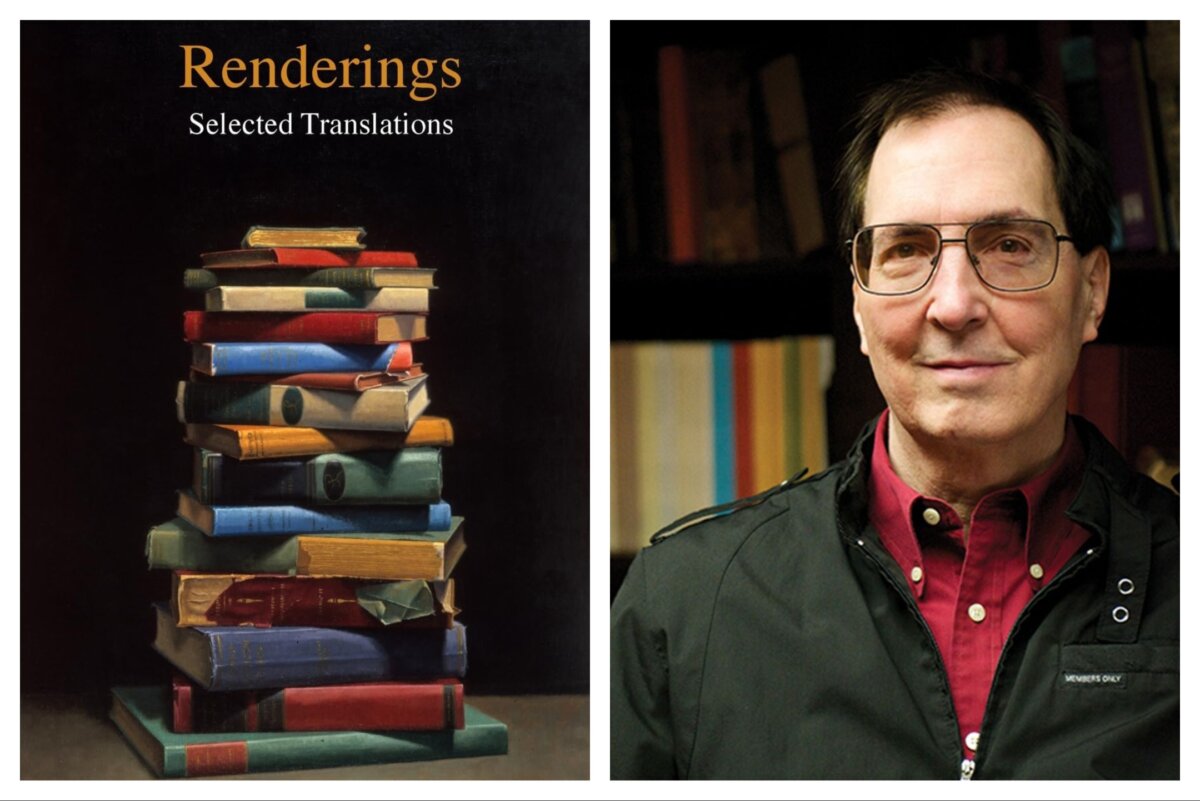
His most recent book, “Renderings,” continues in this vein. A book of translations ranging from ancient to modern times and spanning five languages, the title captures something of the necessary imperfection involved in interpreting carefully ordered structures of words.
Baer begins with the Latin poets Catullus, Horace, and a passage from Virgil’s “Aeneid.” From there, he moves to excerpting the great medieval epics: Dante’s “Divine Comedy,” “The Song of Roland,” and “El Cid.”
The bulk of the collection, however, is devoted to the sonnet. As the most iconic verse form developed in the West, Baer’s selections take us from Petrarch to the present.
A Profound (If Depressing) Italian
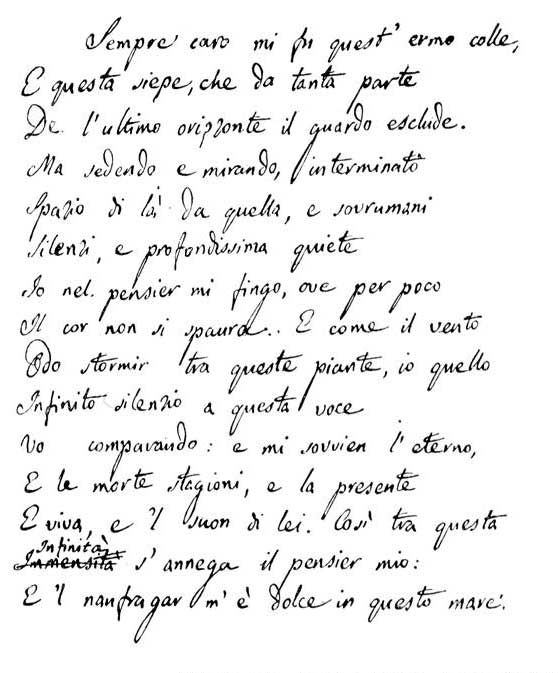
Giacomo Leopardi, considered the greatest Italian poet since Dante, has one poem represented here, “Infinity.” The original poem is a single, 15-line stanza of blank (unrhymed) verse. Its lines of hendecasyllables—the 11-beat line standard in Italian—cannot be reproduced in English without sounding awkward. Fortunately, iambic pentameter is a good substitute. By way of comparison, here is American poet Jonathan Galassi’s translation:
This lonely hill was always dear to me,
and this hedgerow, which cuts off the view
of so much of the last horizon.
But sitting here and gazing, I can see
beyond, in my mind’s eye, unending spaces,
and superhuman silences, and depthless calm,
till what I feel
is almost fear. And when I hear
the wind stir in these branches, I begin
comparing that endless stillness with this noise:
and the eternal comes to mind,
and the dead seasons, and the present
living one, and how it sounds.
So my mind sinks in this immensity:
and foundering is sweet in such a sea.
With its themes of loneliness, vastness, and mortality, the poem is somewhat of a downer, as is Leopardi’s work in general. The question as to how much of philosophical pessimism is mirrored in the biography of the pessimist—in Leopardi’s case, his life was sad, lonely, and short—is one we don’t have time for here. Still, the poem’s final line is unexpected: Despite the despairing thoughts and feelings building up to it, he manages to say his shipwreck is “sweet.”
Structurally, Galassi retains a metrical rhythm in his translation, but only about half the lines scan as having five beats. The others haphazardly range from two to six.
Unlike the pentameter line in English, the Italian hendecasyllable line does not have a rigid stress pattern, so the number of stresses in a line can vary. Still, Galassi’s seems to vary a bit too much. Now here is Baer’s rendering:
I’ve always loved this solitary hill
and even the hedges that partially obscure
the far and distant horizon from my view.
But sitting here and staring off I conjure
the infinite spaces beyond the far horizon,
the inhuman silence, the frightening stillness,
and my heart is almost overcome with fear.
Then I hear winds rustling through the trees
and compare the infinite silences of space
to the voice of the wind, and think of the eternal:
the now-dead seasons of the past,
and the living present with its own sound,
and all these immensities drown my thoughts,
but still it’s sweet to shipwreck in such a sea.
Baer’s stresses are more consistent, ranging between four and five beats. At the same time, his meter is less rigid and more supple than Galassi’s. By throwing in an extra syllable or two when it suits, Baer both avoids the predictability of undeviating iambs and mirrors Leopardi’s own practice of varying his lines slightly. Also, in accord with the collection’s theme, the translator has slightly compressed the poem to 14 lines, turning it into a sort of blank-verse sonnet.
The Greatest Poet (You’ve Never Heard Of)
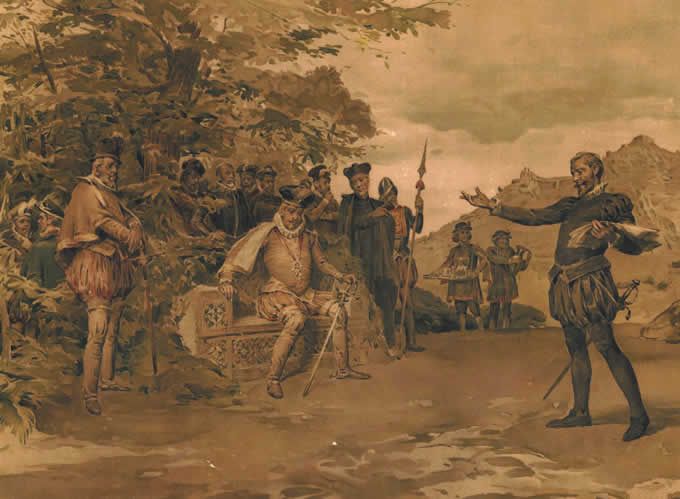
One of the most represented poets in this volume is also the greatest poet in the Portuguese language, Luis de Camoes (circa 1524–1580).
In contrast to Leopardi, a sickly nobleman who spent his youth confined in his father’s library and never left his native Italy, Camoes was a lusty lover of life. A seafaring adventurer, he suffered imprisonment, banishment, and even mutilation when he lost an eye fighting Moors in Morocco.
He is best known for “The Lusiads,” an epic poem about the explorer Vasco de Gama. But he also wrote an astounding amount of lyric poetry that is not well-known outside of his native Portugal.
This obscurity is reflected in his lack of representation in online databases. On the Poetry Foundation website, which has the English-speaking world’s largest catalogue of classic poems, Camoes does not even show up in the author section when searched. On the Academy of American Poets website, Poets.org (the second-most extensive database), he has one—a 19th-century translation of Sonnet VIII which, by our standards, is a somewhat stilted version full of archaic vocabulary.
As the first great European poet to explore the non-Western world, Camoes’s sonnets reflect his wide-ranging experiences. Even when they are about the more conventional topic of love, he often couches his subject from the perspective of a voyager. Here is Baer’s rendering of “Shipwreck”:
Like a weary sailor, a refugee
from wreck and storm, who escapes half-dead,
and then, in terror, shudders with dread
at the very mention of the name of the “sea”;
who swears he’ll never sail again, who raves
he’ll stay at home, even on the calmest days,
but then, in time, forgets his fearful ways,
and seeks, again, his fortune above the waves;
I, too, have barely escaped the storms that revolve
around you, my love, traveling far away,
vowing to avoid another catastrophe,
but I can’t, the thought of you breaks my resolve,
and so, I return to where, on that fateful day,
I nearly drowned in your tempestuous sea.
Only a few people have translated Camoes’s lyric verse into English. One of these is Landeg White, who faithfully reproduces the metrical structures but not the rhyme schemes. Unlike White, Baer goes the whole way here, giving us rhymes that sound natural and unstrained.
The first eight lines of “Shipwreck” are entirely taken up by an extraordinary extended simile about seafaring. Comparisons of such length are unusual in such a short poem, and in this case Camoes has transferred the conventions of narrative verse to the lyric form: This sonnet is epic in scope. The psychological details, too, reflect his own experience of being shipwrecked off Cambodia.
Then at line 9, the poem turns in a different direction: Like the sonnets of Shakespeare and Petrarch, this one ends up being about love after all. Notice, too, that though the poem cheats a bit with semicolons, the entire piece is written in one sentence. The verse flows in imitation of its “tempestuous” subject, a woman who is like the sea.
The Enduring Sonnet
Several later pieces in this collection are tribute poems to Camoes and poems featuring the sea are also a recurring theme. Jorge Luis Borges is one such poet who tackles each of these subjects, matching Camoes with 12 poems included.

Though he is more well-known for his prose writings that pioneered the genre of magical realism, Borges was also a master of the sonnet. And appropriately for a book that is composed mostly of sonnets, Baer includes one about the invention of the sonnet form. In “A Poet of the Thirteenth Century,” Borges imagines the moment of the genre’s creation:
Once again, he studies the laborious draft
of the very first sonnet, as yet unnamed:
still arbitrary, with its poorly-framed
quatrains and tercets, still lacking the formal craft.
Revising, slowly, he suddenly prevails.
He stops. Something flashes from a future time,
something wondrous, frightening, even sublime,
like the melodious murmur of distant nightingales.
Does he realize that many more sonnets will follow?
Baer’s collection, taken as a whole, emphasizes the continuity of traditional verse in the Western tradition. Several important 20th-century poets are included alongside Borges, like Frederico García Lorca and Cecília Meireles. The selections demonstrate that, while traditional poetry may have become unpopular in the 20th century with the rise of free verse and modernism (at least in the English-speaking world), it never died out. Strong poets kept writing in the same old forms as they always had and will no doubt continue to do so.
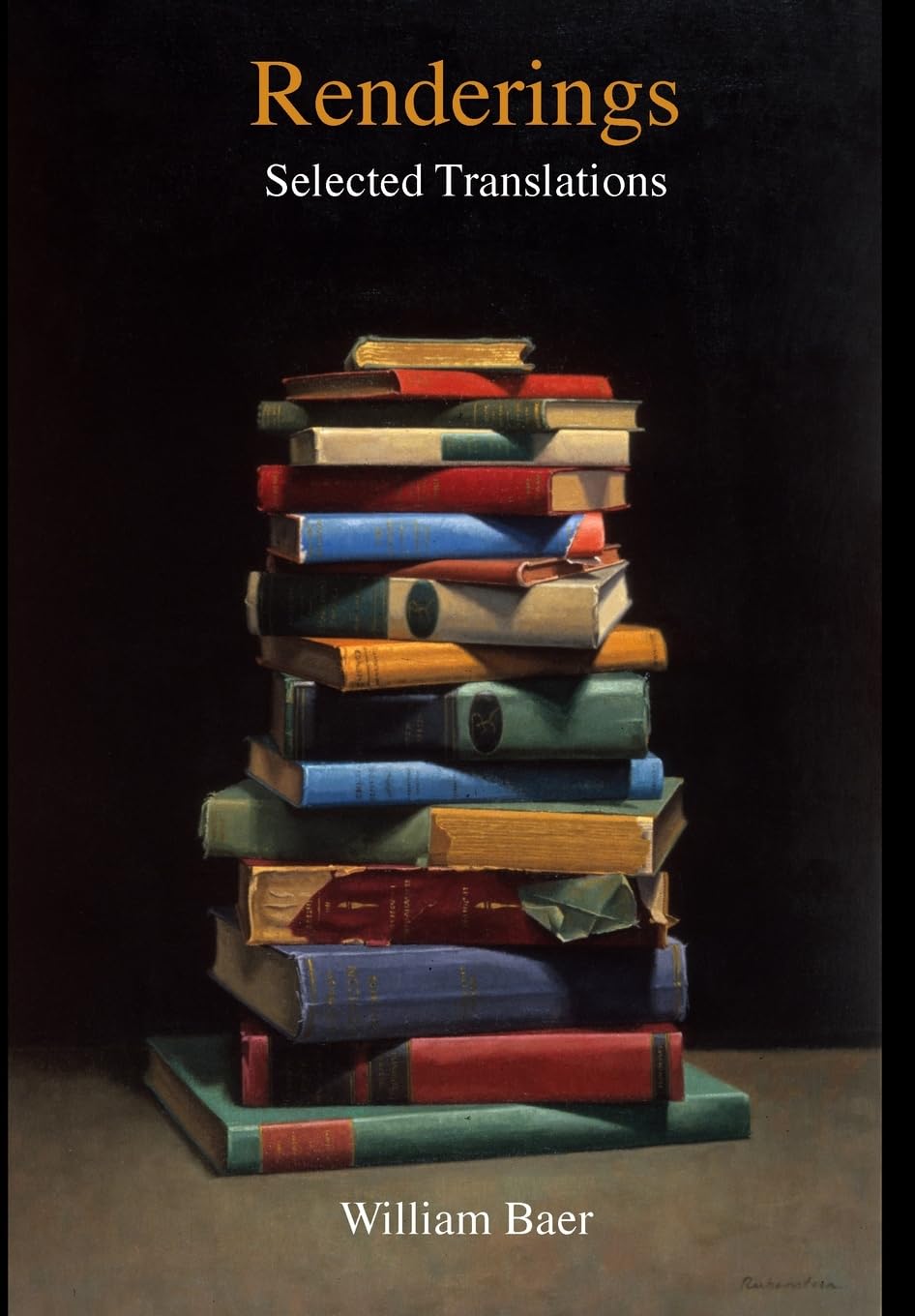
‘Renderings: Selected Translations‘
By William Baer
Measure Press, Inc.: Sept. 30, 2025
Hardcover, 114 pages
What arts and culture topics would you like us to cover? Please email ideas or feedback to features@epochtimes.nyc
