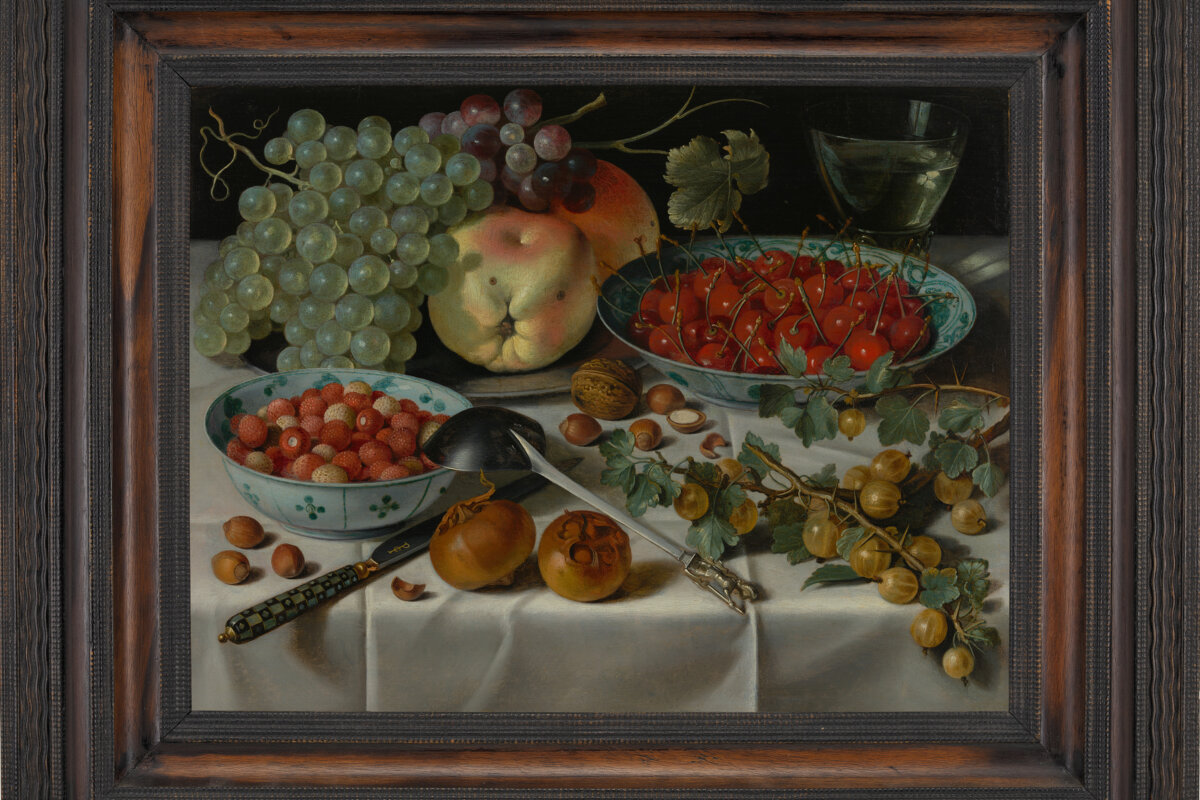
The Los Angeles Getty Museum has filled gaps in their collection with the recent acquisitions of two exquisite 17th-century Dutch still life paintings.
The circa 1622 “Still Life With Assorted Fruit” by Pieter Claesz is a small, superb picture by one of the genre’s leading Dutch Golden Age painters. Claesz was known for his meticulously observed and technically skilled artworks, and this early panel is the first of his works to enter the Getty’s collection.
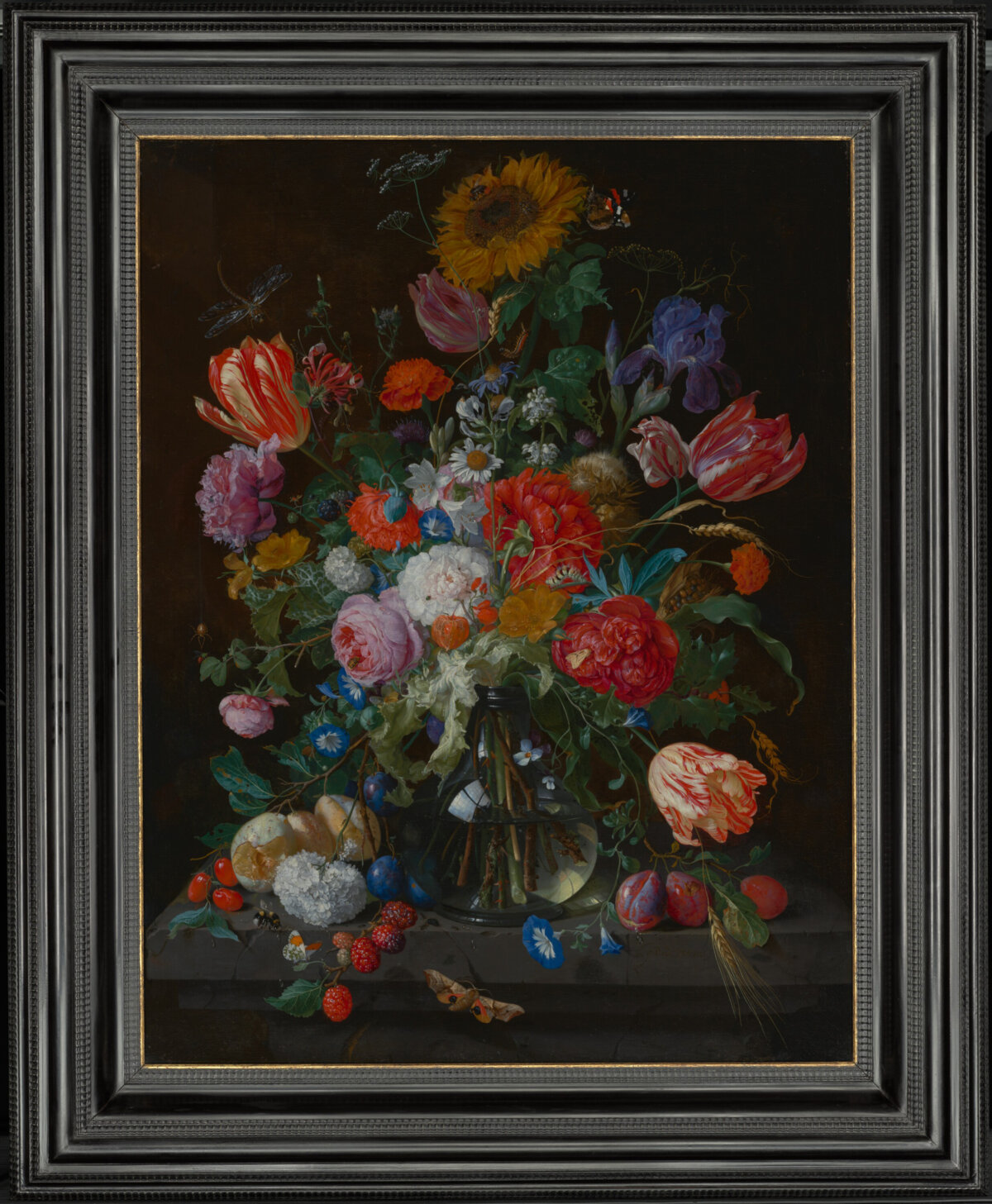
The same honorific applies to Jan Davidsz. de Heem’s “Glass Vase With Flowers and Fruit” from about 1673 to 1674. This magnificent canvas by the Dutch Golden Age’s preeminent floral still life painter is a recently discovered example. The joint announcement of these acquisitions is apt because the innovative Claesz and De Heem influenced each other, along with future generations of still life artists.
Dutch Golden Age Painters
Claesz (1596 or 1597–1660) was born in Berchem, near Antwerp, in the Southern Netherlands. Though Flemish by birth, he spent the majority of his career in the Dutch city of Haarlem. With whom he studied remains unknown, but his earliest works recall the still lifes of the Antwerp painters Clara Peeters and Osias Beert the Elder.
Claesz is esteemed for his ability to create distinctive compositions while working with the same stock of objects. Within the still life genre, he specialized in banquet scenes, breakfast pieces (“ontbijtjes”), smoking vignettes (“toebakjes”), and vanitas rendered in tangible detail. For an extended period, beginning in the late 1620s, Claesz explored a monochromatic, or “tonal” palette, and simpler compositions. His uses of subdued colors along with a focus on light effects were an inspiration for De Heem’s early work. In turn, Claesz went on to pursue a brighter palette and more complex compositions about a decade later in response to the exuberant still lifes of De Heem.
Claesz had a successful career in his lifetime. However, his practice of signing paintings with the monogram “PC” contributed to the loss of his identity to art history by the 18th century. It was not until the late 19th century that scholars associated his full name with his paintings.
‘Still Life With Assorted Fruit’
The intricate “Still Life With Assorted Fruit” is hot off the auction block—the Getty purchased the work at a February 2026 Sotheby’s New York sale for $1.64 million. In this early career work, Claesz presents a compact though harmonious composition of ripe fruits, nuts, vessels, and utensils on a pressed plain white damask tablecloth. This is one of the first still life paintings to showcase primarily an assortment of fruits (“fruijtagie”).
While all of the fruits and nuts portrayed were readily available in the early 17th-century Netherlands, the white and red grapes were likely imported from Southern Italy. As a delicacy, they would have been expensive. They shimmer from Claesz’s handling and sit on a polished pewter platter, a more mundane object.
The two blue and white bowls in the picture were also imported. Originally produced in Jingdezehn, China for the Western market, this type of porcelain was brought to Europe by the Dutch East India Company. Called “kraak” porcelain, such wares were produced during the late Ming dynasty. Claesz’s inclusion of luxury goods evokes the Dutch Republic’s trading empire and mercantile wealth.
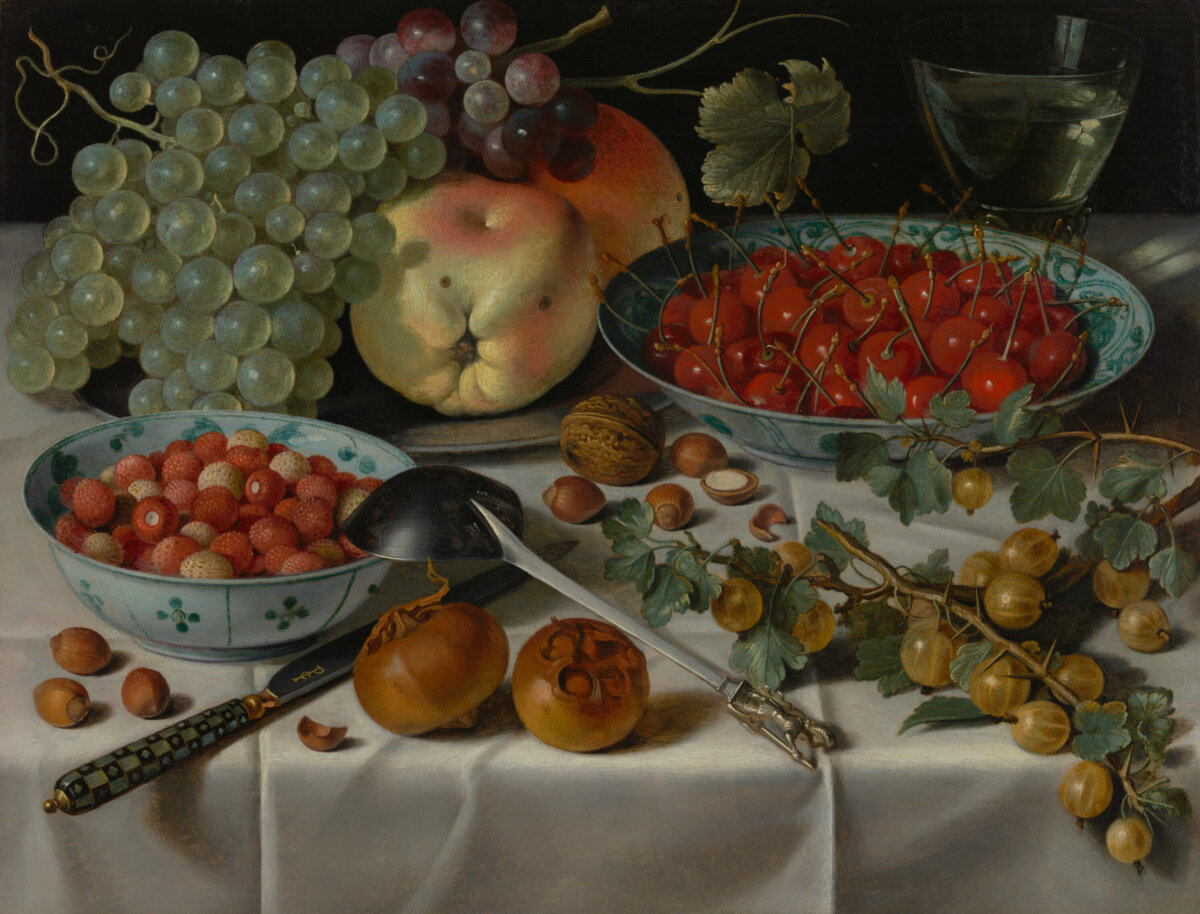
The vessels’ cool tones contrast with the reds of their contents—delicate wild strawberries and rich cherries. Claesz’s fruit selections ripened at different times of the year, so “Still Life With Assorted Fruit” is a fantasy picture. Similarly, De Heem’s still lifes gather flowers that bloomed in different months.
Behind the cherry bowl is a “berkemeyer,” a wine glass with a flared conical bowl and wide low stem, filled halfway with white wine. The goblet, made of greenish glass, reflects daylight streaming into the room through casement windows.
The tablescape’s foreground includes a pair of medlars and translucent golden gooseberries. Claesz depicts masterfully an array of textures, including whole and cracked hazelnuts and a single walnut.
Claesz places an ornamented knife (a recurring feature in his compositions) and overturned silver spoon with a finial in the form of a Roman centurion at diagonals to guide one’s eye through the composition. The knife, monogrammed by the artist, is balanced on the edge of the table and enters the viewer’s space, a device that helps bring one into the picture.
A ‘Show-Off’ Still Life
De Heem (1606–1684) was the greatest still life painter in the Netherlands during his lifetime, celebrated for the sumptuous and elaborate pictures of florals and fruits he produced. He rendered the works with refined illusionistic details and both botanical and entomological accuracy. In the era in which he worked, many wealthy patrons had a growing interest in the natural world and specimens collecting, as well as a desire to advertise their status. This led to the development of “pronkstilleven,” or “show-off” still lifes.
Born in Utrecht, where he likely trained with Balthasar van der Ast, De Heem spent extended periods of time working in both Dutch and Flemish cities. Patrons in the former city favored his early dark, sparse style, while those in the latter preferred a flashier aesthetic. In 1672, he settled permanently in Antwerp. Between that year and 1675, he painted nine extravagant depictions of floral arrangements.
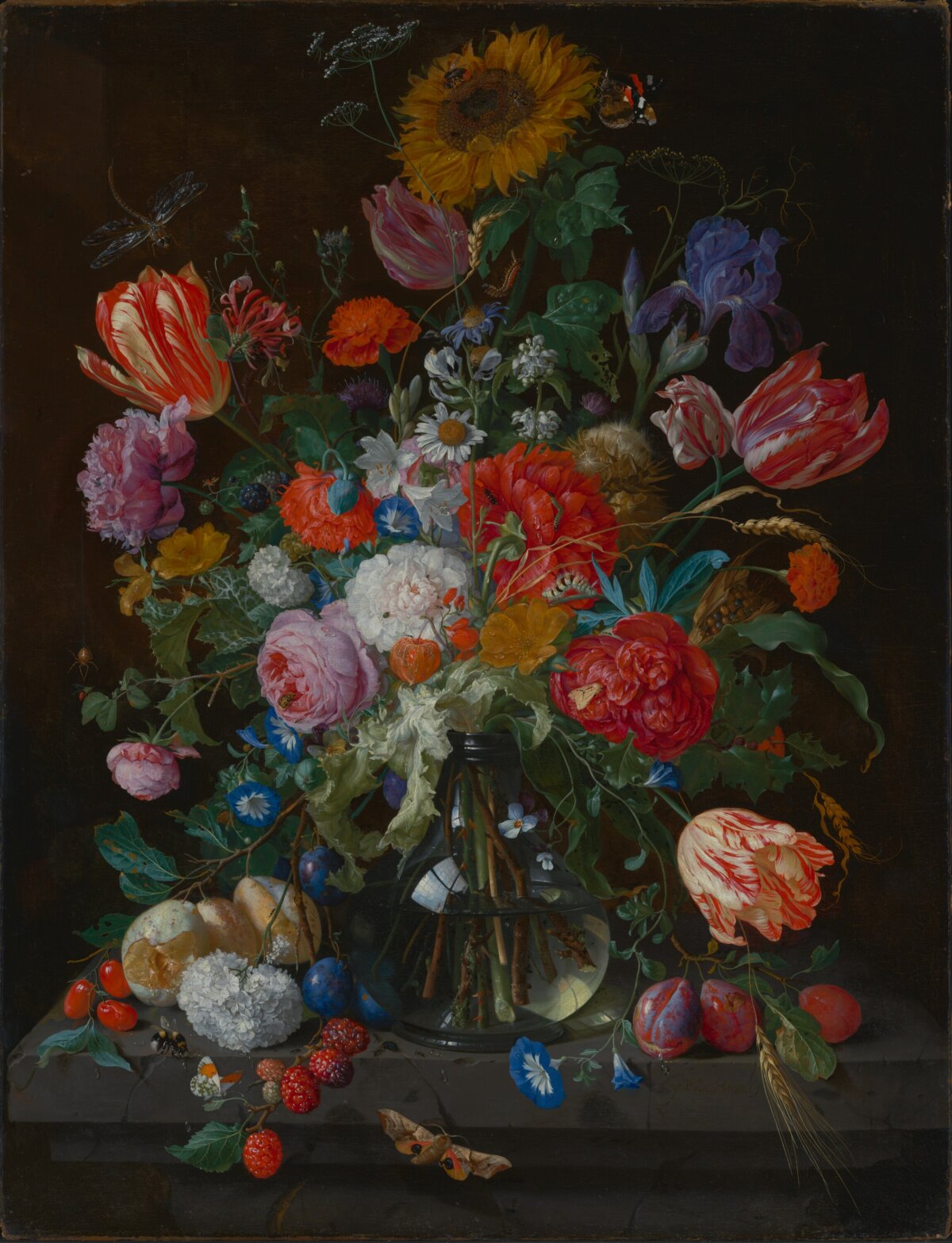
One of these quintessential canvases is the energetic “Glass Vase With Flowers and Fruit.” Precisely painted in the large glass vase situated on a cracked gray hardstone ledge are about 20 different flower species, six kinds of fruits, and 16 types of insects. De Heem shows berries, daisies, honeysuckle, lilies, marigold, milk thistle, morning glory, peonies, plums, poppies, roses, sunflower, and tulips—the flower most emblematic of the Netherlands that was first imported from Turkey to Europe in the 1550s. De Heem would have been able to access examples of what he painted in botanical and private gardens in both Northern and Southern Netherlands.
Insects are found in nearly every section of the canvas, including a bumble bee, butterflies, caterpillars, cross spider, dragonfly, and moths. Like some of the flowers, these elements communicate symbolism. The Getty explains: “Butterflies and caterpillars, associated with metamorphosis, represented the transience of life and the soul freed from greed and desire. And, according to literary tradition, ants were respected as hardworking and symbolized diligence and frugality.” De Heem adds ears of wheat to many of his flower arrangements, as he did here, and it alludes to the Eucharist.
The existence of this painting was completely unknown to scholars until it emerged from a private German collection to great excitement in 2022. The canvas was auctioned in Cologne at Lempertz in May 2025. The Getty bought it for 3,162,000 pounds ($4.20 million), more than twice its high estimate. Timothy Potts, director of the J. Paul Getty Museum, cited the De Heem painting as, “the most consequential addition to our collection of northern Baroque paintings since we acquired ‘Rembrandt Laughing’ in 2013.”
Both Claesz’s and De Heem’s still lifes present vivid images of abundance and prosperity in a time period fraught with religious and political tensions. They continue to bring joy to viewers today.
What arts and culture topics would you like us to cover? Please email ideas or feedback to features@epochtimes.nyc