LONDON—Preeminent 18th-century painter Joseph Wright of Derby’s art is synonymous with the Age of Enlightenment, especially in his depictions of science and industry.
However, the “Wright of Derby: From the Shadows” exhibition at London’s National Gallery challenges the belief that the British artist captured scenes of the Enlightenment for the sake of science alone. Art experts analyzing Wright’s dramatic candlelight scenes, painted between 1765 and 1773, discovered themes of morality, melancholy, and the sublime.
The exhibition, organized by the National Gallery and Derby Museums, is the country’s first major exhibition about Wright (1734–1797). More than 20 works are on display, including paintings, mezzotint prints, works on paper, and objects.
Wright’s Candlelights
While most provincial painters relocated to London, Wright became the country’s first major painter to work almost entirely outside of the capital, in his hometown of Derby, in northern England.
Portraiture made up more than half of Wright’s income. In 1751, 17-year-old Wright first apprenticed in London with eminent portraitist Thomas Hudson (1701–1779), who had taught the great portraitist Joshua Reynolds (1723–1792) a decade earlier.
However, the growing popularity of the Grand Tour, when aristocratic and wealthy young men toured Europe for classical education and art appreciation, stunted British art commissions as those on the Grand Tours favored Italian artists.
To attract patrons and Grand Tourist commissions, British painters had to innovate, and many created signature styles.
Following in the footsteps of Italian master Caravaggio (1571–1610) and Dutch master Rembrandt (1606–1669), Wright painted candlelight scenes in “chiaroscuro,” bold contrasts of light and shade. Caravaggio used the technique to intensify the drama of his realistic compositions.
Wright may have been directly inspired by Dutch genre painter Godfried Schalcken’s candlelight works in British collections. Schalcken (1643–1706) was a pupil of Gerrit Dou, a well-known apprentice of Rembrandt.
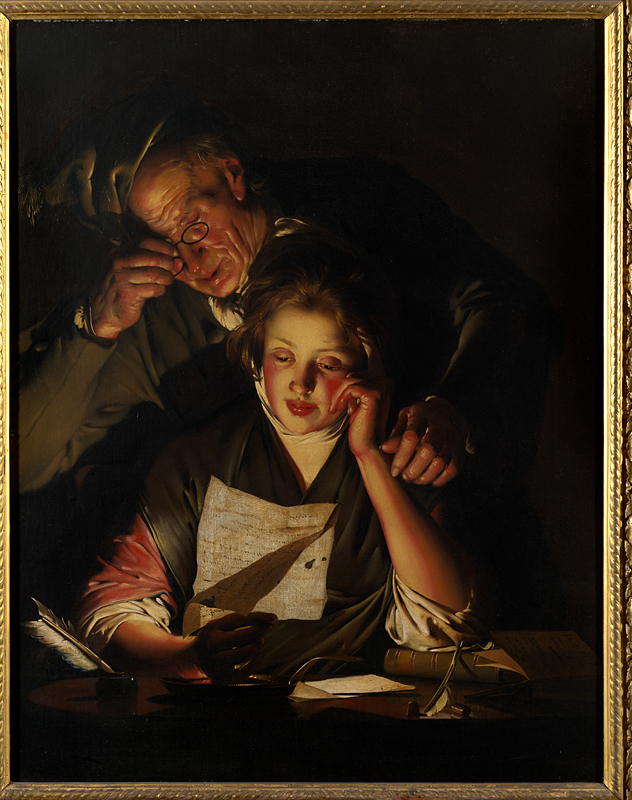
Wright’s candlelight scenes illuminated everyday scenes and the industry and science of the Enlightenment era. Experts believe that Wright’s first foray in candlelight scenes was in the 1760s, titled “A Girl Reading a Letter With an Old Man Reading Over Her Shoulder.” Eventually, he elevated his “candlelights,” as they were then known, from lowly everyday scenes to the highest art genre—history paintings. That was pioneering.
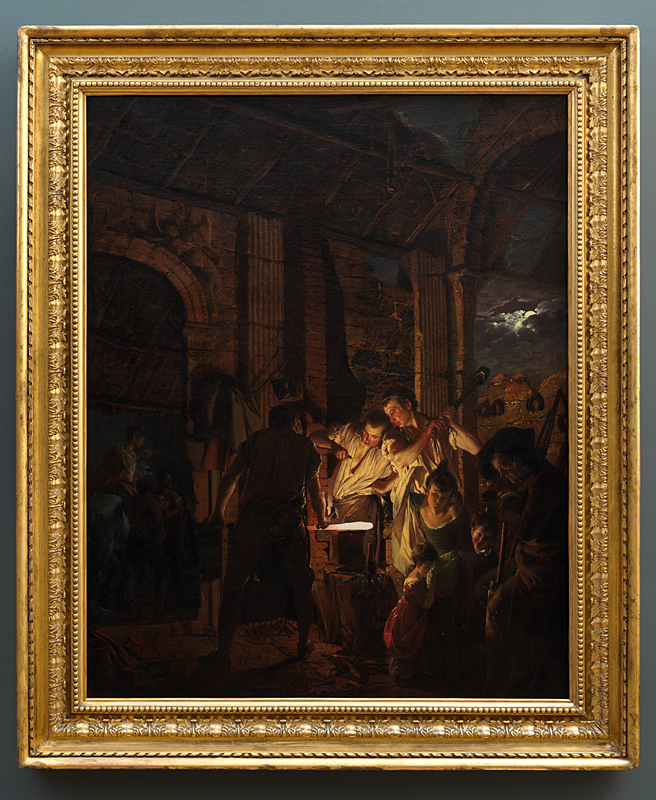
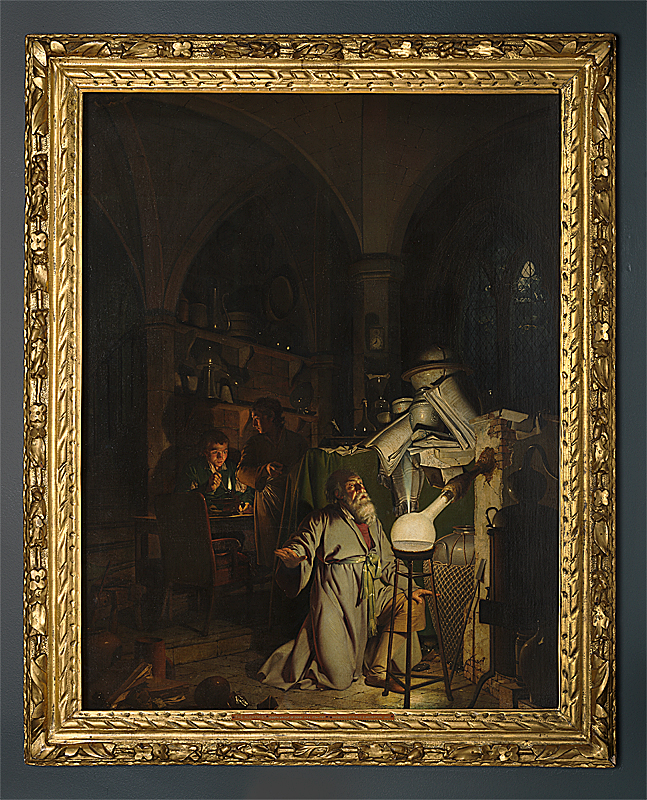
The mid-18th century saw the growth of new art societies and exhibitions, such as the Free Society of Artists and the Royal Academy of Arts. New exhibition spaces provided a testing ground for often pioneering paintings.
Cleverly, the first candlelight painting that Wright exhibited, in 1765, echoed the enthusiasm of a Grand Tourist seeing an ancient sculpture for the first time. In this work titled “Three Persons Viewing the Gladiator by Candlelight,” Wright rendered three men admiring a candlelit copy of an ancient Greek sculpture called the “Borghese Gladiator.”
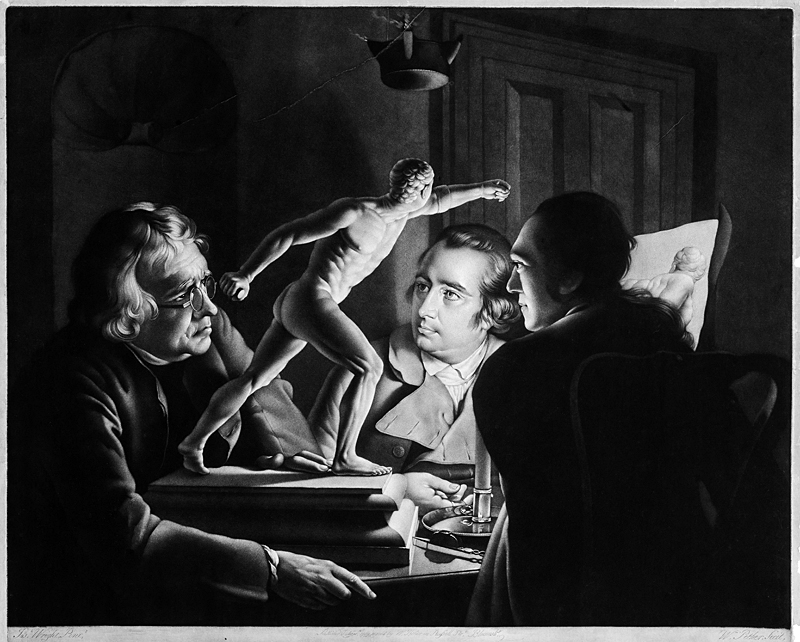
Grand Tourists in Rome would have seen the original life-size sculpture in the Villa Borghese. The work was admired for its classical anatomy. Numerous copies of the sculpture were created in different scales for European collections, to allow art academy students to draw them as the foundation of their training.
Wright knew all three Derby men in the painting. A bespectacled John Wilson, from a local alms-house, acts as the teacher. In the center, his friend, cartographer and draftsman Peter Perez Burnett, steadies the candle so they can study the sculpture against a copy of the work that one of them has drawn. Wright painted himself on the right. An exhibition wall plaque points out the intellectual aspect of observing that is conveyed in the painting: “English philosopher John Locke (1632–1704) described sight as a gateway to knowledge and morality.”
Beyond Science
The exhibition book states that because Wright painted specific scientific events, he was likely most interested in the theater of science—the drama of the debates, discourses, and experiments—more than the science itself.
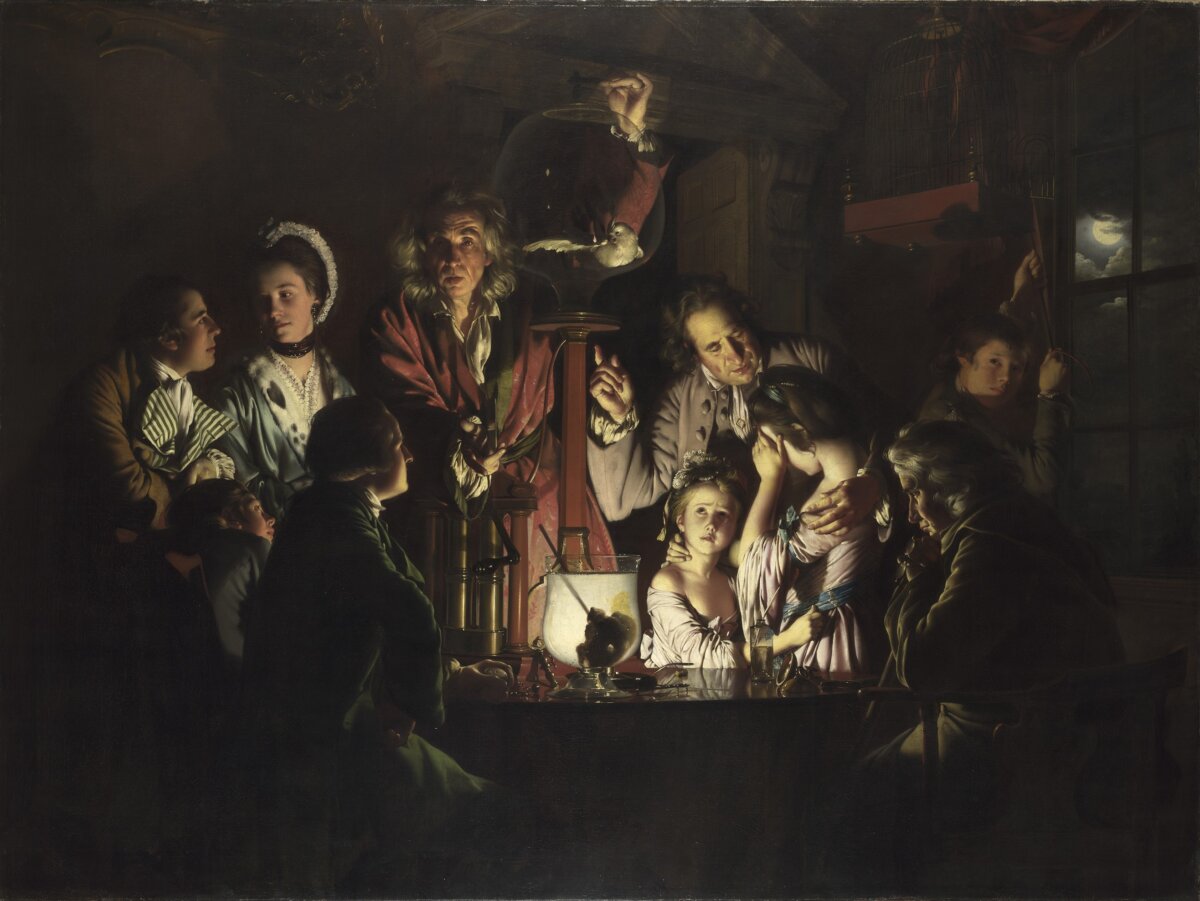
Two of Wright’s greatest paintings, “An Experiment on a Bird in the Air Pump” and “A Philosopher Giving That Lecture on the Orrery in Which a Lamp Is Put in the Place of the Sun,” reflect a popular upper-class pastime: A lecturer visited a private home and performed scientific experiments for a group of family and friends. According to the exhibition book, “the subjects and associated compositions [of those two paintings] were unprecedented in British art.”
In the second painting mentioned above, Wright’s large-scale painting is of a lecturer demonstrating a grand orrery, a model of the solar system with the sun in the center. In the painting, he placed a candle as the sun. The lecturer appears as an almost God-like figure, moving the planets as his audience looks on in awe.
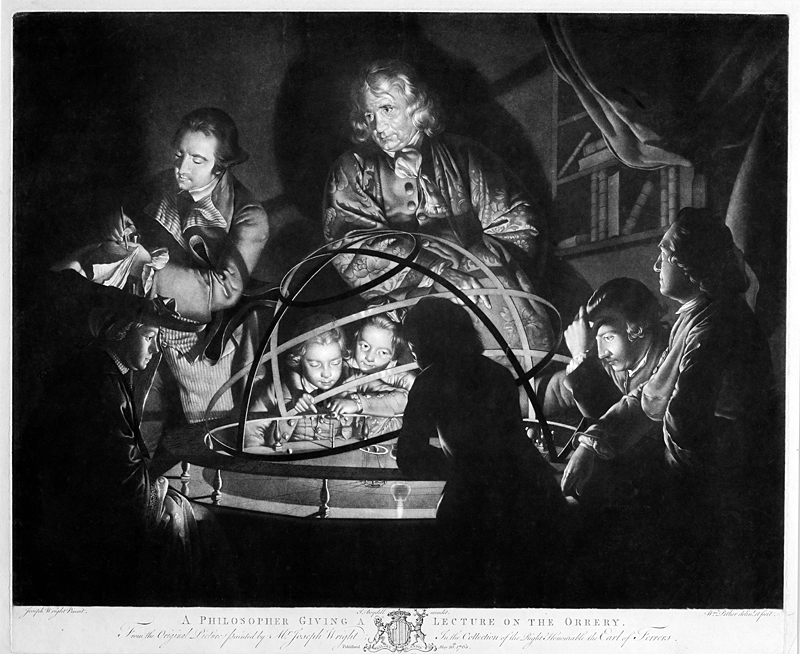
To the modern-day viewer, the orrery appears purely scientific, but in Wright’s day it reminded viewers that the heavens governed the earth. According to an exhibition wall plaque, an astronomer in Wright’s day said that the orrery explained “the Laws by which the Deity Regulates and Governs all the Motions of the Planets.”
Another of Wright’s greatest paintings, “An Experiment on a Bird in the Air Pump” also depicts a scientific pursuit with a higher purpose. In the painting, the lecturer stares out of the painting as he pumps air out of the glass flask containing a live cockatoo, a rare and exotic bird at the time. Spectators look on in varying degrees of awe, rapture, and terror. Two girls cling to each other in fear of what’s to come. Life hangs in the balance. Candlelight flickers behind a glass specimen jar containing a human skull, a nod to the Dutch “vanitas” painting tradition of mortality that underscores the moral and ethical dilemma at hand. The question remains of whether the lecturer saved the cockatoo or not.
Gateways to Genius and the Sublime
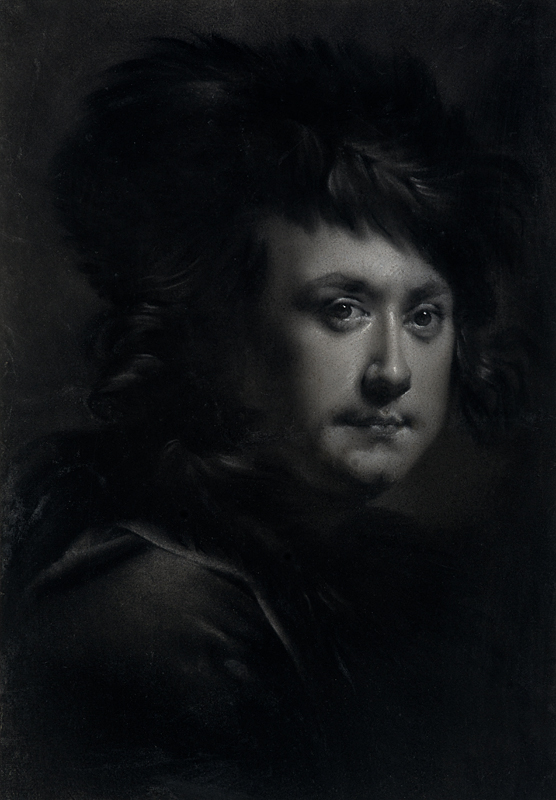
Wright suffered bouts of melancholy. His self-portrait in pastel softly imitates the stormy mental state using tenebrism, a technique of dark contrasting tones. In the exhibition book, art historian Christine Riding states: “A recurring theme in philosophical discourse, from the Renaissance onwards, was that intellectuals—philosophers, poets and even artists—were not only prone to be melancholic but, through the notion of ‘genial’ or ‘inspired melancholy,’ were predisposed to genius and exceptional creative ability.”
Wright and his peers channeled such genius into painting the elusive, the sublime. In the essay “British Art and the Sublime,” art historians Riding and Nigel Llewellyn describe 18th-century Britain’s fascination with the sublime:
“The sublime in writing, nature, art or human conduct was regarded as of such exalted status that it was beyond normal experience, perhaps even beyond the reach of human understanding. In its greatness or intensity and whether physical, metaphysical, moral, aesthetic or spiritual, by the time of the Enlightenment, the sublime was generally regarded as beyond comprehension and beyond measurement. It was at this point in the history of the word sublime that visual artists became deeply intrigued by the challenge of representing it.”
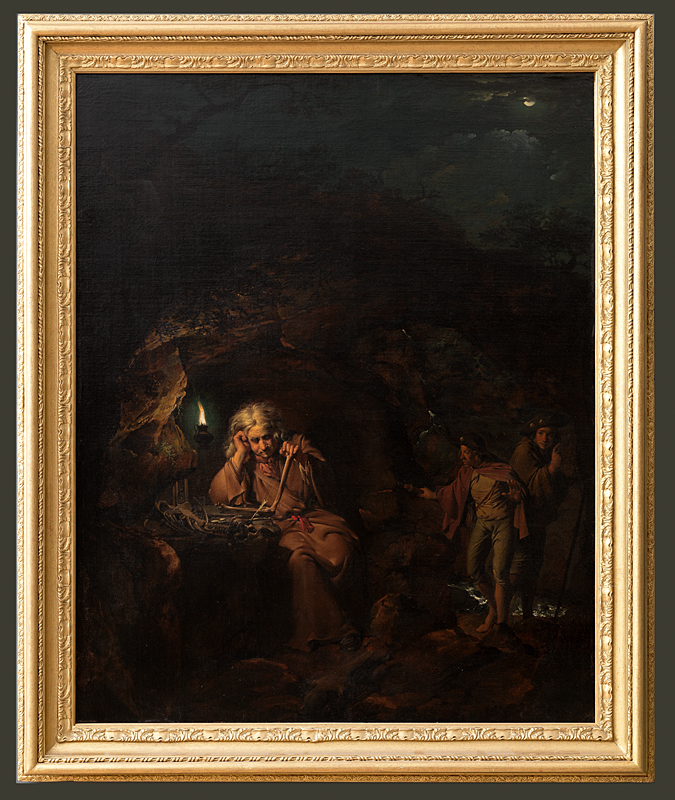
Many of Wright’s virtuoso candlelight paintings expressed aspects of the sublime. It’s defined by philosopher Edmund Burke in his 1757 treatise, “A Philosophical Enquiry Into the Origin of Our Ideas of the Sublime and Beautiful.“ In the exhibition book, Riding states that Burke divided “the sublime into seven categories: darkness, obscurity, privation, vastness, magnificence, loudness, and suddenness, all of which have the potential to shock our sensibilities to the point of disablement.”
Riding postulates that Wright’s orrery painting “evokes the notion of infinity and celestial bodies, and therefore the cosmic sublime.” Similarly, in “The Air Pump” the viewer is “confronted by ‘pain and danger’ and feeling terror (the ruling principle of the sublime).”
A Master of Light
Wright’s fame came from capturing candlelight. He owes a large part of his success to mezzotint prints. As a boy, he copied mezzotints of great art, honing his skills by replicating their velvet light and shade in his pen and ink drawings. He knew the medium would replicate his candlelight paintings well, too, so he commissioned engravers to make mezzotints of them. This made his paintings available to a wider audience, beyond art patrons.
As writer William Hayley’s 1783 “Ode to Mr. Wright of Derby” states: “Thou mighty master of the mimic flame,/ Whose peerless pencil, with peculiar aim,/ Has form’d of lasting fire the basis of thy fame.”
Many of Wright’s candlelight paintings still evoke awe and stoke intellectual fires in viewers today.
The “Wright of Derby: From the Shadows” exhibition at the National Gallery in London runs through May 10, 2026. To find out more, visit NationalGallery.org.uk
What arts and culture topics would you like us to cover? Please email ideas or feedback to features@epochtimes.nyc