
Stock market volatility is always front-page, headline material. As a result, parking your hard-earned money in guaranteed vehicles may feel like the ultimate financial shield. After all, high-yield savings accounts and certificates of deposit currently offer interest rates that seem attractive, predictable, and entirely risk-free.
It’s completely natural to want to pull back, protect what you have earned, and keep a substantial cash cushion close at hand. However, sitting on excessive cash reserves beyond what you actually need can create a quiet financial bottleneck.
This cautious play can create an invisible drain on your financial growth known as cash drag, which quietly erodes your purchasing power over time, perhaps depriving you of long-term wealth building.
Quick Answer: How Does Cash Drag Impact Your Wealth?
Cash drag occurs when holding excessive uninvested cash reduces the overall return of your portfolio.
Cash offers liquidity and security, but it yields far less than growth assets like stocks or real estate. Inflation decreases the purchasing power of idle cash over time. Missed market growth prevents your portfolio from benefiting from compound interest. To prevent cash drag, consider maintaining a defined emergency fund for immediate security while systematically directing excess capital into productive, long-term investments through proven strategies such as dollar-cost averaging and goal-based bucketing.
Understanding the Safe-Haven Trap
It’s easy to understand why many thoughtful savers end up keeping large sums of money on the sidelines. Financial headlines often emphasize market uncertainty, causing folks to seek the safety of liquid deposits.
Behavioral finance calls this phenomenon loss aversion: the emotional pain of losing money in the stock market feels far sharper than the joy of earning investment gains.
When high-yield savings accounts offer yields around four or five percent, holding cash feels productive rather than defensive. This comfort creates what financial planners call the safe-haven trap.
Liquid Illusion
Because you see high account balances and modest monthly interest payments, you feel completely secure. Cash feels safe in the short term, but it is actually one of the riskiest assets to hold in excess over the long term. Security today can inadvertently undermine your financial independence tomorrow.
Hidden Costs of Holding Uninvested Capital
Understanding the true impact of cash drag means looking beyond nominal interest rates and evaluating your real rate of return.
Your real return is the interest rate you earn minus the rate of inflation. A savings account yielding four percent while inflation runs at three percent means your real purchasing power grows by only one percent before taxes. Once federal and state taxes are applied to your interest income, your actual growth may be zero or negative.
Opportunity Cost
Another hidden expense is opportunity cost—the potential gains you give up by choosing cash over long-term growth assets. Over multi-decade periods, broad equity markets have historically outpaced inflation and cash returns by a significant margin.
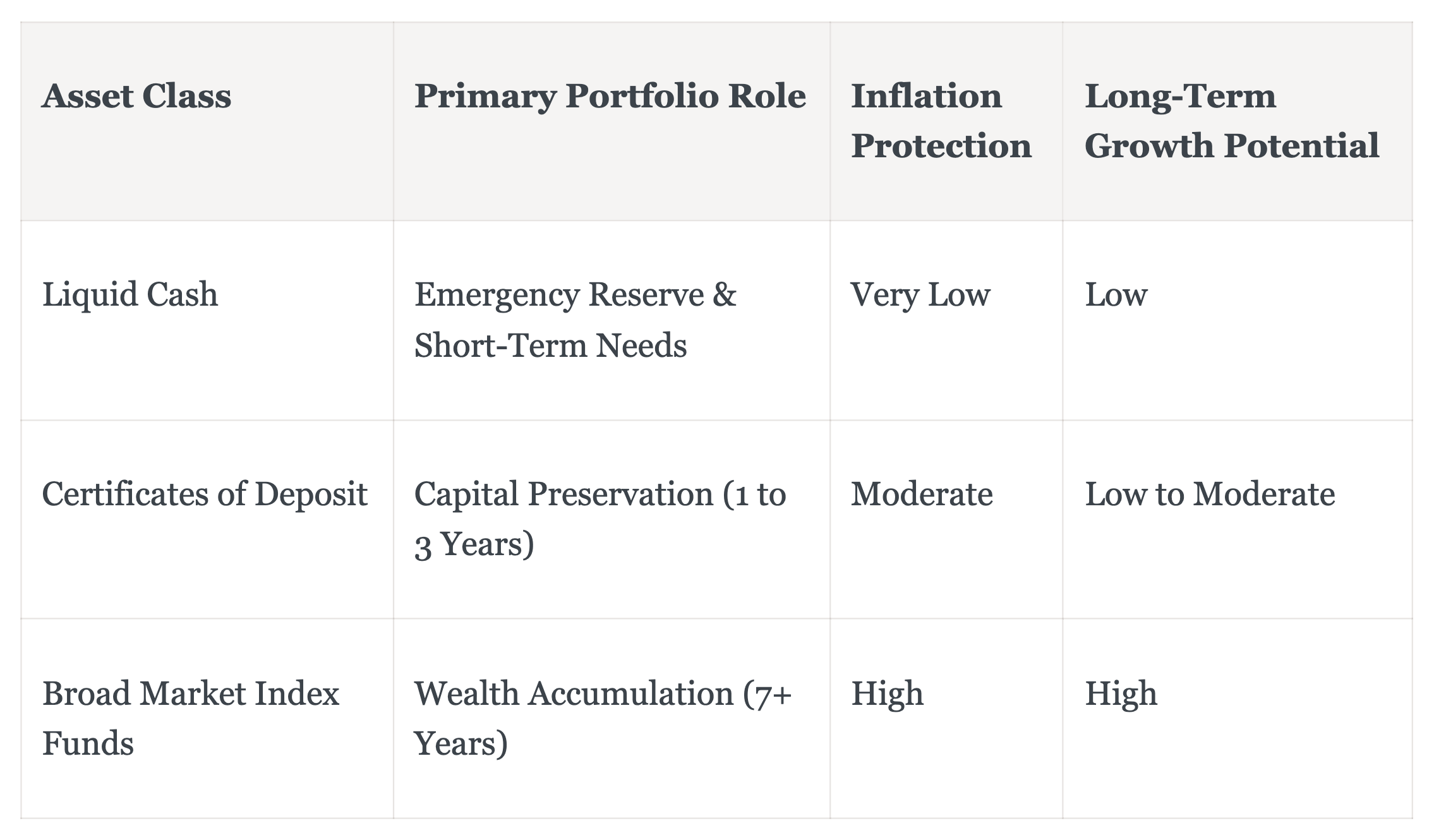
Distinguishing Emergency Cushions From Unproductive Savings
Let’s be clear: Protecting yourself against cash drag does not mean eliminating cash altogether. Liquid cash is vital for financial security, but every dollar should have a specific job. The key is often separating your essential emergency cushion from unproductive excess savings.
Emergency funds serve as financial shock absorbers. They protect you from high-interest debt arising from unexpected events, such as job transitions, medical bills, or major household repairs. Standard emergency funds should generally contain three to six months of living expenses held in an easily accessible, FDIC-insured account.
Cash above that emergency baseline with no clear short-term purpose can be considered unproductive savings.
Ask yourself these practical questions to identify excess cash:
-
Do you have more than six months of living expenses in liquid accounts without an upcoming major purchase?
-
Have you delayed investing money because you are waiting for the perfect market entry point?
-
Is fear of market drops keeping you from funding your long-term retirement accounts?
If you answered yes to any of these questions, your portfolio could have cash drag.
Practical Strategies to Eliminate Cash Drag
Transitioning from defensive saving to active wealth building doesn’t require taking uncomfortable risks. Low-stress strategies are available to put idle money back to work while maintaining your peace of mind.
Consider goal-based bucketing. Divide your savings into three distinct categories based on your time horizon:
-
Short-Term Bucket (0 to 2 years): Keep your emergency fund and upcoming cash needs in high-yield savings or short-term treasury bills.
-
Medium-Term Bucket (2 to 7 years): Allocate funds for medium-term goals into conservative, income-generating investments like short-duration bonds.
-
Long-Term Bucket (7+ years): Direct funds designated for retirement or multi-decade growth into diversified index funds or equities.
Another strategy is using dollar-cost averaging to remove the fear of market timing. Instead of investing a large cash lump sum all at once, schedule automatic transfers of fixed amounts over six to twelve months.
This disciplined framework allows you to build wealth steadily while insulating your emotions from short-term market swings.
FAQs: Cash Drag
How Much Cash Should You Keep in an Emergency Fund Before Experiencing Cash Drag?
Three to six months of essential living expenses in an accessible, liquid account for safety is generally acceptable.
For households with stable income sources, three months is typically sufficient. Single-income families or freelancers might prefer six months. Liquid reserves beyond these thresholds that are not earmarked for major purchases within two years could represent excess cash. Holding these extra funds in low-yield accounts can create cash drag by missing out on the higher compound returns provided by long-term investment assets over multi-year horizons.
Is Holding Cash in a High-Yield Savings Account Always a Mistake?
No, holding money in a high-yield savings account is not inherently a mistake. These accounts are often excellent tools for preserving liquidity, protecting emergency funds, and saving for planned short-term expenses like home repairs or vehicle down payments. But using high-yield accounts as long-term investment vehicles for wealth building can be a mistake. Interest rates on savings accounts fluctuate and rarely beat inflation over extended periods. Keeping long-term funds in cash subjects your capital to inflation risk and limits your ultimate financial growth.
How Does Dollar-Cost Averaging Help Overcome the Psychological Fear of Cash Drag?
Dollar-cost averaging can help eliminate the emotional fear of investing cash by replacing market timing decisions with a predictable schedule. By investing a fixed sum at regular intervals, you automatically purchase more shares when prices drop and fewer shares when prices rise. This strategy often removes the anxiety of picking the wrong day to invest a large lump sum. Automating your contributions over several months can translate into reducing psychological hesitation, eliminating uninvested excess capital, and systematically protecting your long-term portfolio against the hidden costs of cash drag.
The Epoch Times copyright © 2026. The views and opinions expressed are those of the authors. They are meant for general informational purposes only and should not be construed or interpreted as a recommendation or solicitation. The Epoch Times does not provide investment, tax, legal, financial planning, estate planning, or any other personal finance advice. The Epoch Times holds no liability for the accuracy or timeliness of the information provided.