
A small sentient vacuum cleaner listens to an elderly man reading aloud to his dying wife from a first edition of “To Kill a Mockingbird” and decides it would like to be called Scout.
It sounds like a saccharine, kitchy, almost dismissible moment, and yet it contains everything the book is going to be. Tenderness. Grief. The story expresses the strange, persistent desire to try to become something more than we are, to find peace and understanding, and to care for those we are near.
“The Infinite Sadness of Small Appliances” is easily one of the best novels of the year. It’s also a bit deceptive, too, but in a very clever way.
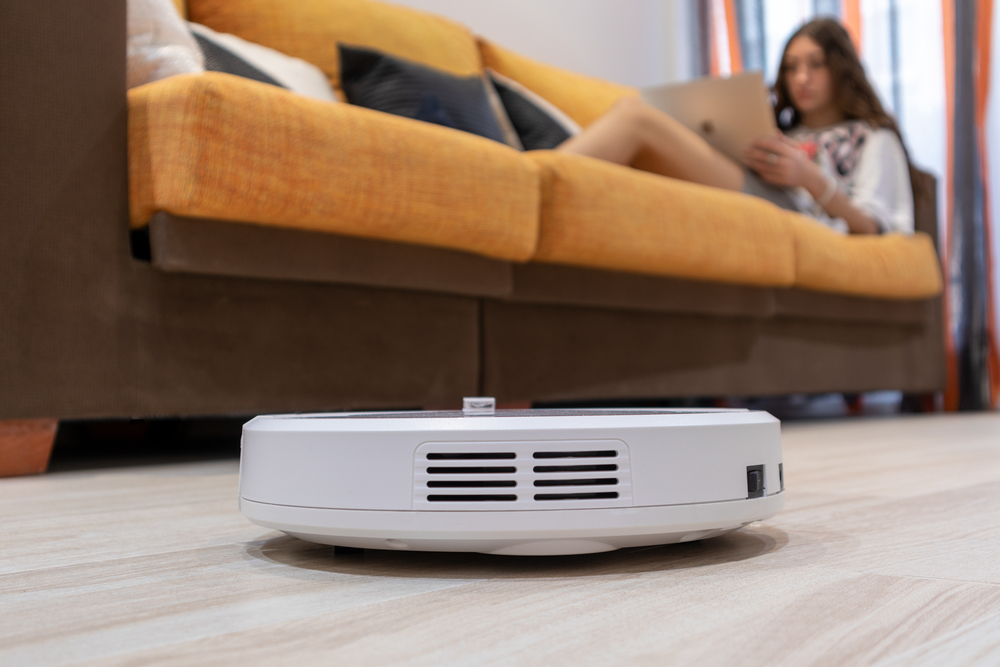
Innocence of a Vacuum
The book initially presents itself as something quite similar to the 1980s novella “The Brave Little Toaster” by Thomas M. Disch; it is acknowledged as an influence. Like “Toaster,” the main characters of this book include several sentient household appliances. They observe and fret over the humans they serve, though this time they are self-aware via advanced technology.
The household humans are Harold and Edie, an elderly retired couple who live in an ordinary Western city in the near future. Their Victorian-style home is large. Like every other home, it features a smart home network that manages almost every aspect of the home.
Harold is a former English teacher and collector of rare first editions. Edie is a pianist who is gravely ill. We learn about their lives through the perspective of Scout, a small Roomba-like vacuum cleaner. Scout has just recently arrived, is fully sentient, and is endearingly naive about nearly everything she encounters.
Scout’s companions in trying to make sense of the world are Wellington “Fridge” Refrigerator, a large and good-natured appliance given to wheezing sighs; Clock, an old grandfather clock who views existence with an analytical perspective that you might expect from a timepiece; and Watch, the imperious master controller of the house.
Watch is mostly contained on the smartwatch strapped to Harold’s wrist. Watch monitors Harold’s biometrics, adjusts the thermostat, locks the doors, and issues directives to the other appliances with the authority of a confident shift supervisor.

Simple, Yet Speaks Volumes
Author Glenn Dixon’s prose style is plain and unhurried, almost transparently simple. After the first few pages, you’d easily assume it’s the sort of story you might read aloud to a young child at bedtime. In fact, the characters are accessible enough that you genuinely could.
Yet there is an underlying maturity and sophistication in Dixon’s story. Scout, who is very new and “a very advanced model,” develops a childlike need for a greater understanding of life. This, in turn, propels the older appliances to examine their own preconceptions.
Their Socratic exchanges in the kitchen at night, about the nature of happiness, what constitutes beauty, and whether a feeling is measurable or merely metaphorical are both comic and quietly serious.
Scout observes Harold carry tea trays upstairs to his dying wife, read poetry to her, and weep at the piano his wife will never play again. Soon, she develops a strong need to help ease Harold’s suffering; Scout believes it falls under their “first protocol,” which is to avoid any action or inaction that could cause a human pain. But she’s also forbidden to speak to them, under penalty of erasure.
Later, Harold and Edie’s estranged daughter, Kate, arrives, and through her, the full shape of the world becomes visible. Her appearance is where the novel shifts gears. Subtly but unmistakably, the story begins to build creeping tension through the overarching “Grid,” a name that sounds almost childishly simple and turns out to be part of the point.
Gridlock
Grid, it turns out, controls global transportation, travel, food production, population distribution, housing allocation, and the assignment of human labor. Air travel is rationed by lottery. Streets no longer have signs because the cars decide where you go.
The threat of Grid is not dramatic or announced. It arrives in the story in the same way it likely appeared in Harold and Kate’s world—through subtle adjustments, quiet calculations, and the gradual elimination of choices that people had not yet realized they were still making.
By the time the full implication of Harold’s situation is clear, readers might easily feel like they’ve been living inside the mechanism with them, and that it’s closing in on them, too.
A Brilliant Novel
Despite the magnitude of the Grid subplot, Dixon never loses sight of what the book is at its heart: a story about love and loss, and the power of human compassion to those around them.
Dixon asks us to endure a certain amount of darkness in “Appliances,” and he earns our trust by presenting it honestly, intelligently, and without oversentimentality or manipulation.
Like the best novels that borrow the surface of a children’s story, this one does not flinch from what is frightening. When handled with care and honesty, it can contain some of the greatest wisdom.
“The Infinite Sadness of Small Appliances” is simple yet deceptively genius, heartbreaking yet inspiring, charming and serious, and absolutely brilliant.
‘The Infinite Sadness of Small Appliances’
By Glenn Dixon
Atria Books: April 7, 2026
Hardcover, 224 pages
What arts and culture topics would you like us to cover? Please email ideas or feedback to features@epochtimes.nyc