Ferragosto is a beloved national holiday in Italy observed on Aug. 15. In Catholicism, it is the feast of the Assumption of Mary; in modern Italian society, it is also a red letter day for summer vacation. Alas, on the evening of this year’s Ferragosto, art crime did not take a holiday. While the port city of Messina, Sicily was celebrating its Marian procession, La Vara, thieves broke into the Regional Museum of Messina (MuMe) around 9:50 p.m., despite the alarm system being activated. Help from the inside in pulling off this heist is suspected.
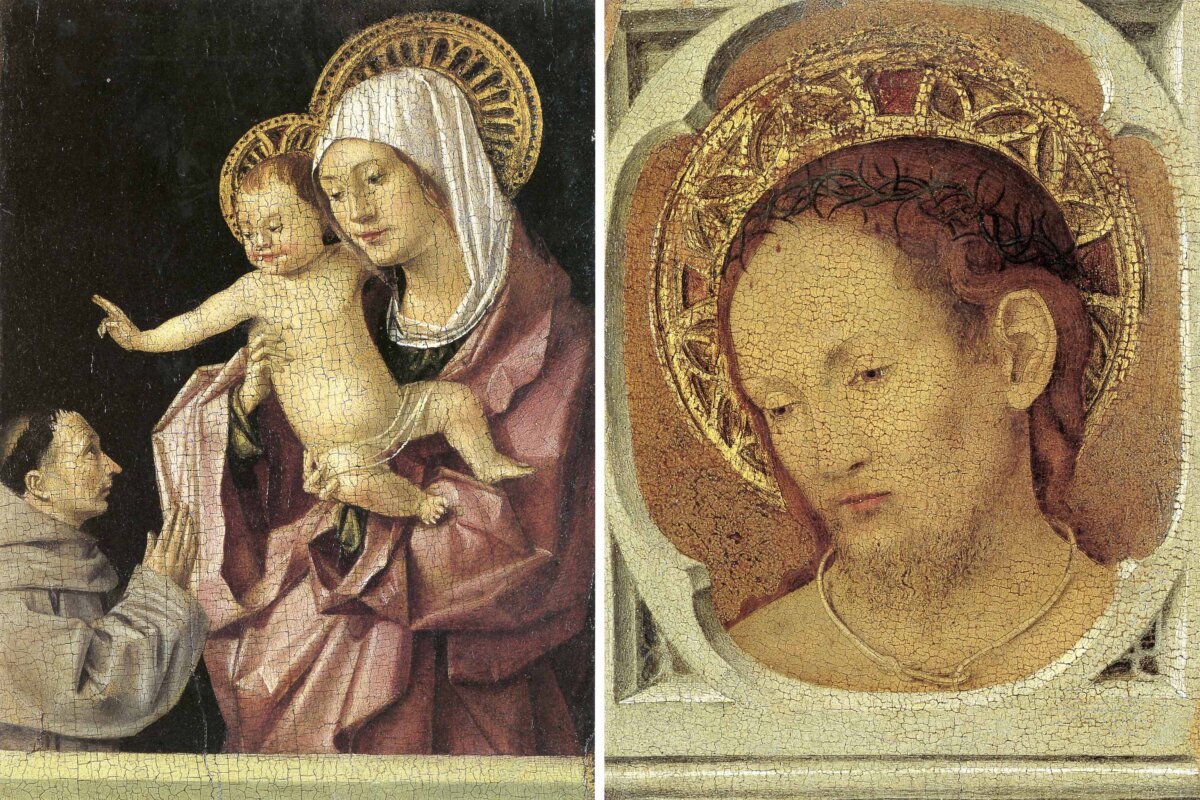
In mere minutes, the burglars absconded with four Antonello da Messina paintings: three panels from the “Polyptych of San Gregorio” and a double-sided painting with a scene of the Madonna and Child on the recto and Christ on the verso. These stolen paintings, estimated to be worth tens of millions of dollars, are invaluable on several accounts: Antonello was the greatest Southern Italian Renaissance artist in the 15th century; only about 40 autograph works are known, and he was also from the very city in which the theft took place.
The Artist Gains International Recognition
In his exquisite oil paintings, Antonello (circa 1430–1479) incorporated stylistic elements from both Northern Renaissance and Southern Renaissance art, forging a unique aesthetic that inspired future generations of European artists. Renowned for his genius in depicting minute detail, light, tone, color, harmonious compositions, geometric clarity, and psychological dimension, his portraits and religious paintings have long been esteemed by scholars. Antonello’s masterpiece “Virgin Annunciate,” housed in Galleria Regionale della Sicilia, Palermo, has been compared to Leonardo’s “Mona Lisa.”

Antonello’s international name recognition rose among the general public when news broke in February 2026 that Italy’s Culture Ministry had acquired in a private sale at Sotheby’s his small painting “Ecce Homo” (a scene of “Saint Jerome in the Desert” is on the reverse) for $14.9 million. One wonders if this was an impetus for the thieves to target Antonello’s work.
The attribution of this panel to Antonello was first proposed in 1981, at which time it resided in a private collection. It was a cultural coup for Italy to secure this important early work. After the sale, several Italian museums vied to add it to their permanent collection, with some people believing that Messina was the rightful home for it. This past June, it arrived at its new home, the National Museum of Abruzzo.
The Ecce Homo theme—portrayals of Christ as a bare-chested, isolated figure shown bust length—was poignantly and innovatively investigated by Antonello in multiple panels. The artist was interested in spatial organization. Some of his works, including this one, employed the pictorial device of a parapet. The parapet depicted in the MuMe panel “Madonna and Child,” the reverse of which shows “Ecce Homo,” is similar.
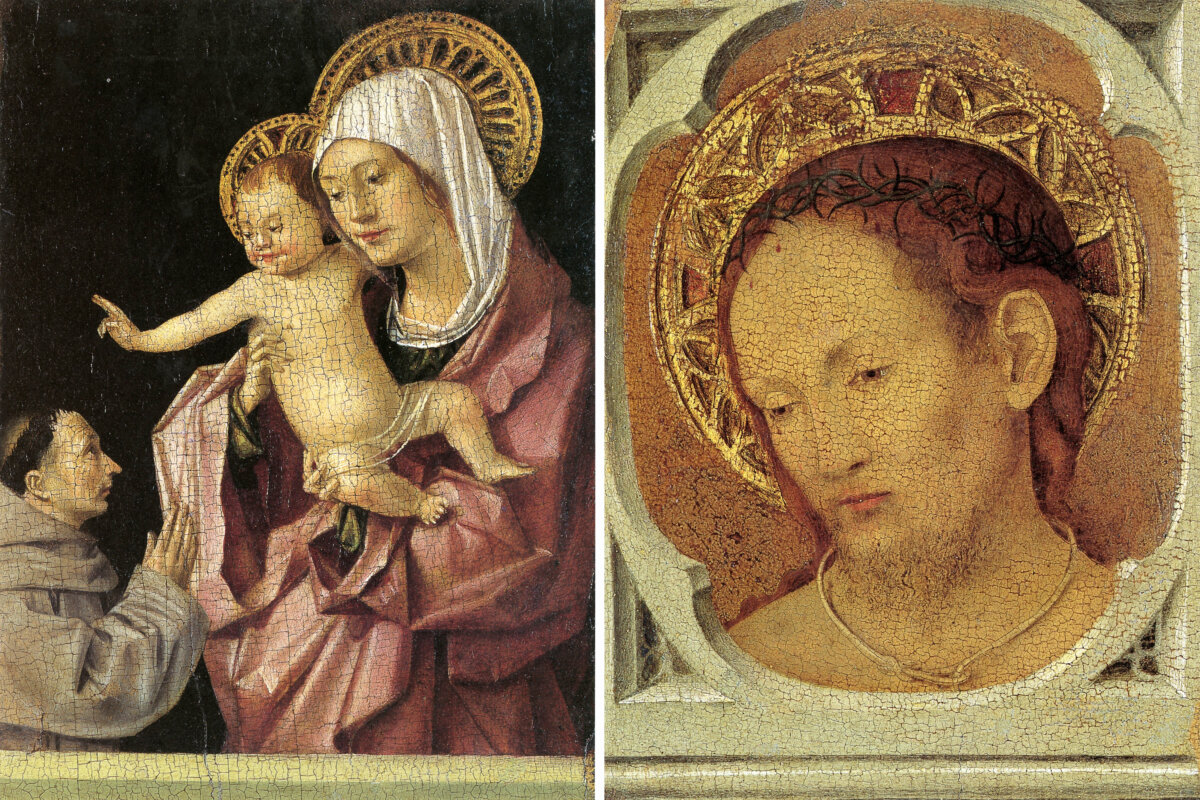
At the turn of the century, the MuMe panel was attributed to Antonello and bought by the Sicilian regional government from Christie’s in 2003. Scholars date the work to the artist’s early period, and it is perhaps his earliest known work. Like the painting now in Abruzzo, it is a small, double-sided portable devotional panel. It encompasses a range of artistic influences, reflecting Netherlandish, Provencal, and Spanish styles, as well as featuring Italian Renaissance perspective.
At the time of the Christie’s sale, Joanna Wright compared aspects of the “Madonna and Child” side that includes a Franciscan monk to the Abruzzo “Ecce Homo” in her catalogue essay: “The hair of the baby falling onto his forehead and the wisp of escaping hair from under the Virgin’s veil are not unlike the details of Christ’s hair on the brow as it falls loosely onto his shoulders.”
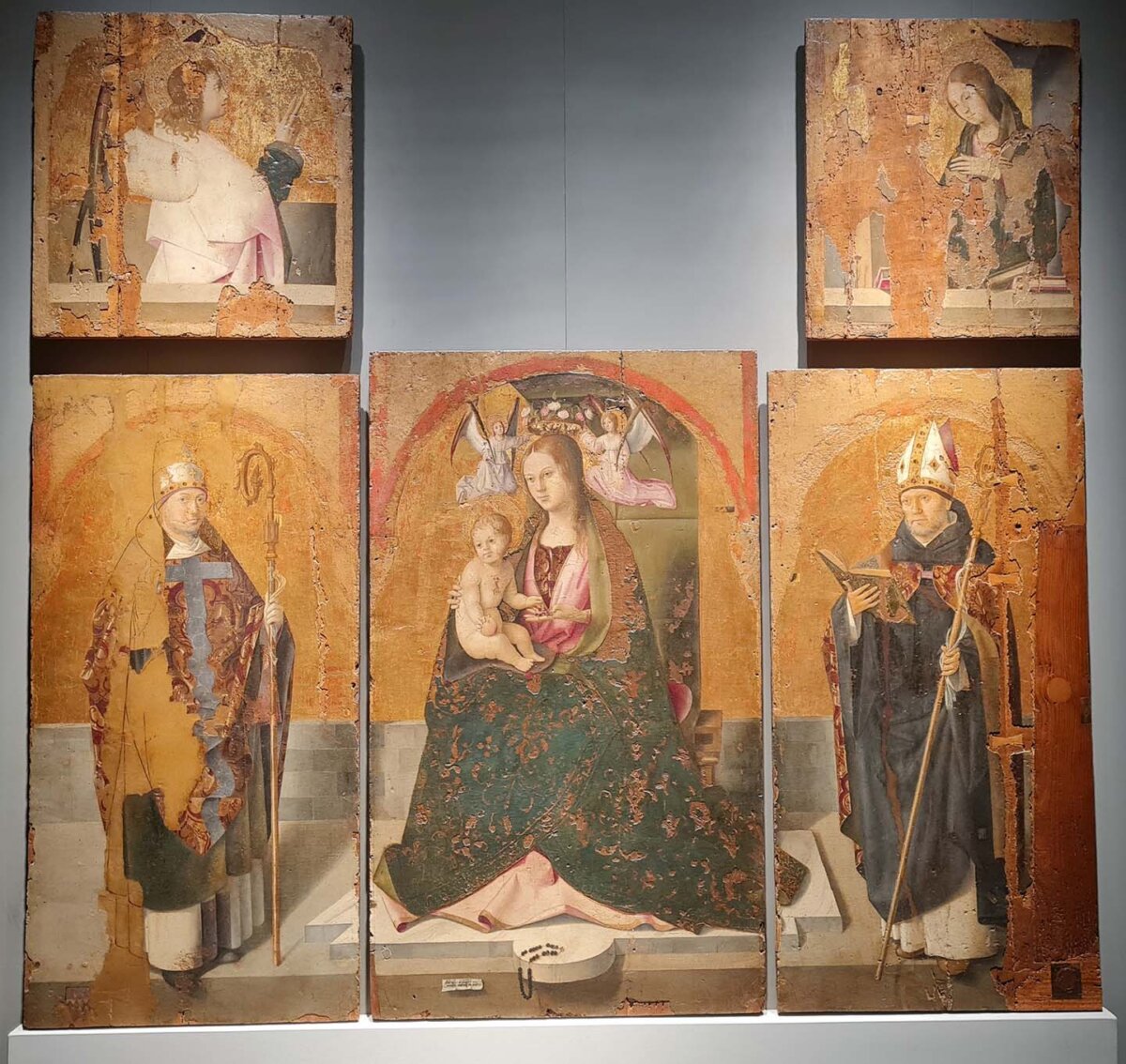
In the now stolen painting, Antonello dressed the Madonna in a pink mantle and dark green dress—uncommon coloration for her attire. The artist was masterful at depicting drapery. Antonello used the same color scheme, but reversed, for the panel of the Madonna in the “Polyptych of San Gregorio,” which is signed and dated 1473. This polyptych was originally six panels. The whereabouts of the upper register’s center panel has long been unknown (it may have disappeared in the 16th century), but the five remaining panels are the only paintings by Antonello to have remained continuously in Messina since their creation.
The “Polyptych of San Gregorio” even survived the 1908 earthquake that destroyed much of Messina, though the work sustained damage. While the thieves removed all five of the wooden panels from MuMe, two were discarded and found leaning against a wall outside the museum.
Sicily was also the scene for one of the most famous art heists in history. In 1969, the precious Caravaggio painting “Nativity With Saint Francis and Saint Lawrence” was stolen from Palermo’s Oratory of San Lorenzo. It has never been recovered. One hopes that there will be a different ending to this story for the city of Messina, which was in the middle of developing an Antonello initiative that would encompass exhibitions and even a new museum for the artist.
What arts and culture topics would you like us to cover? Please email ideas or feedback to features@epochtimes.nyc.