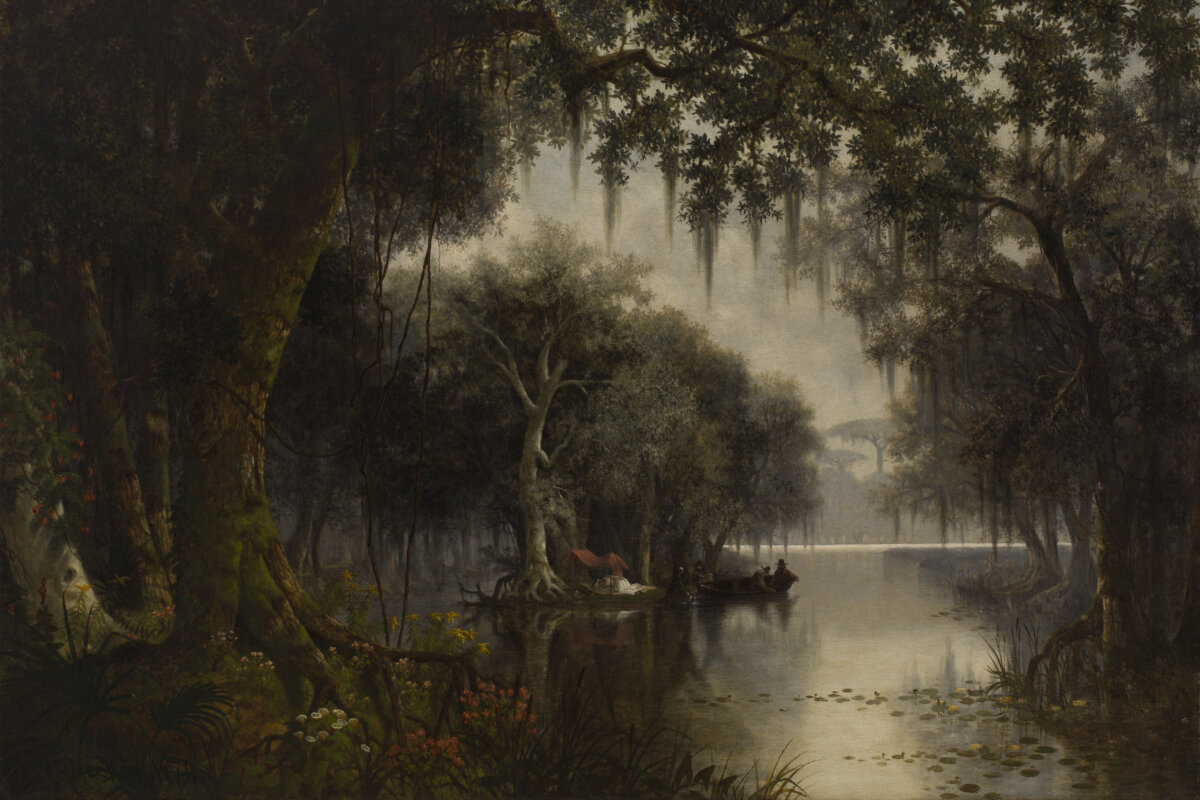
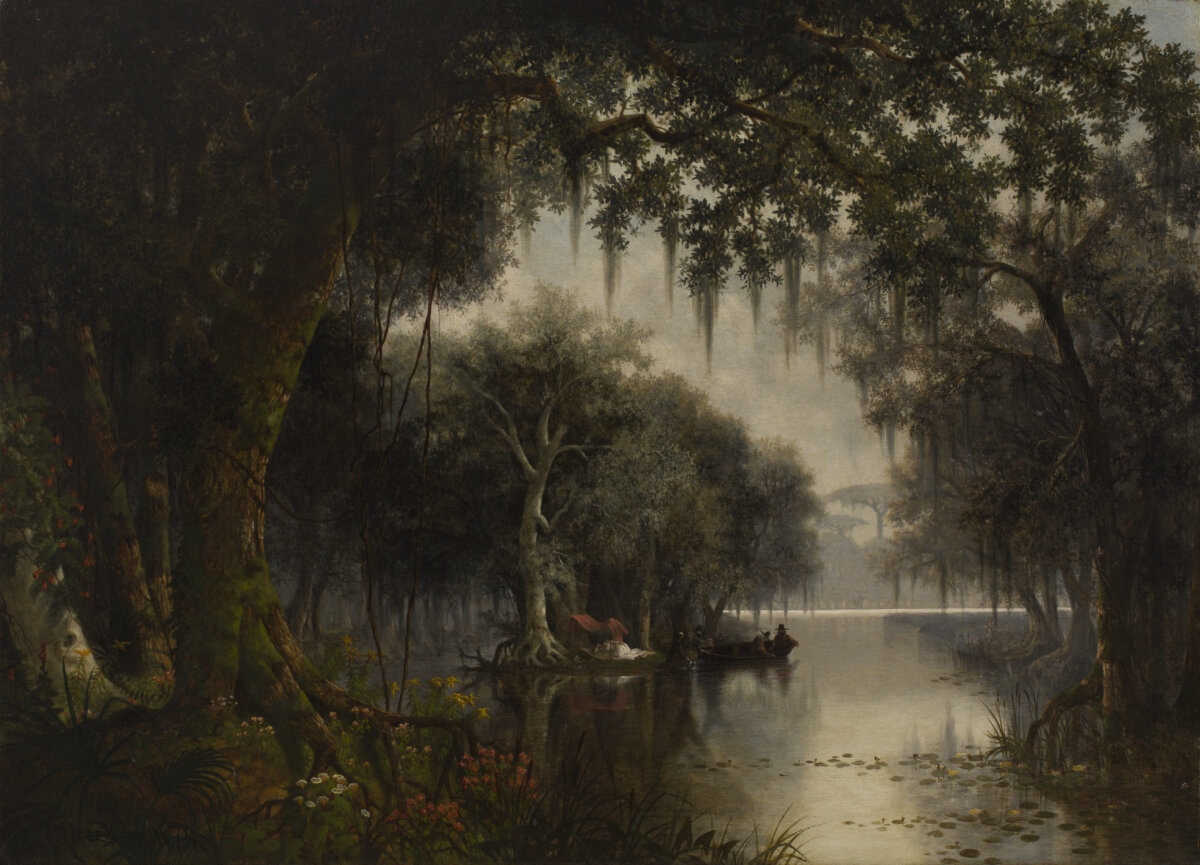
Deep in the Louisiana wetlands, a young woman rests beside still waters, yellow pond lilies drifting at her feet. Her gaze lingers on moss-draped cypress trees, as if she were suspended between memory and longing. This is “The Land of Evangeline,” a painting by Joseph Rusling Meeker, where literary narrative, history, and the haunting beauty of the Southern landscape converge.
Meeker’s emotional and visual sensibilities were shaped by his early life and training. Born on April 21, 1827 in Newark, New Jersey, and raised in Auburn, New York, he came from a family with deep European roots and a strong artistic tradition. His paternal ancestors emigrated in the 17th century from the Spanish Netherlands, present-day Belgium. Educated within this intellectual environment, Meeker was likely aware of the Acadian Expulsion, the mid-18th-century forced removal of French-speaking settlers from present-day Nova Scotia, New Brunswick, Prince Edward Island, and parts of Maine. Later, that history of displacement aligned with the themes that shaped “The Land of Evangeline.”
Artistic Formation
Meeker showed artistic promise from an early age. In 1845, he earned a scholarship to the National Academy of Design in New York City. There he studied under Asher B. Durand and portraitist Charles Loring Elliott, absorbing the landscape traditions of the Hudson River School. The National Academy played a central role in that movement, and Durand, a co-founder of both the Academy and the Hudson River School, helped define its emphasis on direct observation and naturalism. After completing his studies, Meeker moved to Louisville, Kentucky, where he taught art and exhibited his work.
When the Civil War began in 1861, Meeker’s path changed from artist and teacher to Union Navy paymaster. He was now responsible for administrative duties and soldiers’ wages. He served aboard a gunboat on the Mississippi River and in the surrounding swamps.
Unlike many Northerners who viewed these landscapes as harsh and inhospitable, Meeker responded to them with a sense of wonder.
A Landscape of Inspiration
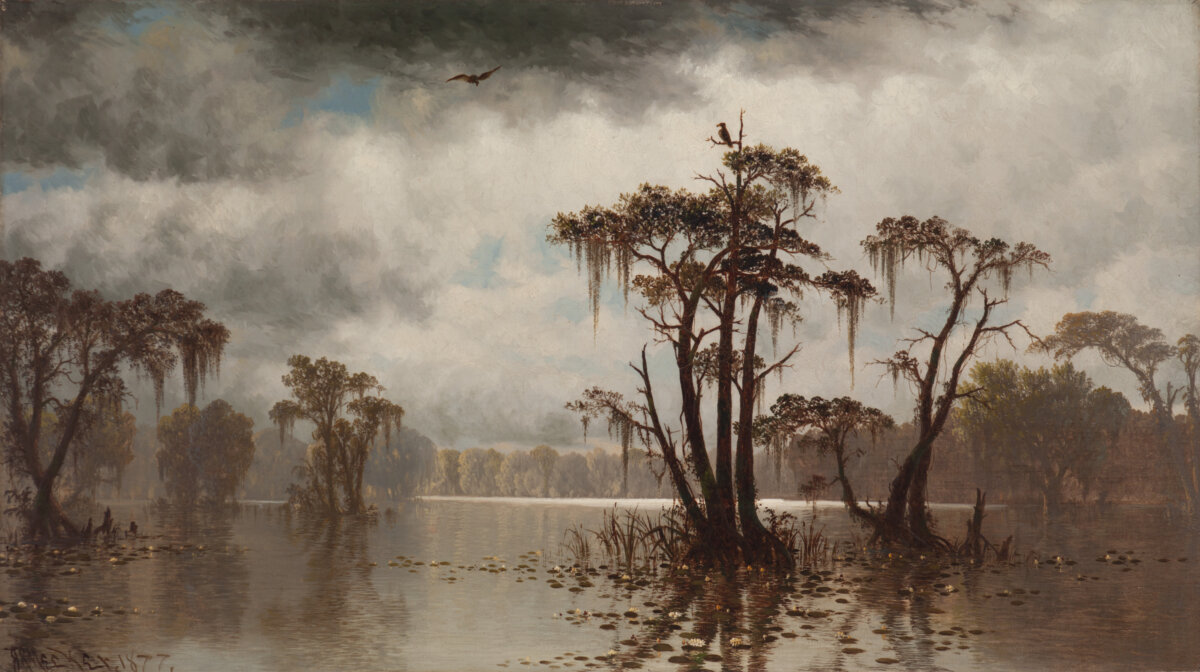
He found beauty in dense cypress groves, hanging Spanish moss, and slow-moving waterways, filling sketchbooks with studies of reflected light and shifting atmosphere. These studies informed later paintings that emphasized stillness and serenity. Reflecting on this period, he wrote:
“The sketches and studies I made during the four years I spent in the South are sufficient to last me for forty years instead of fifteen, and I shall see to it that their freshness and beauty does not fade away.”
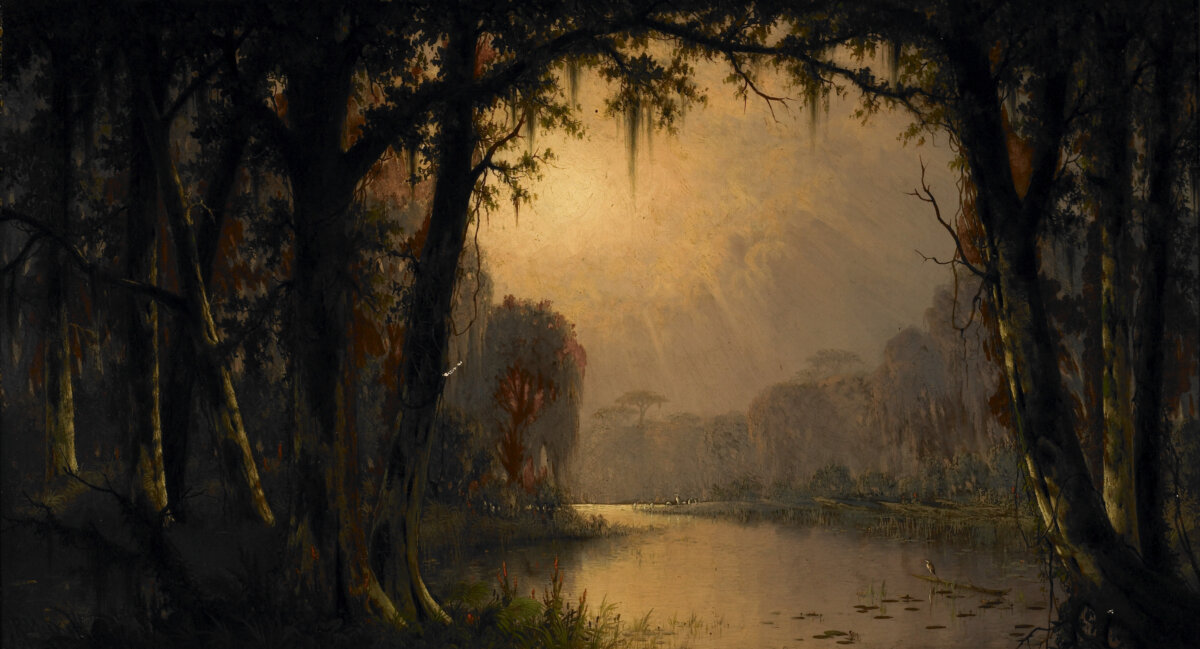
After the war, Meeker continued to explore Louisiana’s landscapes along the lower Mississippi River and its tributaries. His work demonstrates careful composition and attention to the natural environment. In paintings such as “Bayou Teche” and “Bayou Scene,” he developed a poetic vision of the region that combined his lived experience with cultural memory.
From Poem to Painting
Meeker’s most famous work, “The Land of Evangeline,” draws directly from Henry Wadsworth Longfellow’s 1847 epic poem “Evangeline, A Tale of Acadie.” The poem follows Evangeline, an Acadian woman separated from her betrothed during forced removal from her homeland. While fictional, it’s based on the Acadian Expulsion, which displaced roughly 10,000 people, many of whom suffered death from disease, starvation, or shipwreck. Survivors scattered across North America. Some eventually settled in Spanish-controlled Louisiana, contributing to the emergence of Cajun communities.
Longfellow frames this history through a landscape of memory and loss. He opens with, “This is the forest primeval. The murmuring pines and the hemlocks/ Bearded with moss … Stand like Druids of eld, with voices sad and prophetic.” In this vision, the Acadian world is already dissolving. He later reinforces that disappearance: “Waste are those pleasant farms, and the farmers forever departed/ Scattered like dust and leaves … Naught but tradition remains of the beautiful village of Grand-Pré.”
Longfellow emphasizes endurance, devotion, and emotional continuity amid displacement. He invites readers to “List to the mournful tradition still sung by the pines of the forest,” casting Evangeline’s story as both elegy and reflection on steadfast love.
Meeker translates this literary world into visual form. In “The Land of Evangeline,” the diminutive figures heighten the sense of isolation, allowing the landscape to carry emotional weight. Nature is both witness and participant in a story of loss, memory, and endurance.
Legacy and Influence
Meeker’s engagement with Louisiana extends far beyond “The Land of Evangeline.” His works from this period reveal a consistent visual language: waterways framed by trees, reflective surfaces that emphasize stillness, and luminous atmosphere. In paintings such as Wisconsin’s “Lake Mendota,” he continued his signature approach to landscapes, blending close observation with emotional tone.
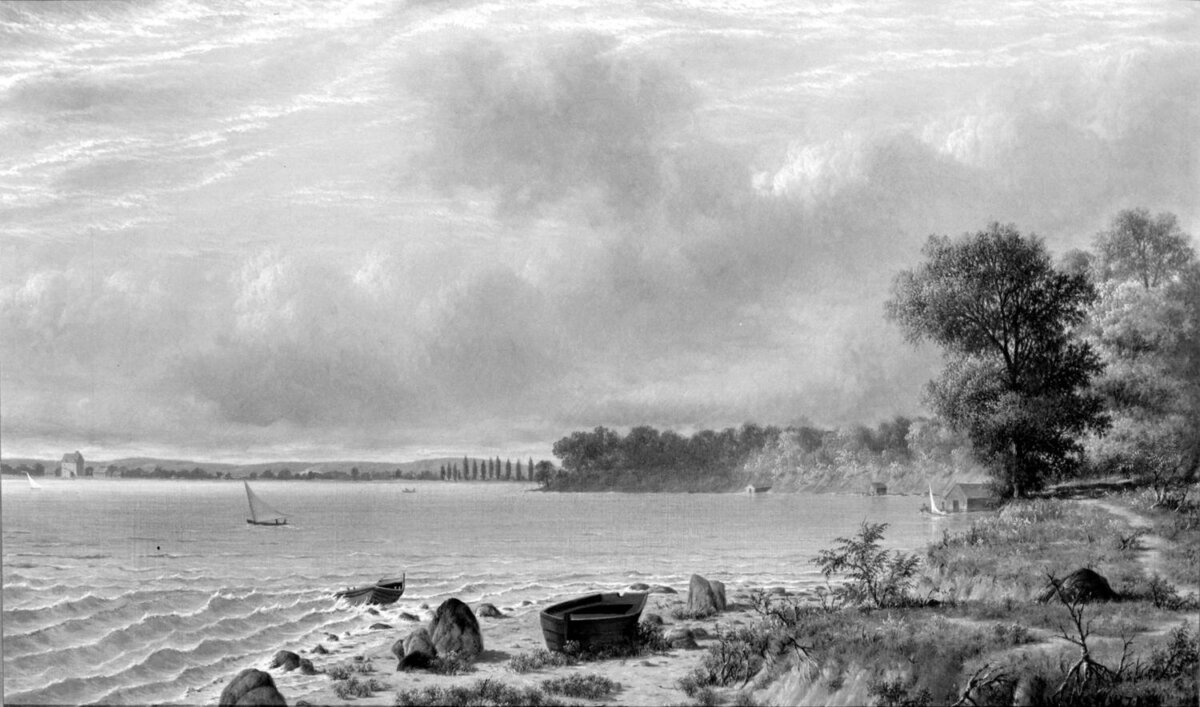
After the Civil War, Meeker settled in St. Louis, Missouri, where he became a central figure in the city’s art community. He co-founded the St. Louis Art Society in 1872 and the St. Louis Sketch Club in 1877. He also mentored younger artists, including Augusta S. Bryant, and contributed writing on painting techniques to a local periodical called The Western. His work is represented in major collections, including the Brooklyn Museum, the Louisiana State Museum, the Historic New Orleans Collection, and the St. Louis Art Museum.
Meeker died in St. Louis on Sept. 27, 1887. Although he never made Louisiana his permanent home, his powerful vision of its landscapes blended observation with imagination. “The Land of Evangeline” expands beyond its origins as a bayou scene, transforming the landscape into a broader meditation on love and longing, rich with emotional and symbolic depth. Meeker’s works ultimately helped reshape perceptions of Southern landscapes, guiding them toward a more lyrical and reflective tradition.
What arts and culture topics would you like us to cover? Please email ideas or feedback to features@epochtimes.nyc.