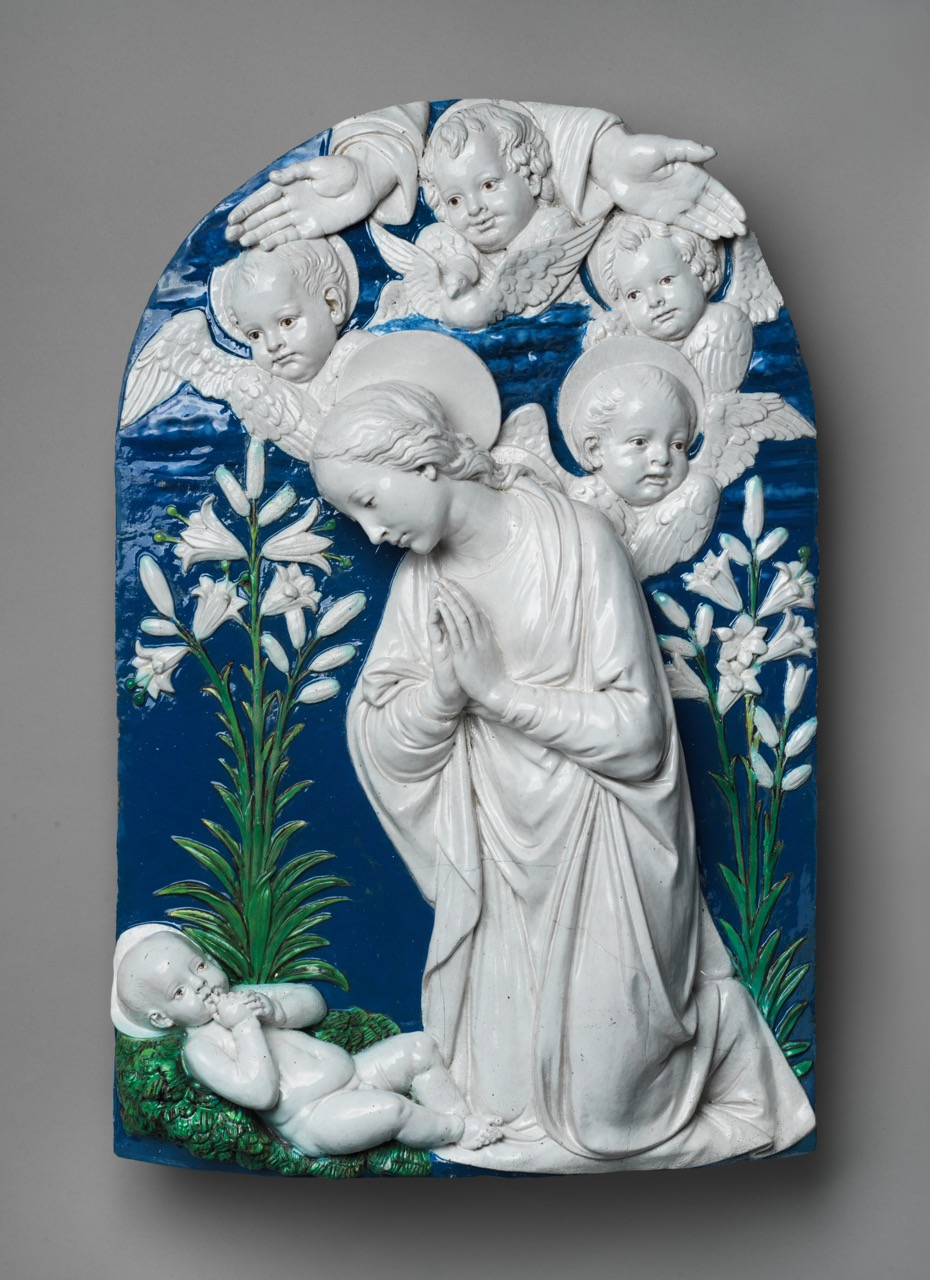
Around 1440, successful Italian sculptor Luca della Robbia forever changed Florentine art when he pioneered a tin glaze that gave terracotta a colorful shine. Before the Renaissance artist’s innovation, sculptures were monochrome bronze or marble works that often cost a fortune.
Besides coloring sculptures, Della Robbia’s glazing had the practical benefit of weatherproofing the terracotta. In addition, large terracotta works could be made piecemeal, using multiple molds. That made the terracotta sculptures portable, cheap to transport, and often seamless to reassemble.
Della Robbia (1399 or 1400—1482) kept his tin glaze formula a secret, except from his nephew Andrea (1435–1525), who along with his five sons later perfected the family art tradition in their workshops through the mid-16th century.
Art scholars Hugh Honour and John Fleming described Luca della Robbia’s glazed terracottas in their book “A World History of Art”:
“The meditative serenity which emanates from his reliefs is achieved by a uniquely simple idealization. Colours are often limited to a background of beautiful sky-blue, to flowering plants and fruits, the figures with their Classically modelled draperies being left white so that they diffuse a celestial radiance.”
Andrea’s early works reflect his uncle’s style, but later Andrea developed a flair for affecting, naturalistic high reliefs.
Della Robbia Glazed Terracotta in America
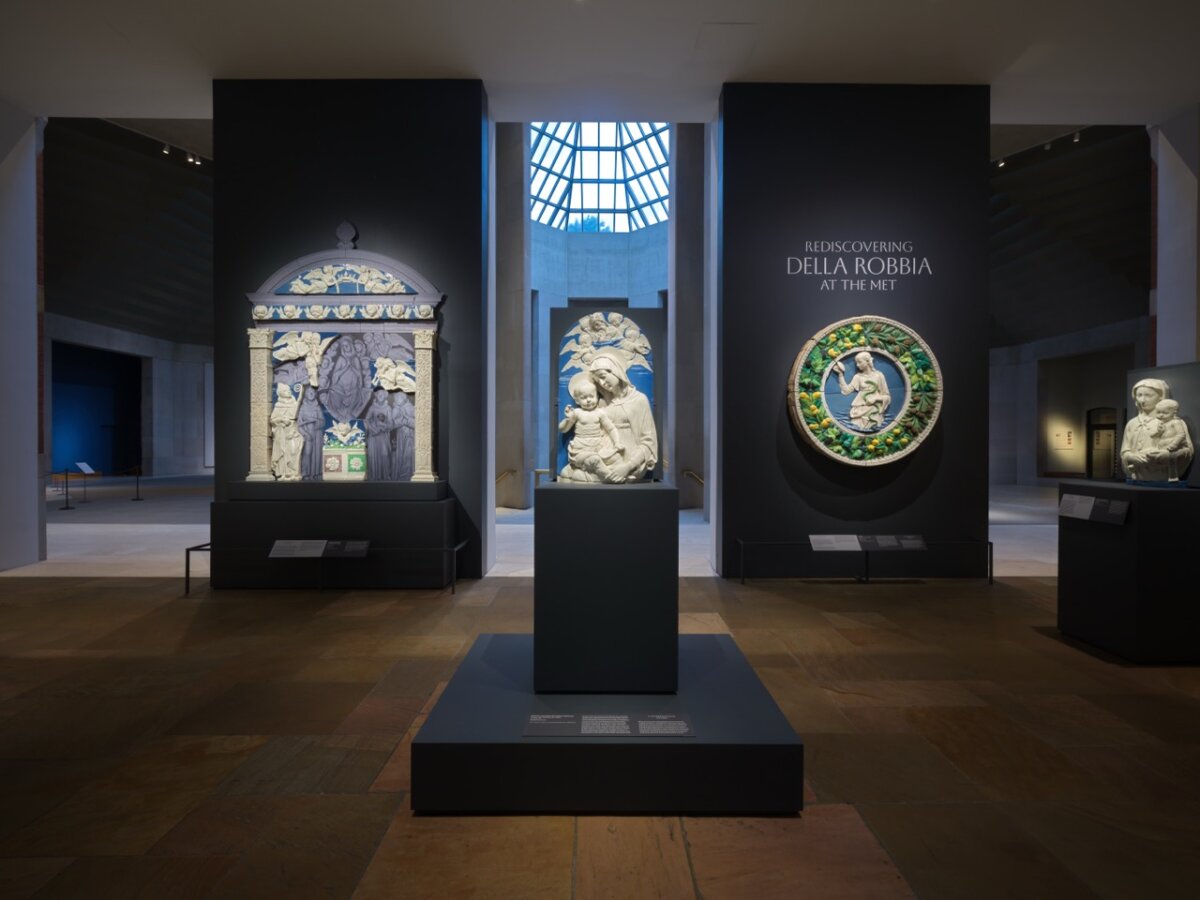
New York’s Metropolitan Museum of Art holds America’s largest collection of Della Robbia glazed terracottas, spanning three generations of the family. Twelve of these Italian Renaissance sculptures feature in the museum’s new exhibition: “Rediscovering Della Robbia at The Met.” The terracotta sculptures on display include private devotional works, small domestic statuettes, and monumental altarpieces.
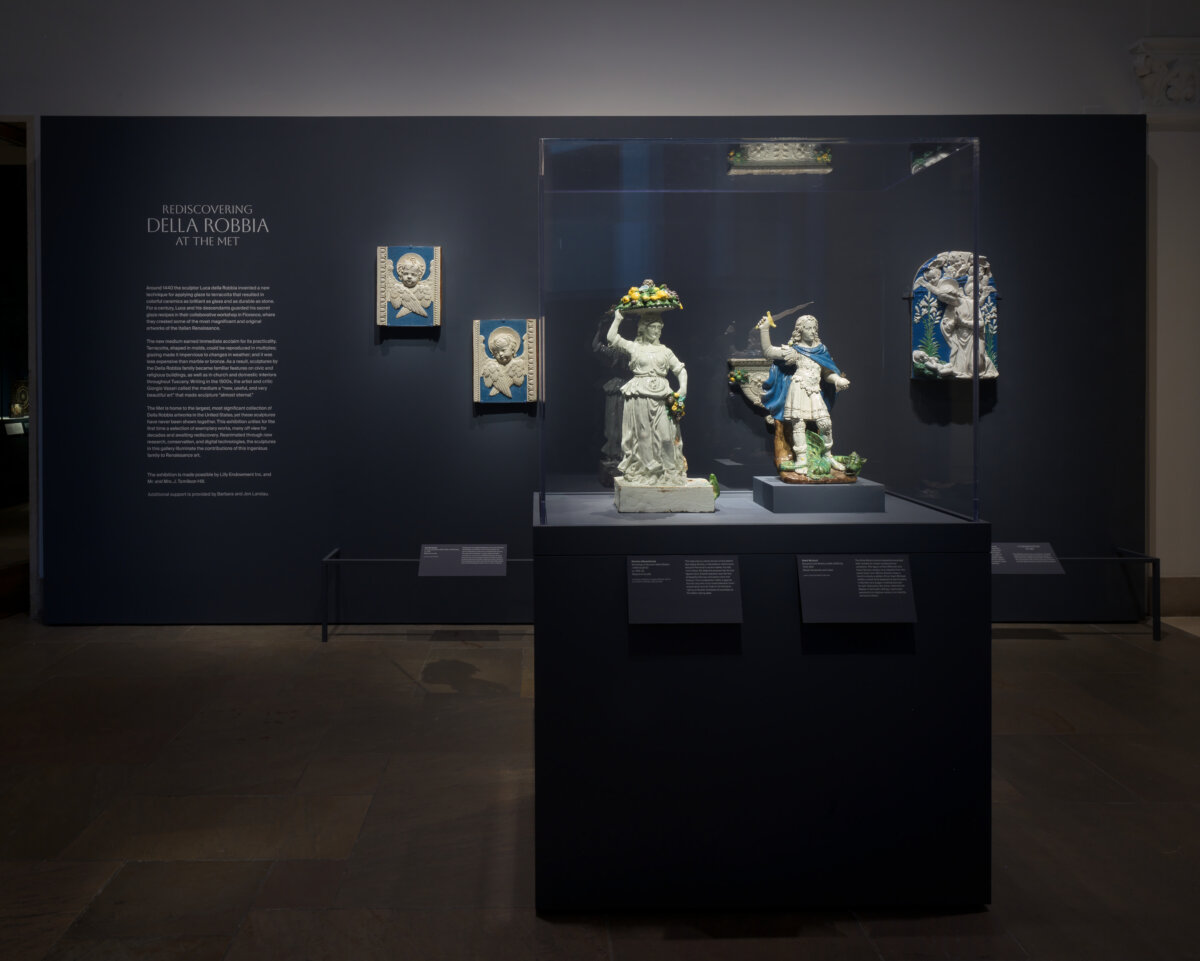
Among the exhibition highlights is an exceptional gift from the Dick Wolf Collection: a luminous lunette, which is a semicircular architectural feature, of the “Mystic Mandorla.”
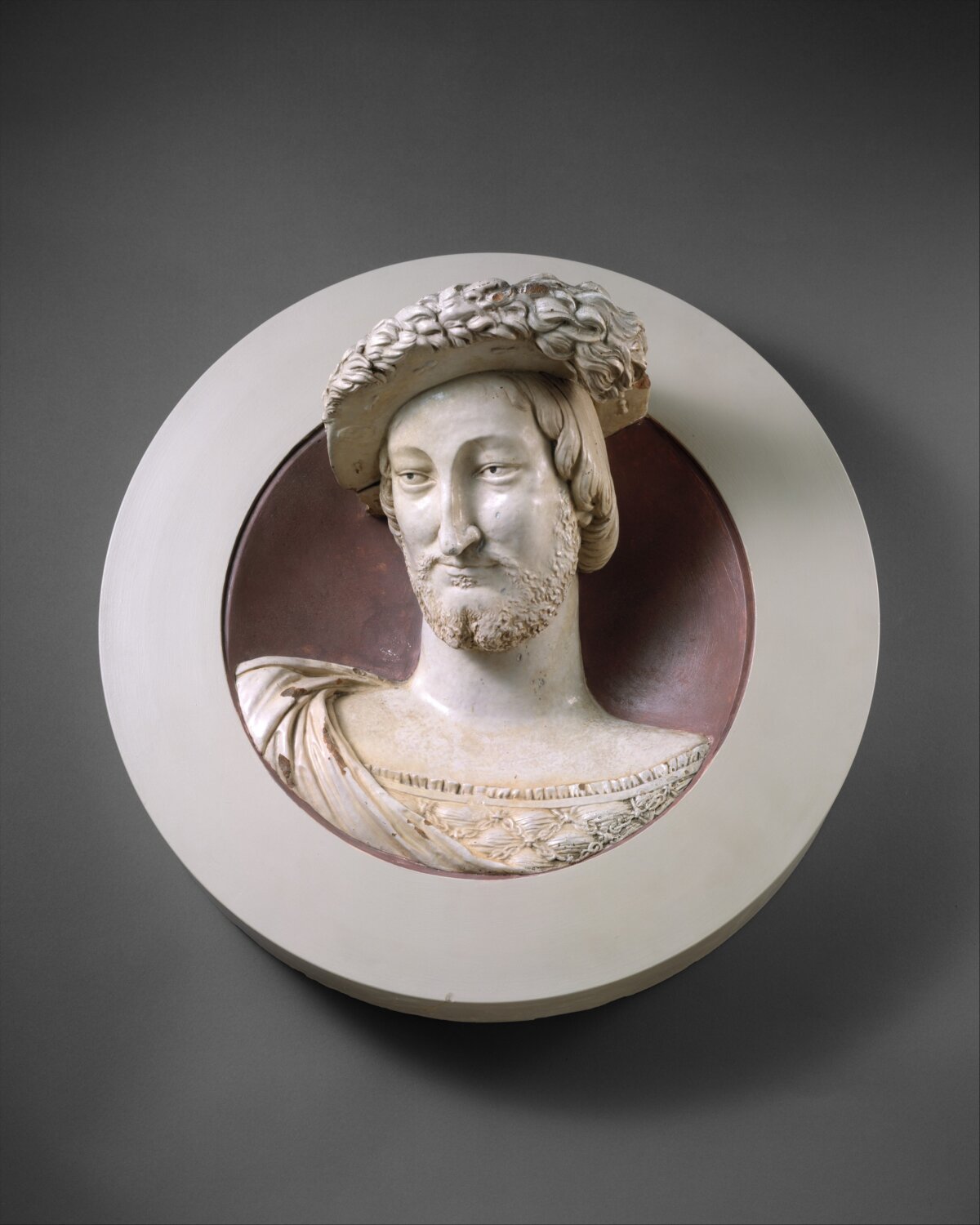
The exhibition also includes the only surviving contemporaneous portrait by the Della Robbia family: a portrait medallion of François I, king of France.
For the first time in 70 years, 33 interlocking pieces of Andrea della Robbia’s “The Assumption of the Virgin (The Marquand Altapiece)” are also on view, after their recent restoration. The partially conserved altarpiece is displayed with a video animation that demonstrates how the altarpiece’s 66 glazed terracotta pieces might originally have been assembled like a jigsaw puzzle.
Surprisingly, Della Robbia’s brilliant glazed terracotta works also had a pioneering impact on American colleges, which began with “The Marquand Altarpiece.”
The Marquands
In 1882, New York businessman and art collector Henry G. Marquand gifted the Metropolitan Museum of Art what he believed was Luca della Robbia’s “The Assumption of the Virgin.” At that time, the 10-foot-high glazed terracotta altarpiece was the most important Italian Renaissance work of art in The Met’s collection.
Marquand’s son Allan completed a comprehensive study of the altarpiece, including identifying its 19th-century restorations. His research also revealed that Luca’s nephew, Andrea della Robbia, actually created the work. Allan’s love for the work, also known as “The Marquand Altarpiece,” led him to record the Della Robbia family’s work in an eight-volume catalog, which The Met says is unsurpassed today.
Allan was one of the first art historians to introduce art history into American collegiate curricula. He went on to become the first director of the Princeton University Art Museum.
‘The Marquand Altarpiece’
According to The Met, a Franciscan convent south of Florence commissioned “The Assumption of the Virgin” altarpiece. The conserved glazed terracotta pieces include the classical style of architecture that frames the altarpiece. Two angels hold the Virgin’s crown aloft in the lunette. A row of seven cherubs lines the entablature, and Corinthian-style floral columns flank the sacred scene.
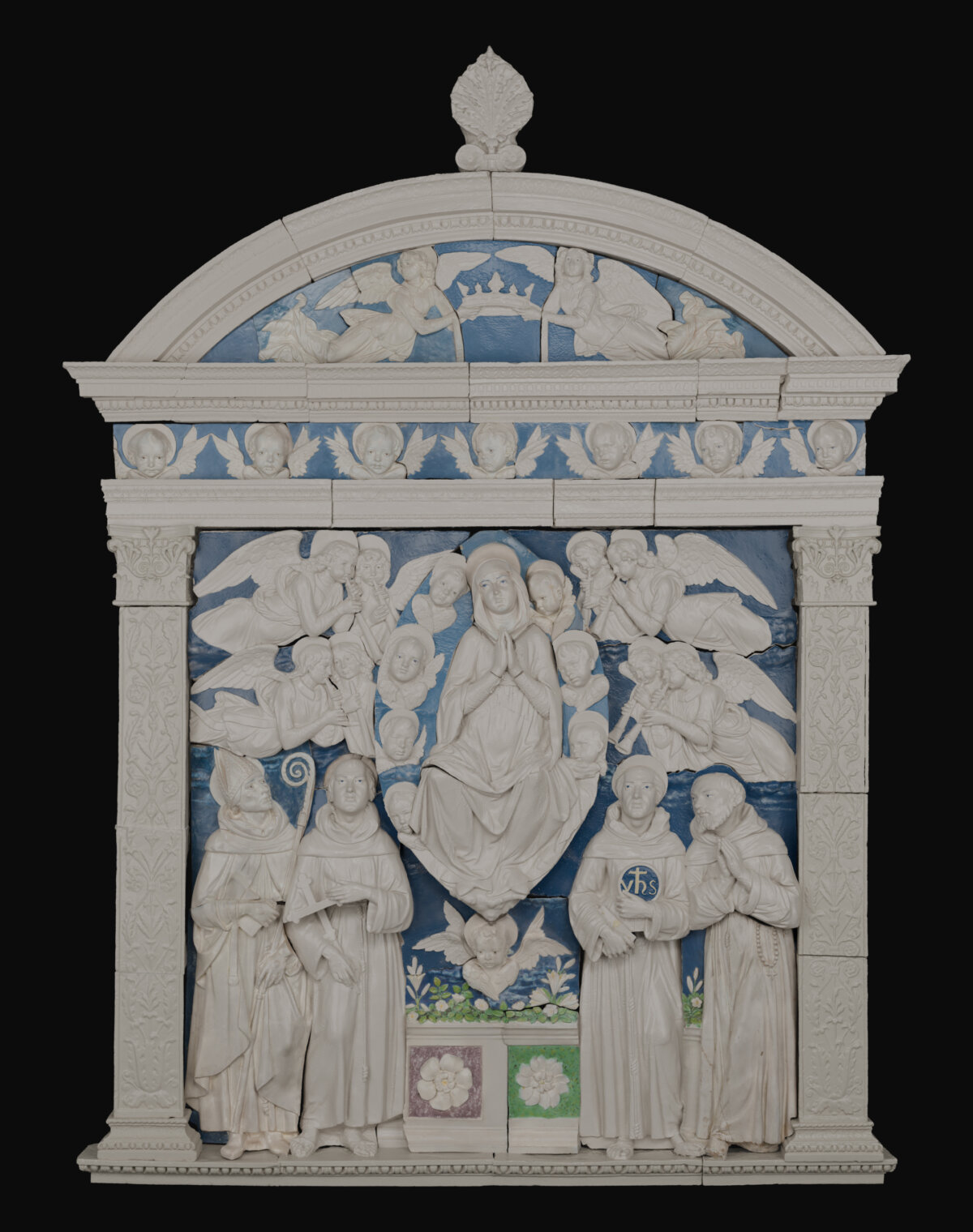
In the main composition, the conserved pieces include four musician angels heralding the auspicious occasion in heaven. The Virgin’s tomb, at the bottom center, is carved with colorful roses and lilies, motifs of the Virgin. One of the four Franciscan saints gazes adoringly up at the Virgin, who is absent from the altarpiece and probably awaiting its conservation treatment in the museum’s storage.
Naturalistic Yet Ethereal
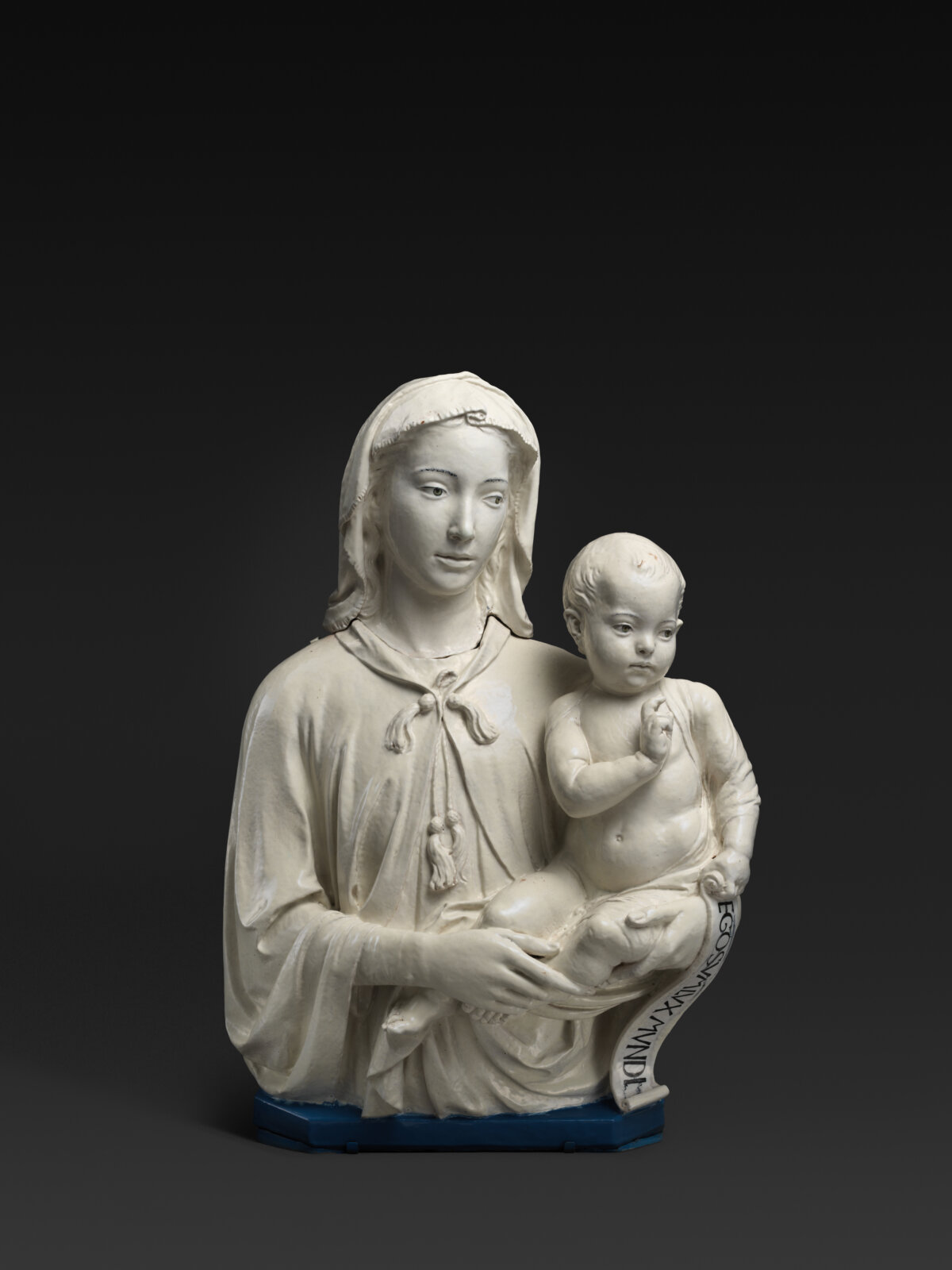
Andrea’s realistic rendering of “Madonna and Child (The Lehman Madonna)” exemplifies the artist’s skill for carving natural human emotions and gestures in a sacred context. This enabled pious viewers to empathize with the maternal scene without losing the essential, divine meaning of the pair. The pudgy Christ child’s confident gaze belies babyhood, as he raises his hand in a blessing gesture. His other hand grips his clothes, just like any baby would. Andrea’s flair for the subtlest of naturalistic details can be observed in the Christ child’s slight lip curl and soft baby curls.
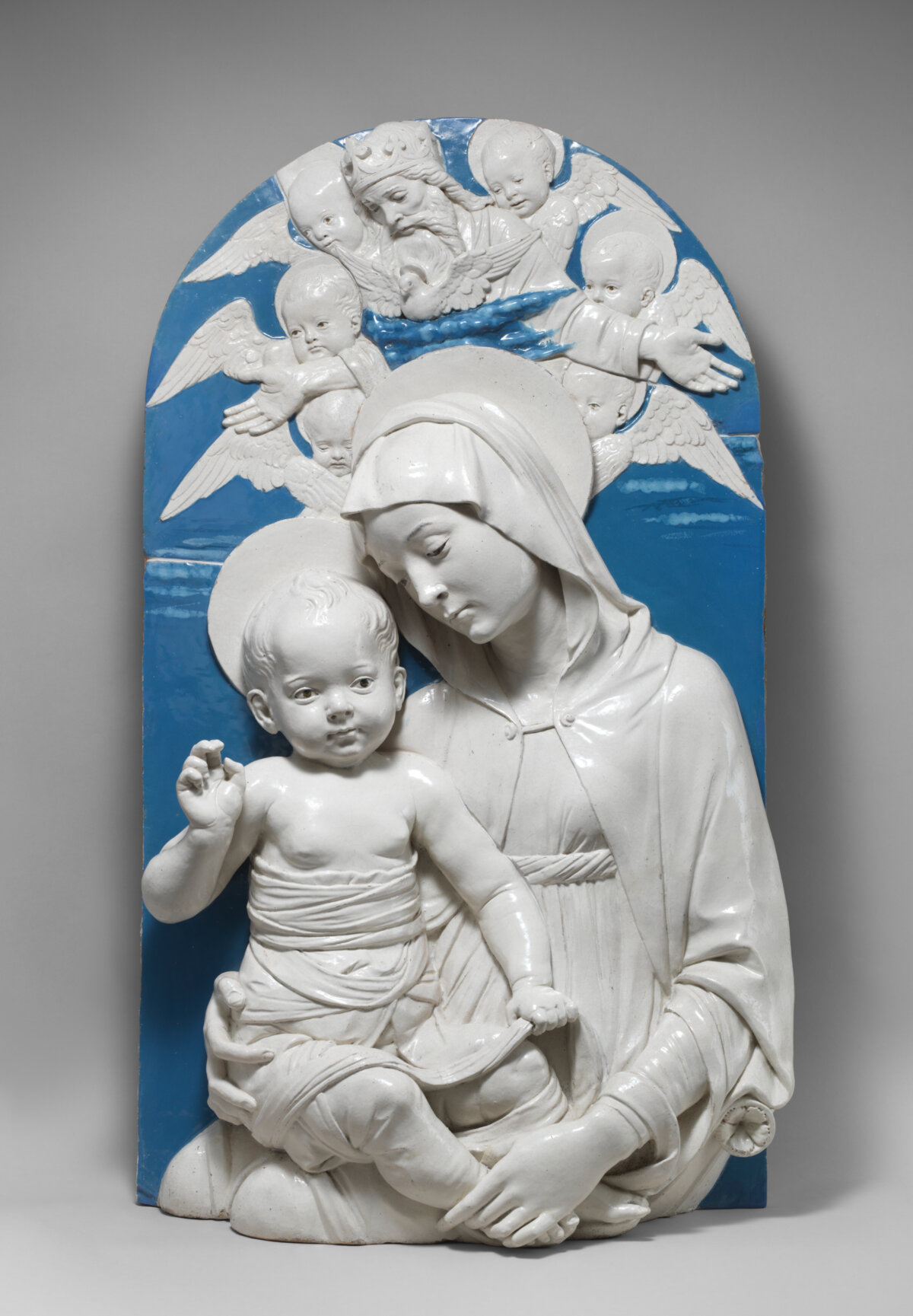
Even the way the Virgin supports her son with the splayed fingers of one hand and grips his foot with the other to keep him from toppling from her arms demonstrates how Andrea closely followed nature. Halos surround their heads to remind viewers that this is a sacred scene. At the top, cherubim surround God in heaven, who solemnly surveys the pair while gesturing with an open embrace. Directly below God, a dove represents the Holy Spirit.
Around the same time that Andrea created “The Lehman Madonna,” he sculpted the lunette of “Saint Michael the Archangel” for the entrance of the Church of San Michele Arcangelo in the small town of Faenza, between Bologna and Ravenna, Italy. The armor-clad angel-warrior wields a sword and, in his scales of justice, weighs two souls of the deceased, who plead for mercy. Again, Andrea’s virtuoso sculpting created the naturalistic figure with a commanding yet peaceful presence.
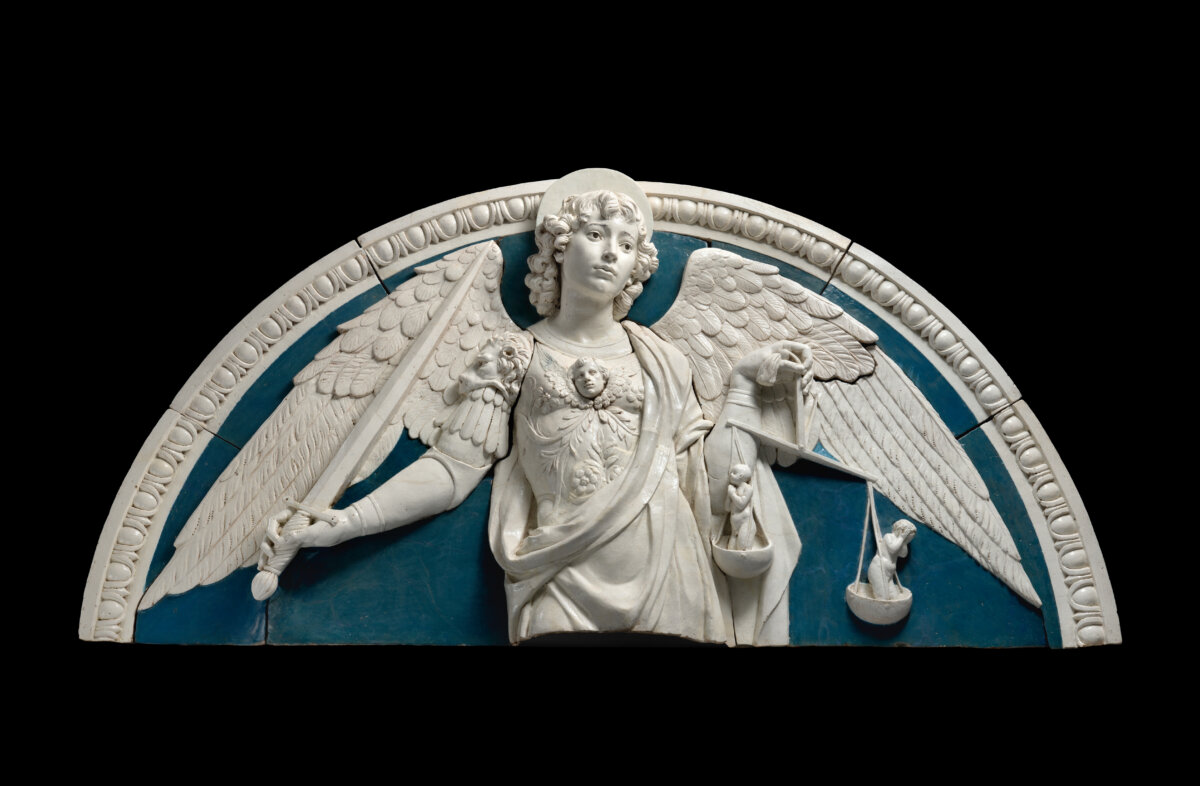
In July 2008, the lunette fell from its mount in the museum, requiring painstaking conservation that included “filling and in-painting.” The accident allowed conservators to observe finger marks and tool marks, and also gain valuable insights into the work’s construction. They found it challenging to replicate Della Robbia’s glaze. The restoration work was completed in 2016.
Mystical Fruit, Flora, and Vegetables
Andrea’s son Giovanni (1469–1529) sculpted the colorful “Mystic Mandorla” lunette that recently entered The Met’s collection, a gift from the Dick Wolf Collection. Giovanni carved two cherubim, and four angels raising a golden mandorla, which is the almond-shaped aura that traditionally surrounds the Virgin in images of her assumption.
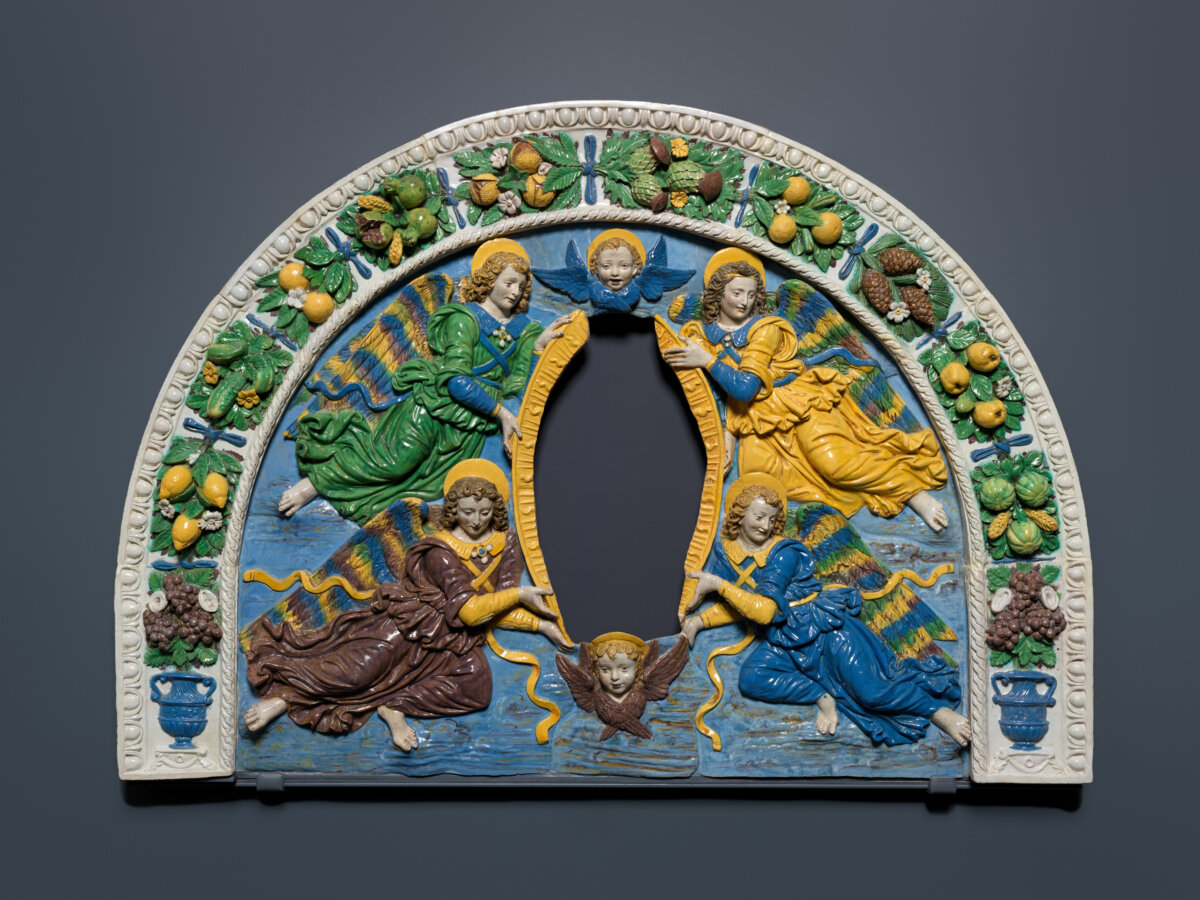
The artist framed his composition with fruit, flora, and vegetables, motifs that recurred throughout the Della Robbia family’s glazed terracottas. Lemons, grapes, cucumbers, quinces, and pine cones are among the motifs in this work. According to London’s Victoria & Albert Museum, the lemons represent salvation, the grapes and cucumbers represent the resurrection, and the quinces and pine cones symbolize virtue and immortality.
The meaning of these motifs can be traced back through the centuries. Pliny (around A.D. 24–A.D. 79) admired the quince tree’s ability to grow from cuttings, so the quince alludes to immortality. Bunches of grapes symbolize the wine Jesus served at the Last Supper. And the lemon tree flourishes in full sunlight. That, along with the fruit’s healing nature—particularly its traditional use as an antidote for poison—led to the lemon’s being the motif of salvation.
The Met wrote: “Praised during the Renaissance as ‘almost eternal,’ today Della Robbia sculptures are often as vibrantly luminous as when they emerged from the kiln five hundred years ago.” Visiting “Rediscovering Della Robbia at The Met” can therefore be likened to time-traveling back to Renaissance Florence, often known as the “Cradle of the Renaissance,” and witnessing the birth of these glazed terracotta sculptures.
The ‘Rediscovering Della Robbia at The Met’ exhibition at New York’s Metropolitan Museum of Art runs through Jan. 17, 2028. To find out more, visit MetMuseum.org.
What arts and culture topics would you like us to cover? Please email ideas or feedback to features@epochtimes.nyc.