Lord Horatio Nelson was not an imposing figure. At 5 feet, 4 inches, with one arm and one eye, he hardly looked like the debonair, swashbuckling terror of Napoleon Bonaparte’s nightmares. Yet he was exactly that. Few figures in naval history accomplished so much—or secured so lasting a place in the imagination of their nation.
An Unlikely Figure of Legend
Fittingly, Nelson grew up by the sea. Born in 1758 to Catherine and Edmund Nelson, he spent his early years in a quiet village in Norfolk, England two miles inland. That peaceful childhood ended with his mother’s death. With 10 other children to support on a rector’s modest income, his father sent him to sea.
Like many naval officers of the era, Nelson began young. At 12, he joined his uncle, Capt. Maurice Suckling, in the Royal Navy. Frail and slight, he hardly seemed suited to the life. Suckling reportedly asked, “What has poor Horatio done, who is so weak, that he, above all the rest, should be sent to rough it out at sea?” Yet he took the boy under his wing, beginning one of the most remarkable careers in naval history.

Nelson’s first year aboard the Raisonnable was spent learning the fundamentals of sailing and naval command. Suckling soon arranged further experience: a voyage to the West Indies aboard a merchant ship, followed by a grueling Arctic expedition. On that northern voyage, Nelson famously tried to shoot a polar bear. When he missed, he attempted to club it with his musket before a shot from the captain drove the animal off—an early glimpse of the reckless courage that would define him.
His next assignment, aboard the frigate Seahorse, exposed him to the harsher realities of naval discipline—he witnessed hundreds of floggings. There, he fell ill with fever and sank into depression. He later described emerging from it after seeing an “orb of inspiration,” resolving: “I will be a hero, and confiding in providence, I will brave every danger.” That sense of destiny never left him.
Nelson rose quickly. He became a lieutenant in 1777 and, just two years later, a captain at age 20. He was given command of a frigate in the Caribbean, and he fought Spanish forces allied with the American revolutionaries. He distinguished himself in an assault on San Juan in 1780, only to nearly escape death afterward from yellow fever.
He commanded another expedition to the West Indies and visited the island of Nevis in March 1785. There, he met and courted the widow Frances Nisbet. They were married in 1787. Back home, he was placed on half pay and did not receive another command for five years.
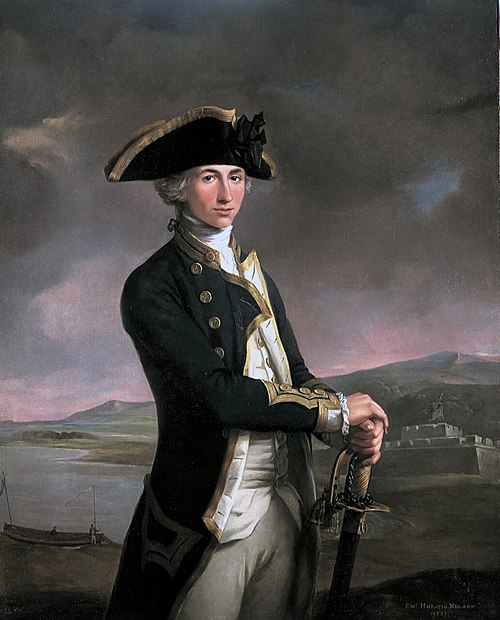
Then, with the flash and thud of the guillotine, war returned. King Louis XVI was beheaded by French revolutionaries in 1793, and England declared war against the revolutionary forces that were upending the political and moral order in Europe. As a result, Nelson received command of the 64-gun Agamemnon. He went into service against the French in the Mediterranean, where he crossed paths at Toulon with a young artillery officer named Napoleon Bonaparte. It was during one of the Mediterranean engagements that Nelson lost sight in his right eye after being struck by debris.
Wounded but Undeterred
Nelson’s slow climb within the navy continued as he earned a knighthood and promotion to rear admiral for his daring performance at the Battle of Cape St. Vincent—where he engaged seven Spanish ships and captured two.
Nelson’s commanders then sent him to capture a Spanish treasure ship in the harbor of Santa Cruz on the island of Tenerife. As the charismatic leader that he was, Nelson personally led the assault. His heroism cost him his right arm, which was shattered by a musket ball and subsequently amputated.
One of his most celebrated victories came in 1798 at the Battle of the Nile. Pursuing a squadron of French ships to Alexandria, Nelson found that French commander, Adm. Francis Brueys, had anchored his 13 ships close to a range of shoals offshore. In a bold maneuver on Aug. 1, 1798, Nelson sent five of his 13 ships to thread their way between the French and the shoals, while attacking from the seaward side. The French were surprised and overwhelmed. The British destroyed them, ship by ship, and managed to win a resounding victory in which they lost no ships. Nelson, wounded in the head during the battle, refused to withdraw.
The U.S. Naval Institute explains the immense implications of this victory:
“First and foremost, it forcibly reestablished British naval presence in the Mediterranean. A French army under Bonaparte was bottled up in Egypt where, without sea supply lines and communications, it could do little to threaten the British presence in the area or their route to India. At home, news of the victory gave a much-needed boost to a government struggling with military and naval unrest, quieted republican sentiments, and even spurred some radical groups to rally around the flag in the fight against France. Overnight, Nelson became the personification of British patriotism and sea power.”
Nelson became a national hero and was named Baron of the Nile.
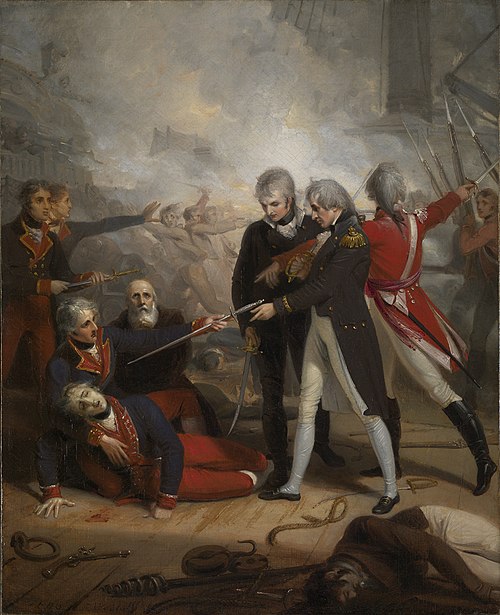
Scandal and Devotion
Yet his personal life grew increasingly complicated. While in Italy, he formed a close relationship with Emma Hamilton, wife of British envoy Sir William Hamilton. By 1799, the two were lovers. Their affair became public, and in 1800 Emma gave birth to Nelson’s daughter. The scandal followed him even as his fame grew.
By 1805, the Napoleonic Wars had broken out again with renewed intensity, and Britain was gripped with fear that Napoleon might invade, assisted by the Spanish navy. The nation turned to Lord Horatio Nelson, now a commander in chief, and his fleet.
At the height of his powers, Nelson relied on well-drilled captains and a bold plan to split the Franco-Spanish line, trusting aggressive tactics to win a decisive battle.
On Oct. 20, 1805, the Franco-Spanish fleet, under the command of Pierre-Charles Villeneuve, sailed out from Cadiz. The British fleet under Nelson met them off Cape Trafalgar. The British ships formed into two divisions, and Nelson sent a simple signal to all the ships: “England expects that every man will do his duty.”
Nelson then did something characteristic—and dangerous. Wearing full insignia and carrying no weapon, he remained visible on deck, an easy target.
Commenting on this decision, Tom Pocock, author of “Horatio Nelson,” wrote:
“Because Nelson went into action unarmed and presenting himself so generously to enemy sharpshooters, it has been suggested that this was a form of suicide, to which his agony of mind over Fanny [Frances] and Emma had driven him. This is unlike Nelson. But it is possible that, with his strong and simple piety, he took the unnecessary risk, unconsciously, as a positive means of offering himself to the judgment of God, in atonement and in gratitude.”
Whatever his intentions, Nelson’s vulnerable position on his ship’s quarterdeck did lead to his demise. During the battle, a French sharpshooter aboard the Redoubtable spotted him and fired. The bullet struck Nelson in the shoulder and lodged in his spine.
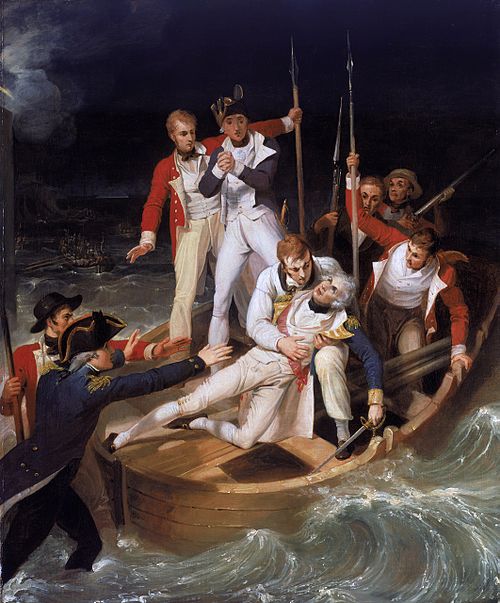
A Nation Mourns Its Hero
Carried to his cabin below, he lingered as the battle raged. When told that 15 enemy ships had been captured, he reportedly replied, “That is well, but I had bargained for 20.” Soon after, he spoke his final words: “Now I am satisfied. Thank God, I have done my duty.”
Not a single British ship had been lost.
Trafalgar saved England from the threat of invasion and established the supremacy of British sea power for at least a century. A grateful nation poured out its grief for the fallen leader who had won her safety. Nelson received a grand funeral at St. Paul’s Cathedral, and countless monuments were erected in his honor.
As Pocock relates, the poet Coleridge wrote that “When Nelson died it seemed as if no man was a stranger to another, for all were made acquaintances in the rites of common anguish.”
A great and flawed man had saved England—at the ultimate cost. “To the British people he had become ‘The Hero,’” Pocock wrote. “He was Superman with Everyman’s weaknesses. That his hold on the imagination is maintained is due to the flash and sparkle of the many sides of his character.”
What arts and culture topics would you like us to cover? Please email ideas or feedback to features@epochtimes.nyc