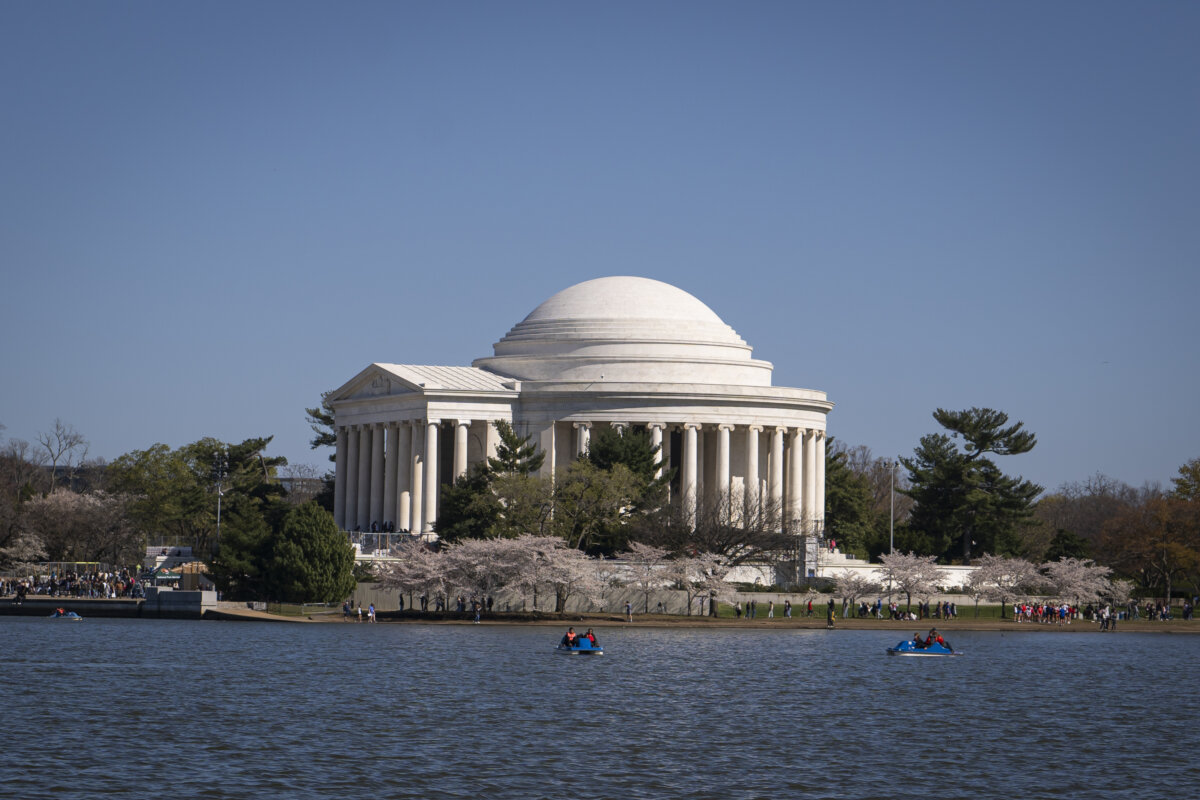
It hardly seemed the right time for the construction of a new memorial in Washington. The timing was inopportune: The year was 1934, and the country was in the midst of the Great Depression. Along the Tidal Basin of the Potomac Park seemed an inappropriate location; it was amid the cherished cherry blossom trees, their planting the brainchild of former First Lady Helen Taft.
Despite the timing and the location, Congress passed a joint resolution on June 26, 1934, to establish a 12-member Thomas Jefferson Memorial Commission (TJMC) “for the purpose of considering and formulating plans for designing and constructing a permanent memorial” to the man whom “the American people feel a deep debt of gratitude.”
Interestingly, in May 1920, Congress had granted permission to the Roosevelt Memorial Association to establish a memorial in Washington to Theodore Roosevelt. On the western portion of the National Mall, the Washington Monument, the Lincoln Memorial, and the White House occupied the east, west, and north points, respectively, leaving the south unoccupied. A debate erupted between “Jeffersonians” and “Rooseveltians” as to whose memorial should be placed in the final spot—the former won out.
A World of Controversy
The Jefferson memorial resolution had actually first been proposed by Congress in 1926—the nation’s 150th anniversary and the 100th anniversary of Jefferson’s death.
It seemed the memorial could not proceed without controversy. Along with the Jefferson-Roosevelt debate, the congressional expenditure during a time of economic hardship, and the displacement of the beloved trees, there was controversy surrounding the selected architect.
John Russell Pope was one of the country’s leading architects. Educated in New York City, Rome, and Paris, his style was neoclassical, and he had designed several major projects, including the National Archives, the National Gallery of Art, two wings of the Metropolitan Museum of Art, and a wing at London’s British Museum.
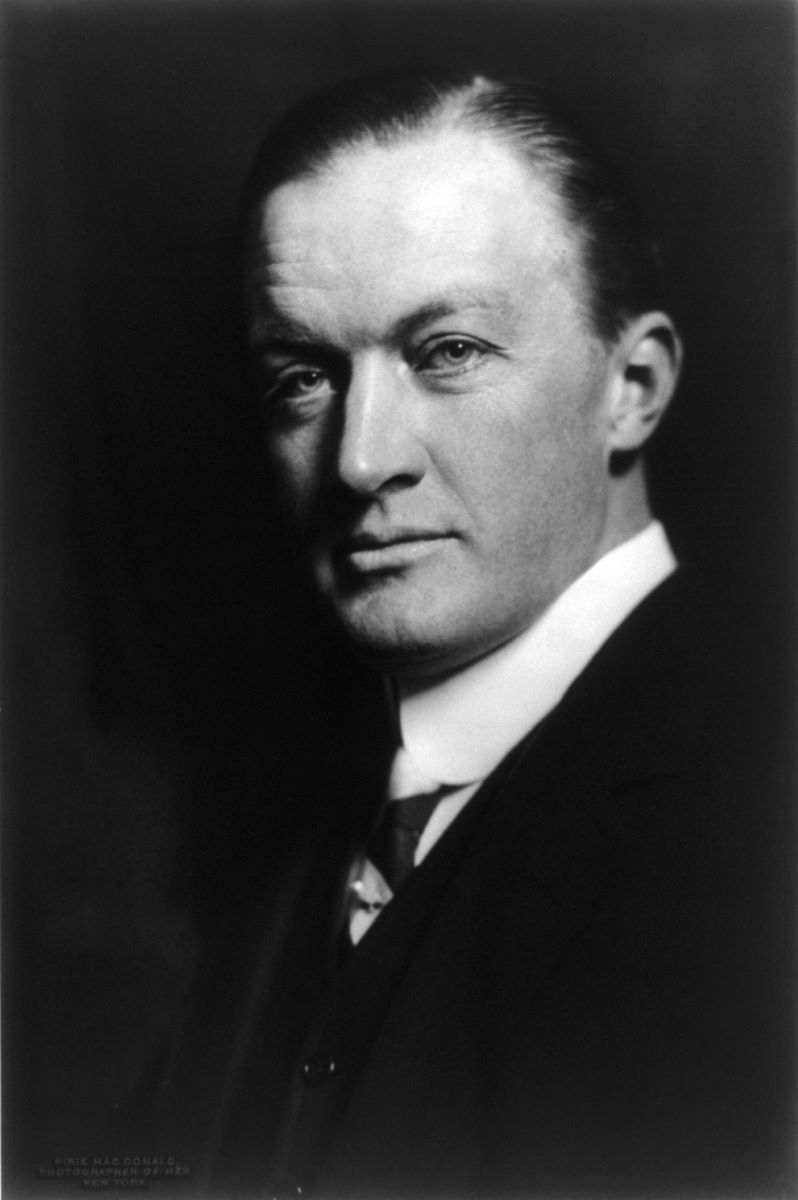
Much to the chagrin of other architects, no competition was held for the design of the Thomas Jefferson Memorial. Pope’s vision for the structure was a classical one based on Rome’s Pantheon. His concept was praised by fellow neoclassical architects, but ridiculed by modern architects, who felt the Roman concept did not fit Jefferson’s democratic ideals.
More emphatically, the design was criticized by the Commission of Fine Arts (CFA), which had been established in 1910 to approve any additions to the National Mall. Additional criticism stated the memorial was too large, too similar to Rome’s Pantheon and the Lincoln Memorial, and destroy too many cherry trees.
Moving Forward
Construction on the Thomas Jefferson Memorial did not begin for more than four years after the resolution was passed. During those intervening years, on Aug. 27, 1937, Pope unexpectedly died of cancer. His death, however, opened the door for some adjustments to the architectural concept.
The TJMC requested that Pope’s associates, Otto Eggers and Daniel Higgins, scale down the structure’s size and remove the proposed formal landscape ideas. On March 24, 1938, the CFA, having rejected Pope’s initial sketch, rejected the revised version as well, and proposed starting the process from the beginning.
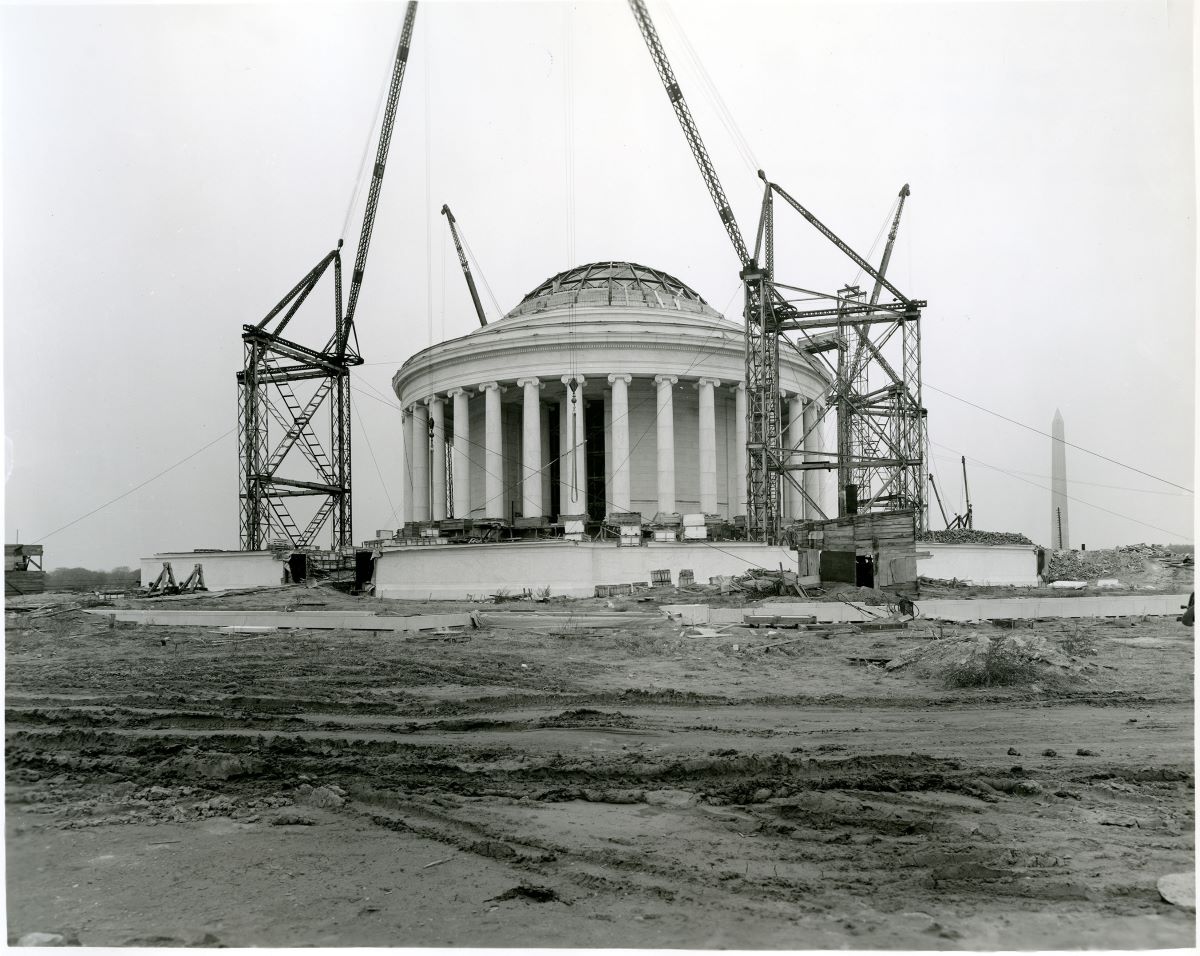
The TJMC took the issue up directly with President Franklin Roosevelt who overrode the CFA and gave the TJMC permission to move forward. The critics had been largely ignored, the revisions minimal, and now the funding, not to exceed $3 million, was approved. For the fiscal year of 1938, the initial funds of $500,000 were provided by Congress to the Commission. But it was hardly the end of the difficulties.
The Cherry Tree Rebellion
A groundbreaking ceremony was scheduled for December 1938, but there was a contingent upset that so many cherry trees would be sacrificed. This contingent was led by Eleanor Josephine Medill “Cissy” Patterson, the editor of the Washington Times and the Washington Herald. She had purchased both papers in 1939, and merged them into the Washington Times-Herald.
Patterson had long been a critic of President Franklin Roosevelt’s policies, so in November, when the National Park Service announced that some 600 trees would be displaced by the construction, she pounced.
The Washington editor wrote a number of articles criticizing the administration and called for locals to protest. The calls worked. On Nov. 17, 1938, the day construction began, 50 women marched to the White House with a petition to halt the construction and save the trees. The next day, Patterson led about 150 women to the construction site where they grabbed shovels from workers, refilled holes with dirt, and even chained themselves to trees. The Nov. 18 event was dubbed the “Cherry Tree Rebellion” by the press.
“It is the worst case of flim-flamming that this dear old capital of ours has been subjected to for a long time,” President Roosevelt stated during a Nov. 18 press conference.
The president cited that Congress had passed the legislation and provided the funds, and he was therefore powerless to make any changes to the memorial. He then added jokingly, “If anybody wants to chain herself to the tree and the tree is in the way, we will move the tree and the lady and the chains, and transplant them to some other place.”
Roosevelt further clarified that the paper had claimed there would be a loss of 600 trees, and later 328 trees. He told the press that 88 trees would be lost, but would be replaced by 1,000 more.
The women finally left and the construction resumed.
Choosing a Sculptor
On Dec. 15, Roosevelt oversaw the groundbreaking ceremony. During the ceremony, it was Stuart G. Gibboney, TJMC chair and president of the Thomas Jefferson Foundation, who turned the first spadeful of dirt. It was the same spade used at the groundbreakings of the Lincoln Memorial and the Tomb of the Unknown Soldier.
A few months later, in April, the TJMC’s Committee on Sculpture made its recommendations on how to proceed with selecting a sculptor for the Jefferson statue. Unlike the method of selecting the architect, it would be a competition. Sculptors sent photographs of and information on their previous works, and a panel of judges were assembled to make a decision.
The Committee’s recommendations were accepted. Once the competition was announced, sculptors began sending in their applications.
While applications poured in, headway made with construction. On Nov. 15, 1939, nearly a year to the date of the Cherry Tree Rebellion, President Roosevelt laid the memorial’s cornerstone. Inside the cornerstone were placed the 1939 TJMC Report, editions from several Washington newspapers, a copy of Jefferson’s “The Life and Morals of Jesus of Nazareth,” Paul Leicester Ford’s 10-volume “Writings of Thomas Jefferson,” a copy of the Constitution, and a copy of the Declaration of Independence.
The three-judge panel soon narrowed the 101 applicants to six: Rudolph Evans, Raoul Josset, Lee Lawrie, Maurice Sterne, Sidney Waugh, and Adolph A. Weinman. By Sept. 13, 1940, the six had been whittled down to three: Evans, Lawrie, and Weinman. The three submitted revised models of their proposed Thomas Jefferson sculptures.
In October 1941, Rudolph Evans’s sculpture of a standing Jefferson in a long shoulder-to-floor coat, holding a scroll in his left hand was selected. Weinman was contracted to create the sculpture of the Declaration of Independence’s five-man committee inside the triangular pediment on the front of the memorial.
Installing the ‘Apostle of Freedom’
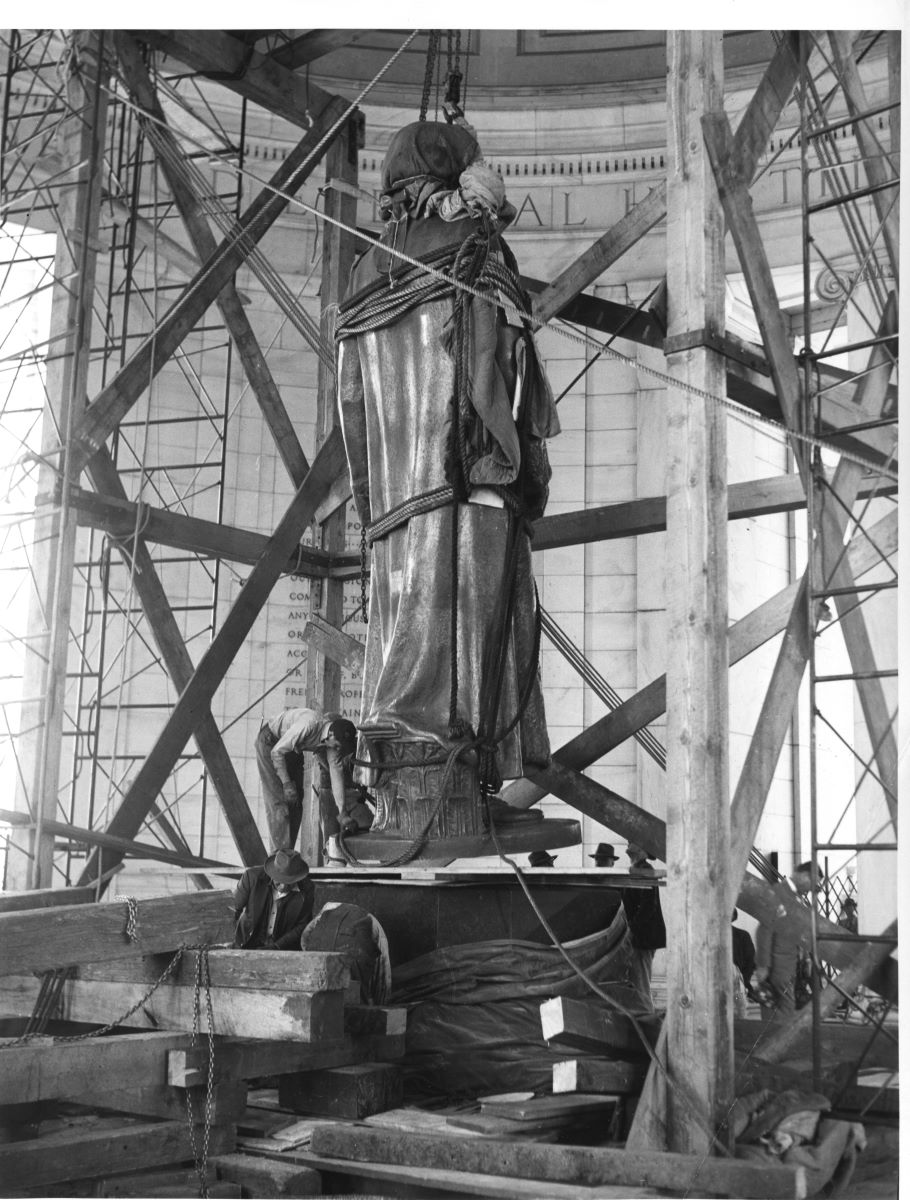
About two months after Evans was selected, America entered World War II. It was another obstacle to creating the Thomas Jefferson Memorial that, nonetheless, was overcome. By early 1942, the Pantheon-inspired memorial with its white marble exterior, pink marble floor, granite base, 92-foot-tall rotunda, 54 columns, stretching 184 feet in diameter was completed. The 19 foot, 6 inch tall Thomas Jefferson statue, which rested on top of a 6-foot pedestal, was installed. Due to war-time shortages, the statue was made of plaster and painted a brownish color to resemble bronze.
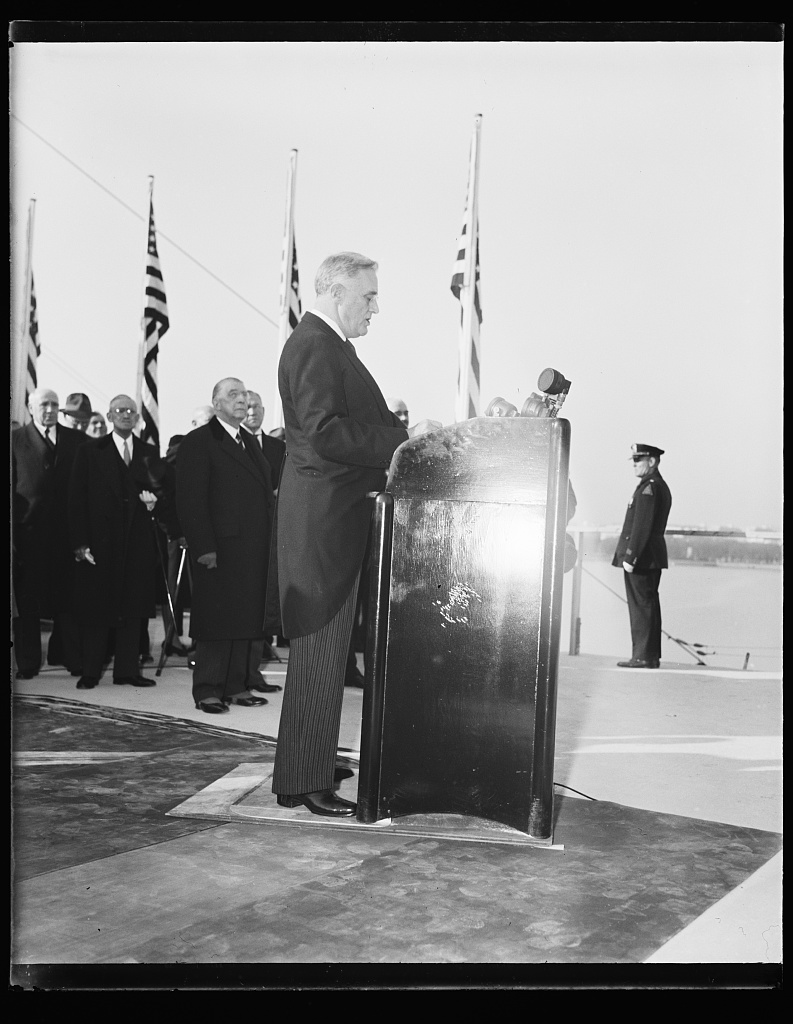
President Roosevelt, who had been in office since the start of the near-decade long process, was still on hand to preside over the dedication ceremony. “To Thomas Jefferson, Apostle of Freedom, we are paying a debt long overdue,” Roosevelt stated during the ceremony. It was during this week in history, on April 13, 1943—on Jefferson’s 200th birthday—that the Thomas Jefferson Memorial was officially dedicated, completing the four corners of the National Mall.
About four years late, the plaster statue was taken down and replaced with the intended bronze statue, which visitors see today. It required approximately 10,000 pounds of bronze to create the sculpture.
Never miss a This Week in History story! Sign up for the American History newsletter here.
What arts and culture topics would you like us to cover? Please email ideas or feedback to features@epochtimes.nyc