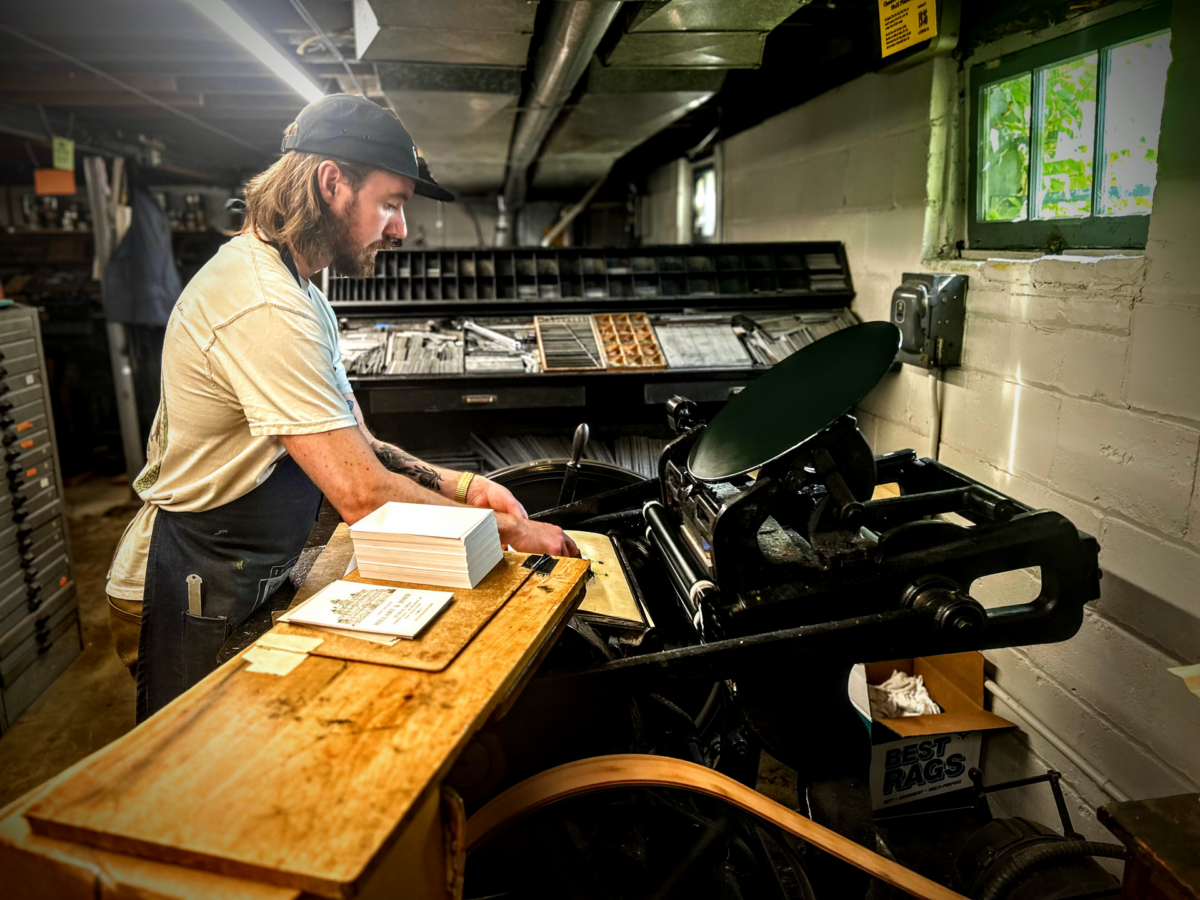
By 1450, after a decade of hard work, Johannes Gutenberg’s printing press became operational. The ingenious machine laid the ground for religious, scientific, and political revolutions that ushered humans into modernity. Yet, despite the press’s immediate success, Gutenberg never reaped the fruits of his labor.
Early Life and Financial Misadventures
Johannes Gutenberg’s life is shrouded in mystery and conjecture.
He was born in Mainz, an affluent city in the lush German Rhineland, on the western side of the Holy Roman Empire. Estimates for his date of birth range from 1393 to 1406. His father was a “patrician,” an ancient Roman term for a hereditary aristocrat with significant political and economic power.
A successful merchant in the cloth trade, Gutenberg Sr. also managed the city’s treasury. In 1386, he married a shopkeeper’s daughter. The couple had three children; Johannes was the youngest.
As elsewhere, Mainz’s elites sought to preserve their privileges to the chagrin of working-class citizens. When violent unrest broke out in 1411, the Gutenbergs fled to the much calmer neighboring town of Eltville, where they spent several months before a truce allowed them to return home. Tensions subsided, but only temporarily. Two years after their first escape, hunger riots forced Gutenberg’s family to move to Eltville permanently.
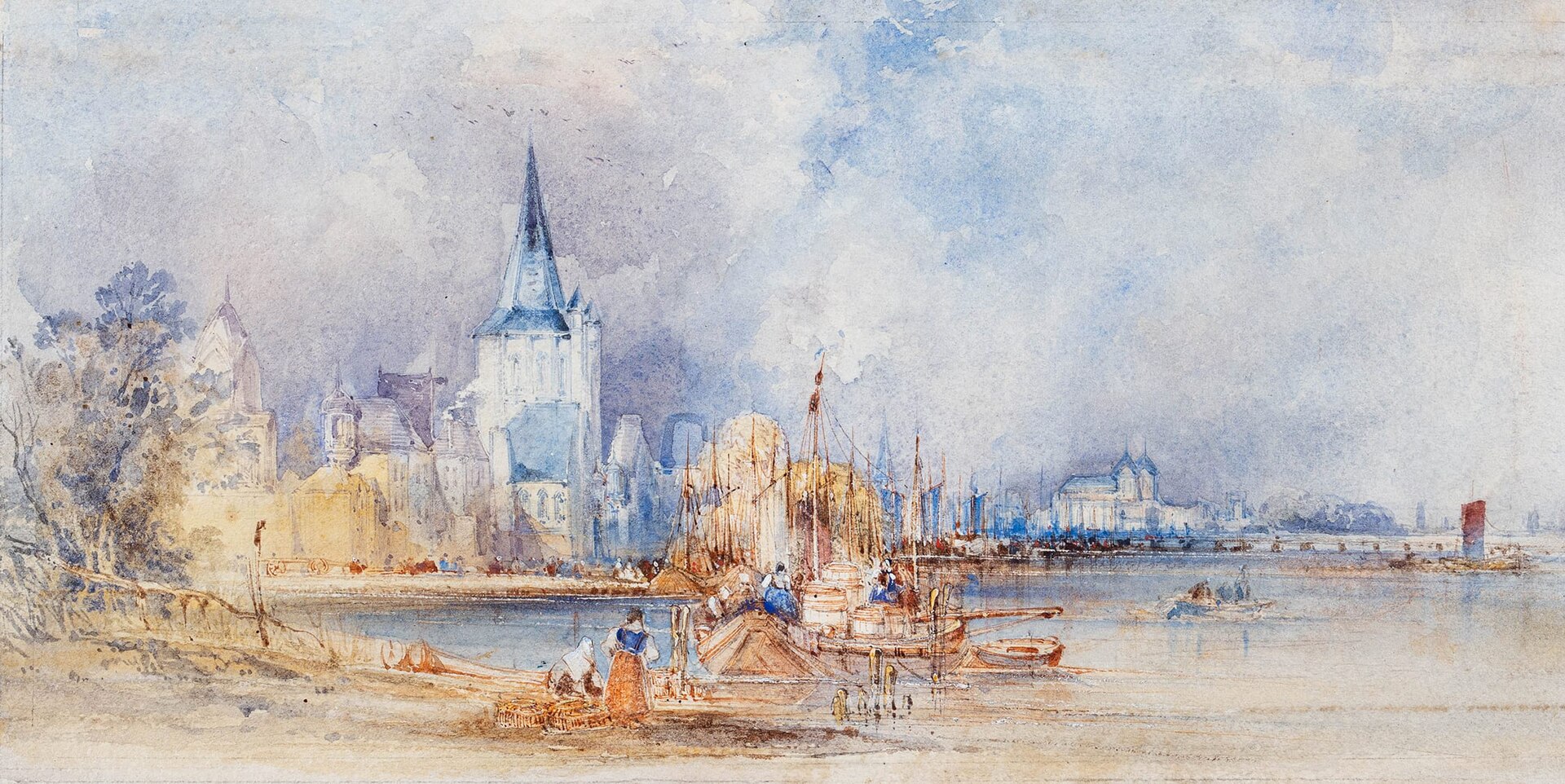 “A View of Mainz,” circa 1835, by William Callow. (Public Domain)
In Eltville, teenage Gutenberg may have joined a parish school, then the most common and accessible option for a basic education in reading and arithmetic. A member of the aristocracy, he almost certainly studied Latin, possibly under the supervision of a private tutor. Proficiency in the ancient language was required for university, which he may have attended in Erfurt.
In the 15th century, universities were vocational. Students received training in the liberal arts (grammar, rhetoric, dialectic, arithmetic, geometry, music, and astronomy) as preparation for careers in law, politics, medicine, or the Catholic church.
Despite what might have been a conventional education, Gutenberg had unconventional aims. In 1434, he was working in Strasbourg as a goldsmith and possibly received money to instruct a wealthy merchant on polishing gems.
In 1439, he was making metal mirrors for pilgrims in Aachen, near modern Belgium. The mirrors were thought to capture light from religious relics, thus transferring the relics’ spiritual powers onto the mirror-holders. That year, the city had planned an exhibition of relics from the Emperor Charlemagne (748–814), who died in Aachen. Tragically, the event was canceled because of a severe flood. Gutenberg lost his investments and any hope of making profit.
Spurred by this failure, the resourceful inventor shifted his attention to a device he’d been working on for years: the printing press. That venture was also a financial mishap. But, unlike the mirrors, it changed the world forever.
 “Johannes Gutenberg,” circa 1584, by Andre Thevet and De Larmessin. Netherlands. (Public Domain)
Books and Literacy in the Middle Ages
Before Gutenberg’s invention, books were extremely rare and expensive. Manuscripts were laboriously hand-copied by scribes, who were usually monks in remote monasteries. Besides a handful of academic treatises, accounting books, and court records, most medieval manuscripts were abridged versions of the Bible. They were copies of copies of copies, often barely legible and full of errors.
To make a hardcover, bookmakers first had to find, clean, stretch, and polish large quantities of animal skin. The skin was turned to parchment, which was cut into sheets and ruled with lines. Once the pages were ready, a scribe hand-copied a text with iron gall ink and a quill pen. Important books were decorated with extra-large initials, colorful illustrations, and even gold leaf. The sheets were finally hand-sewn and bound with glue between sturdy wooden boards with leather coverings.
It took months to complete a single manuscript. Unsurprisingly, learning was for elite scholars, wealthy patrons, and the clergy. Literacy was a privilege, as was the power to produce abridgments of the Bible—the book that governed community life in medieval Europe.
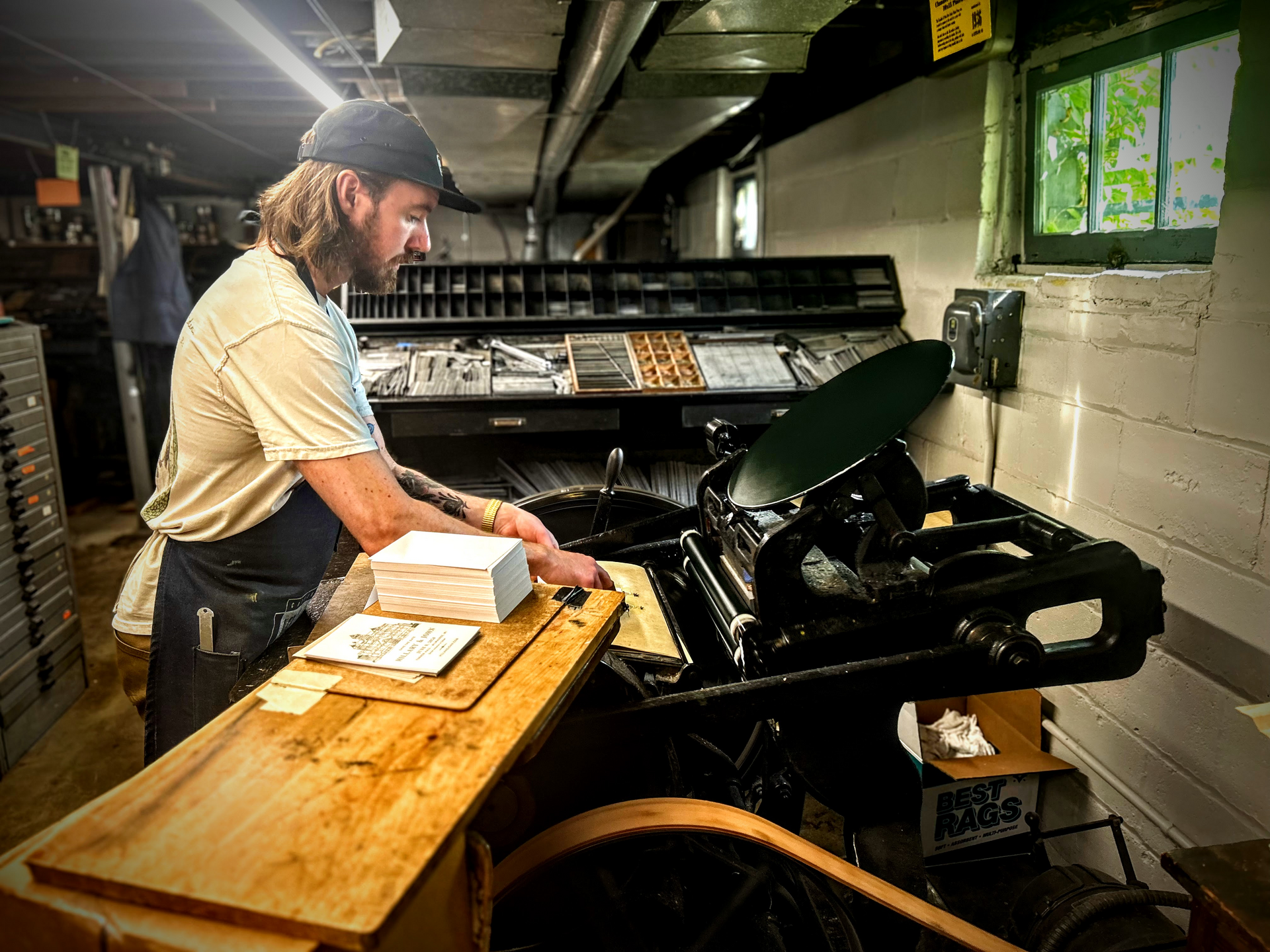 An employee uses an antique printing press at the Bay View Printing Company in October 2023. (Caelb375/CC BY-SA 4.0)
Gutenberg understood the limitations of book production and the Catholic church’s interest in disseminating full-length copies of its sacred scripture. He also knew that new universities were emerging across Europe and that their members would be looking for books.
Gutenberg’s Bibles
After finding intellectual inspiration in Strasbourg, Gutenberg returned to Mainz, where he built the world’s first printing press. Possibly drawing from past experience as a metalworker, he combined a movable metal type with customizable metal letters, an original oil-based ink suited for non-acidic linen-based paper, and a screw press that applied even pressure to a blank page.
Gutenberg wanted to make his pages from “vellum,” a durable skin derived from calves. When he realized that one Bible would require about 140 calves, he turned to plant-based paper as a more viable alternative.
A prototype of the printing press had been invented in China as early as the second century A.D., when artisans used wooden tools to press ink onto paper. The first full-length Chinese books date to the 800s. A few centuries before Gutenberg, the Chinese inventor Pi Sheng developed a movable type with characters made from clay and glue. Metal characters were later used in Korea to print a collection of Zen Buddhist teachings, about 75 years before Gutenberg’s first prints.
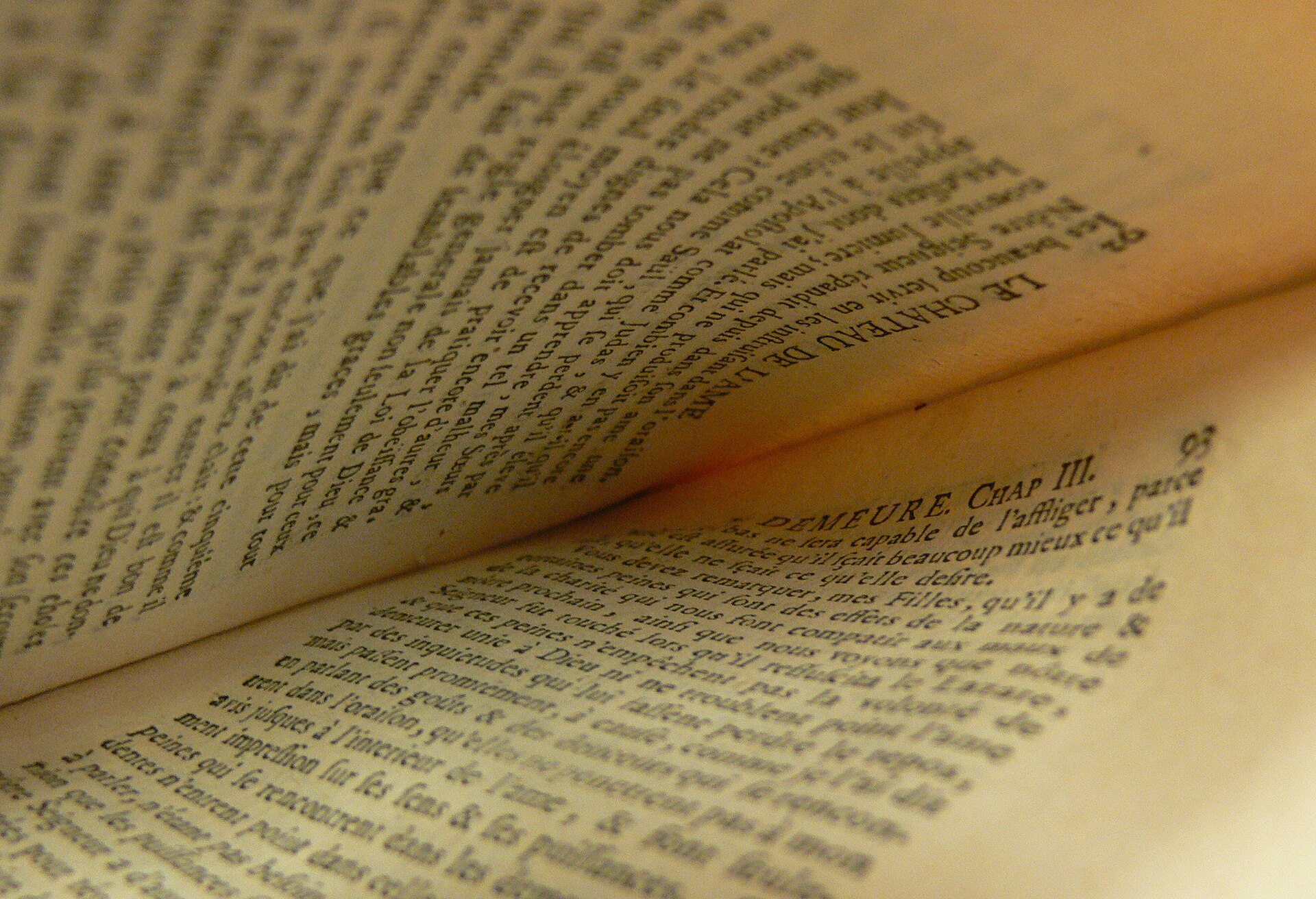 The works of Therese of Avila, translated by Arnauld d’Andilly, in 1707. (Remi Mathis/CC BY-SA 3.0)
Nonetheless, Gutenberg was the first to commercialize the avant-garde tool, which became fully operational by 1450. He focused on smaller projects to sustain his new venture, but his goals remained ambitious.
In 1455, Gutenberg’s printing shop produced 180 complete Latin Bibles; three quarters of their pages were made from paper and the rest from vellum. In a letter to a cardinal in Rome sent shortly after Gutenberg’s first prints began to circulate, the soon-to-be Pope Pius II called Gutenberg “that marvelous man” whose “script is extremely neat and legible, not at all difficult to follow.” Anyone would be able to read it, “without effort, and indeed without glasses.”
In addition to being more legible, printed books also contained much fewer errors than their hand-copied precursors. As long as printers arranged the movable ink-coated letters correctly, the page would turn out spotless.
Though cheaper and faster than manual copying, printing was still prohibitively expensive. A Gutenberg Bible cost a fortune. Most of the 180 copies were bought by wealthy individuals, some of whom donated them to religious institutions, where they were used for private study or communal prayer.
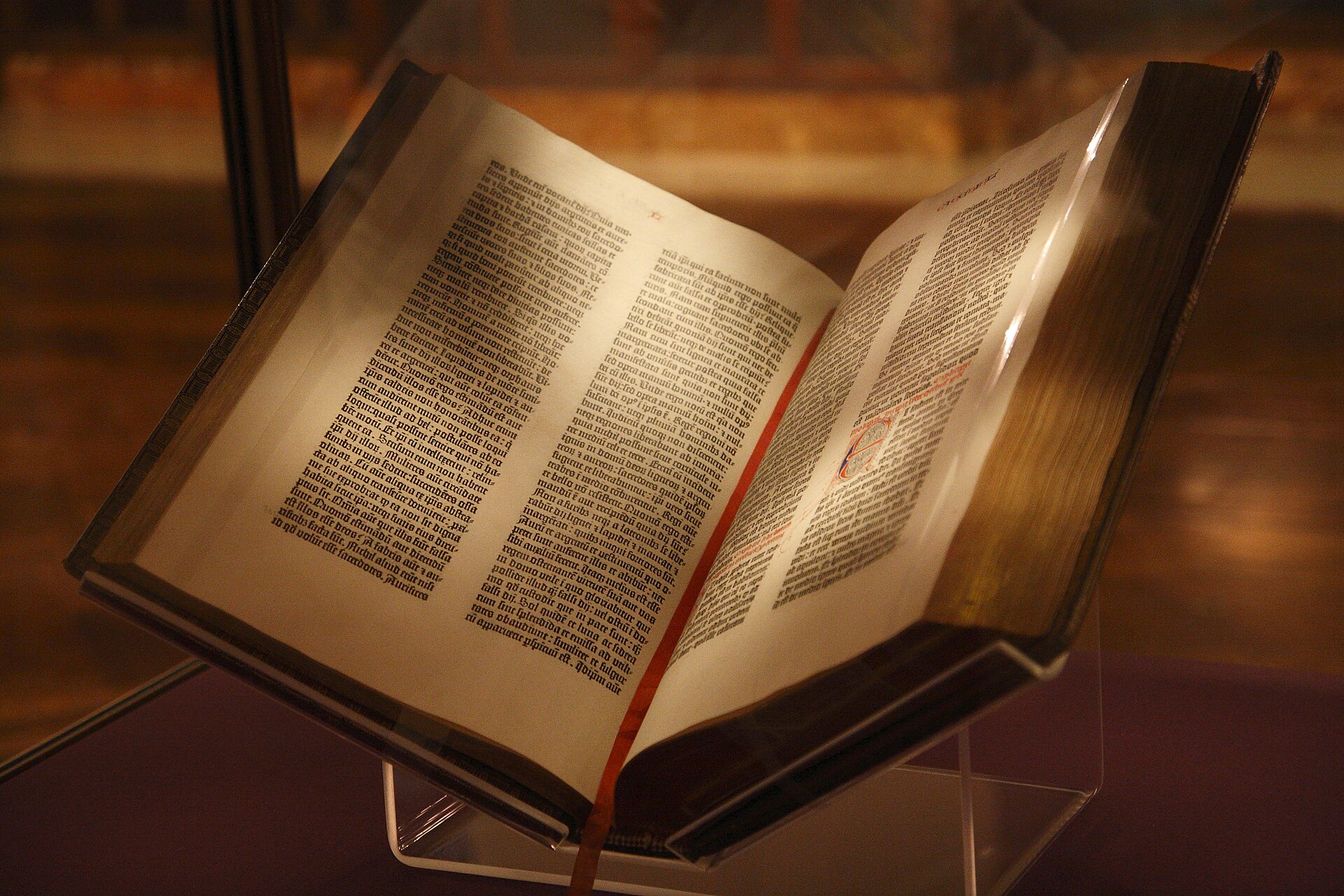 Gutenberg Bible on display at the New York Public Library in 2009. (Gun Powder Ma/CC BY-SA 2.0)
Despite his business’s lucrative potential, Gutenberg barely profited. A year after his first Bible entered the market, he was sued by Johann Fust, a money-driven business partner to whom Gutenberg was largely indebted. Fust accused Gutenberg of misusing his funds. Gutenberg lost the lawsuit. Since he was virtually bankrupt, the court forced him to surrender to Fust the printing workshop and all the profit it would generate.
Three years before Gutenberg’s death in 1468, Mainz’s archbishop Adolph von Nassau recognized the invention by granting him an honorific title, a yearly allowance, and a generous quantity of tax-free grain and wine—a piteous sop for a hardworking man whose entrepreneurial life, though never miserable, had been thwarted by many misadventures.
The Machine Behind Europe’s Revolutions
Without the printing press, the Protestant Reformation, the Italian Renaissance, and the scientific revolution never would have happened.
To sustain his workshop’s expenses as he worked on the intricate Bibles, Gutenberg printed indulgences for the Catholic church. Indulgences were certificates of a reduction in one’s allotted post-mortem punishment for a forgiven sin. To receive an indulgence, one had to perform a specified prayer, embark on a religious pilgrimage, or offer charitable services to one’s community.
In the late Middle Ages, corrupt authorities began selling indulgences in exchange for money. Thanks to Gutenberg, they could print more indulgences and make more profit than ever before.
In 1517, Martin Luther denounced indulgences as an example of moral decay in the Catholic church. He published his complaints in the famous “Ninety-Five Theses” (subtitled “Disputation on the Power and Efficacy of Indulgences”). Originally affixed on a building at the University of Wittenberg, the short, incendiary text was later printed and circulated widely, as were other works by Luther.
A few decades later, the Catholic church discontinued money-based indulgences. Yet Luther’s public campaigns continued on other fronts, fueling the Protestant Reformation and the countless geopolitical transformations it brought about.
Around 1500, Europe’s printing headquarters moved to Venice, where historically-minded scholars had begun translating ancient Greek manuscripts into Latin. From the political and philosophical treatises of Plato to the historical narratives of Thucydides, ancient texts were becoming available to more and more decision-makers, who adapted them to advocate for new social, political, and aesthetic paradigms. This movement became known as the Renaissance.
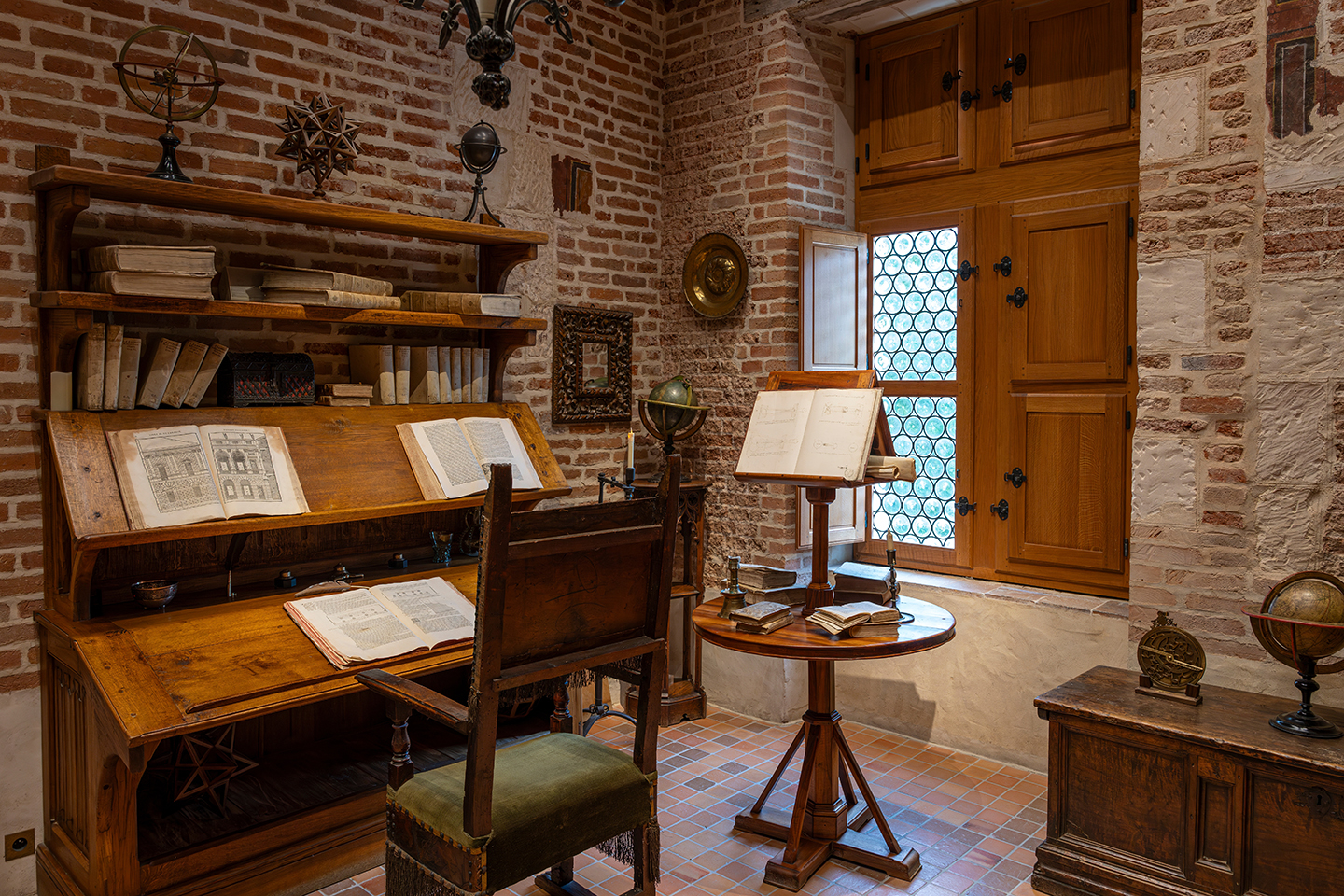 Leonardo da Vinci’s library at Clos Lucé displays copies of ancient texts from the Institute of France, alongside a cabinet of curiosities. (Guillaume Angleraud/Shutterstock)
 The Renaissance’s emphasis on learning also sparked curiosity about the scientific method. As universities welcomed more scientifically-minded students, demand grew for high-quality prints. Scientific books required sophisticated printing that could reproduce mathematical symbols, astronomical diagrams, and other elaborate illustrations.
Behind the pioneering research of priest and astronomer Pierre Gassendi (1592–1655), physicist Isaac Newton (1643–1727), and other monumental scientists were printing workshops that followed in Gutenberg’s footsteps.
Gutenberg’s Legacy
The printing press fundamentally altered the production and divulgation of knowledge. It marked a decisive turning point in human history, perhaps as significant as the invention of the wheel. As with most inventions, however, it also magnified humanity’s destructive tendencies.
American author Mark Twain (1835–1910) aptly summarized the printing press’s legacy in a short letter from 1900. In Twain’s words, the tool brought science “within the reach of every mortal.” It gave new life to the arts, and it transformed religion, “which, during the Middle Ages, assumed tyrannical sway … into a friend and benefactor of mankind.”
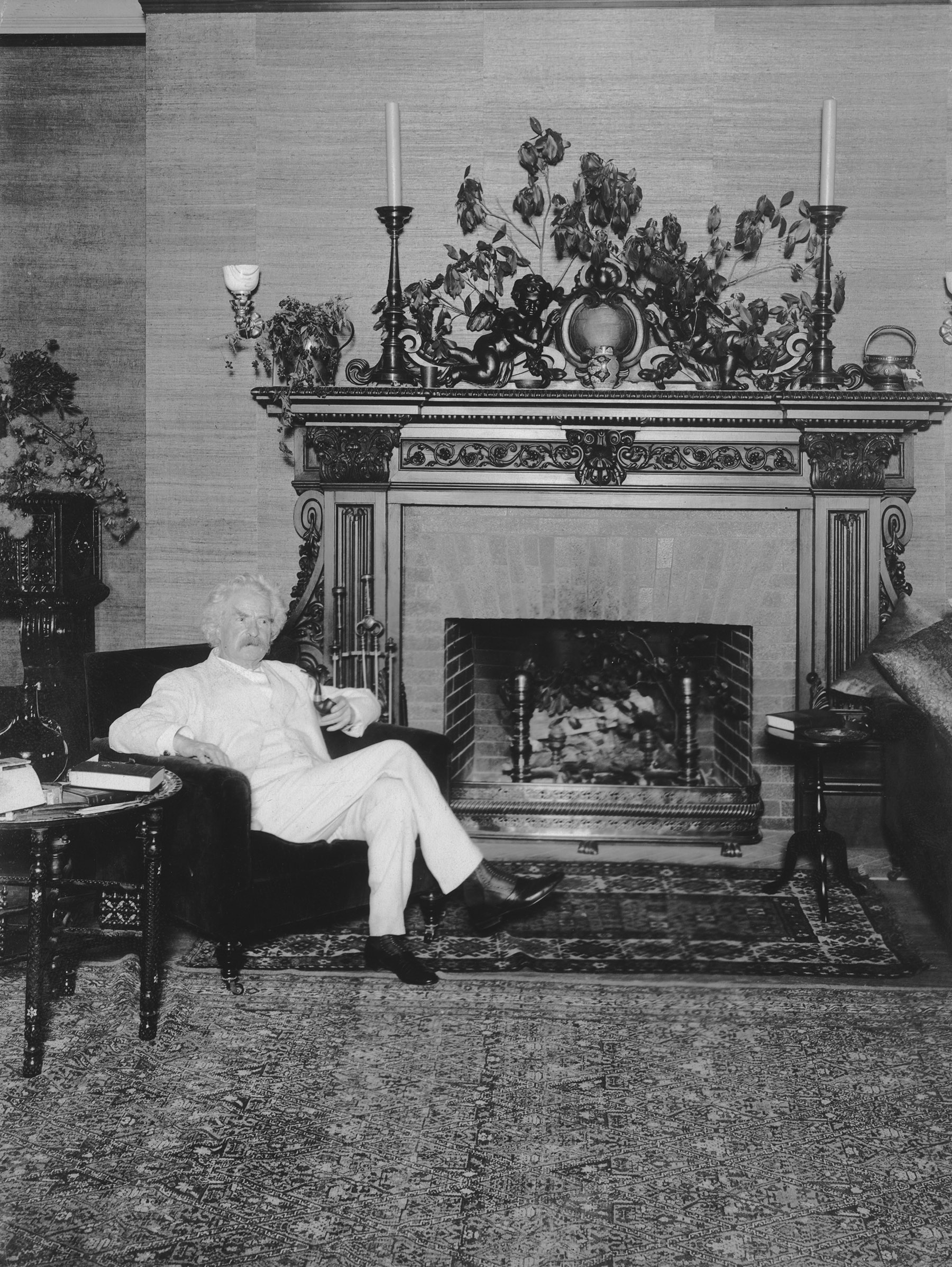 Mark Twain relaxing in a sitting room. (Paul Thompson/FPG/Hulton Archive/Getty Images)
But it also had negative effects. Sometimes it fueled wars where they would have formerly been unthinkable. While “having given to some national freedom, [it] brought slavery to others. It became the founder and protector of human liberty, and yet it made despotism possible where formerly it was impossible.”
Despite its inadvertently adverse consequences, Gutenberg’s printing press remained for Twain a net positive, “for the bad that his colossal invention has brought about is overshadowed a thousand times by the good with which mankind has been favored.”
What arts and culture topics would you like us to cover? Please email ideas or feedback to features@epochtimes.nyc