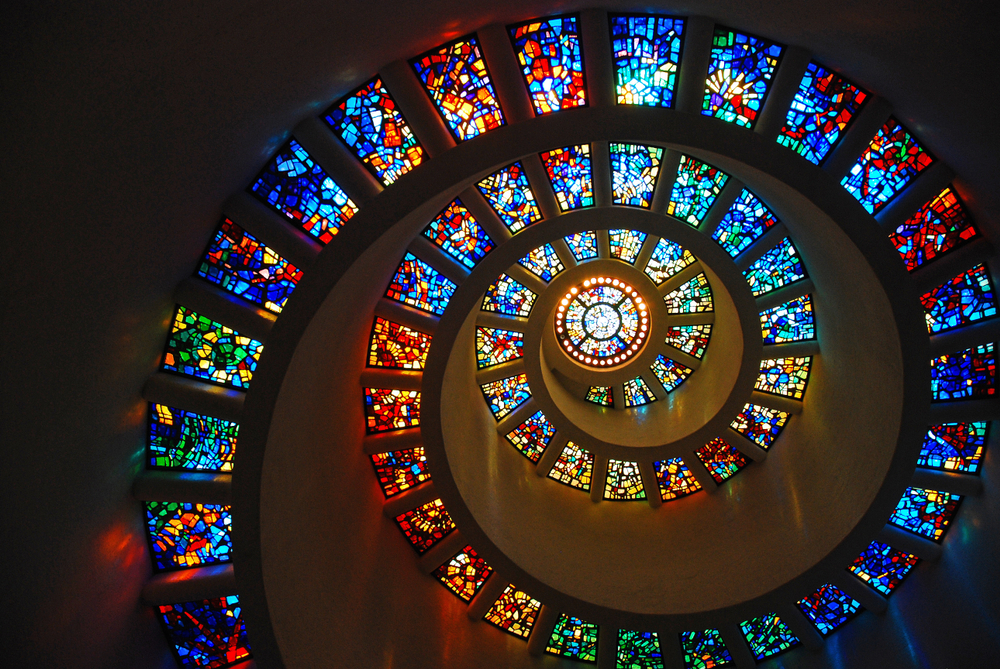
Let’s talk about beauty, the kind that ambushes you in the middle of your day and briefly shuts down your internal monologue. Not makeup-counter beauty, but the sort that makes you stop, stare, and wonder who’s in charge of quality control at the universe because clearly, they’ve had a very good moment.
We like to pretend this reaction is entirely personal, beyond explanation, immune to analysis. But beauty keeps ruining that story by behaving suspiciously like it has rules. And the awkward truth is that those rules look a lot like mathematics.
Mathematics Creates Beauty
Now, I know what you’re thinking. Mathematics? The same subject that made you cry into your high school geometry homework. Yes. That mathematics. But before you roll your eyes and retreat into the comforting arms of beauty is subjective and I don’t wish to be challenged on this, let me tell you a story.
Pythagoras on Beauty
It starts with Pythagoras, the ancient Greek philosopher who, like many great thinkers, had an unfortunate tendency to notice things and then refuse to let them go.
Wandering past a blacksmith’s shop one day, he noticed that some hammer blows sounded harmonious, while others grated like nails on a chalkboard. Instead of chalking this up to taste, Pythagoras weighed the hammers. And lo and behold, he found harmony to be a matter of proportion.
From there, Pythagoras went on what can only be described as a mathematical bender, discovering that musical intervals humans consistently find beautiful, like the octave (2:1) or the fifth (3:2) arise from simple numerical relationships. Pitch depended on vibration; vibration depended on length. Beauty, it turned out was math.
Pythagoras became so convinced of this that he concluded the fundamental harmonies of music emerged from the first four numbers: 1, 2, 3 and 4. Add them together and you get 10, which he considered so significant that his followers arranged it into a triangle called the tetractys and swore oaths upon it.
Douglas Adams on Musical Beauty
Now, I can hear the sceptics muttering, but music doesn’t feel mathematical. It feels emotional. And that’s true. Music feels like heartbreak, hope, nostalgia, and occasionally crying in the car. But as Douglas Adams observed, music bypasses the conscious mind and heads straight into the arms of your own private mathematical genius, the part of your brain that can do differential calculus at astonishing speed while you’re busy feeling things.
This is where things start to get interesting. Because once you begin to see beauty through the lens of mathematics, you notice it everywhere. Take the Fibonacci sequence, a modest string of numbers that spirals its way into sunflower seeds, pinecones, nautilus shells, and even the arms of galaxies. Or fractals, those endlessly repeating patterns that show up in broccoli (suddenly upgraded), snowflakes, coastlines, clouds, and river systems. Nature, it seems, is extremely committed to maths, though mercifully not to showing its workings.
Musica Universalis
Later thinkers formalised this idea. Boethius, writing in the sixth century, described musica universalis: the notion that the universe itself is structured harmonically, whether we can hear it. The heavens, the human body, and music were all expressions of the same principle, proportion. Harmony in the cosmos, harmony in the human, harmony in sound. A neat theory, and one that has aged surprisingly well.
Humans, meanwhile, have been enthusiastically applying this logic to art and architecture for centuries. The Parthenon? Golden Ratio. Notre Dame? Symmetry and proportion. Leonardo’s Vitruvian Man? Geometry having an excellent day. Jackson Pollock? Fractals. Yes, even Pollock, often cited as proof that anyone could do modern art, turns out to have been generating remarkably consistent fractal patterns. Stand in front of one of his paintings and you lose your sense of scale. Chaos, it turns out, is not the absence of order. It’s just order doing something more interesting.
Music follows suit. Bach builds extraordinary complexity from strict numerical rules. Mozart structures The Magic Flute around proportion. Messiaen uses prime numbers to unsettle rhythm and create tension. You don’t need to know any of this for it to work. Your body already does the maths for you, without consulting your high school report card.
Shakespeare’s Iambic Pentameter
Even Shakespeare, that poetic genius, was quietly obsessed with numbers. His most famous line, “To be or not to be, that is the question” breaks the comforting rhythm of iambic pentameter with an extra beat. Eleven syllables. A prime number. A deliberate jolt, like a splash of cold water when you were just drifting off. You feel it before you understand it.
And here’s the reassuring part, understanding the maths behind beauty doesn’t ruin it. It deepens it. It’s like learning the recipe for your favourite dish, it doesn’t make it any less delicious; it just makes you appreciate the skill involved. Or, as Douglas Adams’ character Richard MacDuff in Dirk Gently’s Holistic Detective Agency suggests, recognising that the swirl of milk in your coffee or the dying fall of a musical chord can be described by numbers doesn’t drain the magic. It explains why the magic keeps turning up on time.
Yet in the modern world, we’ve developed a curious suspicion of structure. We’ve decided that beauty should be entirely free, unbound by rules or patterns. The result is familiar, architecture that feels cold and faintly hostile, art that leaves us wondering whether we’re missing something, spaces that make us uneasy even if we can’t quite say why. Our bodies, more perceptive than our theories, notice the dissonance immediately.
The truth is that beauty has always depended on structure. It’s a scaffolding that allows meaning to emerge. As Marcus du Sautoy puts it, mathematics doesn’t reduce beauty; it reveals the patterns that make it possible.
Milk Swirls in Your Coffee
So, the next time you find yourself moved by a piece of music, or awestruck by a sunset, or mesmerised by the way milk swirls into your coffee, take a moment to thank the numbers. They’re the unsung heroes of beauty, quietly doing the work while emotion takes the applause.
Or, to borrow from Douglas Adams, the universe is a symphony, and mathematics is the sheet music everyone’s playing from, whether they know it or not.