



For all its spectacle about sociopolitical tyranny, producer-director-narrator Cecil B. DeMille’s “The Ten Commandments” (1956) recalls a more threatening spiritual tyranny. Its point? A life of obedience to God’s law isn’t so much about obedience or the law. It’s about life, especially one lived in freedom and truth. A life outside of that obedience is slavery and is as good as death.
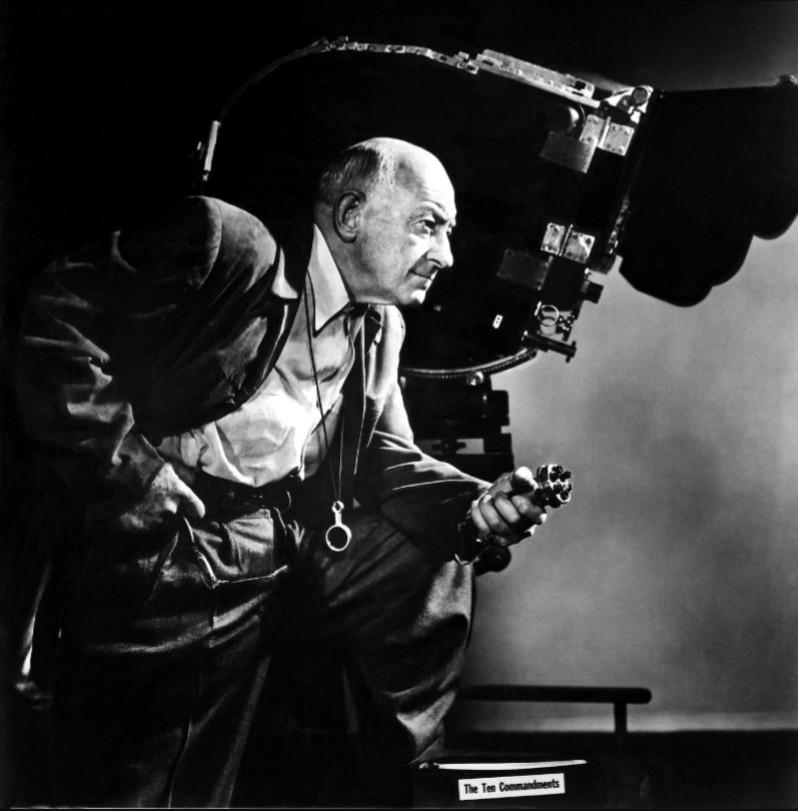
The film’s plot and cast have been celebrated at length for decades. Happily, there’s more to celebrate about its enduring magic.
DeMille was acutely aware of his imperfections. Perhaps that was why he sought perfection in every aspect of his final film. Unsurprisingly, it seems touched by grace.
Directorial cameos are commonplace, but DeMille’s here remains exceptional as he introduces his film. He doesn’t set out to “create a story, but to be worthy of the divinely inspired story created 3,000 years ago.”
His contempt for communism shows in the question he poses: “Are men the property of the state, or are they free souls under God?” In stepping out from behind a curtain or veil, he also echoes the biblical Book of Exodus.
Exodus

Chapter 26 of Exodus makes two dozen references to the word “curtain,” one of which explains its significance: “The curtain will separate the Holy Place from the Most Holy Place.” Chapter 34 refers to a “veil,” but instead of the one covering God’s face, it’s the one covering Moses’s after he sees God’s.
Reverentially stepping behind and then back out from behind that symbolic curtain or veil, DeMille invites audiences to an intimate understanding of God through an intimate understanding of his prophet, Moses. What can top Paramount Pictures’s mountainous logo, cinematically prefiguring a fiery Mt. Sinai in that first frame?
As art directors, costume designers, set designers, and cinematographers worked on the film, DeMille would hand them paintings by Dutch artist Lawrence Alma-Tadema. He instructed his film team: “Make it look like this.”
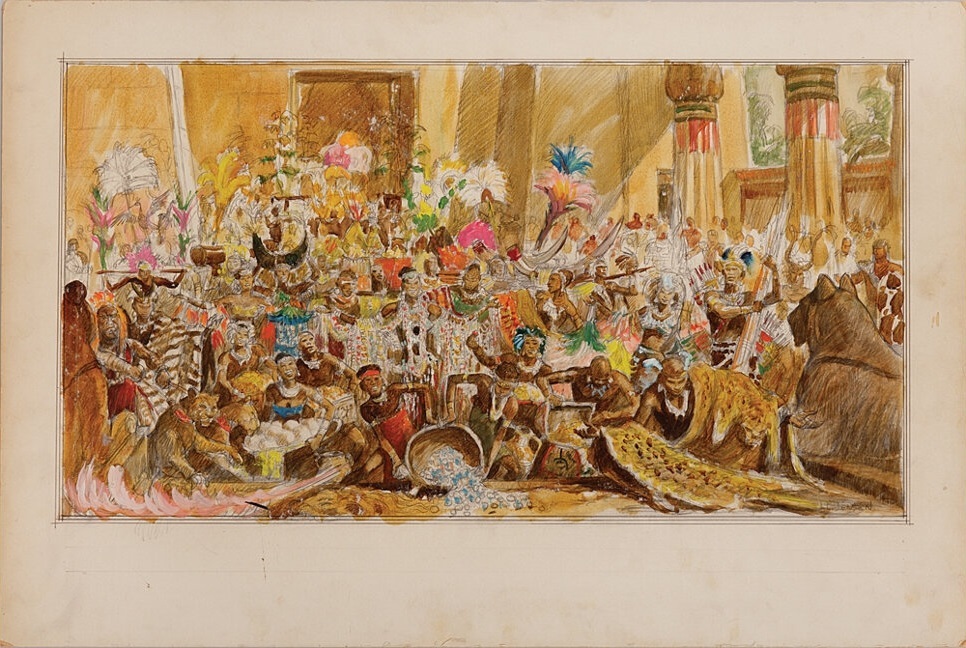
He’d straddled the black-and-white silent film era, so he treasured color and sound in ways that his younger peers didn’t. That preproduction care, even through over 1,000 storyboard sketches, shows in every shot.
Classical Sets
Every scene is riveting, each like a series of classical paintings, brimming with drama and pathos. Of course, scenes featuring God’s appearances and his miracles are stunning.
Yet even through a relatively unsung early scene, lasting barely five minutes, DeMille offers his thesis grippingly but humanely. It features the frenzied construction of yet another Egyptian city for the impatient Pharaoh Seti.
An establishing shot from above shows some 60 bare-chested men ramming a building-sized stone from behind with cannon-sized blocks of wood. The stone barely moves. Another 60 men heave rope as thick as a man’s arm, dragging that same stone from up front toward its hulking twin.
Others sprinkle dry sand on the ground, so fellow slaves don’t slip on their own sweat; they need every inch of grip their aching feet can purchase. Once a stone moves, though, overseers will do all they can to keep it moving until it’s set.
An over-the-shoulder shot features frail, old Hebrew slave Yochabel (Martha Scott) shuffling between and beneath these giant stones. She’s greasing them, easing the labor of fellow Hebrews before they’re whipped senseless by their slave drivers.
The waist-cord of the exhausted slave catches beneath one stone. Grinding granite, grunting men, and the lash of whips drown her cries. DeMille places one camera before the stone, moving inexorably forward; you see her open-mouthed, sliding under. Another camera is behind the stone, edging past; you see only her outstretched fingers.
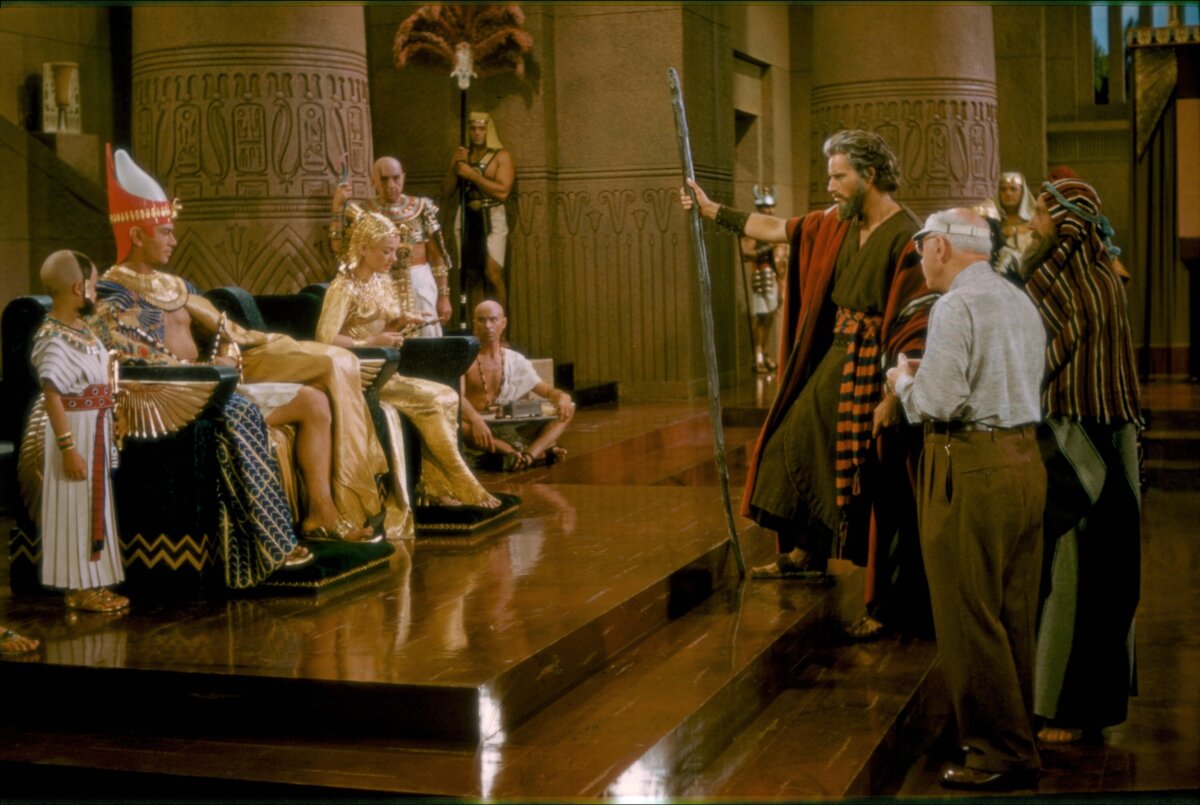
Then Moses (Charlton Heston), who’s still a prince of Egypt at this point, and his Egyptian minders confront stonecutter Joshua (John Derek), who has swung down from working the high ropes above to save Yochabel (Martha Scott).
Through rapid-fire dialogue that follows, DeMille has Moses mulling over the meaning of freedom, love, and life. As Moses mocks a god who apparently couldn’t be bothered leading the Hebrews to freedom, the Hebrews wonder if it’s God, after all, who sent Moses to lead them to freedom.
Inconvenient Truths
This yin-yang of dialogue pervades the film, opposing characters in each subplot and pitting convenient falsehoods against inconvenient truths. Naturally, sparks fly whenever Yul Brynner’s brooding Rameses II is up against Heston’s magnificent Moses.
Above everything and everyone towers Mt. Sinai. Later, Sephora (Yvonne De Carlo), Moses’s Hebrew wife, says, “The mountain rumbles when God is there.”
The likes of Cedric Hardwicke, Edward G. Robinson, Vincent Price, Judith Anderson, and Anne Baxter bring gravitas to spare. Nevertheless, DeMille wields humor here just as expertly.
Rameses’s little son (Eugene Mazzola) represents the atheist-agnostic position, caricaturing his father’s conceit when impishly kicking Moses’s miraculous staff. That’s DeMille saying that it’s natural for those who don’t see with eyes of faith to ridicule what they don’t understand.
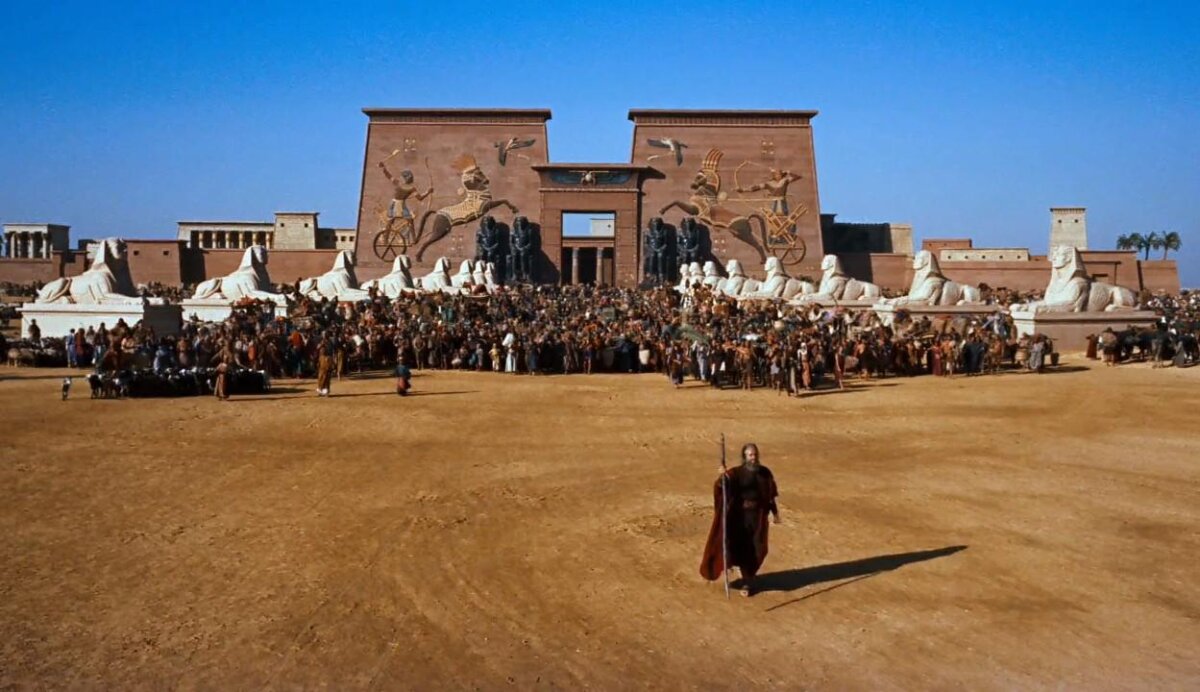
In the exhilarating exodus scene, a lone Heston leads an impossibly huge mass of around 14,000 extras and some 15,000 animals from Egypt’s 100-foot-high gates out into the desert. Even megaphones couldn’t get DeMille heard above the horde of children, women, men, camels, horses, cattle, donkeys, and goats. He couldn’t simply shout the word “action” for cameras to roll. He had to fire a gun.
Music to Match
Young Elmer Bernstein, in his first major motion picture, had written slow music to match this ponderous plodding of an entire population. But DeMille wanted faster music to match their joyful walk to freedom, following centuries of slavery.
Bernstein wondered: Wouldn’t a lively score be out of sync with their leisurely pace? DeMille was firm. If Bernstein wrote the music faster, they would “look faster.” Watch that scene to judge the result.
Heston’s striking features and his slightly dented nose impressed associate producer Henry Wilcoxon. An artist himself, Wilcoxon saw resemblance to Michelangelo’s sculpted Moses and prevailed on DeMille to pick Heston for the part. In interviews, Heston’s son, Fraser, who played baby Moses, says of his father’s audition: “Eventually he did get the part, as Dad liked to say, ‘by a nose’.”
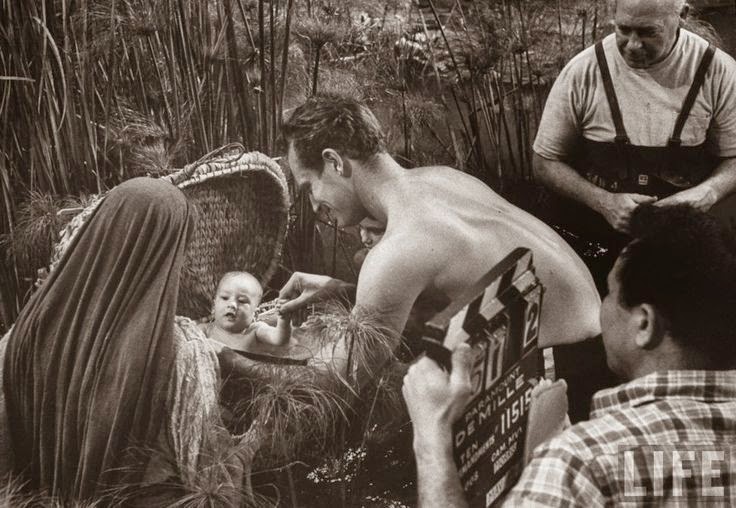
Heston so immersed himself in the project that DeMille allowed his baritone star to voice God in the burning bush. Heston told DeMille: “It seems to me that if you hear the voice of God, you hear it inside yourself.” It helped that the abbot at St. Catherine’s Monastery at the foot of Mt. Sinai concurred.
Lisa Mitchell, who played the 16-year-old Hebrew girl Lulua, listed as Jethro’s daughter, said DeMille received tons of fan mail, but his favorite response was that “this movie made God real to me.” Speaking for herself, she added, “And it’s done it for me.”
DeMille crafted that sentiment into the script. Rameses, frustrated by his failed attempts to hold the Hebrews back, once exclaims as much to the sky as to a long-gone Moses: “His god is God.”
You can watch “The Ten Commandments” on Prime Video, Apple TV, and DVD.
‘The Ten Commandments’
Director: Cecil B. DeMille
Starring: Charlton Heston, Yul Brynner, Anne Baxter
MPAA Rating: G
Running Time: 3 hours, 40 minutes
Release Date: Oct. 5, 1956
Rated: 5 stars out of 5
What arts and culture topics would you like us to cover? Please email ideas or feedback to features@epochtimes.nyc
