About 15 years ago, during a discussion of Robert E. Lee’s ideas of duty in one of my homeschooling seminars, a high school student said, “I don’t like that word duty.”
“Why not?”
He shrugged. “I’m not sure. I just don’t like it.”
Far from being an isolated teenage sentiment, many Americans may unconsciously share that feeling. In our self-centered age of individual rights and liberties with its emphasis on self-fulfillment, we prefer the word responsibility. We choose responsibility, to be held accountable for some task or action, whether it’s in the workplace or in our personal lives.
Duty is different. It implies a standard imposed on us by an outside power, an obligation rather than a choice, often tied to custom or a religious faith. It is the duty of a soldier to obey a superior; it is the duty of police officers to enforce the law. The Old Testament commandment “Honor thy father and mother,” for instance, is a demand, not a choice, a duty without option except in the interpretation and execution of that command.
This concept of duty was front and center in ancient Rome. The Latin word that most fully embodies this concept is pietas, which the Oxford Classical Dictionary defines as “the typical Roman attitude of dutiful respect toward gods, fatherland, and parents and other kinsmen.”
To deepen our understanding of this idea of duty, we have only to turn to Virgil’s great epic “The Aeneid,” where pietas and its consequent moral demands are the story’s beating heart.
Pietas Personified
“I sing of arms and the man.”
So Virgil begins his poem of the Trojan prince Aeneas, who escapes the sacking and burning of Troy by the Greeks, leads a band of refugees on a series of voyages hampered by both enemies and the goddess Juno, and finally follows his fate and his mother, the goddess Venus, to Italy, where he founds a kingdom that will eventually become Rome.
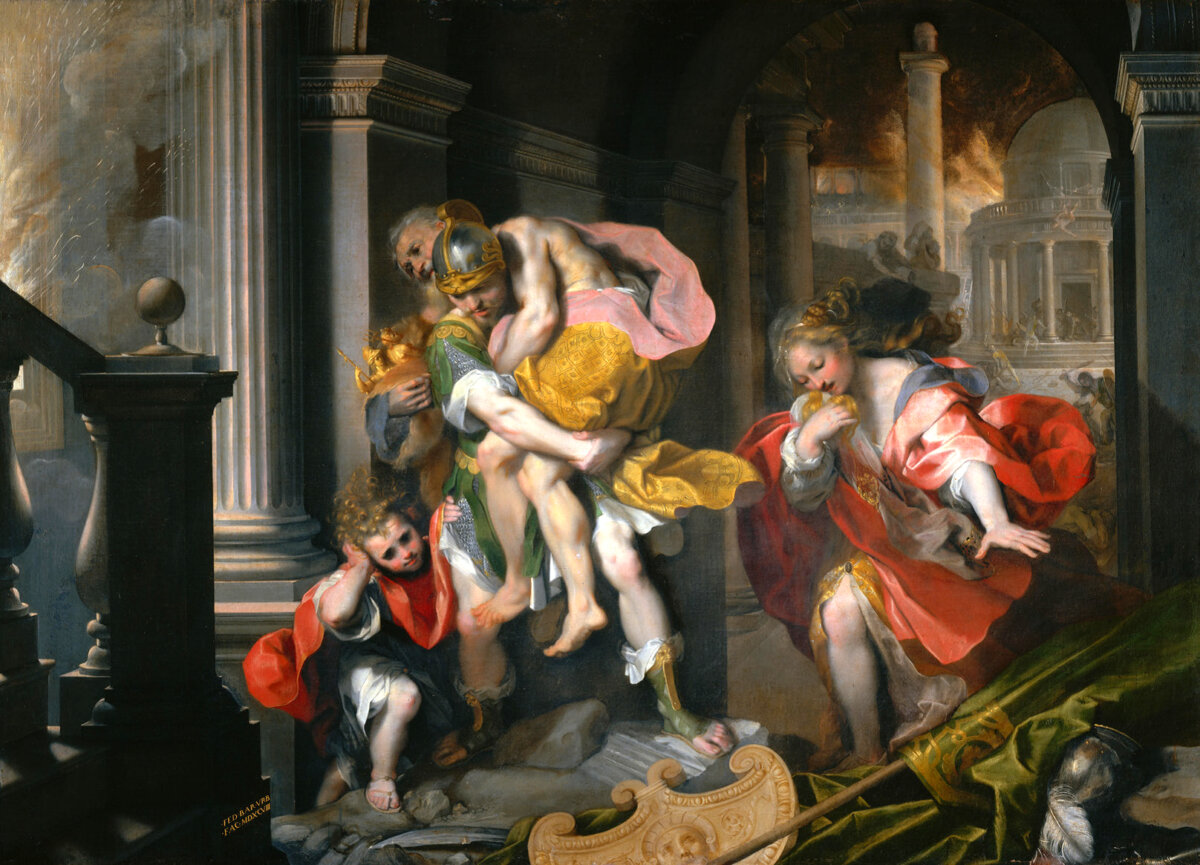
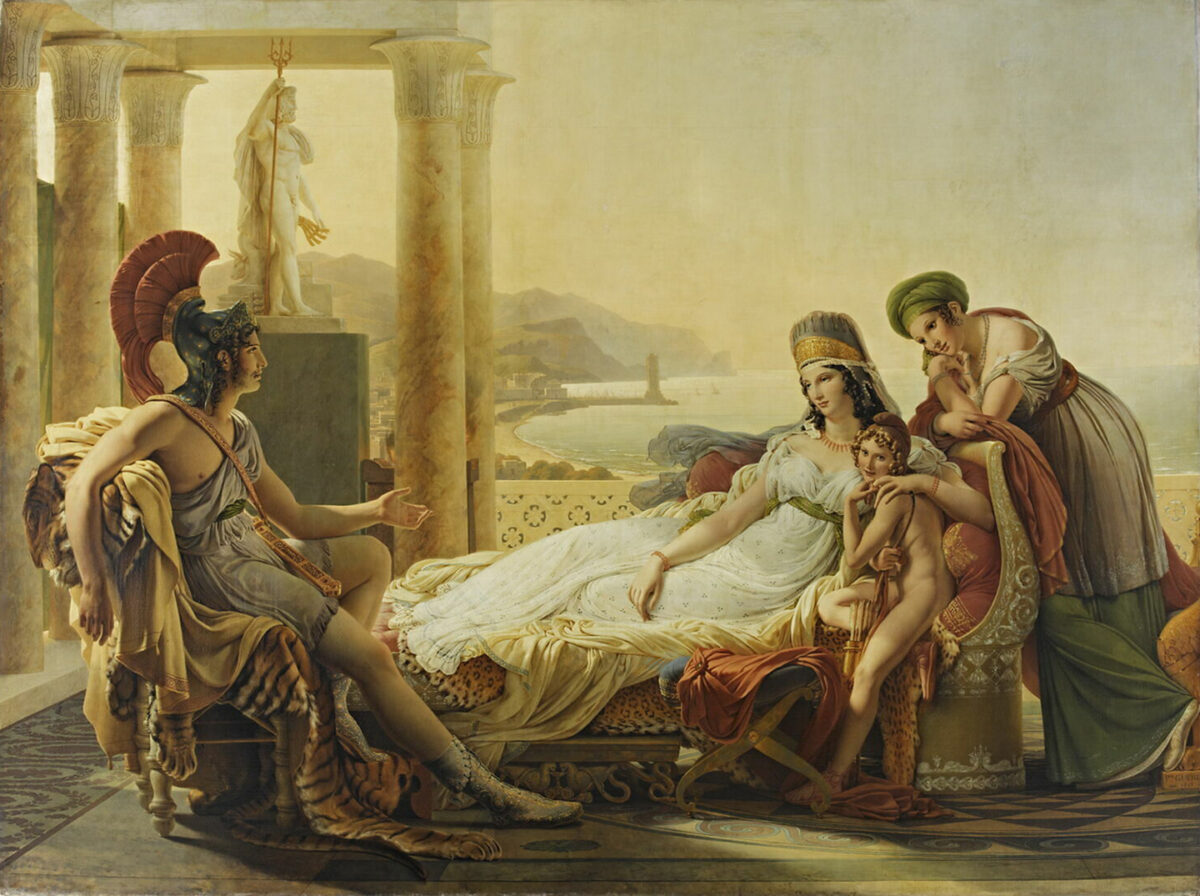
In Book 2 of the epic, Aeneas and his followers have arrived at the court of Dido, queen of Carthage, and there he tells his tale of the destruction of Troy. In that telling, Aeneas paints a word picture of his flight from Troy that has since inspired numerous paintings and sculptures. It adroitly sums up the meaning of pietas.
Asleep when the Greeks first begin their final assault on Troy, Aeneas sees the dead Trojan hero Hector in a dream, who tells him to escape the city, and that it will be his destiny to build a new Troy. Nevertheless, he attempts to join the resistance, but Venus also tells him that Troy is lost and that he should leave the city.
And so he does. Carrying his crippled, elderly father on his back, who in turn carries the Penates, the household gods, holding his little son, Ascanius, by the hand, and followed by his wife, Creusa, Aeneas escapes the city and finds a band of other Trojans who have fled the carnage. This short scene, in which Aeneas bears with him the past, represented by his father, his son, who is the future, and the gods, signals his dutiful love for family and the gods.
But what of his duty to his country?
The Costs of Duty
Aeneas realizes that in their wild flight, Creusa has gone missing. Mad with grief, he returns to the havoc he has just left and searches wildly for his wife. Creusa then appears to him as a spirit, tells him she has died in the slaughter, that he will endure a long exile, and that he will then establish a kingdom on the Tiber where he will be happy. She ends by bidding him farewell and asking him to protect their child.
Here, Aeneas’s destiny is reaffirmed. It is his duty to Troy to reestablish the city’s gods and ancient bloodlines in a new land.
Yet, here, too, is an example of the tremendous costs of doing one’s duty. As Creusa bids her husband farewell, asking him to protect and love their child, the weeping Aeneas tries three times to embrace that fading shadow, and three times Creusa escapes as though in a vanishing dream. He has not only failed to protect his wife from death, but now must face and bear the weighty and unpredictable tasks of the future.
Throughout the rest of his story, Aeneas must face the challenges and demands of duty. With Dido, for example, he temporarily finds respite and love. Still, when ordered by the gods to follow his destiny and leave Carthage, he breaks that relationship and sails away, leaving the queen bereft and suicidal. His departure seems cold-blooded, but later, when he is surprised to meet her in Hades—Aeneas had no idea she had died—he approaches her tearfully, entreating her to believe that he had not left her by his own will but by that of the gods. She refuses to speak to him and turns away, scornful and proud.
Throughout the “Aeneid,” this hero weeps frequently over misfortune and loss, makes mistakes, and even wishes that the horrific nightmare of Troy’s fall had swallowed him up and left him without all these burdens, yet duty always calls him and leads him forward.
Aeneas in America
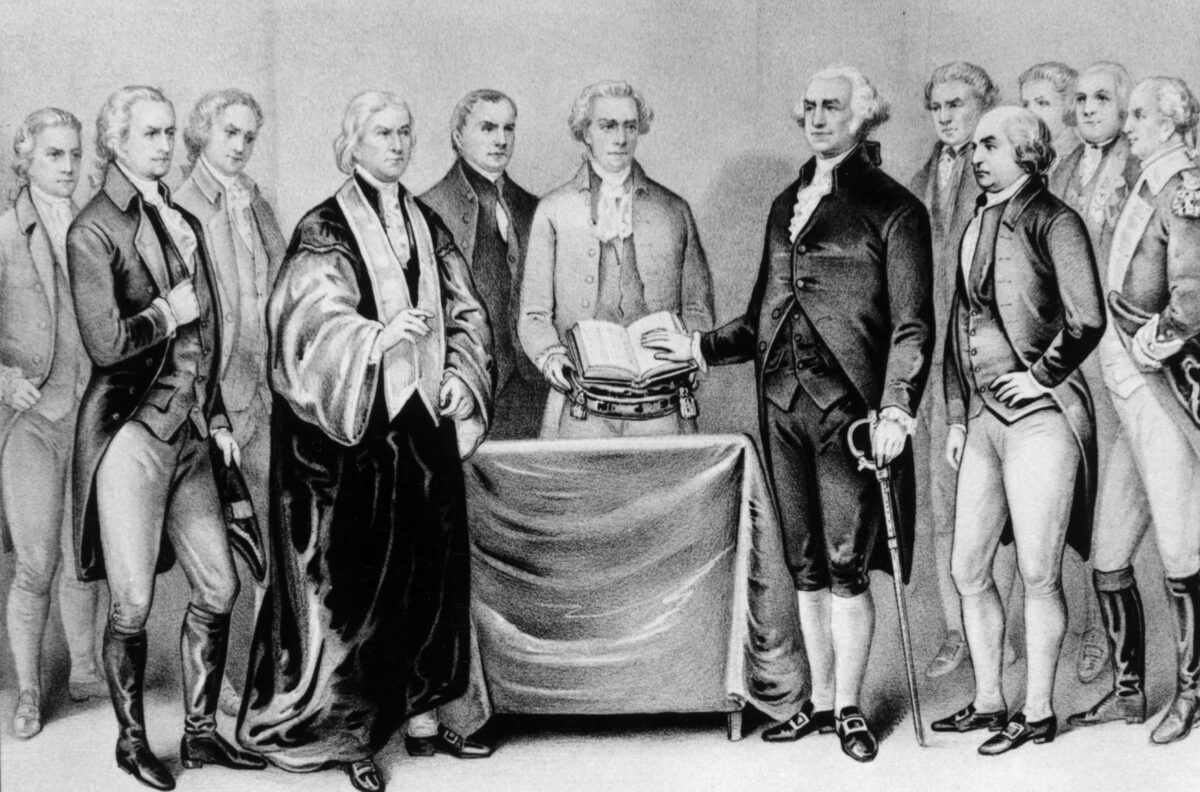
In his 2025 article “Vergil: Poet Laureate of the American Founding,” former constitutional professor and classicist Robert Natelson points out the many ways the Founding Fathers reflected on the influence of the “Aeneid.” By directly transferring some Virgilian ideas into certain of our national symbols and slogans, and by making many many references to them in their correspondence, they paid homage to the mythic hero of Virgil’s epic.
Admiration was a chief reason for this attraction. Natelson writes that Aeneas “was reverent and dutiful (pius), a man sincerely committed to doing the right thing. He was a leading force in the foundation of a new nation. A George Washington sort of hero.”
For the next two centuries, many Americans deemed duty a virtue, an obligation imposed by faith, country, and family. In the mid-20th century, it apparently became less visible, as noted by novelist and Nobel Prize Winner Pearl Buck in 1967, “We need to restore the full meaning of that old word, duty. It is the other side of rights.”
We have forgotten, too, the benefits brought by duty performed faithfully and with a good heart. In her 1840 poem, Ellen Sturgis Hooper highlighted these rewards, gifts which both Aeneas and George Washington would have recognized:
I slept, and dreamed that life was Beauty;
I woke, and found that life was Duty.
Was thy dream then a shadowy lie?
Toil on, sad heart, courageously,
And thou shalt find thy dream to be
A noonday light and truth to thee.
What arts and culture topics would you like us to cover? Please email ideas or feedback to features@epochtimes.nyc