



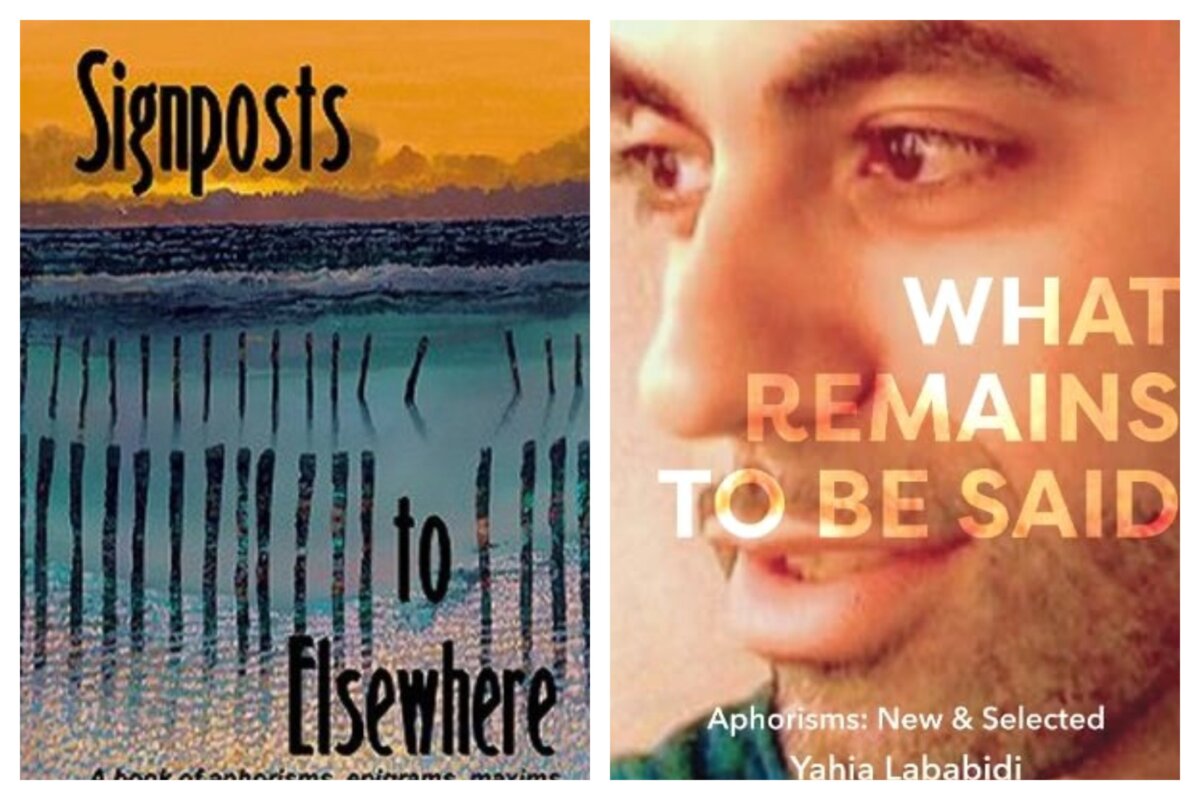
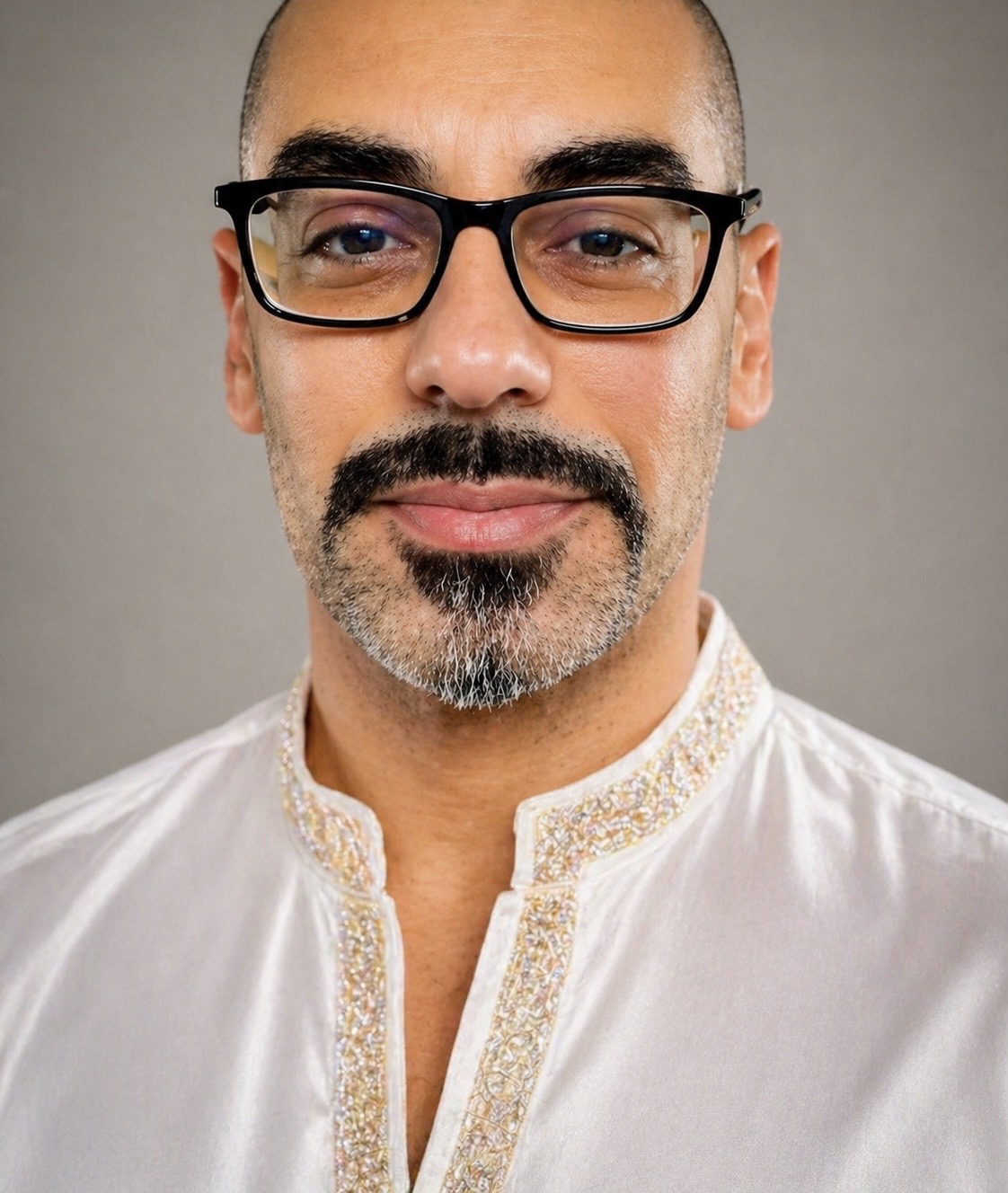
Arab American poet, essayist, and aphorist Yahia Lababidi has written 16 books, including “Palestine Wail,” “What Remains to Be Said,” and the forthcoming “Wherever You Are: Essays From East to West.” His work has appeared in Liberties, Salmagundi, The New Statesman, The Threepenny Review, World Literature Today, and has been translated into more than a dozen languages.
Writing, Lababidi has said, came to him almost against his will. Though raised among artists and thinkers, it was only while attending George Washington University in Washington, that he began to recognize he had something to contribute to literature.
After graduating, he returned to his native Cairo, working at UNESCO as an editor and speechwriter for nearly a decade. Driven by a growing sense that he could no longer live or create freely there, and that unwritten works were inside him “fluttering wildly against the bars,” he left Egypt for the uncertainty of starting life over in the United States.
Not long after arriving in Florida, he secured an O-1 visa for Individuals of Extraordinary Ability, proposed to his current wife, and received a book deal for his debut collection, “Signposts to Elsewhere.” From there, author James Geary included Lababidi in “Geary’s Guide to the World’s Great Aphorists,” and the Egyptian-Lebanese writer was stunned to find himself in the company of his literary heroes.
The Epoch Times: Like the proverb, the aphorism is one of the oldest literary forms. What gives this concise, self-contained expression of insight its enduring reach across cultures and centuries?
Yahia Lababidi: It is the form that most honestly respects human attention and human forgetting. We can hold a single sentence in the mind and turn it over for years, decades. We cannot do that with a treatise. Every culture that has taken wisdom seriously has reached for this form, because truth, when it arrives, tends to arrive compressed.
The Epoch Times: You’ve described growing up in Cairo in a culture where proverbs and wit were part of daily life. How did that shape your writing?
Lababidi: Cairo was my first classroom in concision. Wisdom there travels in the open air, in markets and on crowded busses, in the quick counsel of strangers. Even in a city where a large portion of the population was illiterate, people spoke in sayings: “Knowledge is what’s in your head, not in your notebooks.” My grandmothers had a string of sing-songy, witty-wise remarks for every occasion: a portable philosophy, passed along in handfuls of words.
Egypt also has ancient wisdom literature going back millennia: Ptahhotep, Amenemope, carrying a belief that counsel should be brief enough to memorize, spoken aloud, woven into daily life. Ptahhotep writes that “good speech is more hidden than greenstone, yet may be found among the maidens at the grindstones.” Wisdom surfaces where the powerful are not looking. I unconsciously inherited this tradition.
I was also named after my paternal grandfather, a Lebanese poet-musician, whose bloodline delivered to me a love of song, a hint perhaps that the literary life might be my calling. And mercifully, when I began aphorizing as a teenager, there was no internet. I had great pools of uninterrupted time to read, think, and when I got lucky, produce an aphorism—in the margin of a book, talking back to the author, or on a napkin by my bedside.
The Epoch Times: You’ve spoken about learning from elders who were “not book smart, but world smart.” How has that early exposure to lived wisdom influenced your understanding of what literature is for?
Lababidi: Those elders taught me that the page is not a substitute for experience; it is experience distilled. The ones who shaped me most were not learned in any academic sense. They were fluent in life and the kind of knowledge that only is only earned after something has cost you.
What I absorbed from them is that literature, when it is alive, does the same work: It condenses a life. One of my own aphorisms tries to say this directly: We read and write books because we forget what we know. A good sentence is a reminder smuggled past the forgetfulness we accumulate. That is what those elders gave me, before I had a name for it. Knowledge is borrowed, until we make it our own.
The Epoch Times: Do you feel that oral traditions—proverbs, sayings, shared wisdom—have a different kind of authority than formally taught literary traditions?
Lababidi: Yes, and the difference is in how they enter you. A proverb learned in childhood, repeated in moments of crisis, remains emblazoned on your mind. It becomes part of your makeup and conscience. Formally taught literature arrives through the intellect and has to work its way down. Both matter, but the oral carries a bodily authority that written culture often envies without knowing how to replicate.
The Epoch Times: As someone who has lived between cultures, do you feel that displacement sharpened your sensitivity to language and meaning?
Lababidi: Displacement affords you a distance to better understand where you’re from. When you move between Arabic and English, also French and Spanish, between Egypt, USA, and Colombia, you are always a stranger who sees and hears things differently. What others take for granted may be fresher or even at times profound to defamiliarized eyes and ears.
I love words and collect them, even before I know their meaning. I cannot help but notice that no one language is adequate. You notice the weight a word carries in one tongue that it loses in translation. You discover what survives the crossing and what does not.
The Epoch Times: Do you think something is lost, culturally, when art becomes detached from community and everyday life?
Lababidi: What is lost is precisely the authority oral tradition carries. Art embedded in community knows who it is speaking to and why it matters today, now, at this moment of crisis or celebration.
The true aphorism resists that separation; it wants to circulate and to return to the mouths of strangers. Aphorisms are like seeds, carrying entire orchards. But a seed needs soil. Cut off from community, even the most perfectly formed sentence remains ungerminated. What keeps the tradition alive is people who love wisdom enough to pass it on.
The Epoch Times: In an age of constant noise, you’ve written about the importance of silence. Why is silence especially needed today?
Lababidi: Because, as I have come to believe, silence is the midwife of revelation. Without it, we cannot overhear our inner life. The chaos of contemporary life leaves us half stormed and bewildered. Loud, unexamined opinions are the enemies of peace. We cannot know serenity or clarity when we are always talking. Listening to silence we are not reactionary or at the mercy of our biases or half formed ideas. There is humility in silence and patience and a kind of surrender akin to prayer.
Silence became my teacher early. I took long stretches of self-imposed fasts from speech as a teenager, and wrote only what survived that inner listening, lines worth sharing. A sentence worth writing has to come from somewhere interior, somewhere still. That inner sanctuary is increasingly hard to overhear, and increasingly necessary.
The Epoch Times: As a post-industrial society, America is often described as forward-looking and future-oriented. How does that temperament affect the reception of your writing?
Lababidi: I am old world and an old soul in many ways still living in the past and mining it for insight. Modern life can be impatient and one is forced to compete with what rewards instant gratification. Yet I have found that individual American readers are often hungry for exactly what their culture discourages them to seek.
Beyond political activism, there is cultural activism, and spiritual activism. America may resist the latter two more than most, but the hunger for them persists underneath. The reception of my work has been warmer here than I might have predicted, perhaps because of the thirst this culture leaves unsatisfied. People know when they are thirsty, even if they have forgotten what might quench it.
The Epoch Times: Do you find that American readers approach aphorisms differently than readers formed in older proverb-rich cultures?
Lababidi: A reader formed in a proverb-rich culture is in conversation with history and better able to collapse time. American readers can sometimes want to move through aphorisms the way they move through social media, collecting lines they agree with and moving on.
The form invites a different pace. The ones who discover that pace often become devoted readers. Truths are living entities that, if delivered prematurely, will be deformed or, worse, stillborn.
The Epoch Times: What do you think American culture needs most from its artists right now?Lababidi: A witness and a reminder of its ideals. The culture already has enormous quantities of self-expression, outrage, confession. What it might benefit from is art that reminds us of our higher allegiances to one another, that honors mystery.
It also needs artists willing to be changed by what they encounter. The page, when treated with proper seriousness, becomes a prayer mat, a place where intention is tested and refined. Such kneeling and marveling belongs to the conditions under which honest work becomes possible.
Wisdom, if it ever arrives, arrives in glimpses. It can hardly be said to be earned. It comes as grace, as one bows before the mysteries.
Artists are also here to remind us that we belong to one another. That may be the oldest function of the literary life, to return us to one another’s humanity.
Lababidi’s Aphorisms
We read and write books because we forget what we know.
If we approach life and others with awe, we are less likely to destroy them.
The work of the poet is to help us forgive: ourselves, others, and the world.
Purify yourself and the world will follow.
When you despair of this world, remember, there is another world.
We cannot heal our wounds without heeding spiritual laws.
Beyond political activism, there is cultural activism and spiritual activism.
Silence is the midwife of Revelation.
Pain has its own time zone.
To create is how the artist communes with the Divine.
This interview has been edited for clarity and brevity.
What arts and culture topics would you like us to cover? Please email ideas or feedback to features@epochtimes.nyc.
