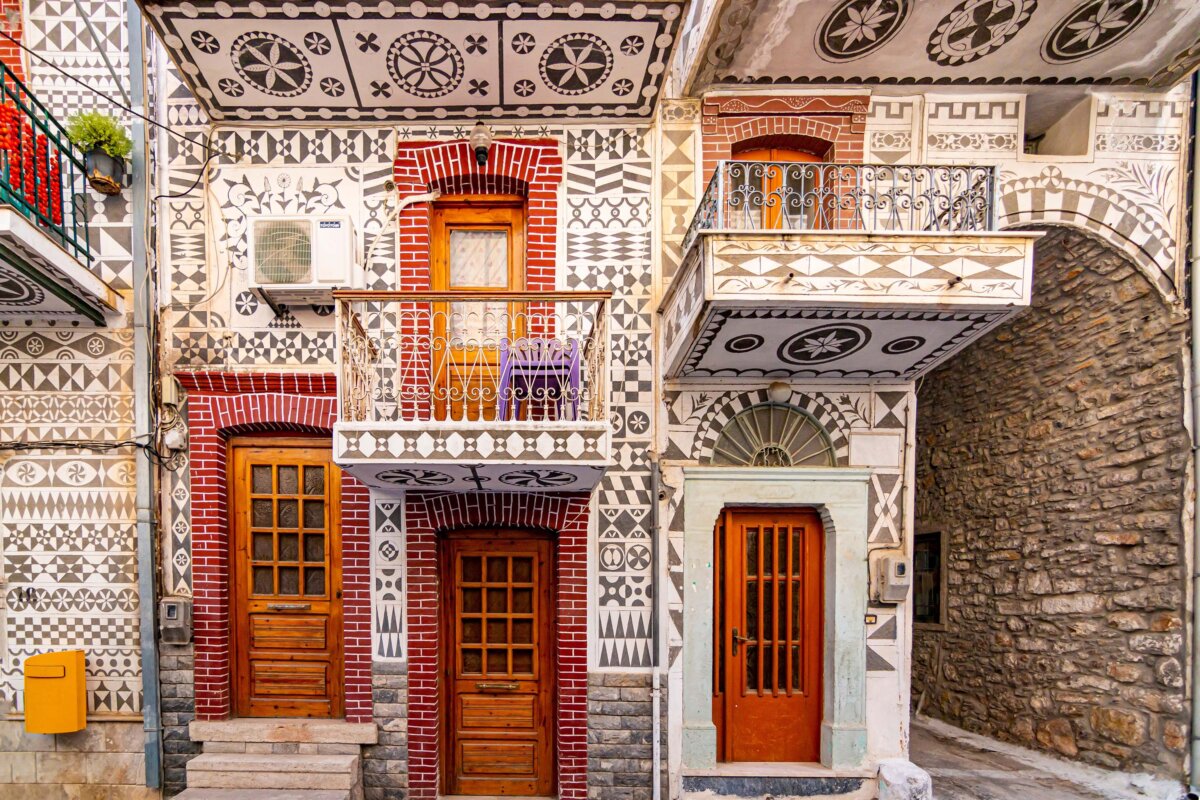
The island of Chios is dramatically stunning, set within the azure Aegean Sea and rimmed with golden beaches and volcanic cliffs. And yet, hard as it is to imagine, this is not what makes the island truly enchanting. It is Pyrgi, a village that appears to be draped in lace, where black-and-white diamonds climb around windows and doorways, circles unfurl into intricate rosettes, and bands of geometric pattern stretch across entire façades. This illusion is xysta, a distinctive decorative tradition that has turned the Pyrgi into one of the most striking villages in Greece.
A Mediterranean Technique
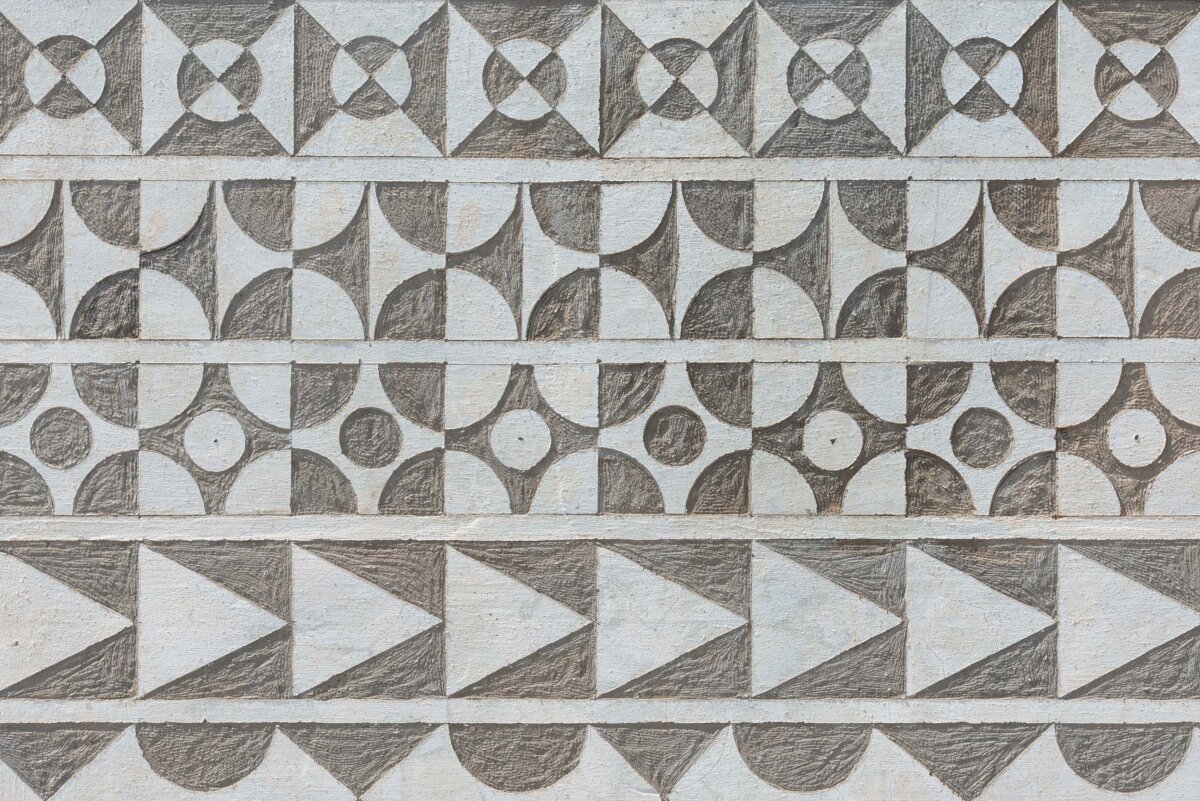
Xysta, from the Greek word for “scratched,” is a style in which intricate engravings are carved into an outward-facing wall, a technique that is deceptively simple in principle. First, the wall is covered with plaster, historically made from lime, river sand, and water, sometimes mixed with straw. A second, lighter coating is then applied over this darker base. Once the plaster has set, the designs can be etched into the upper layer, exposing the color beneath. The contrast between the light plaster and the dark ground beneath produces xysta’s characteristic effect.
The art of xysta draws on centuries-old Mediterranean practices, though its specific origins remain debated. Some scholars connect it to the Genoese, who ruled Chios from 1346 to 1566. The Genoese practiced sgraffito, a discipline much like xysta in which a contrasting upper layer of slip or underglaze is scratched away to reveal a differently colored layer beneath. Initially used on wares, sgraffito was later applied to walls to create decorative frescoes, which became popular across Italy in the 15th and 16th centuries.
Xysta also resembles Turkish artistic customs, an influence that is hardly surprising given Chios’s proximity to the Turkish coast. This is especially evident in Cappadocian carpets and textiles, where angular shapes such as triangles and squares form repeating motifs, often interwoven with animal and plant motifs. During festivals, such pieces were often hung from building fronts, transforming otherwise plain walls into intricate displays.
Patterns in Plaster
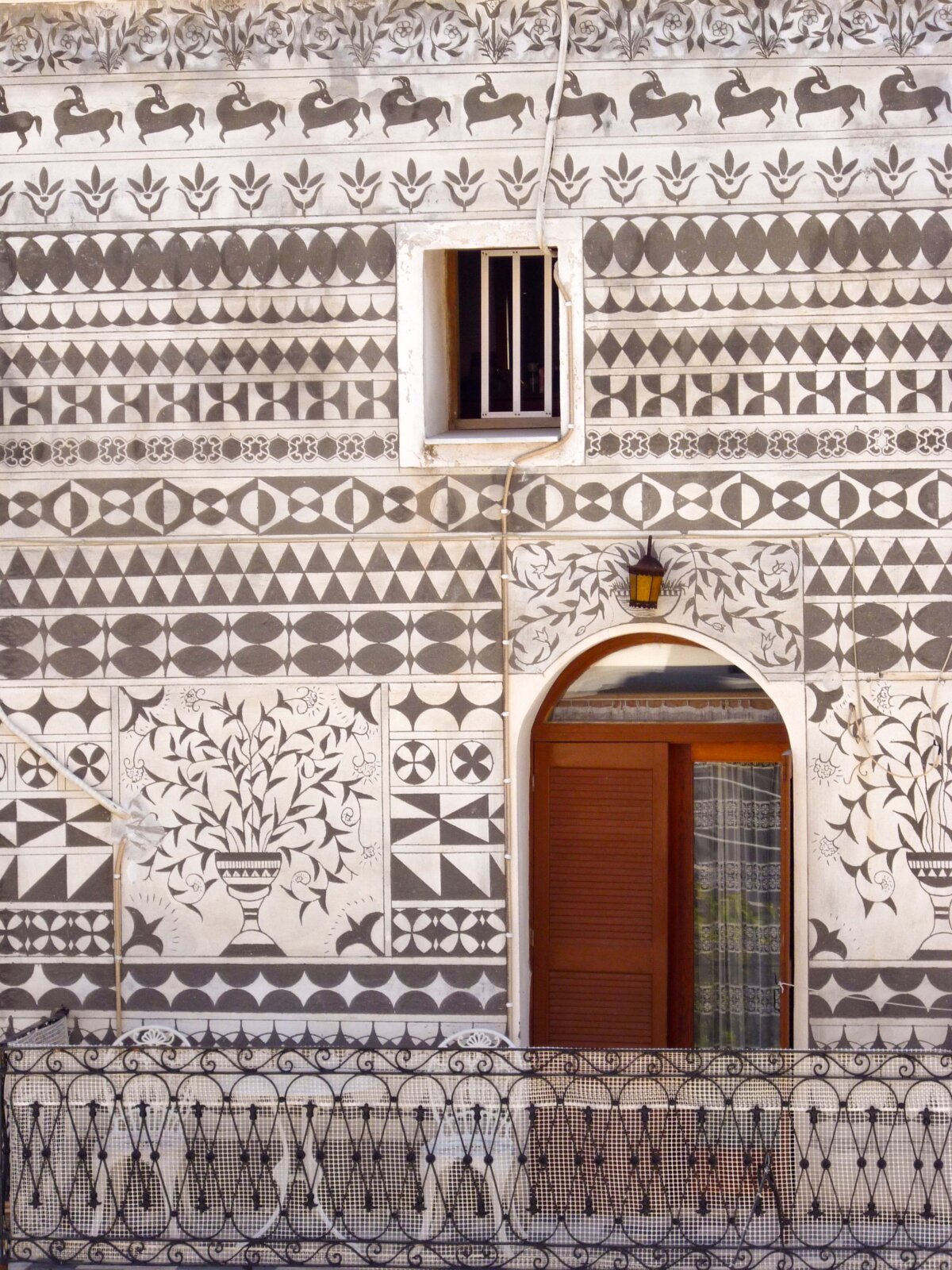
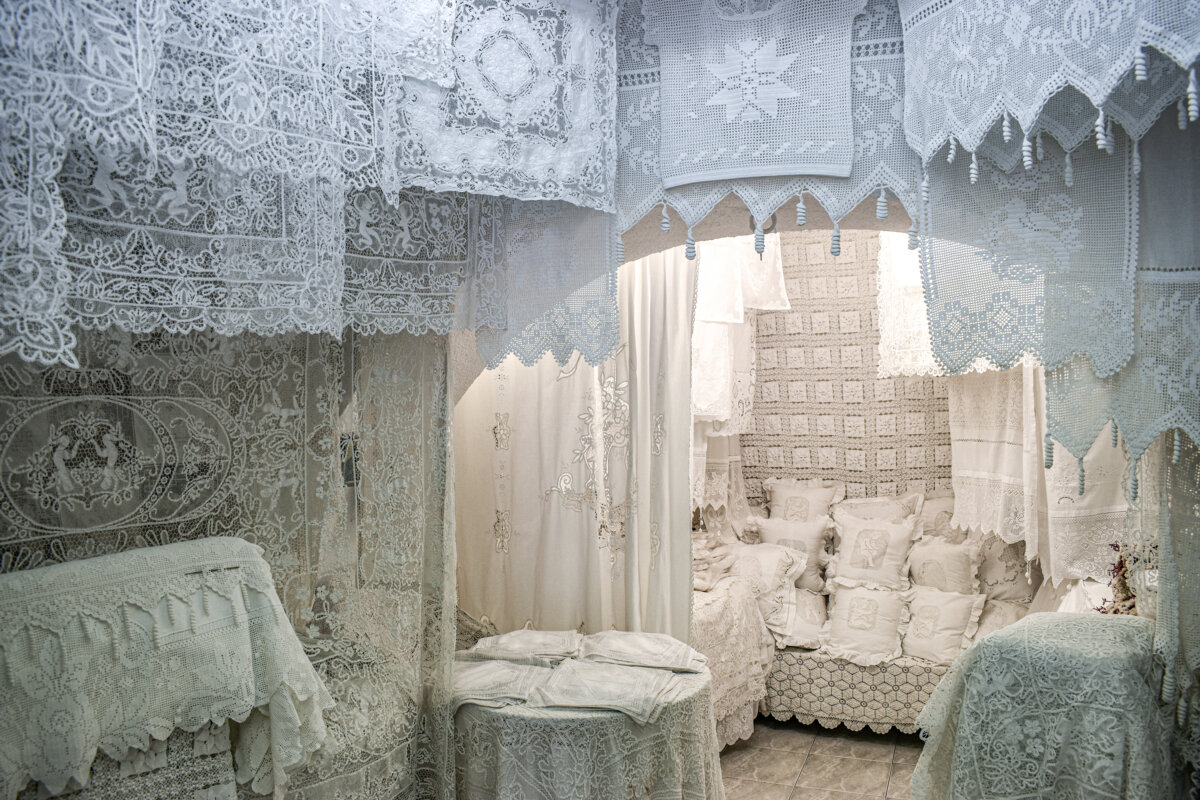
At the heart of xysta’s appeal are its striking geometric forms, many of which also appear in delicate Grecian lace. From a distance, the narrow borders and dense decoration can make the façades look woven or embroidered. In some areas, the imagery stops short of the ground, reinforcing the impression of a textile laid across the wall. This resemblance is especially apt in a Greek context, where lace has long been used to decorate church robes and altar cloths. Like textiles, xysta demonstrates how decorative motifs can take shape in different materials, appearing in woven cloth, painted pottery, carved wood, and plaster.
The process begins with a survey of the building’s exterior. The craftsman notes windows, doors, balconies, and floor levels, since these architectural features determine how the decorative zones will be arranged. Uninterrupted patterns are arranged within horizontal bands, every 6 inches to a foot high, while openings such as doors and balconies are often marked by a circular motif.
The individual compositions are relatively restrained, relying on repeated triangles, diamonds, semicircles, and other simple forms, but together they build into something intricate. The system allows remarkable variation from a small number of basic forms. By shifting the center of a circle in relation to a fixed square, craftsmen can generate different combinations: Squares can become diamonds, and circles can be divided into segments. Modern researchers have identified mathematical principles, including symmetry, reflection, rotation, and translation, within the designs. The craftsmen who created them passed their methods down through generations, learning the craft through observation and experience.
Cultural Heritage
Though xysta has been practiced for centuries, the earliest surviving works date to roughly the 1850s. Before then, the technique was already in use but remained relatively limited, primarily seen on the homes of affluent families and important public buildings.
But the history of xysta is inseparable from the upheavals that have shaped Chios. From 1821 to 1829, Greeks fought for their freedom from the Ottomans during the Greek War of Independence; thousands were killed, and many more were enslaved or displaced, bringing further destruction to the village. Chios was struck again in 1881, this time by an earthquake that destroyed and badly damaged buildings across the island and killed thousands. In the aftermath, locals committed to working together to keep the legacy of xysta alive.
Many buildings in Pyrgi are now protected, and new construction must respect the village’s traditional character. Where possible, restoration projects preserve the original façades. Conservation is specialized, requiring knowledge of plastering, the right proportions for each pattern, and the precise tools needed to scratch the surface, all of it typically passed down through hands-on practice rather than written instruction.
Pyrgi’s devotion to xysta has carried it across the village, adorning churches, shops, and public buildings alike. The result is an art form that occupies an unusual place in Greek cultural history, belonging simultaneously to architecture, drawing, decorative art, and craft. Much like xysta itself, Pyrgi is a village of remarkable, layered beauty.
What arts and culture topics would you like us to cover? Please email ideas or feedback to features@epochtimes.nyc.