



NR | 1h 15m | Documentary | 2025
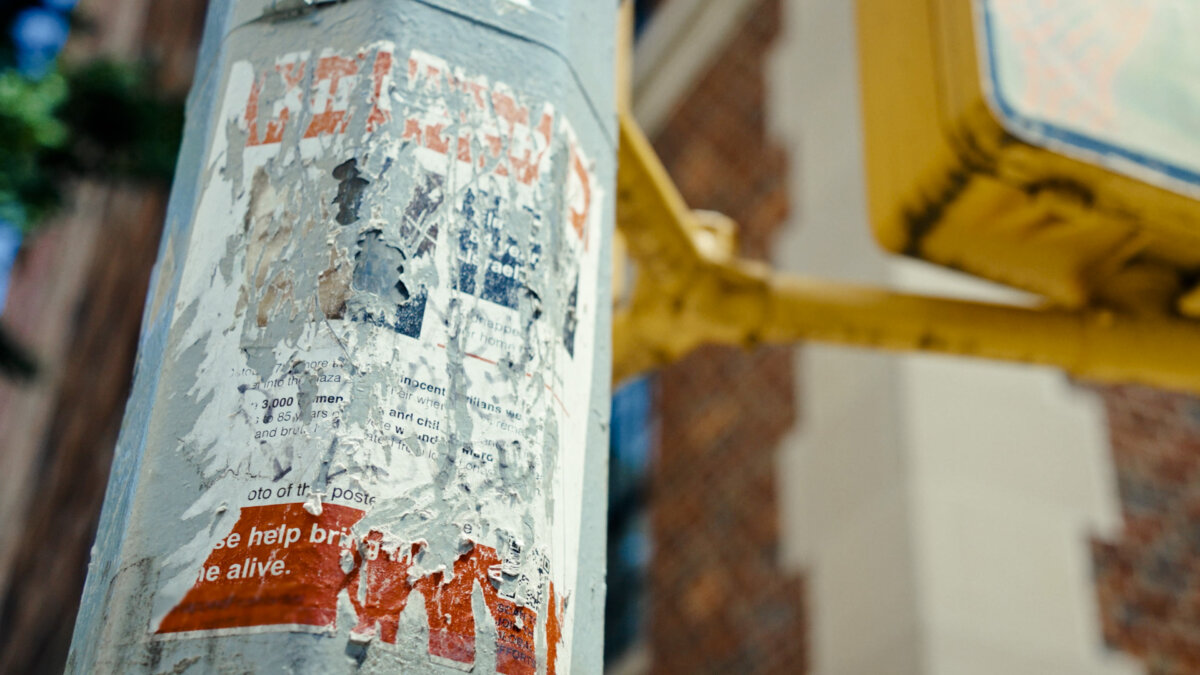
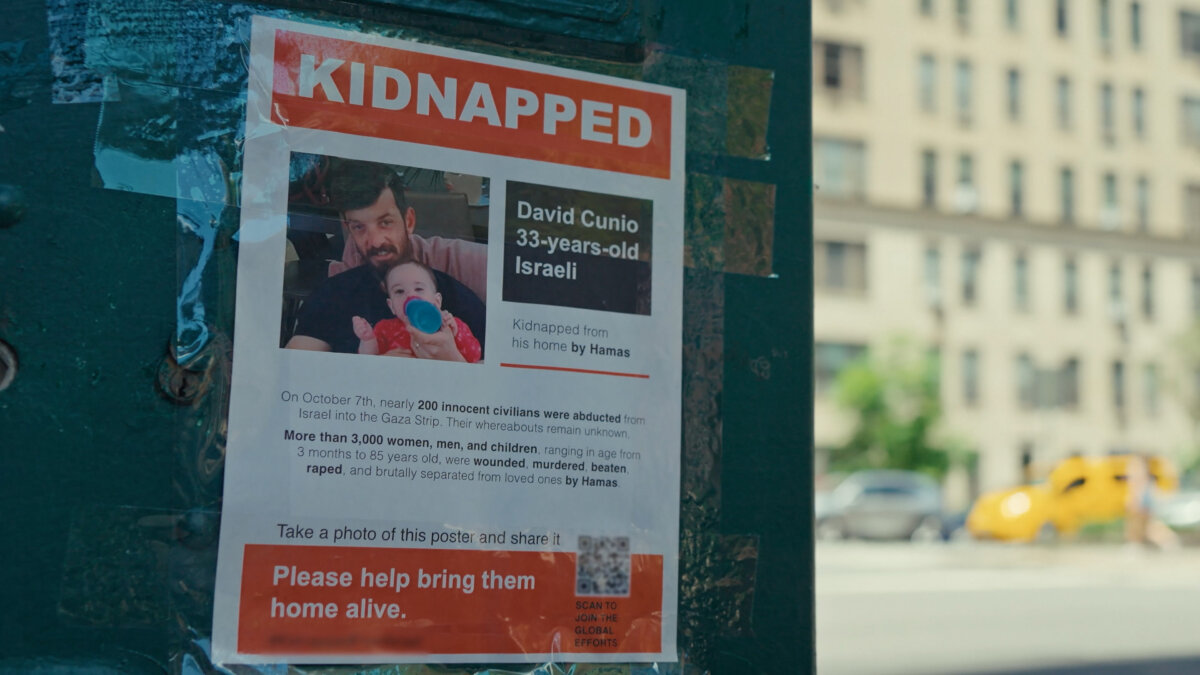
By most advertising standards, the “Kidnapped” posters of innocent Israelis held captive in Gaza have been remarkably effective. Their red-and-white color scheme has made them immediately recognizable. They very directly force viewers to consider the hostages as human beings by giving them names and faces.
The designers—Nitzan Mintz, Dede Bandaid, and Tal Huber—might argue they failed, because Hamas still holds an estimated 20 hostages. But their posters undeniably kept their plight in the public eye.
Perhaps the greatest indication of their success could be the vehemence with which partisans aligning with the Palestinian cause have ripped them down. While the war still rages and emotions remain raw on all sides, director-producer Nim Shapira thoroughly examines the clash of urban activism in the documentary “Torn: The Israel-Palestine War on NYC Streets” (“Torn”).
The Posters
Mintz and Bandaid wanted to do something to draw attention to the hostages. They often created happenings (spontaneous performances in public) on New York streets, so they felt comfortable operating in that environment. Mintz preferred masked anonymity as part of his artistic persona, even before the Oct. 7 atrocities. They devised the “Kidnapped” posters in collaboration with Huber. Their first day of distribution yielded little response, but the next morning, their posters erupted online.
Alana Zeitchik and her brother Liam soon started posting the “Kidnapped” posters to raise awareness for their six abducted family members, including Emma and Yuli, the 3-year-old twin daughters of their cousin Sharon, and Amelia, the 5-year-old daughter of their cousin Danielle. For the siblings, postering served as a means of taking constructive action. When their loved ones’ faces were ripped and defaced, it felt like a deliberate denial of their humanity.
How do the rippers justify their actions? They refused to appear on camera. This is much like those infamously captured on social media trying to hide their faces while mostly responding with obscenities.
Director Shapira reached out to them in good faith, but the best he was able to get in return was a handful of written statements. Posterer Nina Mogilnik responded on-camera with a remarkable spirit of understanding. She even responded to one writer, who was allegedly fired after her ripping session was documented online.
‘Heckler’s Veto’
Shapira never glosses over the thorny issues involved. Aaron Terr is the director of public advocacy for FIRE, the Foundation for Individual Rights and Expression; the organization actively fights campus censorship. As befitting his nonpartisan status, he criticizes both the tearing down of the posters (as a “heckler’s veto”) and the cancel-culture tactics employed against those caught defacing them.
There is something unseemly in the destruction of these posters, which the defacers perhaps recognize on an instinctive level. At the time of production, art student Julia Simon still hoped that her friend, the late Omer Neutra, remained alive in captivity. She incorporated many of those ripped shreds into starkly powerful artistic statements. Indeed, her canvases represent art holding up a mirror to society in an extraordinarily telling way.
Everyone involved in “Torn” admits that the Israel-Palestine issue is complex, with victims on both sides. Shapira offered an opportunity for dialogue, but there were no takers among the poster-rippers. Consequently, “Torn” cannot be criticized for being one-sided. You cannot have honest debate if one side refuses to engage in dialogue.
Indeed, that serves as a metaphor for the act of ripping down hostage posters. As Terr and others suggest, those who feel Palestinian victims are not adequately represented should create their own posters. Activist and damaged-poster archivist Elisha Fine rather eloquently expresses the wish that we could live in a world where both sides could at least “share the poles.”
Shapira never really asks the question of why that is not the case. He is clearly reluctant to explore why extremist activists feel so compelled to tear down pictures of abduction victims, including children and senior citizens. “Torn” vividly explains how New Yorkers like the Zeitchiks coped with some of the darkest days of their lives, which sadly are still not yet behind them.
“Torn” is personal rather than polemical, but it is undeniably revealing. This is a phenomenon that deserves a rigorous examination, which Shapira delivers.
Highly recommended as a snapshot of post-10/7 American society.
“Torn: The Israel-Palestine War on NYC Streets” opens in theaters Sept. 5.
‘Torn: The Israel-Palestine War on NYC Streets’
Director: Nim Shapira
Documentary
Not Rated
Running Time: 1 hour 15 minutes
Release Date: Sept. 5, 2025
Rated: 4 1/2 stars out of 5
What arts and culture topics would you like us to cover? Please email ideas or feedback to features@epochtimes.nyc
