



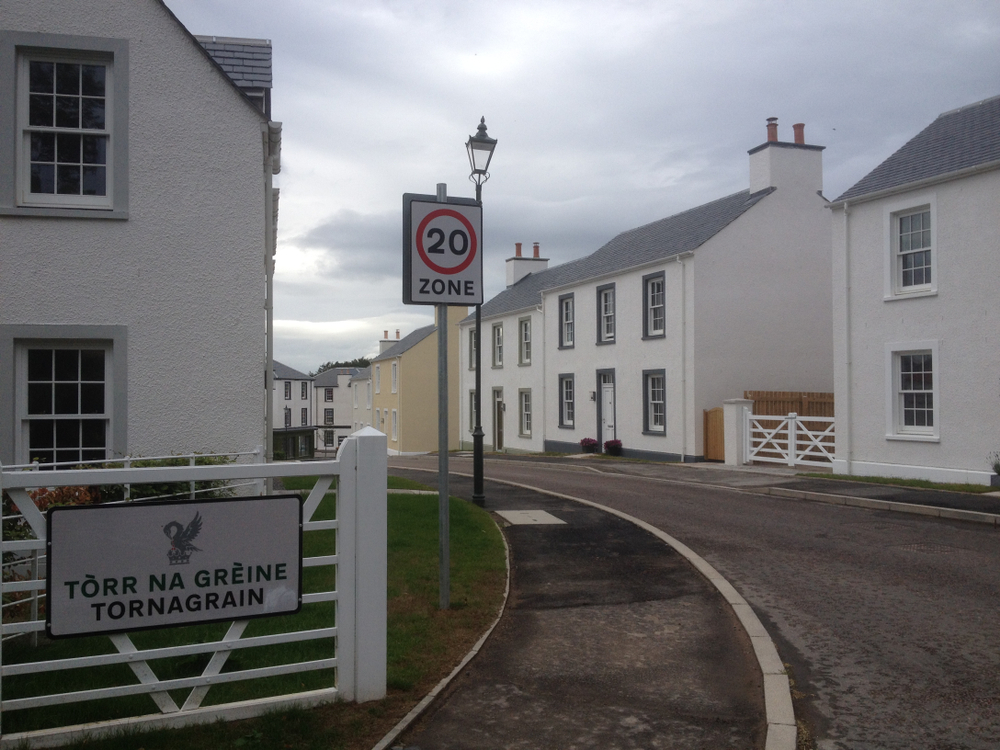
Less than 10 miles east of Inverness, long known as the “Capital of the Highlands,” Tornagrain might appear to be just another of Scotland’s beautiful small towns. A few hundred small buildings are tucked next to each other, mainly with white walls and slate roofs, and most between one- and four-stories high.
Many of the homes approach the proportions of a cubic square. Several units are joined together townhouse-style. Like many such towns, it was built by a major local landowner and peer of the realm, in this case, the earl of Moray.
What sets Tornagrain apart from other towns built in similar style throughout centuries of Scottish history? It’s the first built in the third millennium and proves that the substance of Scotland’s traditional town planning and architecture are perfectly suited to contemporary needs.
Highland Council
Tornagrain’s story begins in 2002. Inverness had been sprawling since the 1980s, mainly through the building of characterless suburban developments. The Highland Council (the governing body of Scotland’s five northernmost counties) realized more careful planning was needed.
Members proposed a better-organized version of the same pattern to the 21st earl of Moray—three new residential communities on the Moray Estate, each for about 3,000 residents.
Moray, for his part, was disturbed by the utilitarian mediocrity replacing the natural beauty of a region his family had lived in since the 16th century. He agreed to build on his 620-acre estate, but on his own terms.
Rather than three residential developments, there would be a single, traditional mixed-use town with homes, businesses, professional offices, and schools all in close proximity. In time, it would have 5,000 homes, from one-bedroom apartments located above stores to four-bedroom freestanding houses. The town would accommodate over 12,000 residents. Social housing would be mixed in with privately owned homes and rented units.
The Scottish Style
Architecturally, the town would be based on Scotland’s traditional vernacular styles. Dunkeld, almost entirely rebuilt in the 18th century, was the most important inspiration. Other significant historical influences included Cromarty, a major 18th-century redevelopment, and Edinburgh’s New Town, a late 18th- to early 19th-century expansion of the city built by Moray’s ancestors.
Contemporary inspiration was provided by the New Classicist and New Urbanist developments. The New Classicist style is committed to designing new architectural works in traditional styles; the New Urbanist style adapts traditional town planning to modern needs.
While neither style strictly needs the other, the two often work hand in hand. Moray was particularly fortunate in the planning process. Andres Duany, a leading American New Urbanist whom he consulted, had a Scottish grandmother and had long been interested in designing a traditional style Scottish town.
A perfect match for Scotland’s slightly rugged, green, and often misty landscape, this traditional architecture has a stark simplicity which is intriguingly beautiful.
In its basic outlines, the Scottish vernacular style is remotely derived from the classicist tradition. Important building sprees took place in the 16th and 18th centuries. Fashionable in high architecture were the semi-classicist French Renaissance and the more strictly classicist English Georgian styles.
Practical and Beautiful
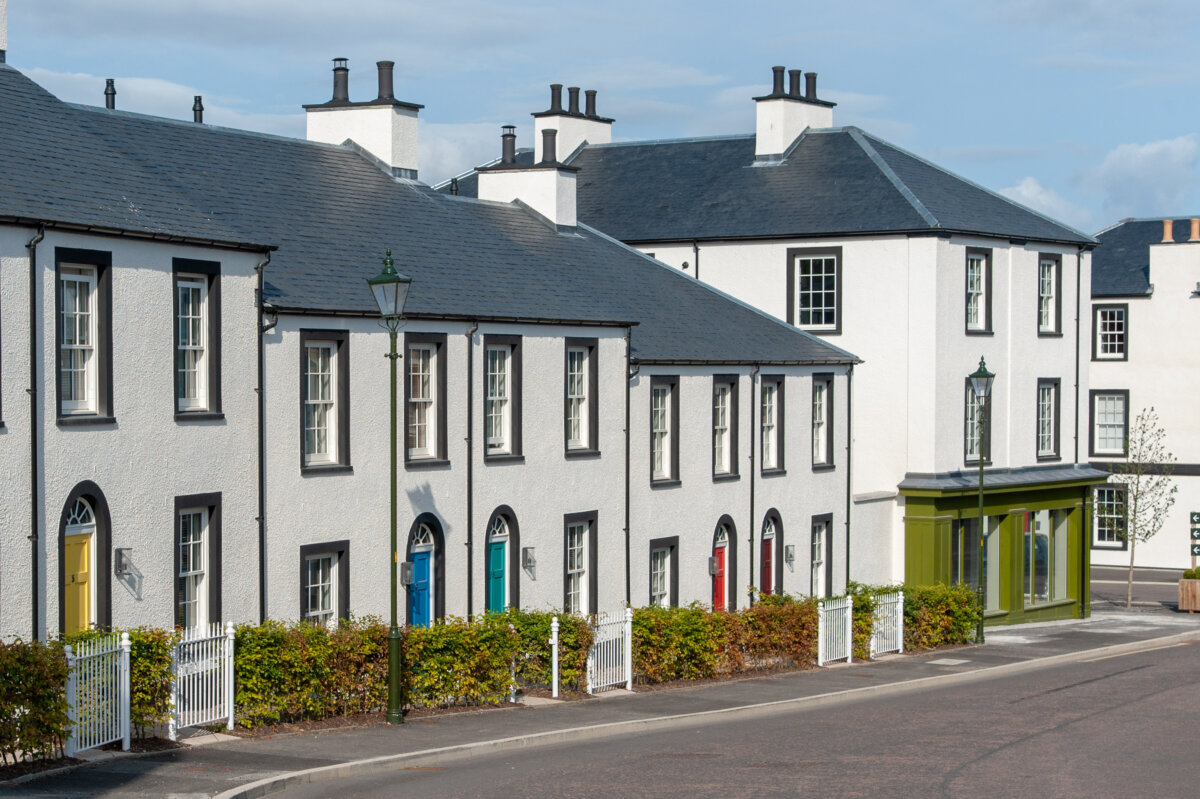
The proportions, symmetry, and straight lines of Scottish vernacular architecture unmistakably reflect this influence. So, too, do the whitewashed walls and slate roofs typical of the style. While largely rooted in practicality, they also reflect ordinary people’s desire to beautify their homes.
Most buildings in Tornagrain have traditional Scottish “external render” walls. This is a wall covered in a protective plaster or mortar, often made, at least partly since the early 19th century, with cement. Aside from its rough surface, the siding gives walls a starkly uniform appearance.
Buildings with the siding have an extraordinarily pretty appearance when combined with colorful window frames and doors. Red, dark green, and light blue doors and frames are particularly common at Tornagrain.
Here and there, a bit more variety can be seen. Often, this is a matter of introducing variations on the same basic themes. A popular way is to cover significant portions of a bottom story with the same wood used for the doors and window frames and painted in the same color. Another is the addition of small, colored wooden outbuildings such as sheds. In other cases, the “external render” is colorfully painted in pale shades of pink or yellow.
Details are important. Roads and sidewalks match the gray of the slate roofs. Streetlights at close intervals combine traditional aesthetics with modern technology. The pillars of many porches are made of painted knotty spruce tree trunks, a longstanding feature of local architecture.
There are plans to construct police, fire and ambulance stations, sports facilities, schools, and buildings for many other modern purposes, all in traditional styles.
Tornagrain is expected to take 50 years to complete. At present it includes over 250 homes, a pharmacy, supermarket, a cafe, and a nursery school. Few as that might seem compared to the earl of Moray’s plans, what has been built is being quickly filled. Young families are flocking to a place where they feel at home.
This beautiful town is already developing a very real sense of community and gives much to hope for in the future of the Scottish Highlands.
What arts and culture topics would you like us to cover? Please email ideas or feedback to features@epochtimes.nyc

.jpg)