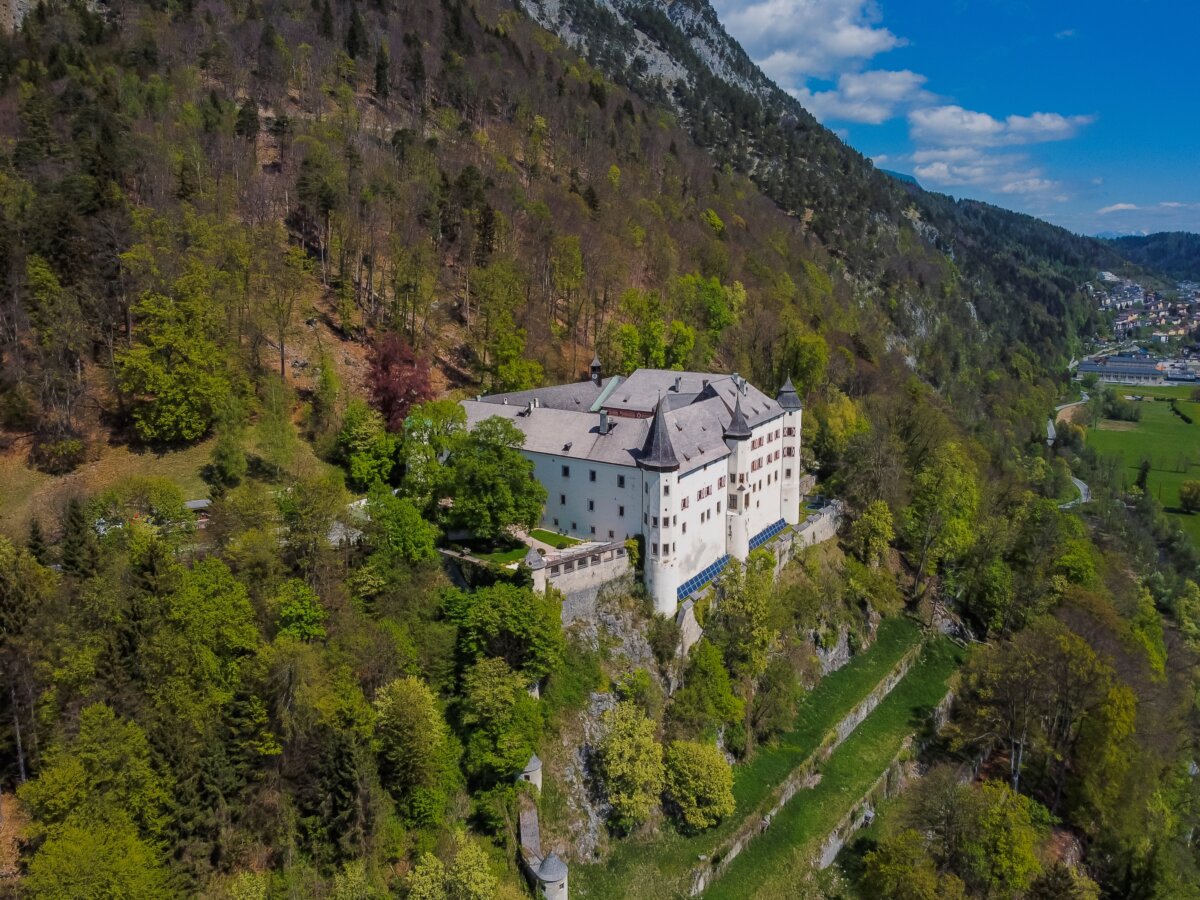
One of the Alps' most intact examples of late-Gothic and Renaissance castle architecture, Tratzberg covers over 73,000 square feet. Its spired towers and vast wooden shingle roof—spanning nearly 54,000 square feet—have defined this forested ridgeline above the Inn Valley for centuries. (Stanislav Oprysnyk/Shutterstock)
Perched atop a steep forested ridge, Tratzberg Castle rises like something out of a fairy tale, its pale stone towers sharp against the alpine sky. Traceable to the 13th century, the Austrian castle began as a formidable border fortress guarding against Bavaria—though its destiny was to become something far more storied. Its most illustrious early owner, Holy Roman Emperor Maximilian I of the powerful Habsburg dynasty, prized Tratzberg as a private hunting retreat.
That chapter came to a dramatic end in 1492, when a devastating fire consumed the original fortified structure entirely. Rather than rebuild, the Emperor traded the ruins with two prosperous silver mine owners, Veit-Jakob and Simon Tänzl, in exchange for a castle. Wasting no time, the pair set about reimagining what would rise from the ashes, and beginning in 1500, they constructed the breathtaking castle complex that stands proudly on that ridge today. Through inheritance, Tratzberg passed into the hands of the wealthy Fugger merchant family. The inner courtyard, Renaissance rooms, and most of the original furnishings all date from this era.
Count Ulrich Goëss-Enzenberg and his wife Katrin now call Tratzberg home, making them the first family to live within its ancient walls year-round in nearly 500 years. Having inherited the estate, the couple has passionately carried on a family tradition of careful restoration and stewardship now spanning over 150 years.
Tratzberg is now open to the public, and few castles in the Alps can match it as a window into this period of history. Intricately carved marble, robust ironwork, and exquisite woodwork survive in remarkable condition throughout, a testament to late-Gothic and early-Renaissance craftsmanship. Beyond the castle walls, majestic meadows and ancient forests unfold, with scenic hiking trails winding through the landscape just beyond.
Inside, over 500 years of priceless artifacts and exhibits are presented openly, without the barrier of artificial display cases, allowing visitors to connect with each object up close. To bring the castle’s layered past even more vividly to life, Count Ulrich and Katrin have collaborated with a dedicated castle researcher to digitally reconstruct the original fortress lost to flames in 1492. Through immersive VR technology, visitors can step into the past. They watch the original castle fall to flames, move through the bustling construction site of the 1500s, and see the magnificent new palace take shape, stone by stone, right before their eyes.
Widely regarded as one of the best-preserved castles in all of Austria, Tratzberg has retained an extraordinary amount of its original character, furniture, and fittings across the centuries.
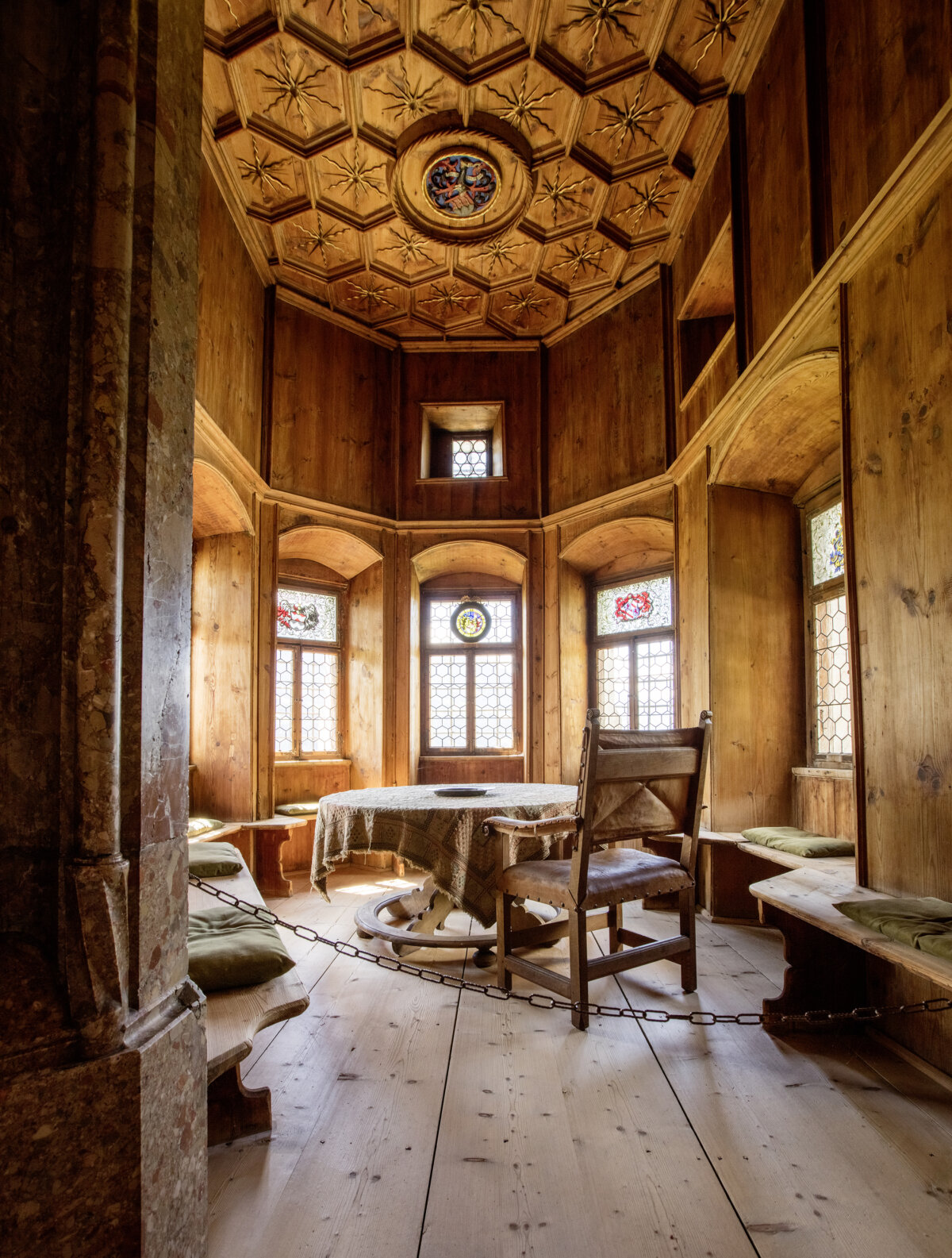
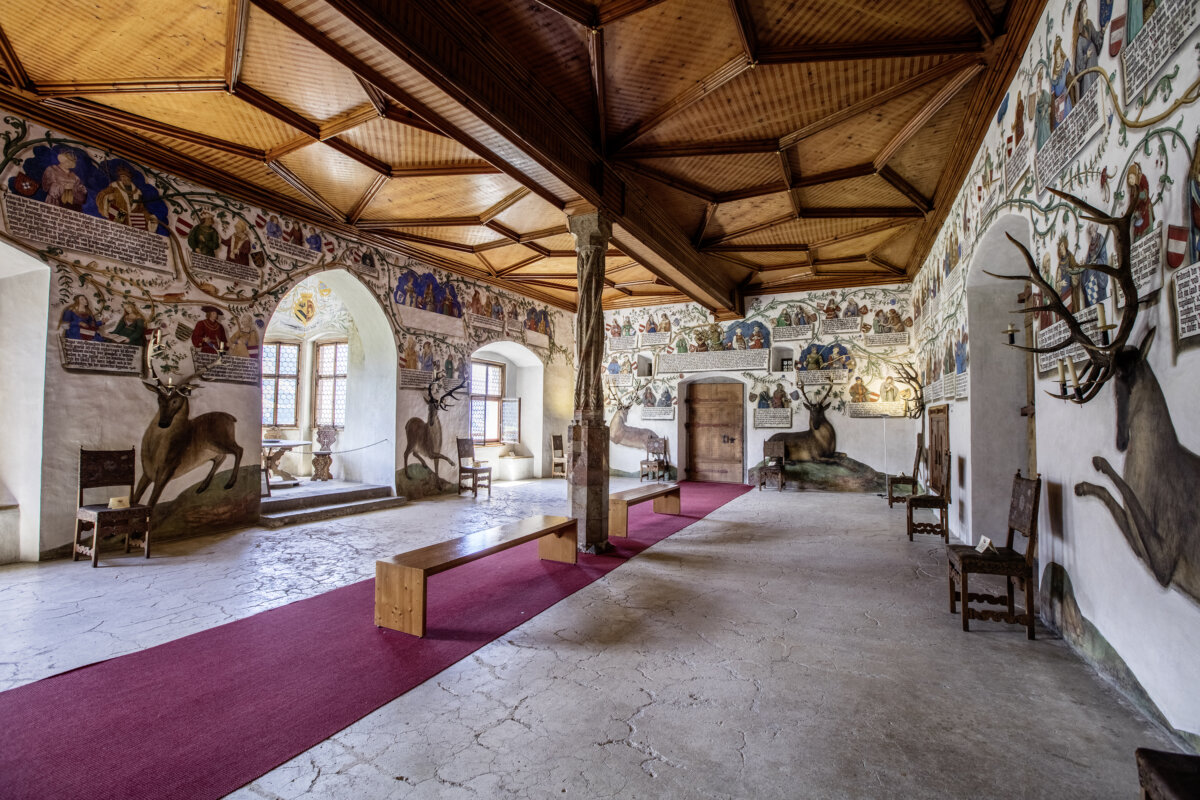
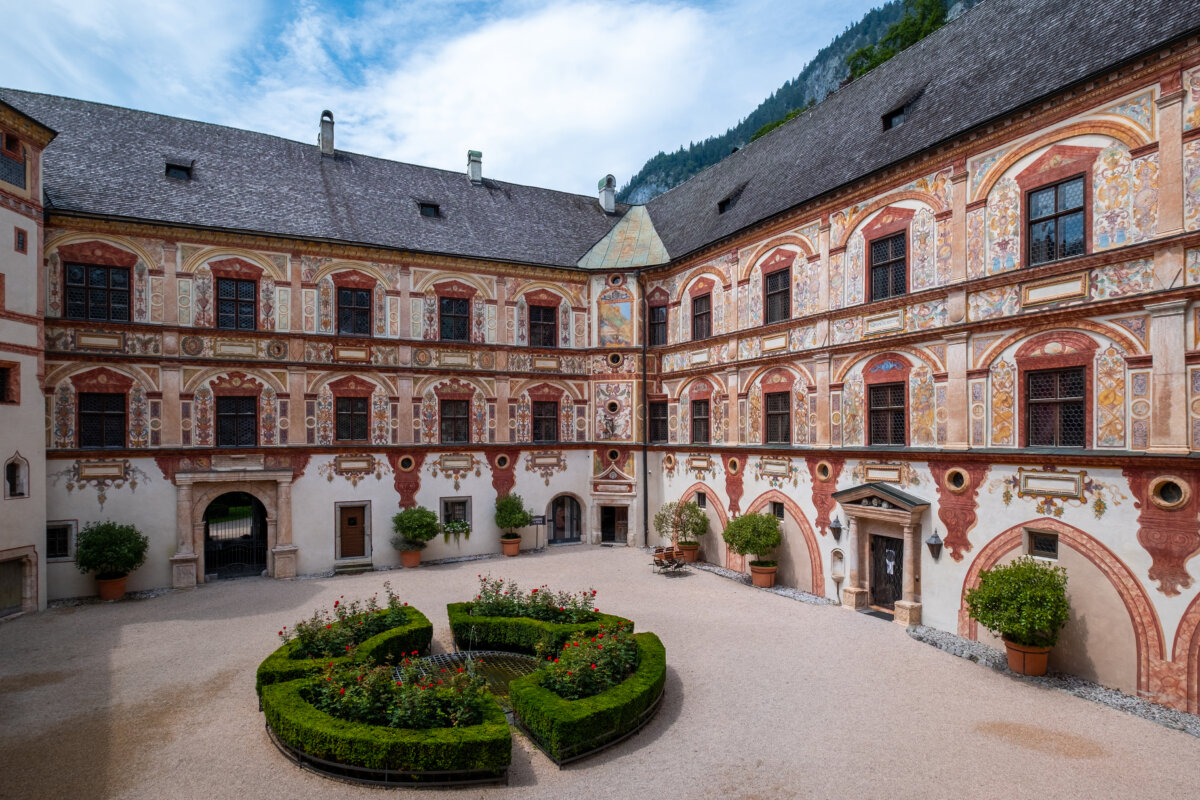
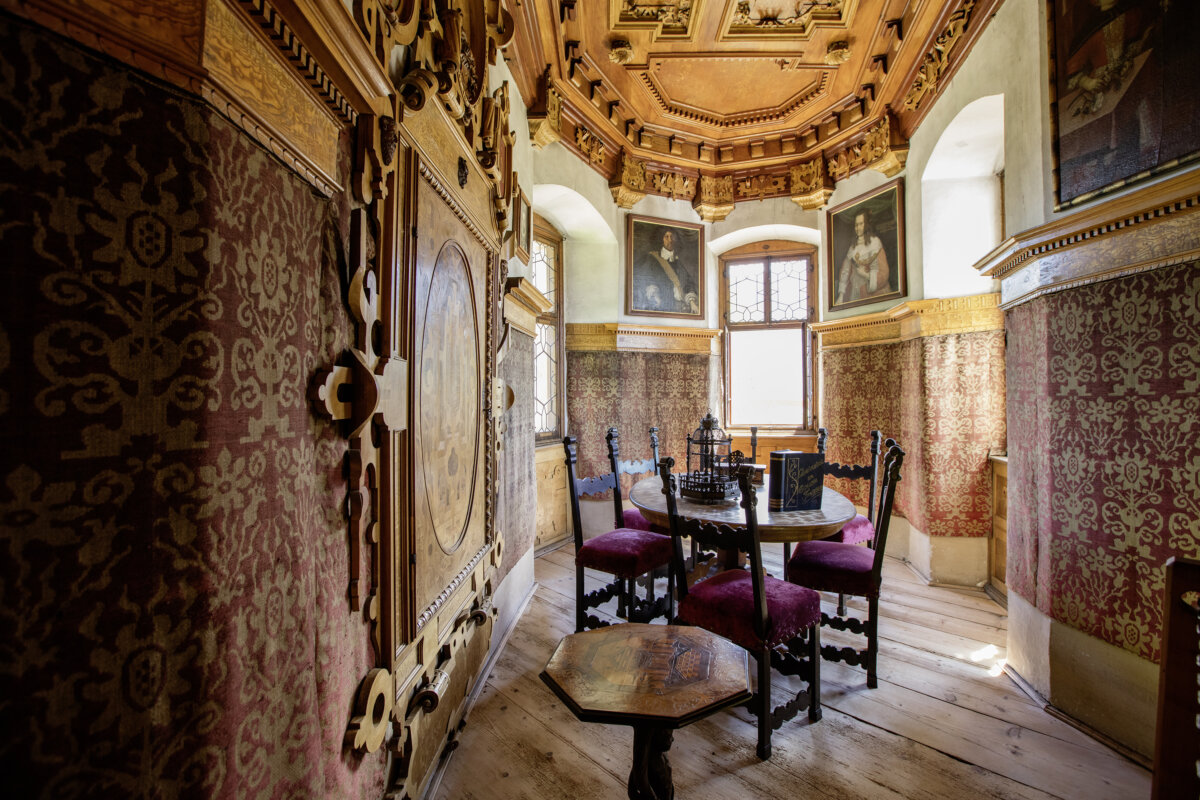
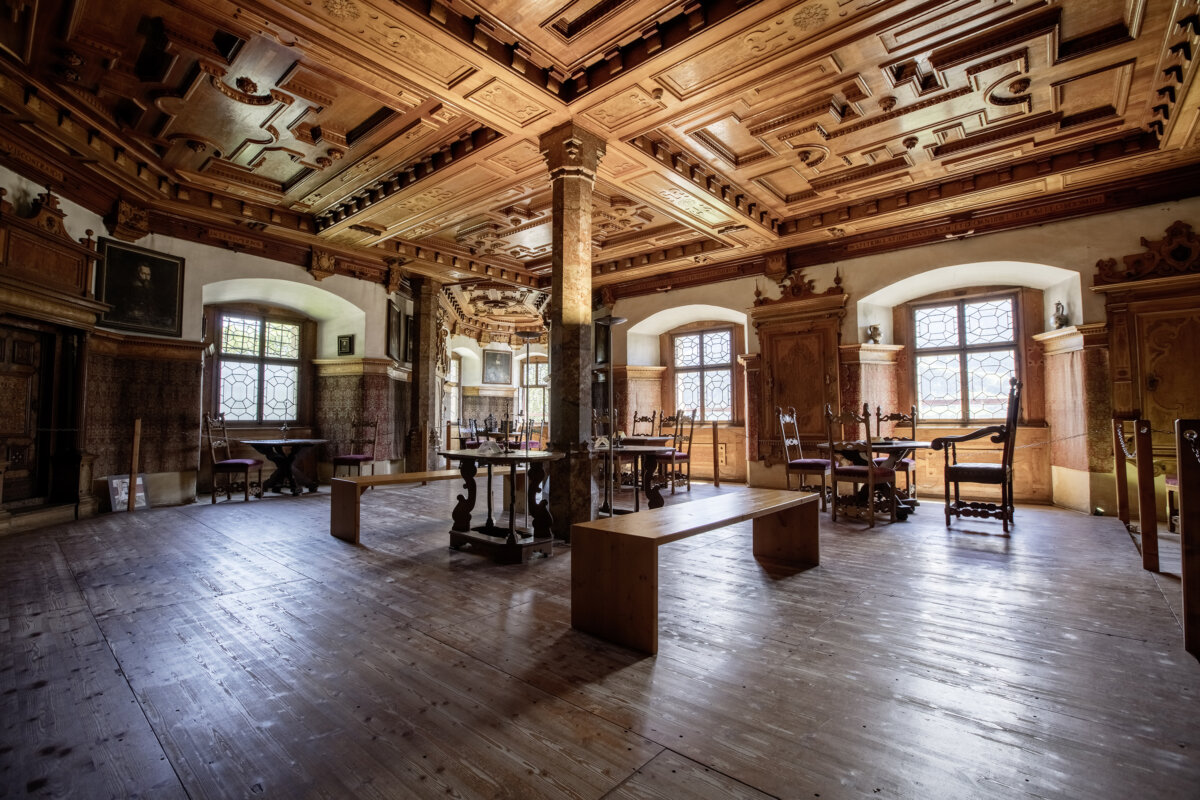
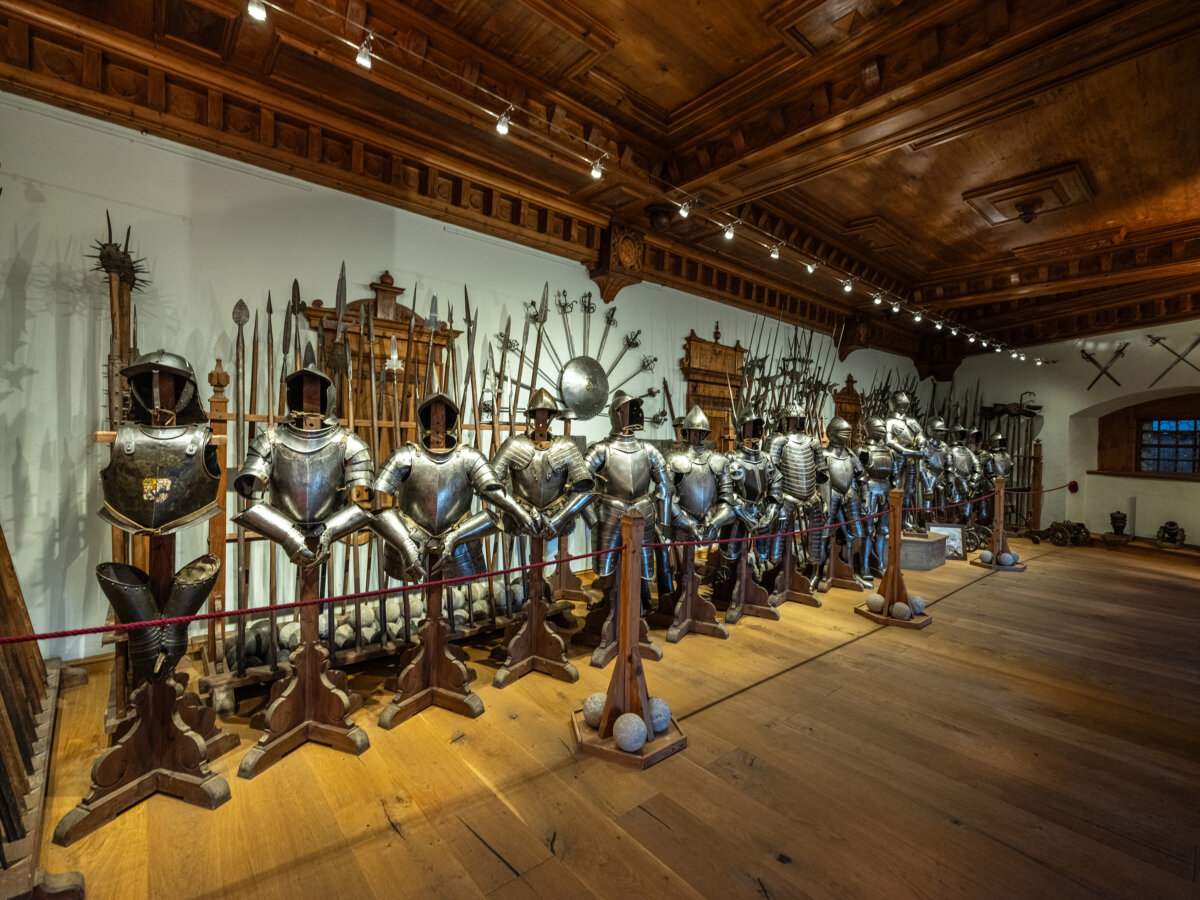
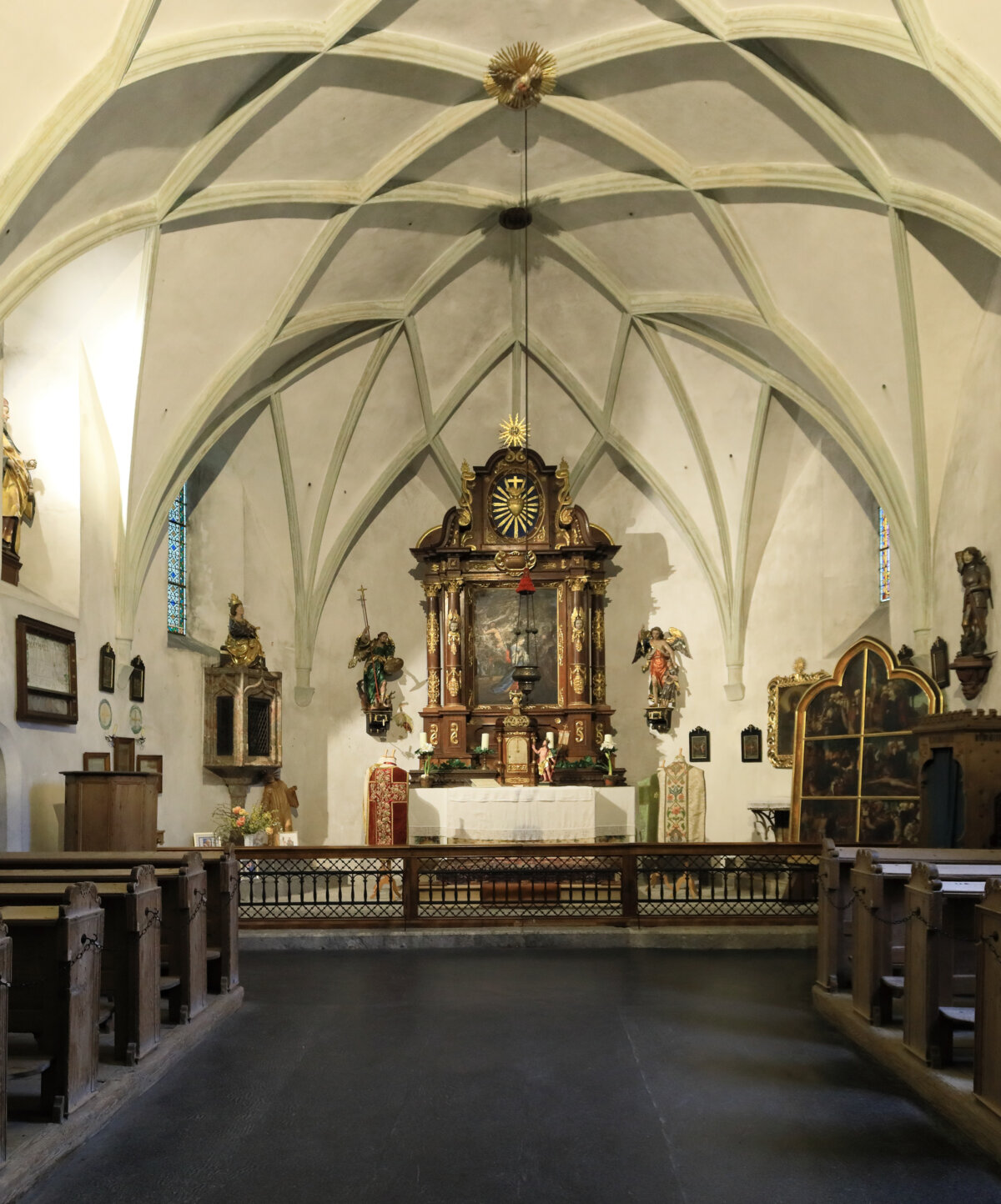
The Fugger Room served as the private quarters of one of Europe’s most powerful merchant families and remains almost entirely original. Adding to these historic elements is a hexagonal coffered ceiling design. This sophisticated reinterpretation of the traditional square coffer pattern is composed of recessed panels framed by decorative molding to create a dimensional honeycomb effect. In 16th-century European architecture, particularly in Habsburg-controlled regions, hexagonal geometry symbolized mathematical precision and harmony. (Courtesy of Schloss Tratzberg) Known as the Habsburg Hall, this nearly 2,000-square-foot ballroom is crowned by a coffered wooden ceiling and encircled by one of Tratzberg’s most extraordinary features: a painted dynastic family tree of 148 figures. Frescoes depict Emperor Maximilian I alongside his two wives, King Rudolf I, and other Habsburg luminaries, while life-size painted deer mounted between the portraits bear real antlers that once functioned as candle holders. (Courtesy of Schloss Tratzberg) At nearly 9,688 square feet, Tratzberg’s inner courtyard is one of its most visually striking spaces. Newly restored frescoes gleam across a colorful facade decorated with trompe-l’œil columns, an artistic technique that uses perspective and shading to render flat surfaces as three-dimensional. Leaded windows inset with stained-glass crests complete the scene, reflecting the Renaissance sensibility of Georg Ritter von Ilsung, who expanded the castle after acquiring it in 1554. (Courtesy of Schloss Tratzberg) Executed in the High Renaissance style, the private Queen’s Chamber showcases exceptional craftsmanship. The chamber showcases an elaborately carved ceiling and original 1560 wall coverings adorned with a rich burgundy-and-gold damask pattern. Ancestral portraits and finely crafted wooden furnishings, including an octagonal occasional table, enrich the historic atmosphere. The dark wood chairs, upholstered in deep red velvet, echo the damask textiles, reflecting the queen’s status and refinement. (Courtesy of Schloss Tratzberg) The Königinzimmer, or Queen’s Parlor, represents one of the finest surviving interiors in the region. Dating to 1568 to 1569, the room is attributed to craftsman Hans Waldner and distinguished by its rich woodwork: a coffered ceiling, paneled walls, and a cornice inlaid with biblical texts. Renaissance and baroque furnishings complete the space. (Courtesy of Schloss Tratzberg) Drawn from the collection of Count Franz Enzenberg III, the Armor Chambers display an extensive array of 15th- and 16th-century arms and armor. Steel suits of armor are displayed alongside an array of weapons designed for armored combat, including morning stars, sickles, and sabers. The collection also includes crossbows, widely used as hunting weapons among the nobility for their precision and long-range accuracy. (Courtesy of Schloss Tratzberg) The castle chapel traces its origins to 1462, though it was rebuilt by the Tänzl brothers around 1500. The interior features a characteristic ribbed vault, a main altar dating to around 1703, and a Gothic tabernacle carved from marble. A Gothic sculpture of St. Catherine of Alexandria, to whom the chapel is consecrated, stands within. (Cropped photo Falk2/CC-BY-SA-4.0)
What arts and culture topics would you like us to cover? Please email ideas or feedback to features@epochtimes.nyc.
Sarah Isak-Goode is a writer and art historian rooted in the Pacific Northwest. Her name—pronounced EYE-zik-good and meaning "good laugh"—hints at the warmth she brings to everything she does. Equal parts scholar and storyteller, Sarah brings the past to life through a distinctly human lens, exploring what connects us across the centuries. Away from her desk, she feeds her curiosity through traveling, painting, reading, and hiking with her dog, Thor.