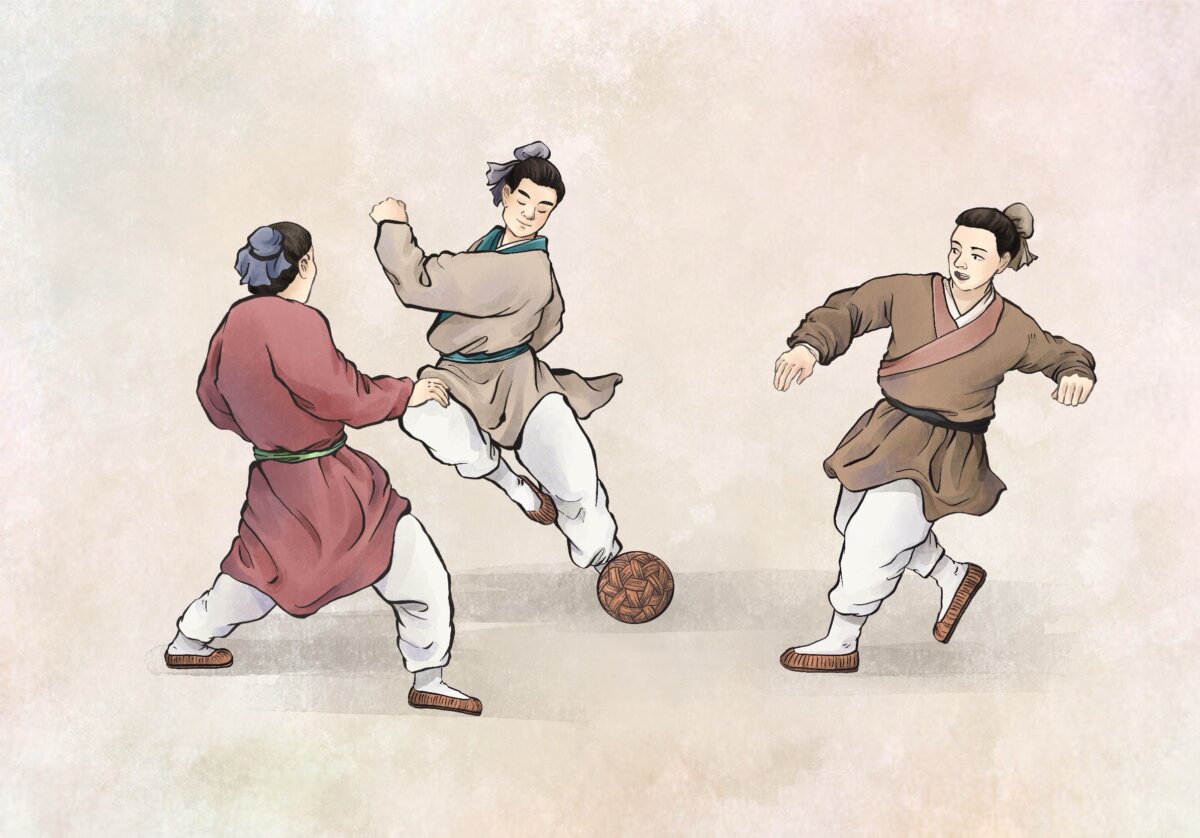
When soccer tournaments such as the World Cup take over the global stage, few realize that the earliest form of this beloved sport originated not in Europe, but in ancient China.
Since at least 2004, FIFA has recognized Tsu’Chu, a competitive ball game dating back over 2,000 years, as the earliest known form of soccer.
The Origin of Tsu’Chu
Tsu’Chu is documented in classical texts such as “Strategies of the Warring States” and “Records of the Grand Historian,” both referencing its popularity in Linzi, the capital of the Qi state during the Warring States period (circa 475 B.C.–221 B.C.).
The name “Tsu’Chu” combines tsu (to kick) and chu (ball). According to the Qing Dynasty collection “Jianhu Shouji” by Chu Renhuo, early Han Dynasty balls were made of leather and stuffed with animal hair.
Initially, it served as a military exercise—a way to train soldiers and test their physical fitness. The Han Dynasty text “Records of the Grand Historian” states: “Tsu’Chu reflects military tactics. It trains warriors and reveals capability.”
Tsu’Chu Rules in the Han Dynasty
Tsu’Chu became more formalized during the Han Dynasty (206 B.C.–A.D. 220). It was valued as a structured physical activity with both tactical and moral significance.
The scholar Li You wrote “Inscription of the Ball Field,” detailing the field design and game rules. The playing field symbolized yin and yang; each end featured six moon-shaped goals called “chu chambers.” Matches were played between two teams of 12.
Li’s inscription also emphasized fair play:
- Referees must be impartial: “No favoritism, no personal bias.”
- Players must show good conduct: “Stay calm and do not blame others.”
- Captains and referees were to be elected, and rules followed consistently.
Li concluded: “If soccer demands virtue, how much more so does governance?”
A 25-chapter handbook titled Tsu’Chu is recorded in the “Book of Han.” Sadly, it was lost after the Tang Dynasty, but it was once categorized under military science for its strategic rigor.
Golden Age in the Tang Dynasty
During the Tang Dynasty (618–907), solid balls were replaced with air-filled ones, allowing for greater bounce and agility and leading to new techniques and styles of play.
Wang Wei, a famous poet in the Tang Dynasty, once wrote: “The ball was so high, it soared beyond the birds.”
Tsu’Chu was so popular in the Tang Dynasty that it became an imperial court activity. Emperors such as Tang Taizong and Xuanzong were avid spectators. The emperors awarded winners with brocade, which was a rich, decorative silk fabric woven with gold or silver threads that represented imperial favor, high status, and great honor.
Highest-Ranking Soccer Player
When it comes to emperors who played Tsu’Chu, Emperor Taizu of the Song Dynasty (960–1279) was the highest-ranking player. The painting “Emperor Taizu Playing Tsu’Chu,” by Song dynasty artist Su Hanchen, shows Emperor Taizu kicking the ball, joined by his close minister Zhao Pu. Four others were watching them.
The original painting has since been lost, and the version now housed in the Palace Museum in Beijing is a copy made by Qian Xuan, a painter active in the late Southern Song and early Yuan periods.
World’s First Recorded Starting Formation
The Southern Song record Wulin Old Stories listed a full lineup of 32 players, possibly the world’s first recorded starting formation, with positions similar to those in modern soccer.
According to research by Taiwan’s Soochow University, the game started with one player kicking off, and the ball being passed to players in different positions following a set formation.
Players were not allowed to use their hands, and the ball could not touch the ground during passing. The sequence would continue until the ball was returned to the player taking the kickoff, who would attempt a goal by kicking the ball through the goal, which was called the “wind-flowing eye”—placed high on two poles. Scoring a goal counted as a win for that round.
Women also participated. The “Comprehensive Examination of Literature” mentions a 153-member female team in the Song court, dressed in embroidered robes and silver belts, performing for large audiences.
Decline and Legacy
Despite its long and vibrant history, Tsu’Chu declined during the Ming and Qing dynasties.
Emperor Hongwu issued bans due to excessive indulgence of the high-ranking officials and military officers in the game, and punishments were severe: Some players reportedly had their feet amputated as punishment.
By the Qing era, Tsu’Chu had lost its noble image and faded from cultural prominence. Yet, its legacy as the world’s first organized soccer lives on, offering a rich and surprising chapter in the global story of sport.
What arts and culture topics would you like us to cover? Please email ideas or feedback to features@epochtimes.nyc