
True story: Once long ago, in music school, I exclaimed with undergrad enthusiasm to a chemistry major friend, “I’ve just heard the most amazing symphonic poem, written by a Russian composer named Alexander Borodin!”
My friend did a double take. “No, no, no. Alexander Borodin was a Russian chemist, not a composer.”
We stared at each other. I broke the silence.
“Could he have been … both?”
He was. Alexander Borodin (1833–1887) was a major Russian composer of the 19th century and, I am told, an important figure in the history of chemistry. I recall my chemist friend reeling off Borodin’s scientific accomplishments, which I did not understand then and cannot today recite, but which might have included the following, taken from Wikipedia: “One experiment (by Borodin) published during 1862 described the first nucleophilic displacement of chlorine by fluorine in benzoyl chloride.”
Well, there you have it.
I assume that Borodin’s work as a chemist, which I can’t begin to comprehend but which is testified to by myriad sources, left a vibrant legacy. Even so, how can it compete with writing melodies that powered one of the biggest hit Broadway musicals of the 1950s? Our boy wrote symphonies and chamber music and even an opera, but most people today would recognize his music from an old Tony Bennett record. More about that later.
Borodin started composing relatively late in life, taking his first lessons at age 29 from Mily Balakirev. Balakirev was associated with the Russian nationalist school of composition, along with Nikolai Rimsky-Korsakov, Modest Mussorgsky, and César Cui. With young Borodin’s addition to the nationalists, they became known as “The Five” or “The Mighty Handful.” (Tchaikovsky’s Western affinities blocked his membership.)
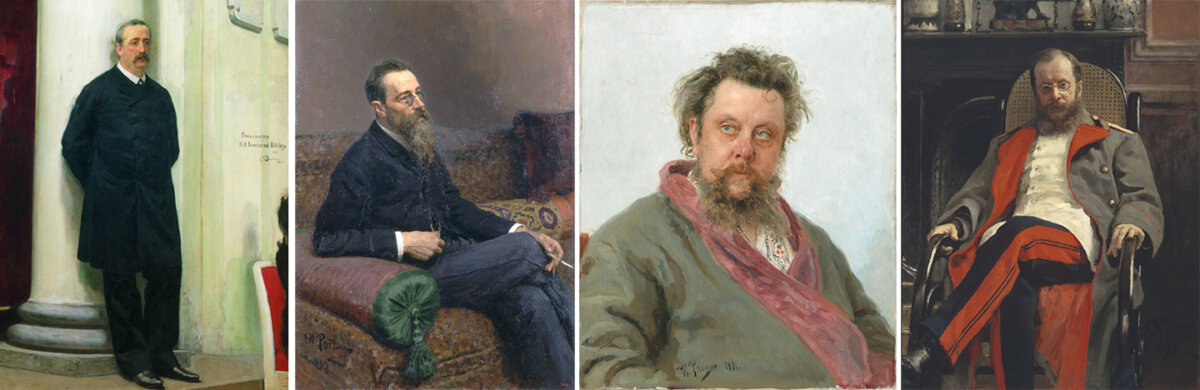
By the time he became the fifth finger on “The Mighty Handful,” Borodin’s stature as a chemist was already established. Throughout his life, he considered himself a scientist first and foremost. Music was an avocation.
The three Borodin scores most commonly programmed by orchestras are his Symphony No. 2 in B minor, the “Polovtsian Dances” from his unfinished opera, “Prince Igor,” and our selection for today, “In the Steppes of Central Asia.” (Listen)
The Steppes
The piece evokes the grassy plains of one of Russia’s easternmost holdings, an area today occupied mostly by Kazakhstan and Mongolia. It opens with a quiet statement from the clarinet, echoed by the French horn in a higher key, of what will later become the second subject of the short piece. The main subject announces at 1:03, a plangent melody in the Phrygian mode, played by the English horn. The Phrygian mode lowers the second step of the minor scale a semitone, giving the tune its “Asian” flavor. (To hear the Phrygian mode, go to a piano and play the note “E,” then play all the white notes up and down from “E” to “E.”)
At 2:10, the second subject, which was heard in the opening measures, makes its formal appearance. It is also in Phrygian mode but has a more assertive character. At length, these two will develop, intertwine, and repeat until the piece’s quiet ending.
Now, what about that Broadway musical? In 1953, songwriters Robert Wright and George Forrest decided to plunder Borodin’s treasure box of Oriental-ish tunes and apply them to a Middle Eastern tale. They called it “Kismet,” and it was huge. Tony Bennett made a hit record of its central love song, “Stranger in Paradise,” which was based on a melody from the “Polovtsian Dances.” The main subject of “In the Steppes of Central Asia” became “The Sands of Time.” Listen to it at 1:18. (Listen)
Prepare to be amazed by how closely Wright and Forrest set their words to this expansively beautiful melody written by a chemist.
What arts and culture topics would you like us to cover? Please email ideas or feedback to features@epochtimes.nyc