Can the expressive content of one art form be successfully transferred to another art form? Modest Mussorgsky (1839–1881) evidently thought so. When the Russian composer viewed a retrospective exhibition of works by a late artist friend, he turned it into a set of 10 piano impressions of specific paintings, interspersed with variations on a theme he called “Promenade.” All in all, it was a musical picture of walking from one gallery to another.
He called the suite, “Pictures at an Exhibition.” A unique contribution to the piano repertoire, it’s unlike anything else ever composed for the piano. A piano prodigy when young, Mussorgsky didn’t pursue the life of a performing musician. He instead dedicated his life solely to composition, often having to support himself as a government employee.
In writing “Pictures,” it’s as if Mussorgsky rethought the piano as an instrument. Though its usual vocabulary of scales and arpeggios are present, he exploits its vast range. Included are the shifting colors of the keyboard’s myriad registers and the textural contrasts of brittle, percussion-like articulation instead of sustained, choir-like sonorities. In doing all this, Mussorgsky frequently flaunted traditional rules. In this suite, examples for the musically trained include such “violations” as parallel fifths and unresolved dissonances.
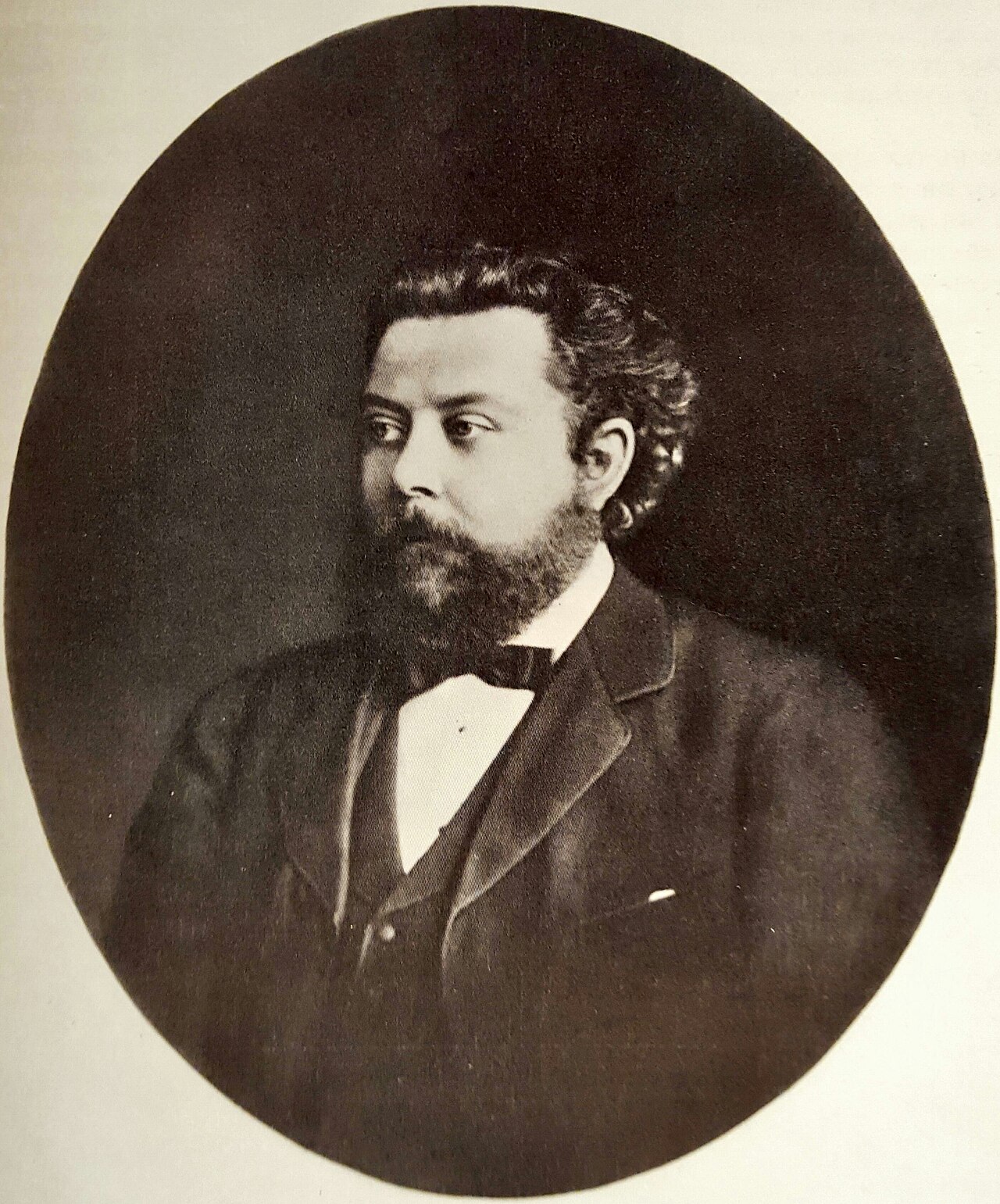 Mussorgsky in 1876. (Public Domain)
A Tribute to a Friend
Mussorgsky’s artist friend was the painter and architect Viktor Hartmann (1834–1873), a major figure in the Russian art world. Hartmann’s sudden death in August 1873, at just 39 prompted the Imperial Academy of Arts in Saint Petersburg to mount a memorial exhibition of more than 400 Hartmann works from February to March of 1874. Mussorgsky chose 10 pieces from the exhibition to set to music, some of which have since been lost.
He produced the score at white heat in three weeks of June 1874, but it was neither published nor performed in the composer’s lifetime. “Pictures” was discovered slowly after its posthumous publication in 1886. By the turn of the century, it had entered the repertoire and caught the attention of orchestrators, who set about arranging Mussorgsky’s originals for symphonic forces. The most successful of the latter was Frenchman Maurice Ravel, whose 1922 orchestration is so widely performed that some concertgoers mistakenly think he wrote the suite itself. He actually re-scored it for woodwinds, brass, strings and percussion.
Here is a breakdown of the suite’s movements. We will use the perfectly realized performance by Evgeny Kissin for the first movement, Promenade I. Subsequent movements appear as separate videos. (Listen)
The 10 Movements
Promenade I. The viewer enters the Academy galleries with the promise of seeing many noble and astonishing works.
The first: “Gnomus” or “The Gnome.” This alternates rapid fire bursts of music at Vivo tempo (very fast) with “pesante” or ponderous, slow music.
Promenade II. We move on to a new gallery. The walking music has become more introspective.
The second: Il “Vecchio castello” or “The Old Castle.” It’s stately and serene.
Promenade III. A determined viewer marches forward. There is much more to see!
The third: “Tuileries.” The name refers to the Tuileries Garden in Paris, where “children are quarreling after a game.”
The fourth: “Bydlo” or “Cattle.” What stronger contrast to quarreling children than the heavy tread of cattle?
Promenade IV. It’s a slow, moody variation.
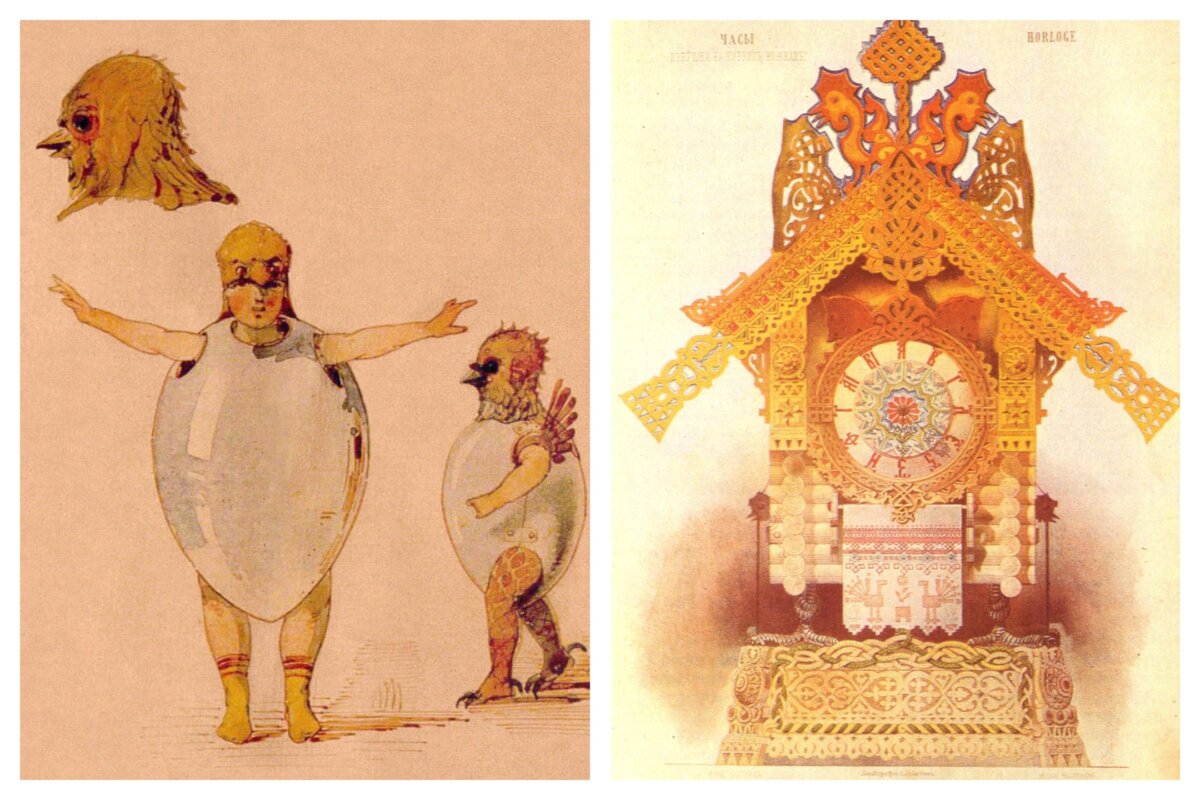
The fifth: “Ballet of the Unhatched Chicks.” Marked “Scherzino,” usually taken at a hyper speed. The painting was of a costume design Hartmann made for a ballet.
The sixth: “Samuel Goldenberg” and “Schmuyle.” Two paintings in one piece, and the most controversial of the lot, since “Samuel” is a rich Jew, while “Schmuyle” is a poor Jew. Even so, both figures are treated with dignity.
Promenade V. The last promenade takes us into the grand hall.
The seventh: “Limoges marche” or “The Market at Limoges.” A busy market scene.

The eight: “Paris catacombs.” Hartmann put himself in the painting along with two friends. The eeriness caused Mussorgsky to devote a second movement to the painting as “Cum mortuis in lingua mortua” or “With the Dead in a Dead Language.”
The ninth: “The Hut on Fowl’s Legs” (“Baba-Yaga”). The design of an elaborate clock.
The tenth: “The Great Gate at Kiev” or “The Heroes Gate at Kiev.” This was a project for city design that Hartmann didn’t complete.
“Pictures at an Exhibition” isn’t something to listen to once or twice. Its special brand of virtuosity and its deep expressivity will call you back many times.
The internet is abundant with videos of the Ravel orchestration. Pick one. But be warned: For reasons not entirely clear, Ravel omitted the final promenade.
What arts and culture topics would you like us to cover? Please email ideas or feedback to features@epochtimes.nyc