



When Mily Balakirev’s “Islamey: Oriental Fantasy” first premiered in 1869, it quickly gained a reputation as one of the most difficult piano pieces ever composed. Finger-twisting double notes and difficult repeated-note patterns made this work an insurmountable challenge even for seasoned virtuosos. Even Balakirev himself, an accomplished pianist in his own right, admitted that he was unable to play some of the work’s trickier passages.
Yet while the difficulty of this flashy showpiece brought it notoriety and fame, it is the music’s beautiful orientalism and exoticism, as well as its influence on the piano repertoire, that have cemented its place in history.
Mily Balakirev and Russian Romanticism
While classical music was being dominated by the traditions of Western European countries such as Germany and Italy in the early 19th century, Russia was struggling to find its musical identity. Before he composed “Islamey,” Balakirev was on this quest.
He became the central force in the movement to discover the soul of Russian music. He gathered and led a group of composers known as the “Mighty Five.” The other composers were Cesar Cui, Alexander Borodin, Modest Mussorgsky, and Nikolai Rimsky-Korsakov.
The goal of the “Mighty Five” was simple: Develop a distinctly Russian style of classical music independent of Western European traditions. However, this was easier said than done. Of the five composers, only Balakirev had any musical education, and even his studies were largely informal and unsystematic.
Yet it was precisely the freedom from the rigid Western systems of harmony and counterpoint that allowed for experimentation and the emergence of a distinctly Russian voice. This school of “Russian Romanticism” drew for inspiration upon the folk melodies, Orthodox Christian church music, and Eastern exoticism of Eastern Europe and Asia. These elements would become major influences in Balakirev’s “Islamey.”
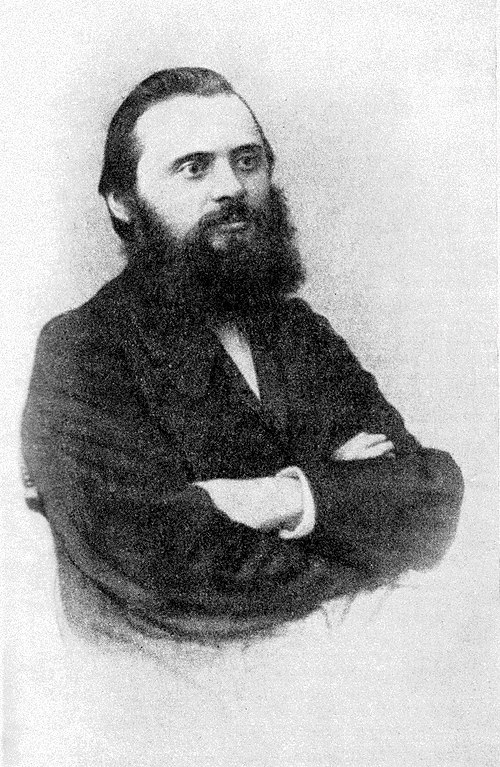 Mily Balakirev in the 1860s. (Public Domain)
‘Islamey: Oriental Fantasy’
The recording of Balakirev’s “Islamey: Oriental Fantasy” is by Vladimir Horowitz, performed at Carnegie Hall.
Balakirev found inspiration for “Islamey” when he made a trip to the Caucasus region of Eurasia. He wrote how “the majestic beauty of luxuriant nature there and the beauty of the inhabitants” made a deep impression on him. Witnessing the music of the Tartars and the fiery dance of the Circassian locals, he compiled his experiences in musical form.
“Islamey” begins with a series of percussive repeated-notes, aggressive and rhythmic. Based on an energetic Kabardian dance tune called “Islamey,” this exotic motif forms the basis of the music’s acrobatics.
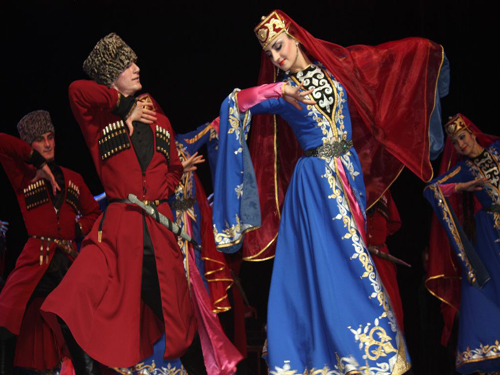 The Circassian Folklore ensemble in 2010. (ShapsougSochi1864/CC BY-SA 3.0)
At 2:02, we reach the middle section, a Tatar love song full of warmth. The rolling arpeggios in the accompaniment carry hints of the East, lending the piece an otherworldly feel. The mesmerizing slow section eventually returns back to the virtuosic dance theme, this time even more passionate. Spirited and bombastic, the melody unfolds in increasingly complex variations, capturing the relentless energy of the native Kabardian dance. The energy builds until a spectacular run of ascending octaves finishes off this virtuosic masterpiece.
What arts and culture topics would you like us to cover? Please email ideas or feedback to features@epochtimes.nyc
